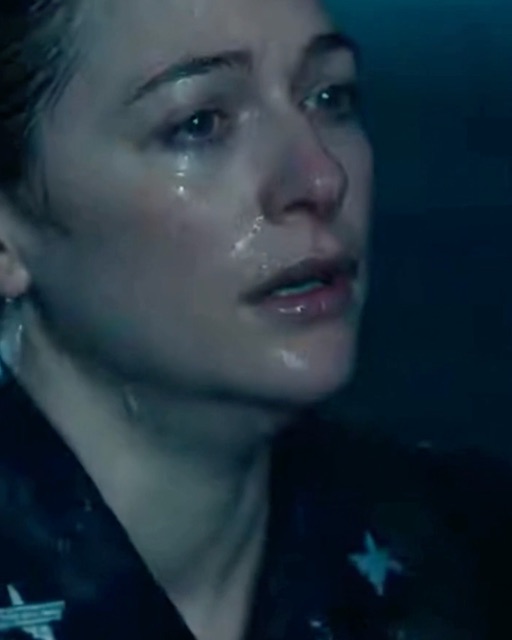
My wrists were zip-tied behind my back. The Pacific Ocean was freezing, a black void swallowing me whole. I kicked my legs, heavy with soaking tactical gear, fighting to keep my chin above the swells.
I’m a Naval Intelligence Officer. I knew the risks. But getting tossed off a hostile trawler in the middle of nowhere with no life vest wasn’t how I planned to go out.
The cold was biting through my torn uniform. My limbs felt like lead. I stared at the shredded American flag patch on my shoulder, barely visible in the starlight. “Keep kicking,” I whispered through chattering teeth. “Don’t you dare give up.”
I was about to slip under when the water beneath me changed.
It wasn’t the moon. It was a strobe.
Suddenly, the surface erupted. Eight dark shapes rose from the deep like avenging ghosts. No bubbles. Just the hiss of rebreathers and the green glow of night vision goggles.
Navy SEALs.
They moved with terrifying, silent precision. It was the most beautiful thing I’d ever seen. One of them cut through the waves toward me, his movements sharp and practiced. I saw the IR patch on his helmet.
I sobbed, relief flooding my freezing veins. We never leave our own behind.
He reached out, his gloved hand locking onto my vest to haul me up. “I’ve got you, Ma’am,” he grunted, his voice distorted by his mask.
But he didn’t pull me to the surface. He froze.
His grip tightened on my vest, bruising my ribs. He wasn’t looking at me. He was staring past my legs, into the infinite black depth beneath us.
The water around us began to churn violently – not from the waves, but from displacement. Something massive was rising.
The SEAL looked me dead in the eye, pure fear behind his tactical lenses, and screamed… “KICK! NOW!”
His command was a lightning bolt through my hypothermic fog. I kicked with everything I had left.
The SEAL, my rescuer, yanked me sideways with savage force. He didn’t pull me up; he dragged me parallel to the surface, a human shield between me and whatever was coming.
The water behind us boiled. A colossal black shape breached the surface, sleek and silent, utterly devoid of markings.
It was a submarine.
It was a class I had never seen before, and my job was to know every class of submarine, friendly or hostile. This one was all sharp angles and strange, non-reflective coating. It moved with an unnatural silence, a predator in its element.
The other SEALs were already in motion, abandoning their silent approach. They scrambled onto their two Rigid-Hulled Inflatable Boats, the RHIBs, which had been concealed beneath stealth tarps.
Their quiet professionalism had evaporated, replaced by a desperate, controlled urgency.
My rescuer finally hauled me over the rubber siding of the nearest boat. I collapsed onto the floor, gasping, salt water pouring from my lungs. He sliced through my zip ties with a practiced flick of his combat knife.
“What is that thing?” I coughed, pointing a trembling finger at the silent black leviathan.
He didn’t answer. He was already barking orders into his comms. “Spectre-1, this is Bravo Lead. We have the asset. Hostile sub, unknown class, has engaged. I repeat, hostile has engaged. Evasive maneuvers!”
The twin engines on our RHIB roared to life, and the boat lurched forward, slapping hard against the churning waves.
The SEAL leader knelt beside me. He pulled off his mask and goggles. His face was young, but his eyes were ancient, filled with a tension that went beyond the current crisis. His name tape read ‘CARTER’.
“Officer Thorne?” he yelled over the engine’s scream.
I nodded, still shivering uncontrollably. My name is Sarah Thorne.
“What intel did you have on that trawler?” he demanded.
“Smuggling ring,” I managed to say. “High-tech weapons components. Untraceable.”
Carter’s jaw tightened. He looked from me to the submarine, which was now pacing us effortlessly, a shark circling its prey.
“That wasn’t a smuggling ring, Ma’am,” he said, his voice grim. “That was bait.”
And I was the cheese.
The sub made no move to fire. It just followed. It was toying with us, herding us further and further away from any possible rescue coordinates.
One of the other SEALs, a man with a thick neck and a calm demeanor, handed me a thermal blanket. “It’s not after us,” he said to Carter, his eyes fixed on the dark shape. “Not directly.”
“It’s containing us,” Carter agreed. “Waiting for something.”
I wrapped the blanket around my shoulders, my mind finally beginning to clear through the adrenaline and the cold. A Naval Intelligence Officer’s brain is a pattern-recognition machine.
I thought about the mission briefing. It had been sparse on details, pushed through with unusual speed by Admiral Vance himself. He’d told me it was a simple snatch-and-grab of a ledger.
The trawler crew hadn’t fought like simple smugglers. They fought like trained soldiers, and their goal wasn’t to capture me. It was to kill me and dispose of the body in the deep.
They threw me overboard. Why not just shoot me? Because a body in the ocean is harder to find. It disappears.
They wanted me erased.
The submarine wasn’t some random hostile encounter. It was Part Two of the plan. If the trawler failed, the sub was the cleanup crew. It was here to make sure I, and anyone who came for me, vanished without a trace.
“This whole mission was a setup,” I said, the words tasting like ash and salt.
Carter looked at me, a flicker of something unreadable in his eyes. He knew more than he was letting on. “My orders were to retrieve you or your body, Ma’am. High priority. No questions.”
“Orders from who?”
“Admiral Vance.”
The name hung in the cold night air. The same man who sent me out here. He sent Carter’s team to “rescue” me, but he must have known about the sub. He was sending them to their deaths, too. It was the perfect crime. A tragic loss at sea. An officer and an entire SEAL team gone, lost in a mission against faceless enemies.
No witnesses. No loose ends.
“It’s a ghost sub,” I mumbled, my eyes widening as a piece of the puzzle clicked into place. I’d seen whispers of it in classified intelligence reports. Project Manta. An experimental stealth submarine with a next-generation silent drive.
It was our own technology. An American project.
“There’s no such thing,” one of the younger SEALs said nervously.
“There is,” I shot back, my voice gaining strength. “It went missing, presumed destroyed, during deep-sea trials two years ago. The lead designer, my father, was on board.”
The entire boat went silent, except for the roar of the engines.
Carter stared at me, his face a mask of disbelief. “Your father was Commander Elias Thorne?”
I nodded slowly. “They said it was a catastrophic hull breach. An accident.”
My father had been obsessed with his work. He believed Project Manta would change naval warfare. He also believed someone high up was trying to sabotage it, to sell the technology to the highest bidder. He told me he was close to finding proof.
A week later, he and his submarine vanished.
Now, here it was. His creation. His tomb. And it was hunting me.
Carter ran a hand over his face, the pieces visibly connecting in his mind. “Elias Thorne… He was my first commanding officer’s mentor. A legend. He taught us that honor was the only thing you truly own.”
He looked at me, his eyes filled with a new, fierce determination. “He wouldn’t have had an ‘accident’.”
The submarine was getting closer. We could feel the pressure wave from its passage in the water beneath us.
“They’re not trying to sink us with a torpedo,” I said, thinking out loud. “That would leave debris, evidence. They’ll just run us down. Make it look like we were swamped by a rogue wave.”
“Not on my watch,” Carter growled. He keyed his comms again. “All Spectre elements, listen up. Change of plan. We’re no longer evading. We’re engaging.”
A chorus of confused “Say again?” and “Bravo Lead, we’re outgunned!” came over the radio.
“You heard me,” Carter snapped. “This is no longer a rescue op. This is a recovery. That sub is sovereign U.S. property. We’re taking it back.”
It was the craziest plan I had ever heard. A handful of SEALs in two rubber boats against a state-of-the-art stealth submarine. It was suicide.
It was also our only chance.
“It has a flaw,” I said suddenly, the memory surfacing from a late-night conversation with my dad years ago. He was so proud of his work, but he was also a realist.
“Everything has a flaw, Sarah,” he’d told me, sketching on a napkin. “The Manta’s is her ears. The external hydrophone array is so sensitive that a sudden, close-proximity acoustic shock can overload the system. It’ll blind her, deafen her, and force a temporary system reboot.”
“How close?” Carter asked, leaning in.
“Inside a hundred meters,” I said. “And it has to be a specific frequency. A violent, percussive blast.”
One of the SEALs, the comms specialist, looked up. “The demolition charges we’re carrying for scuttling the RHIBs… I can rig the detonator to a timer, but the blast is generic.”
“It’s all we’ve got,” Carter said. “Here’s the plan. We split up. Boat Two, you’re the decoy. Draw its attention. We’ll come in from its blind spot, the rear baffles.”
He looked at me. “Can you pinpoint the hydrophone array?”
I closed my eyes, picturing my father’s blueprints. “Midship, just below the waterline. A series of small, recessed ports.”
“Good enough.”
The two boats split, veering off in opposite directions. The submarine, after a moment’s hesitation, followed the other RHIB. It saw them as the bigger threat.
We cut our engine, bobbing in the dark water, the silence suddenly deafening. Carter and another SEAL worked silently, prepping a small block of C4.
“This is for your father, Ma’am,” Carter said quietly, not looking at me. “Men like him don’t get to be forgotten.”
We waited. The minutes stretched into an eternity. On the horizon, we saw the other RHIB making a sharp, desperate turn. The submarine was closing in on them.
“Now,” Carter ordered.
Our engine sputtered back to life, but on the lowest possible power, just enough to move us forward. We were a whisper on the water.
We approached the sub from behind. It was even bigger up close, a sheer wall of black metal rising from the sea. It was a ghost ship, utterly silent.
My heart hammered against my ribs. I pointed to a spot on the hull. “There. That’s the primary array.”
The SEAL with the charge gave Carter a nod. He had it attached to a magnetic clamp.
“Get us closer,” Carter breathed.
We were twenty meters away. Ten. Five. The side of our little boat scraped against the submarine’s hull. The sound was like a gunshot in the silence.
There was no time to think. The SEAL slapped the magnetic charge onto the hull right where I had pointed. He set the timer.
“Five seconds! Go, go, go!”
Our engine roared at full throttle, peeling us away from the massive submarine. I held my breath, counting down.
Four. Three. Two.
The explosion wasn’t huge, but it was sharp and violent. A muffled ‘CRUMP’ that we felt more than heard, a shockwave that vibrated through our bones.
For a moment, nothing happened.
Then, the ghost sub shuddered. Lights flickered on and off along its length. A low groaning sound, the noise of a machine in agony, echoed across the water.
It began to list to one side.
“Systems reboot,” I whispered in awe. “It worked.”
A large hatch on the sub’s topside hissed open, and three figures in dark uniforms emerged, armed with rifles. They were momentarily blinded by the sudden open air.
They weren’t expecting us to fight back. They weren’t expecting us at all.
Carter didn’t hesitate. “Light ’em up,” he commanded.
The SEALs opened fire with suppressed weapons. Their aim was precise, economical. The figures on the submarine fell.
“We’re boarding,” Carter announced, as if he were ordering lunch.
Minutes later, we were on the deck of the Manta. The other RHIB joined us, its crew wide-eyed with a mixture of fear and adrenaline-fueled victory.
We descended into the submarine. It was American. The signs, the controls, the layout. But the crew were mercenaries, their faces hard and unfamiliar. We subdued the few who remained.
In the control room, we found their leader. He was a man in a crisp, unmarked uniform, speaking frantically into a satellite phone.
“…compromised. I repeat, the asset is compromised. Thorne’s daughter is here. With a SEAL team.”
Carter leveled his rifle at him. “Drop it.”
The man turned, his face pale. He looked at me, and a flash of recognition, and hatred, crossed his features.
“You,” he spat.
On the main console screen, a video call was still active. The face on the screen was one I knew all too well. It was a face I’d once respected.
Admiral Vance.
He stared out from the screen, his patrician features contorted in disbelief and rage. He saw me, saw Carter, and knew it was over.
“You were never supposed to get off that trawler,” he said, his voice a cold whisper through the speakers.
“My father trusted you,” I said, my own voice shaking with a cold fury. “He thought of you as a friend.”
“Your father was a fool,” Vance sneered. “He put his ‘honor’ and his country before progress. Before profit. This vessel could have made us billions. It still will.” The connection cut out.
Carter was already on the comms, using the sub’s powerful transmitter to send an encrypted burst to CENTCOM. He relayed our position, the situation, and named Admiral Vance as a traitor.
The fight wasn’t over, but the battle was won.
We sailed my father’s submarine through the dawn. As the first rays of sun hit the water, a formation of Navy helicopters appeared on the horizon, coming for us.
Coming for their own.
Back on the deck of an aircraft carrier, the debrief was short. Admiral Vance had been apprehended trying to flee the country. The mercenaries were talking. The whole conspiracy was unraveling.
My father’s name was cleared. More than that, he was a hero who had died trying to stop a traitor.
Carter found me later, standing at the edge of the flight deck, watching the ocean.
“We recovered the ship’s log from the Manta,” he said, his voice softer now. “The real one. Your father hid it.”
He handed me a datapad.
“The last entry… it was for you.”
I took it with trembling hands. On the screen were my father’s words, written just hours before he died.
He wrote that he knew he was trapped. He knew Vance had betrayed him. But he wasn’t afraid. He wrote about his project, not with pride of ownership, but with a deep regret that it had been turned toward greed instead of defense.
The last line read: “To my Sarah. Know that I love you. Never let them tell you what you’re worth. Your integrity is your own. Finish what I started. A legacy isn’t what you build; it’s what you leave behind in the hearts of others. Be brave.”
Tears streamed down my face, mixing with the salt spray from the sea. They weren’t tears of sadness, but of closure. Of pride.
They threw me overboard to die in the cold, dark water, thinking they could erase a person, a name, a legacy. They tried to bury the truth in the deepest part of the ocean.
But they forgot one thing. The truth, like a body, will always find its way to the surface. And they forgot that a legacy of honor, trust, and love is more powerful than any weapon. It’s a light that can never be extinguished, calling its own home from the deepest dark.