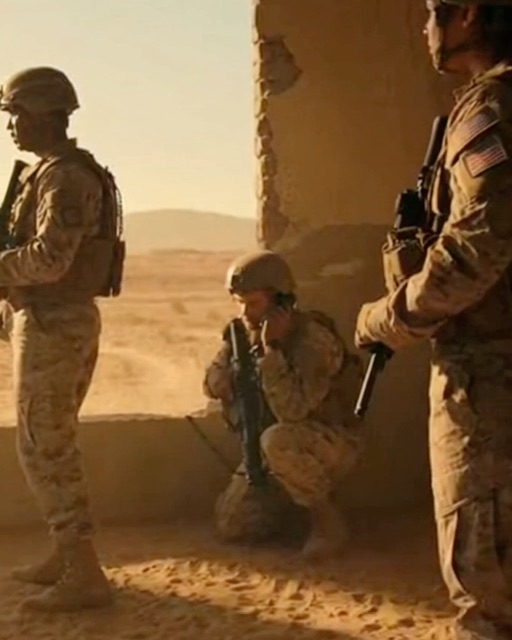
“We’re black on ammo. Water’s gone. Tell my wife…” Scott didn’t finish the sentence. He just slumped against the cracked concrete wall, staring at the dust motes dancing in the dying light.
We were stuck in a blown-out compound in the middle of nowhere. Three of us. Cut off. Command had given the order to pull back hours ago. The extraction birds were waved off. “Too hot,” the suits said. “Asset denial.” We were the acceptable loss.
The silence was louder than the gunfire. Travis was at the shattered doorway, watching the ridge. I saw his knuckles turn white on his rifle grip. We knew what was coming when the sun went down. We were just waiting for the end.
Then, a puff of dirt exploded on the ridge line.
It wasn’t incoming fire. It was impact.
A rhythmic, heavy thudding echoed through the valley. Crack. Thud. Crack. Thud.
Travis looked back at me, eyes wide. “That’s not the enemy,” he whispered. “And that’s not a standard issue rifle.”
My radio, which had been dead for hours, suddenly hissed with static. It wasn’t the polished voice of the Lieutenant back at base ordering us to surrender. It was a voice I hadn’t heard in five years. A voice that was supposed to be retired in Montana.
“Sit tight, boys,” the voice drawled. “I decided to go for a walk.”
I crawled to the window and looked toward the high ground. I saw the faint, impossible glint of a scope against the setting sun.
My throat tightened. It wasn’t a rescue team.
It was the one man who had been discharged for refusing to leave a man behind, and when I saw what he had painted on the side of the cliff, I fell to my knees.
It was a wolf’s head.
The paint was fresh, a stark white against the red rock, but the design was ancient to me. It was the snarling profile of our old unit’s insignia. The “Phantoms.” A ghost unit that Command had officially disbanded years ago.
Travis scrambled over to me, peering out. “Milo, what is it?”
“It’s Gunny Silas,” I breathed out, the name feeling like a prayer on my lips.
Scott, weak from dehydration, looked at us with confusion. He was new, brought in after the old team was broken up. He didn’t know the legend.
“Gunny Silas?” Travis repeated, a mix of disbelief and hope in his voice. “He’s supposed to be fishing for trout.”
“Looks like he found bigger fish,” I said, a dry laugh escaping my throat.
The heavy crack-thud of his rifle echoed again. Another enemy fighter, who had been creeping along the ridge, simply vanished in a cloud of pink mist. The sound of that rifle was terrifying and beautiful all at once. It was a .50 cal, by the sound of it. A monster.
“How?” Scott whispered. “How is he here?”
“Because that’s what he does,” I said, remembering. “He doesn’t leave his people.”
Five years ago, Gunnery Sergeant Silas had been our rock. He was a man carved from oak and principle. We were pinned down in a village, one of our guys, a kid named Peterson, had been hit. He was out in the open.
The order came down from a fresh-faced Lieutenant. “Leave him. We’re pulling out.”
Silas didn’t even look at the officer. He just keyed his radio and said, “Negative, sir. We get our people.”
He ran out into the street himself, under a hailstorm of fire, and dragged Peterson back. He saved the kid’s life.
For his trouble, he got a direct order from the Lieutenant to stand down. Silas stood up, walked over to the officer, and broke his jaw with a single punch. He was dishonorably discharged a month later for striking a superior officer.
The unit was disbanded not long after. They said we were “unmanageable.” In truth, they just broke the one thing that held us all together.
Now, that same unmanageable force was our only hope.
The radio crackled again. “Milo, you read me?” It was Silas.
“We read you, Gunny,” I said, my voice thick with emotion.
“Good. Status.” His voice was calm, steady, like he was ordering a coffee.
“Three of us. Scott’s got shrapnel in his leg, not deep but he’s losing blood. We’re out of water and nearly out of ammo.”
There was a pause. Then another crack-thud from the ridge.
“Copy that. I’m going to thin the herd a bit. Then you’re going to move. There’s a wadi about two hundred meters to your west. Head for it. Stay low.”
“What’s the plan, Gunny?” Travis asked, crawling closer to the radio.
“The plan is you don’t die today,” Silas said simply. “I’ve got a ride stashed over the next ridge. Just need to get you to it.”
For the next twenty minutes, Silas worked. It was like watching an artist. He wasn’t just shooting. He was orchestrating the battlefield. He took out their heavy machine gun nest first. Then the man with the radio. Then, one by one, he picked off anyone who dared to show their head.
The enemy fire, which had been constant, became sporadic, then fearful. They didn’t know where he was. He was a ghost on the mountain, a phantom, just like our old callsign.
“Okay, they’re rattled,” Silas’s voice came through. “Get ready to move on my mark. West side of the building. Go.”
I looked at Travis. He nodded. We got Scott to his feet, draping his arms over our shoulders. He was groaning, but he was alive, and that was all that mattered.
“Let’s go,” I grunted.
We burst out of the shattered doorway, half-carrying, half-dragging Scott. The sunlight was almost gone, casting long, deep purple shadows across the sand.
Immediately, a machine gun opened up from a rocky outcrop we hadn’t seen. Dirt kicked up around our feet. We froze, exposed.
“Get down!” Travis yelled.
Before we could even drop, the sound of Silas’s rifle cannoned through the valley. The machine gun went silent. I looked over and saw the gunner slumped over his weapon.
“I said move!” Silas barked over the radio, a rare edge to his voice.
We didn’t need to be told twice. We scrambled, stumbled, and ran for the dry riverbed, the wadi. We collapsed behind its sandy bank, our lungs burning.
“We’re in the wadi, Gunny,” I panted into the radio.
“Good. Follow it north. I’ll keep their heads down. And Milo?”
“Yeah, Gunny?”
“It’s good to hear your voice, son.”
A lump formed in my throat. We pushed on, using the wadi for cover. Every time a hostile poked their head up, Silas’s rifle would answer. He was a guardian angel with a very big gun.
It was slow going with Scott. Every step was agony for him. But he gritted his teeth and kept moving. He understood now. He was part of this, part of something that Command had tried to erase.
After what felt like an eternity, we reached the end of the wadi. Ahead of us was open ground, leading up to the next ridge.
“Gunny, we’re at the end of the line,” I reported. “Open ground for fifty meters.”
“I see it,” he replied. “Get ready. I’m going to give you some smoke.”
A moment later, a projectile hissed overhead and slammed into the ground between us and the enemy positions. Thick white smoke billowed out, creating a perfect screen.
“Go, go, go!”
We hauled Scott into the smoke, blind and choking. We just kept moving forward, up the slight incline. We burst out of the smoke on the other side and saw it.
Tucked behind a cluster of boulders was an old, beaten-up pickup truck. The kind you see all over this part of the world. And leaning against it, was Silas.
He looked older. The lines on his face were deeper, his hair was more gray than I remembered. But his eyes were the same. Sharp, clear, and steady. He held the massive rifle in one hand like it was a toy.
He wasn’t smiling, but he didn’t need to.
“Took you long enough,” he grunted, moving to help us get Scott into the truck’s bed.
Travis just stared at him. “Gunny… how? How did you even know we were here?”
Silas finished making Scott comfortable, then turned to us. “I’ve been in-country for a few months. Working a private security gig for some geologists a couple valleys over.”
It almost made sense. Private security contractors often used ex-military.
“I keep a scanner on the military bands,” he continued, tossing a canteen to me. “Old habits. I heard the call, recognized your unit’s designation. Then I heard the order for extraction to stand down.”
He looked me in the eye. “I knew what that meant. So, I told the geologists I was taking a sick day.”
I took a long drink from the canteen. It was the best thing I had ever tasted. “This truck? This rifle?”
“Perks of the job,” he said with a slight shrug. “My new employers are very generous. They don’t like losing assets, either.”
We climbed into the cab of the truck. It smelled of dust and old coffee. As Silas started the engine, the logical part of my brain was still trying to piece it all together. A retired soldier, happening to be in the right place, at the right time, with the right gear? It was too perfect.
As we rumbled away, leaving the firefight behind, I looked back at the cliff face. The white wolf’s head seemed to glow in the twilight.
“Why did you paint that, Gunny?” I asked.
He glanced at me, his knuckles tight on the steering wheel. “So you’d know who it was. So you’d know you weren’t alone.”
But there was something else in his eyes. A deeper, colder anger.
We drove for hours in silence, deeper into the desert. The landscape turned from rocky hills to flat, empty plains under a blanket of stars.
“Where are we going?” Travis finally asked.
“An airstrip,” Silas said. “A private one. A plane is waiting for us.”
This was way beyond a simple security gig. The questions were piling up in my head.
“Gunny,” I started, “the geologists… who are they really?”
Silas was quiet for a long time, his eyes fixed on the dark horizon. “They’re not geologists, Milo. The man I work for is a former senator. His son’s unit was wiped out in this same sector three months ago.”
He let that sink in.
“They got the same order. ‘Too hot.’ Asset denial. He hired me to find out what really happened. He wanted the truth, not the official report.”
Suddenly, everything clicked into place. This wasn’t a coincidence. This was a mission.
“And what did you find?” I asked, my voice barely a whisper.
“I found a pattern,” Silas said, his voice low and hard. “I found a Colonel back at Command, a man named Davies. He’s been feeding bad intel to small units, sending them into meat grinders. Then he pulls their support at the last minute.”
“Why?” Travis asked, leaning forward. “Why would he do that?”
“To build his career,” Silas spat. “Every time a unit gets ‘overrun by a superior enemy force,’ he gets to write a report about how he’s holding an impossible line. He looks like a hero, sacrificing men to save the region. He’s padding his resume for a General’s star with our lives.”
The truth was so much uglier than just being an acceptable loss. We weren’t a sacrifice for the greater good. We were just a stepping stone for some officer’s promotion. The bitterness tasted like acid in my throat.
“So the senator’s son…”
“Davies sent him and his men to their graves,” Silas finished. “And he almost did the same to you. When I heard your callsign, I knew it was happening again. I couldn’t let it.”
He wasn’t just a rescuer. He was an avenger. The money from the senator had equipped him, but it was his own code, the one that got him kicked out of the service, that brought him to that ridge.
We reached the airstrip just before dawn. It was nothing more than a strip of flattened dirt and a single-engine plane. The pilot, a quiet man in civilian clothes, nodded at Silas and helped us get Scott on board.
Before I climbed in, I turned to Silas. “What happens now?”
He pulled a small hard drive from his pocket. “I have everything. Radio logs, Davies’s doctored reports, eyewitness accounts from locals. The senator is waiting for this. Davies isn’t just going to be reprimanded. He’s going to prison.”
He clapped me on the shoulder, a firm, reassuring weight. “You boys are officially listed as MIA, presumed dead. The senator will handle the paperwork. You’ll be home in a week, quietly discharged. It’s over.”
A year later, I was standing on a porch in Montana. The air was clean and cold. The sky was a shade of blue I’d forgotten existed.
Silas’s ranch was nestled in a valley, a peaceful slice of the world he’d fought so hard for. The senator had been very grateful.
Travis was there, flipping burgers on a grill, laughing with his wife. Scott was there too, walking with a slight limp but smiling. He was holding his newborn daughter.
We were all out of the army. We were free.
Silas came out of the house with two beers and handed one to me. We stood there for a minute, watching our new families.
“Colonel Davies got life,” Silas said quietly. “They buried him so deep in a military prison he’ll never see the sun again.”
It was justice. It was a victory we never could have won with a rifle.
“You never told me why you really came for us, Gunny,” I said. “It wasn’t just the senator. It wasn’t just us.”
He took a long drink of his beer, his eyes on the mountains. “When they kicked me out, they took my uniform. But they couldn’t take who I am. That day I punched that Lieutenant, it wasn’t about him. It was about Peterson. It was about the promise we make to each other.”
He turned to look at me. “Orders change. Borders change. Politicians change. The only thing that’s real, the only thing that matters, is the person standing next to you in the fire. You hold that line. You don’t break it. Not for a flag, not for a promotion, not for anything.”
I looked over at Travis and Scott, at the lives that were almost thrown away for a lie. Silas hadn’t just saved three soldiers in the desert. He had saved the truth.
In a world of acceptable losses and asset denials, one man had decided that the lives of his brothers were the only assets that could never be denied. He turned off his radio to Command so he could listen to his conscience instead. And that made all the difference.