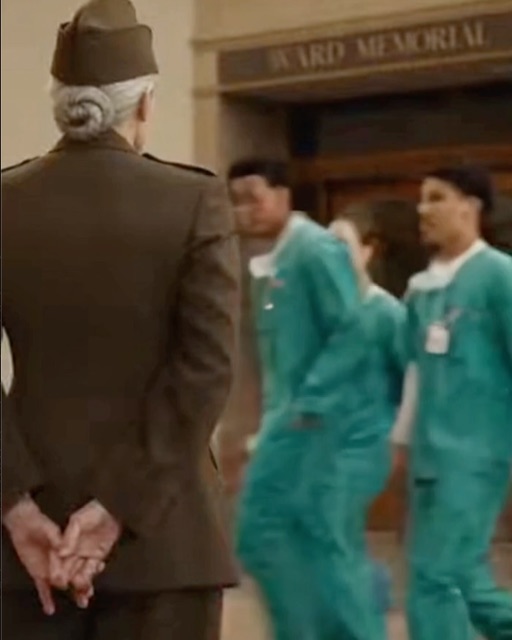
She stood outside the ward memorial in a pressed Army service uniform, ribbons fixed in perfect rows, hands clasped behind her back like she’d never left formation.
People walked past her all morning.
Most figured she was somebody’s widow.
Somebody’s grandmother visiting on Veterans Day.
Nobody asked.
A group of young medics passed and one muttered to another, “She’s probably just here for a photo op.”
The old woman turned her head.
Her voice didn’t waver.
“I’m here because the Army does not forget its wounded.”
They stopped cold.
Her name was Ruthann Dellacroce.
Eighty-one years old.
Retired Lieutenant Colonel.
Army Nurse Corps.
She hadn’t visited that memorial in over thirty years.
Not because she’d forgotten.
Because she remembered too much.
She walked inside and went straight to a black-and-white photograph near the back wall.
A field hospital tent.
A line of stretchers under storm light.
Mud everywhere.
You could almost smell the canvas and the blood through the glass frame.
Her tent.
Her shift.
Her war.
She pressed two fingers against the edge of the photo and held them there.
That’s when a young captain from the hospital staff approached.
He was carrying a plain gray accession box from the medical archives.
His hands were shaking slightly.
“Ma’am – records flagged something during a digitization project. It was attached to one of the unidentified casualty files from your unit.”
Ruthann’s face changed.
“That’s not possible. I reviewed every file myself. Every single one. Before I left theater and again when I came stateside.”
The captain set the box on the display ledge and opened it.
Inside: a faded Army medic armband.
A blood-type tag, cracked and brown at the edges.
And a sealed envelope, yellowed but intact.
Handwritten across the front in block letters:
FOR THE NURSE WHO REFUSED TO LEAVE THE FLAG PATCHES BEHIND
She didn’t breathe.
One of the young medics who’d mocked her two minutes ago stepped closer.
“Ma’am – who wrote that?”
Her lips moved before her voice caught up.
“The soldier they told me died on my table.”
The corridor went silent.
Every medic, every technician, every staffer within earshot froze.
She picked up the envelope.
Her hands – the same hands that had packed wounds and held dying boys’ fingers and written letters home to mothers she’d never meet – those hands trembled.
She opened it.
Inside: a single handwritten page.
And half of a photograph, torn cleanly down the center.
She unfolded the letter.
Read the first line.
You were right. I was never supposed to be listed.
Her knees buckled.
A medic caught her arm.
She didn’t look up.
She kept reading.
The second line made her grab the display case for balance.
The third line made her whisper a name – a name nobody in that hallway had heard in fifty-three years.
She turned the half-photograph over.
On the back, in the same handwriting, was an address.
A current address.
Dated eleven months ago.
Ruthann looked up at the captain.
Her eyes were wet but her jaw was set like concrete.
“Get me a car.”
The captain blinked.
“Ma’am?”
“I said get me a car. That soldier isn’t dead. He never was.”
She folded the letter carefully, slid it into her breast pocket, and straightened her ribbons.
“And the other half of this photograph? It’s with him.”
She turned toward the exit.
Every person in that corridor stood at attention without being told.
The young medic who’d called her a photo op stepped forward, voice cracking.
“Ma’am — what did the letter say?”
Ruthann stopped at the door.
She didn’t turn around.
“It said he watched me carry him out. And that the reason he was listed as dead…”
She paused.
“…was because someone in that hospital needed him to be.”
She pushed through the doors and walked into the parking lot, half a photograph in her pocket and a name on her lips she hadn’t spoken since 1971.
The captain looked down at the accession box.
There was something else at the bottom he hadn’t noticed.
A second envelope.
This one was addressed to the hospital commander.
It was stamped CLASSIFIED — and it had been opened before.
Captain Miller caught up to her just as she reached the edge of the lot, a staff car’s keys already in his hand.
“Colonel Dellacroce,” he said, his voice now firm with purpose. “I’m driving you.”
She just nodded, her mind miles and decades away.
They drove out of the city, the silence in the car thick with unspoken history.
Ruthann stared out the window, but she wasn’t seeing the passing suburbs.
She was seeing mud-caked boots and the frantic dance of lantern light on canvas walls.
“His name was Daniel Callahan,” she said, her voice low. “Private First Class.”
Miller kept his eyes on the road.
“He was from Ohio. He had a tattoo of a sparrow on his wrist.”
She remembered that sparrow.
She’d held his wrist to find a pulse, her thumb brushing against the faded blue ink.
“There was a mortar attack,” she continued. “A bad one. We had casualties stacked up in the triage area.”
The memories came back in sharp, painful fragments.
The smell of rain and iron.
The constant, dull roar of choppers overhead.
The faces of the boys, all so impossibly young.
“Daniel was brought in with shrapnel to the chest. It was bad, but I thought he had a chance.”
She’d been working on him for ten minutes, maybe fifteen.
She’d just managed to stop the worst of the bleeding.
Then Major Alistair Finch, the chief surgeon, had pushed her aside.
“Finch took over,” she said, the name tasting like ash in her mouth. “He was always so arrogant, so sure of himself.”
Finch had worked on Daniel for less than a minute.
He’d checked his pupils, felt for a pulse, and then straightened up.
“He’s gone,” Finch had declared, pulling a sheet over Daniel’s face. “Tag him and move him to the morgue tent.”
Ruthann had protested.
“I told him there was still a pulse, that it was faint but it was there,” she whispered.
Finch had glared at her, his face slick with sweat and condescension.
“Your sentimentality is a liability, Lieutenant,” he’d snapped. “We have men we can actually save. Now move.”
She’d been forced to step away.
But before they took Daniel’s body, she’d done one last thing.
It was a small ritual of hers, something the other nurses had adopted.
She would take the American flag patch from the sleeve of a fallen soldier’s uniform and place it in a small pouch with his dog tags.
A final piece of them to go home with.
Finch had mocked her for it.
He called it a waste of time.
She did it anyway.
She had tucked the patch into Daniel Callahan’s hand.
“For the nurse who refused to leave the flag patches behind,” she murmured, touching her breast pocket.
He remembered.
After all this time, he remembered that small act of defiance.
Miller glanced over at her.
“What did the letter say about why he was listed as dead?”
Ruthann took a deep breath.
“It said that Finch needed a body.”
“A body? For what?”
“To cover a mistake,” she said. “Daniel wrote that just before the mortar attack, he saw Finch operating on a senator’s son.”
The boy had been a high-priority evac.
A “golden ticket” patient everyone was ordered to keep alive at all costs.
“Finch messed up. A nicked artery. The boy bled out on the table.”
In the chaos of the mortar attack, Finch saw an opportunity.
A chance to swap one body for another.
To bury his fatal error in the mud of a foreign field.
He declared the senator’s son a survivor, wounded but stable, and shipped him to a hospital in Germany.
And he declared Daniel Callahan, the quiet private from Ohio, dead on arrival.
It was a perfect, monstrous lie.
The address on the back of the photo led them to a quiet street in a small town she’d never heard of.
The houses were modest, with neat lawns and American flags hanging from the porches.
Number 24 was a small blue house with a well-tended garden in the front.
A faded wind chime tinkled softly from the eaves of the porch.
Ruthann got out of the car, her legs feeling unsteady.
Captain Miller stood by her side, a silent, supportive presence.
She walked up the path and knocked on the door.
For a long moment, there was nothing.
Then, the sound of a lock turning.
The door opened, and a man stood there.
He was older, his hair gray and his face lined with the map of a long life.
He walked with a slight limp.
And on his wrist, a little faded but still there, was a tattoo of a sparrow.
His eyes widened as he saw her.
He looked at the uniform, at the ribbons, at her face.
A flicker of recognition.
Then, disbelief.
Then, a slow, dawning certainty.
“Lieutenant?” he whispered, his voice thick with emotion.
Ruthann couldn’t speak.
She simply reached into her pocket and held out her half of the photograph.
It was a picture of her unit, taken on a rare, quiet afternoon.
A group of tired, smiling nurses, with a very young Ruthann in the center.
Daniel Callahan looked at the torn piece of paper, and his own hands began to shake.
He disappeared into the house for a moment and came back holding a worn leather wallet.
From a hidden flap, he pulled out the other half.
It was the rest of the unit, the medics and corpsmen.
He held his half next to hers.
The two jagged edges fit together perfectly.
The photograph was whole again.
“I never knew if you’d get the letter,” he said, his eyes welling up. “I sent it to the archives. I just hoped… I just hoped one day the truth would find a way.”
He invited them inside.
He told them his story.
He’d woken up on a transport plane, his head throbbing.
His dog tags were gone, replaced with another soldier’s.
He was in a hospital in Germany for months, recovering under a false name.
He was terrified.
He was just a private.
Finch was a powerful Major, a man who could make people disappear.
Who would believe a grunt over a decorated surgeon?
So he stayed quiet.
He was honorably discharged under the other man’s name.
He came home to a country that didn’t know him.
He built a new life from scratch, always looking over his shoulder.
Always wondering if Finch’s lie would ever be uncovered.
He became a carpenter.
He married, had children, and now grandchildren.
He lived a good, quiet life.
But he never forgot.
He never forgot the nurse who tried to save him.
The nurse who honored him even when she thought he was gone.
Back at the military hospital, the commander had read the contents of the second envelope.
It was from a corpsman named Peterson, who had been on duty in the morgue tent that night.
It was a deathbed confession, written thirty years after the war.
Peterson had seen everything.
He saw Finch swap the dog tags.
He saw him falsify the paperwork.
He was the one who, on a crisis of conscience, rerouted Daniel’s “body” from the morgue transport to the medevac plane.
He had lived with the secret his whole life, too afraid of Finch’s reach to come forward.
He sent the letter to the archives, a final, desperate prayer for justice.
The hospital commander made a call to the Pentagon.
The wheels of military justice, though they turn slowly, began to grind.
Three days later, Ruthann, Daniel, and Captain Miller stood on the manicured lawn of a sprawling estate.
This was where retired General Alistair Finch lived.
He had become a celebrated figure after the war, a hero surgeon lauded for his life-saving work.
Finch, now in his late eighties, met them on his porch.
He was frail but his eyes were still sharp, and still filled with the same arrogance Ruthann remembered.
“Colonel Dellacroce,” he said, feigning a pleasant surprise. “To what do I owe the honor?”
Ruthann didn’t waste time with pleasantries.
“I believe you know this man,” she said, gesturing to Daniel.
Finch glanced at Daniel, his expression blank.
“I’m afraid you have me at a disadvantage.”
“He has a sparrow tattooed on his wrist,” Ruthann said, her voice like ice. “You declared him dead on my table in 1971.”
A flicker of panic in Finch’s eyes.
Just a flicker, but it was there.
“That’s a ridiculous accusation,” he blustered. “The fog of war is thick. Memories become unreliable.”
Captain Miller stepped forward.
“Sir, we have a sworn statement from Corpsman Peterson. We have PFC Callahan’s own testimony.”
Finch laughed, a dry, rattling sound.
“The ravings of a dead man and the fantasy of a shell-shocked private. It’s your word against mine. And I am a General.”
Daniel Callahan then spoke for the first time.
“You took a crate of morphine, sir,” he said quietly. “You traded it to a man with a scar over his left eye for a leather satchel full of cash.”
Finch went pale.
“You stole it from the supply tent just before the attack. One of the ampules fell out of the crate when you were moving it. It rolled under my cot.”
Daniel reached into his pocket.
He pulled out a small, glass ampule, its contents long since evaporated, the label still barely legible.
“I kept it,” Daniel said. “All these years. The lot number is from the same shipment that was reported ‘lost in combat’.”
That was it.
The final, undeniable piece of truth.
The arrogance in Finch’s face crumbled, replaced by the hollow mask of a man whose entire life had been a lie.
He didn’t say another word.
He just sagged into a patio chair, a defeated old man.
Alistair Finch was not arrested in a dramatic scene.
He was quietly stripped of his rank, his medals, and his honors.
His name was removed from medical journals and memorial plaques.
He lived out his last few years in obscurity, his legacy of heroism erased, replaced by a footnote of shame.
The Army held a ceremony for Daniel Callahan.
They officially corrected the records, declaring him a survivor and restoring his name.
They gave him his back pay, his medals, and the honor he had been denied for over fifty years.
Ruthann Dellacroce was the one who pinned the Purple Heart to his chest.
The young medics from the hospital corridor were there.
They stood in the front row, their posture ramrod straight, their eyes fixed on Ruthann with a respect that went deeper than rank.
Afterward, Ruthann and Daniel went back to the ward memorial.
They stood before the old black-and-white photograph of the field hospital.
Daniel taped their now-whole photograph to the glass, right over the image of the muddy tent where their lives had intersected.
A picture of two old survivors, smiling under a peaceful sky.
He was no longer a ghost on a wall of the forgotten.
She was no longer the keeper of a lonely, painful secret.
Honor, they both knew, was not something awarded in grand ceremonies.
It was forged in small, quiet moments.
In the refusal to leave a flag patch behind.
In the courage to hold onto a single glass vial for a lifetime.
It was the simple, unbreakable truth that the Army does not forget its own, no matter how long it takes for the roll call to be corrected.