
I spent thirty-four years in Army supply. I’ve tagged body armor with bullet holes still in it. I’ve inventoried rucksacks that came back from deployment without their owners. You learn to keep your hands steady and your mouth shut.
But nothing prepared me for what happened last Tuesday in Warehouse 9.
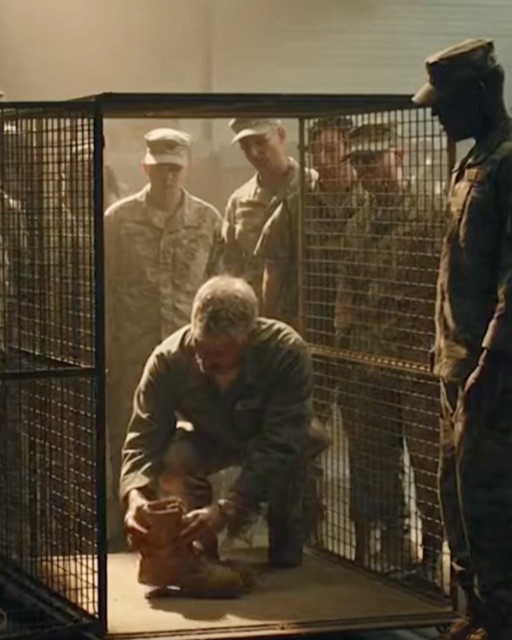
I was doing a final walkthrough before the decommission audit. The place was scheduled for demolition in six weeks. Most of the cages had been cleared out already – old MOPP gear, broken radios, pallets of expired MREs nobody wanted to count.
Then I got to Cage 14-Echo, way in the back corner where the fluorescent lights had been dead for years.
There was a pair of combat boots sitting on the concrete floor. Laced tight. Regulation knot. Toes pointed toward the door like someone had set them down and walked away barefoot.
A civilian contractor named Phil laughed behind me. “Just old boots, Chief.”
I turned around and gave him the look. The one that used to make privates forget how to breathe.
“There is no such thing as just old boots when they belonged to an American soldier.”
Phil shut up.
I crouched down. My knees cracked loud enough to echo off the rafters.
I knew these boots.
The scuff on the left toe from where he’d kick the bumper of the LMTV every morning like a ritual. The stitched repair near the right heel – I’d watched him do it himself with paracord and a leather needle because he said the cobblers at the boot repair shop “didn’t understand the soul of a boot.”
That was Specialist Terrence Wardlaw. Twenty-one years old. My convoy clerk. Fastest hands on a LOGSTAT report I ever saw. Disappeared after a route clearance mission outside the wire in 2003.
Command said IED. Said there wasn’t much left. Said the identification was confirmed.
We had a ceremony. His mother got a flag.
I never believed it. Not fully. Because his personal effects came back wrong. His watch was missing. His journal was missing. And his boots – these boots – never made it into the shipment home.
I asked questions. Got told to stop asking.
So I did. For twenty years.
Now I was staring at them again.
My hands were shaking when I picked up the left boot. Something rattled inside.
By then, word had traveled. Sergeant First Class Kimball from the logistics unit was standing behind me with three of her soldiers. A captain named Pruitt leaned in close.
“Permission to inspect, Chief?”
I nodded once.
We pulled the insole out carefully.
Underneath was a flat metal tag – not a dog tag, something custom-stamped. A folded map square. And a tiny screw-top aluminum tube, the kind guys used to store waterproof matches.
Captain Pruitt opened the tube with steady hands. Inside was a rolled strip of paper so old and brittle it almost disintegrated when he unrolled it.
He read the first line out loud.
“If these boots are in storage, then the Army never got the right body.”
Nobody moved. Nobody breathed.
I shut my eyes. It hit me like a .50 cal round to the chest. Twenty years of being told I was crazy. Twenty years of Terrence’s mother, Gloria, calling me every Christmas asking if I’d heard anything new.
Captain Pruitt unfolded the map square across a wooden crate.
It was a hand-drawn overhead of this installation. Our installation. Not some FOB in Iraq.
There was one red X.
It was drawn directly over the location of Building 7741 — the old cold-storage transfer facility on the north side of post.
The building that burned to the ground in 2004. One year after Terrence supposedly died overseas.
The fire was ruled electrical. Nobody investigated further. It was just an old building.
I stared at that red X until my vision blurred.
Then Kimball’s radio crackled. The forklift driver out on the loading dock, a kid named Acevedo, came through loud and broken:
“Sergeant — there’s somebody out here at the bay door. Civilian. She’s asking for a pair of boots by serial number.”
Kimball looked at me.
I looked at the tag we’d pulled from under the insole.
It had a serial number stamped on it.
Pruitt was already walking toward the bay door. I grabbed his arm.
“Captain. That serial number was never entered into any system. I know because I’m the one who was supposed to log it — and Terrence asked me not to.”
Pruitt’s face went white.
“Then how does someone outside know it?”
I didn’t answer. I just started walking toward the loading dock.
Because standing in the morning light, holding a photograph and a folded American flag, was a woman I hadn’t seen in four years.
Gloria Wardlaw. Terrence’s mother.
And standing next to her — quiet, hands in his pockets, wearing a faded Army t-shirt — was a man about forty years old with a scar across his jaw and the exact same eyes as the kid who used to kick my truck bumper every morning.
Gloria looked at me. Her voice didn’t shake.
“Chief. I told you he’d come back for his boots.”
The man beside her didn’t speak. He just looked past me, into the warehouse, like he could see straight through to Cage 14-Echo.
Then he reached into his jacket pocket and pulled out a key.
Old. Brass. Military-issue.
The kind that used to open cold-storage transfer buildings.
He held it out to me and said one sentence — just one — and every single thing the Army told us for twenty years fell apart in my hands.
He said, “They buried the wrong man, Chief.”
The world seemed to shrink down to just the space between us. The sounds of the warehouse, the hum of the forklifts, the chatter on the radio, it all faded away.
It was his voice. Deeper, rougher around the edges, but it was him.
Captain Pruitt found his footing first. He stepped forward, all command presence, but his eyes were wide with disbelief.
“Sir,” Pruitt said to the man, his voice tight. “I’m going to need you to come with me. Ma’am, you too.”
Gloria didn’t flinch. She just squeezed the man’s arm.
The man who looked like Terrence Wardlaw nodded slowly. “That’s fair, Captain. But let’s find a quiet room. What I have to say isn’t for the whole installation to hear.”
My legs finally decided to work. I walked over and stood right in front of him. I looked into his eyes, searching for the twenty-one-year-old kid I remembered.
He was in there, behind the lines carved by two decades of a life I couldn’t imagine.
“Terrence?” I whispered, the name feeling foreign on my tongue after so long.
He gave me a small, sad smile. “It’s been a while, Chief.”
We ended up in the supply unit’s conference room. It was a sterile, windowless box with a big oak table and pictures of past commanders on the wall.
Just me, Pruitt, Kimball, Gloria, and Terrence.
Pruitt started. “Specialist Wardlaw… if that is who you are… you have a lot of explaining to do.”
Terrence leaned forward, his hands flat on the table. He looked older than his forty-one years.
“I was never just a convoy clerk, Captain. That was my cover.”
He took a deep breath. The story came out, not in a rush, but steady and measured, like a mission briefing he’d rehearsed a thousand times.
“I was working for CID. The Criminal Investigation Division. They recruited me out of AIT. Said I was good at noticing things that didn’t add up.”
He glanced at me. “Like supply manifests that were off by a few hundred thousand dollars.”
I felt a cold knot form in my stomach. I remembered those discrepancies. I’d reported them up my chain. I was told they were clerical errors, to be expected in a warzone.
“A few of us suspected a ring,” Terrence continued. “High-level stuff. Not just stealing MREs or fuel. They were moving sensitive items. Night vision, encrypted radios, even small arms. Selling them to contractors, local militias, whoever had the cash.”
He said the operation was run from both ends – in Iraq and right here, on this post.
“The hub for the stateside operation was Building 7741,” he said, tapping a finger on the table. “They called it cold-storage, but it was just a transfer point to get the gear off post and into civilian hands.”
Captain Pruitt’s jaw was tight. “Who was running it?”
“Back then? A Lieutenant Colonel named Matheson. He was in charge of theater logistics.”
My blood ran cold. I knew Matheson. He was the one who personally told me to stop asking questions about Terrence’s death. He’d called it “disruptive to morale.”
Matheson was a retired two-star General now. Lived in Virginia, sat on the boards of three major defense contractors. A real success story.
“Matheson found out I was getting close,” Terrence said, his voice flat. “The IED on that route clearance mission wasn’t random. It was a hit. Meant for me.”
He paused, looking at his mother. She reached out and placed her hand over his.
“The blast… it was bad. The vehicle was torn apart. I was thrown clear. When I came to, the only other person from my truck was PFC Garrett. He was part of the ring. A mule. Matheson’s eyes and ears.”
“Garrett was dead. Burned. Unrecognizable. I knew they’d be back to finish the job, to make sure I was gone.”
“So I made a choice. In the middle of all that smoke and fire, I switched our dog tags.”
The room was silent. Sergeant Kimball was staring at her hands. Pruitt looked like he’d been punched.
“I became a ghost,” Terrence said. “I let the Army believe I was dead. It was the only way I could stay alive long enough to find the proof I needed to burn them all.”
I finally found my voice. “The boots, son. Why the boots?”
“A contingency plan, Chief. A dead man’s switch. Before we deployed, I had a bad feeling. I knew this investigation was dangerous. So I set up an insurance policy.”
“I put that map and the note in there. I asked you not to log the custom serial number. I knew, out of everyone, you were the one who wouldn’t just toss them. You’d hold onto them. You’d see them for what they were.”
He was right. I’d kept them off the books for years, moving them from cage to cage, telling myself it was just sentimentality.
“The serial number,” he looked at his mom. “It was a code. My high school locker combination. I told Mom that if she ever got a message with that number, it meant I was alive and it was time.”
Gloria spoke for the first time, her voice as strong as steel. “I got a postcard two weeks ago. From a town I’ve never heard of. It just said, ‘The weather’s clearing up. Time to bring out the old boots.’ And that number was written under the stamp.”
My mind was reeling. Twenty years. For twenty years, this woman grieved in public and held onto this impossible secret in private.
“So, what happened to the evidence in Building 7741?” Pruitt asked, leaning forward. “The fire…”
This was it. The twist. The part I hadn’t seen coming.
Terrence gave a dry, humorless chuckle. “That’s the part they got wrong. Matheson and his crew got sloppy. They torched the building a year after I ‘died,’ thinking they were cleaning house, destroying any lingering proof.”
“But I was smarter than that. The map in my boot? It didn’t point to the stolen gear. It pointed to where the ledgers used to be.”
He let that sink in.
“The real proof? The shipping manifests with forged signatures, the offshore bank account numbers, the list of every person involved, from PFCs to a Lieutenant Colonel… I moved it all two weeks before that IED ever went off.”
I stared at him. The kid I knew was a sharp clerk. The man in front of me was a chess master.
“Where is it now?” Captain Pruitt demanded.
Terrence reached into his pocket again. He didn’t pull out a key this time. He pulled out a small, tarnished silver locket.
He opened it. It was a picture of him and his mother, taken right before he deployed.
He handed it to Pruitt. “Look at the back.”
Pruitt flipped it over. Scratched into the silver, almost invisible, was a series of numbers and letters.
“It’s the number of a safe deposit box at a bank in Baltimore,” Gloria said quietly. “Opened under my grandmother’s maiden name in 2002. Terrence gave it to me for ‘safekeeping’ before he left.”
“Everything is in that box,” Terrence confirmed. “Twenty years of evidence, waiting for the right time.”
“Why now?” I asked, the question that had been burning in my mind. “Why wait twenty years?”
“Because General Matheson just retired,” Terrence said, a hard glint in his eye. “As long as he was on active duty, he was protected. The system protects its own. It would have been my word against a decorated officer. The evidence would have been buried in a mountain of red tape.”
“But now? He’s a civilian. He’s vulnerable. And I’m not a ghost anymore.”
Captain Pruitt stood up. He walked to the corner of the room, turning his back to us. He was a young officer, a West Point graduate. His entire career was built on order, regulations, and the chain of command.
This situation was a grenade tossed into all of that.
He could bury it. He could report Terrence as a deserter and turn everything over to be classified and forgotten. It would be the safe career move.
He stood there for a full minute. Then he turned around. His face was set, his decision made.
He looked at Terrence. “Specialist, what you did was against a dozen articles of the Uniform Code of Military Justice. You abandoned your post. You falsified an official record. You’ve been a deserter for two decades.”
My heart sank.
“However,” Pruitt continued, picking up his phone from the table. “You also uncovered a criminal conspiracy that compromised national security and betrayed the trust of every soldier serving this country. And you did it when your command failed you.”
He unlocked his phone. “There’s only one call to make here.”
He dialed a number. “Yes, sir. This is Captain Pruitt at Fort Michael. I need to speak with the Inspector General’s office. It’s a matter of urgent command interest… Yes, I’ll hold.”
And just like that, the gears of justice, rusted shut for twenty years, began to grind back to life.
The weeks that followed were a whirlwind. Investigators from the IG’s office and the FBI descended on the post. Terrence was placed in protective custody, spending days in debriefings.
The safe deposit box was opened. It was exactly as he’d said. A treasure trove of corruption.
General Matheson was arrested at his country club in Virginia. The headlines were explosive. His entire network began to crumble as his co-conspirators started turning on each other to save their own skin.
They corrected Terrence’s record. The deserter charge was dropped, replaced with a classified commendation. The Army officially declared him alive.
The hardest day was when they went to the post cemetery.
I stood with Gloria and Terrence in front of the small, white headstone that had borne his name for twenty years. A work crew was there, waiting respectfully.
They were going to exhume the remains of PFC Garrett and have him re-interred in his family’s plot, with the truth of his actions finally on record.
Terrence was quiet. He was wearing his old boots. He’d cleaned them up, and the leather shone in the afternoon sun.
“He had a family, Chief,” Terrence said softly, looking at the stone. “They thought their son was a hero who died next to me. Now they have to know he was part of the reason good men died.”
“The truth is a heavy thing, son,” I said. “But it’s lighter than a lie. You carried that lie for twenty years.”
He nodded, looking out over the rows of identical headstones. “I just wanted to do my duty.”
He had. He’d done it in a way no regulation could account for.
A few months later, after the noise died down, I was finishing my final out-processing to retire for good. Terrence came to find me in the now-empty Warehouse 9.
He was in civilian clothes. He looked younger, the weight finally lifted from his shoulders.
“They’re tearing this place down next week,” I said, my voice echoing in the vast space.
“Good,” he replied. “Some things need to be torn down to build something new.”
He handed me a small, framed photo. It was the picture from the locket, of him and his mom.
“Mom wanted you to have this. She said you were the only one who kept a light on for me.”
I took it, my throat thick with emotion.
“What will you do now, Terrence?”
He smiled, a real smile this time. It reached his eyes.
“Live,” he said simply. “Go to college. Maybe become a history teacher. For twenty years, I lived in the past. It’s time to see what the future looks like.”
He turned to leave, then stopped at the massive bay door.
“You know, Chief,” he said, looking back at me. “All that time, all those years I was a ghost, the one thing I kept thinking about was those boots.”
“I knew as long as they were sitting in a cage somewhere, a piece of me was still here. Still a soldier. Still waiting to finish the mission.”
He walked out into the sunshine, and I was left alone in the silence of the warehouse.
I looked down at the empty spot on the floor in Cage 14-Echo.
It occurs to me now that some things are never truly lost. Honor, duty, a mother’s love, a soldier’s promise. They don’t expire. They don’t get decommissioned. Sometimes, they just get put in storage for a while, laced up tight, waiting for someone to come back and claim them, ready to walk the final mile home.