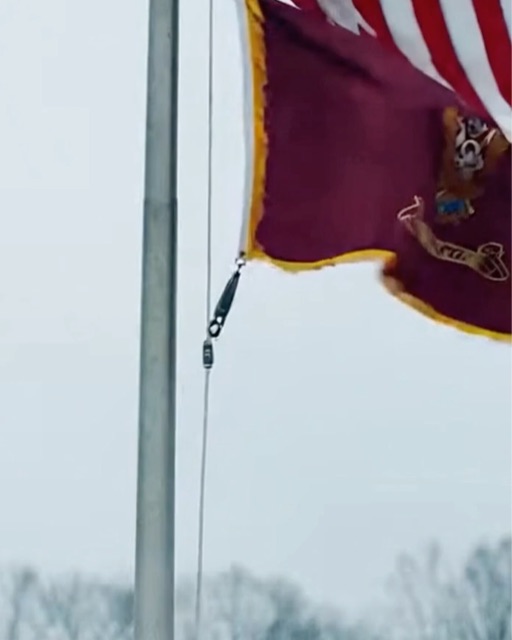
The ceremony had already begun when the wind tore the battalion colors loose.
One hard snap. One broken clasp. Then the American flag and unit colors whipped sideways across the parade field as rows of soldiers froze in formation.
But one man moved.
A retired Army veteran in dress uniform sprinted out of the bleachers before anyone could stop him. His knee brace locked, his medals bounced against his chest, and his breath came hard in the cold air, but he never slowed. The flag was dropping fast, twisting in the wind, seconds from the pavement.
He dove.
His gloved hands caught the fabric inches above the ground.
The entire field went silent.
Cadets, officers, families, NCOs – every eye locked on the old soldier kneeling in the grass with the American flag held high in both arms like it weighed more than a man.
A command sergeant major ran onto the field with two active-duty soldiers. Together they secured the colors while the veteran rose back to his feet, slower this time, chest heaving, uniform stained at the knee.
No one laughed. No one whispered.
Then the battalion commander stepped toward him and noticed something tucked inside the retired soldier’s left sleeve cuff. A sealed strip of plastic.
“Sir,” the commander said carefully, “what is that?”
The veteran looked down like he had forgotten it was there.
He pulled it free.
Inside was a folded recovery roster from decades earlier, water-stained but intact.
The commander frowned. “Where did you get this?”
The veteran’s breathing changed.
Because the name at the bottom of the roster was not his.
It belonged to the lieutenant who had gone missing carrying the colors on a different field, in a different war, under a different sky.
And before anyone could ask another question, a helicopter thundered low over the parade ground and turned sharply toward headquarters.
The commander grabbed his radio. Static. Then a voice cut through: “Sir, we found something at the old firebase. You need to see this.”
The veteran didn’t look surprised.
He looked relieved.
He turned to the commander and said three words that made the man’s blood run cold.
“I made a promise.”
Major Wallace felt a chill that had nothing to do with the wind.
He looked from the old soldier’s tired, earnest eyes to the helicopter now landing in a flurry of cut grass near his office.
“Come with me,” Wallace said, his voice low and firm.
The veteran simply nodded, his duty on the field done, another one just beginning.
They walked in silence across the parade ground, the ceremony forgotten behind them. The command sergeant major had taken over, his voice a distant bark restoring order.
But here, in the space between the two men, there was no order. There was only a fifty-year-old question hanging in the air.
Wallace’s office was sparse and functional. A desk, two chairs, a flag in the corner. He shut the door, and the sound of the helicopter blades winding down filled the room.
The veteran stood stiffly, as if still on parade. His name tag read Mills. Arthur Mills.
“Sit down, Sergeant Mills,” Wallace gestured to a chair.
Mills sat, his back ramrod straight. He placed the plastic-wrapped roster on the edge of the desk.
“A promise to whom?” Wallace asked, his voice softer now.
“To him,” Mills said, his gaze fixed on the roster. “To Lieutenant Daniel Hayes.”
The name was legendary in the battalion’s history. The young officer who vanished during a brutal firefight, last seen charging an enemy position with the unit colors.
He was listed as Missing in Action, Presumed Killed. His body was never recovered.
“You were there,” Wallace stated. It wasn’t a question.
“I was his radio operator,” Mills said. His voice was raspy, thick with memories. “I was right beside him.”
There was a sharp knock on the door. A young captain entered, holding a battered, rust-colored ammunition can.
“Sir. From Firebase Eagle’s Nest. The survey team found it under a collapsed bunker.”
Wallace took the can. It was heavy. He placed it on his desk with a dull thud.
Mills stared at the can, his breath catching in his throat. He recognized the stenciled numbers on the side.
Wallace looked at Mills, then at the can. He pried open the rusted latches.
Inside, protected by layers of oilcloth, was a leather-bound journal.
Wallace carefully lifted it out. He opened it to the first page. The handwriting was neat, precise.
Property of 2nd Lt. Daniel Hayes.
Mills closed his eyes. A single tear traced a path down his weathered cheek.
“Tell me what happened, Sergeant,” Wallace said, his voice a near whisper.
Mills took a long, shaky breath. “It wasn’t like the stories they tell now.”
“No story ever is,” Wallace replied.
“The monsoon had been going for a week. Mud up to our knees. We were on patrol, a small unit, when we walked into it. An ambush.”
He paused, lost in the sound of rain and gunfire that only he could hear.
“It was chaos. Green tracers everywhere. Men were yelling, men were falling. I… I froze.”
The admission hung in the silent office, more powerful than any explosion.
“My rifle felt like it was made of lead. I couldn’t move. I was just a kid. Nineteen. I was so scared I couldn’t breathe.”
“The Lieutenant saw me. He was trying to rally the men, trying to find a weak point in their line. But he saw me, huddled behind a rotten log.”
Mills’s voice broke. He cleared his throat and continued.
“He crawled over to me. The noise was deafening. He had to shout right in my ear.”
“He said, ‘It’s okay to be scared, Mills. Just ain’t okay to stay scared.’ Then he did something I’ll never forget.”
He looked at Wallace, his eyes pleading for understanding.
“He unslung his own rifle and laid it across my arms. He smiled. In all that madness, he smiled at me.”
“He told me to just focus on that rifle. To just breathe. One breath in, one breath out.”
The memory seemed to steady him, even now.
“It worked. I started breathing again. I could think. But by then, our position was collapsing. The command post was overrun.”
“The colors,” Wallace said, putting the pieces together.
“The colors were about to be captured,” Mills confirmed. “And our wounded were being cut off. We had the roster of everyone who was out there. If the enemy got it…”
“They’d know our exact strength and who was missing,” Wallace finished.
“Lieutenant Hayes knew he had to do two things. Save the men, and save the colors. He couldn’t do both.”
He looked down at his hands, turning them over as if seeing them for the first time.
“He made a choice. He pulled this roster from his pocket.” Mills tapped the plastic sheet on the desk. “He shoved it into my hands.”
“He told me, ‘Your mission is to get this back. No matter what. Promise me, Mills. Promise me you’ll get this home.’”
Mills swallowed hard.
“So I did. I promised.”
“Then he grabbed the colors from the fallen standard bearer. And he told the rest of us to fall back toward the wounded, to provide cover fire.”
“What did he do?” Wallace asked, though he suspected he knew the answer.
“He ran. Not away. He ran toward them. The unit colors held high. A single man charging the heart of the ambush.”
Mills’s voice was a ghost.
“He drew all their fire. Every last bit of it. It was the bravest, craziest thing I’ve ever seen. But it gave us the time we needed.”
“We pulled the wounded out. We fell back. By the time the gunships arrived to clear the area, he was gone. The colors were gone.”
He fell silent. The weight of fifty years of silence settled in the room.
“They called me a hero when I got back,” Mills said, a bitter edge to his words. “For getting the roster out. For helping with the wounded.”
“I never told them the truth. I never told them that I froze. That the only reason I was alive was because Daniel Hayes saved my worthless hide.”
“I let them believe I was brave. I’ve been living with that lie my whole life.”
He looked at the ammo can.
“I tried to tell them, but they were building a legend. The hero who vanished. It was a better story. My story… my real story… would have tarnished his.”
“So you kept his secret,” Wallace said. “And your own.”
“It was his last order. ‘Get this home.’ For years, I thought he just meant get it back to base. But that wasn’t it.”
“Today,” Mills continued, his voice finding a new strength, “when I saw that flag fall… I couldn’t let it happen again. I couldn’t let another one touch the ground on my watch.”
“I saw my chance to finally do something right. To keep the real promise.”
Wallace finally looked away from Mills and opened the journal. The pages were stiff, the ink faded in places. He flipped toward the end, to the last entry, dated the morning of the ambush.
The writing was rushed, hurried.
“Raining again. Mud’s a real beast. Mills is quiet today. I think the kid is scared. Don’t blame him. We’re all scared out here. The trick is to find something to hold onto.”
Wallace read the words aloud, his voice steady.
“He’s a good kid. A good soldier. He just needs to see it in himself. Fear is a shadow. It only has power if you stand still and let it cover you. You have to move. You have to do the next right thing.”
Wallace paused, his own throat tightening. He turned the page to the final, scribbled entry. It must have been written in the moments before the patrol left.
“If something happens to me, tell my sister not to be sad. Tell her I was where I was supposed to be, with the best men I’ve ever known.”
Then, a last sentence, almost an afterthought.
“And tell Mills he was brave enough. He got back up. That’s all that ever matters.”
Wallace finished reading and looked up. The room was utterly still.
The words weren’t an accusation. They were a validation. A message of grace sent across five decades of silence and guilt.
Lieutenant Hayes hadn’t seen a coward. He had seen a young soldier who was scared, who faltered, and who then got back up and did his duty.
He had seen the man Arthur Mills would become, not the boy he was in one terrible moment.
The twist wasn’t that Mills had failed. The twist was that his hero had never seen it as a failure at all. He saw it as part of being human.
Mills was openly weeping now, quiet, shuddering sobs of a burden finally released. He had carried his shame for fifty years, only to find out it was a weight he had placed on himself.
His promise wasn’t just to bring a piece of paper home. It was to live. To survive. To carry their story forward. And in his own quiet, guilt-ridden way, he had.
Major Wallace stood up. He walked to the window and looked out at the parade field, now empty.
“Sergeant Mills,” he said, turning back. “You didn’t fail him. You fulfilled your mission. You brought the roster home.”
He placed a hand on the old soldier’s shoulder.
“And now, you’ve brought him home, too.”
The story of what happened in Major Wallace’s office spread, not as gossip, but as a quiet, reverent truth.
Official records were amended. New witness statements, based on the account of Arthur Mills and corroborated by the personal journal of Lieutenant Hayes, were entered into the archives.
Two months later, there was another ceremony on the same parade field.
The sky was a brilliant, cloudless blue.
This time, the guest of honor was an elderly woman with bright, kind eyes, sitting in the front row. She was Daniel Hayes’s younger sister, his last living relative.
Beside her sat Arthur Mills. He was in his dress uniform again, but he stood taller. The haunted look in his eyes was gone, replaced by a quiet peace.
Major Wallace stood at the podium. He told the story not of a hero who vanished, but of a leader who made a choice. He spoke of a man who ran toward danger to save his men.
He read the last entry from the journal.
Then, he called Arthur Mills to the stage. He explained how for fifty years, this man had kept a sacred promise, carrying the story of his friend’s final moments.
A general with a chest full of medals stepped forward. He presented Daniel Hayes’s sister with the Distinguished Service Cross, an upgrade to the Silver Star her brother had been awarded in absentia.
The citation spoke of his incredible bravery, his selfless sacrifice, and his leadership in the face of impossible odds.
Then the general turned to Arthur Mills.
He didn’t present a medal. He offered something more.
He unpinned the Combat Infantryman Badge from his own uniform and pinned it above the ribbons on Mills’s chest. It was a gesture of profound respect, from one soldier to another.
“You got back up, soldier,” the general said, his voice just for Mills to hear. “Welcome home.”
After the ceremony, as the crowds dispersed, Mills stood with Hayes’s sister by the newly dedicated memorial plaque bearing her brother’s name.
“He always looked out for people,” she said, touching the cold bronze. “Even when he was little. He told me being brave wasn’t about not being scared. It was about doing what you had to do, even when you were terrified.”
She turned to Mills. “He would have been so proud of you, Arthur. You kept your promise. You brought my brother home.”
Arthur Mills could only nod, his heart too full for words. He looked up at the battalion colors, snapping smartly in the breeze, securely fastened this time.
He had spent a lifetime believing he was a footnote in a hero’s story, a secret shame to be buried. But he finally understood. Honor isn’t found in a single, flawless moment of battlefield courage. It’s found in the long, quiet years that follow. It’s in the promises you keep, the burdens you carry for others, and the truth you protect until it’s time for it to be heard.
His war was finally over. His mission was complete.