The music didn’t stop when his body did.
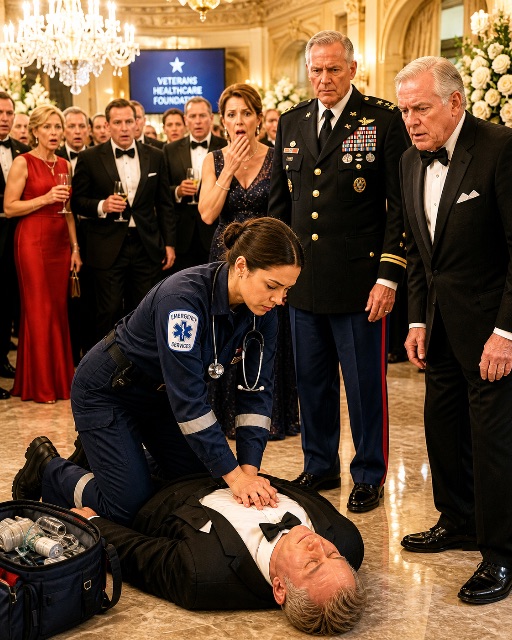
The tray didn’t even rattle when I set it down. Knees to marble. Two fingers to carotid.
Nothing.
“Call 911,” I said, already tilting his head, already checking his airway. “You – red case on the wall by the coat check. That’s the AED. Run.”
Silk and diamonds turned to statues.
Someone fumbled a glass. Champagne hissed against stone.
“Don’t make a scene,” my father hissed behind me. “We have private physicians. Just step back.”
My blood ran cold – and my hands stayed moving.
“Sir, move.” I laced my fingers, locked my elbows, and started compressions. Center of the sternum. Hard. Fast. Count in my head. Push the floor away. Let the chest spring back.
Click. Pop. A rib. I didn’t stop.
“Someone clear the area,” I snapped. “Two feet of space. Now.”
A woman in pearls gasped. A man muttered, “Is she even certified?” The laughter from two minutes ago died like a blown-out candle.
My father’s hand landed on my shoulder. “Enough.”
I shrugged him off without looking. “If you interfere, you’re endangering a life.”
The room tilted toward me. Eyes. Phones. Whispers. Charles Vale’s lips had a blue edge now.
“Breathe, Charles,” I said, breathless. “Come on.”
The AED slid across the floor to my knee. I ripped the box open with my teeth. Pads out. Shirt up. Tuxedo buttons pinged like little gunshots.
“Applying pads,” I said, half to the machine, half to the room. “Do not touch the patient.”
The device chirped. “Analyzing heart rhythm. Do not touch the patient.”
“Back!” I barked. I didn’t have to raise my voice. It cut anyway.
“Shock advised,” the machine said.
My heart pounded so hard I could feel it in my fingertips.
“Clear!” I yelled, lifting my hands. The air around us held its breath. I pressed the button.
His body jerked. The woman in pearls screamed. Someone prayed.
“Resume compressions,” the AED ordered.
I went back in. Sweat crawled down my spine. The smell of lilies turned sharp and metallic.
“Where are the medics?” my father snapped at no one. “This is unacceptable.”
Boot steps clicked, not rushed. Not panicked. Measured.
“Make way,” a voice said, low and even.
I glanced up. Dress blues. Four silver stars that caught the light like knives. Broad shoulders. Weathered face that had seen dust and fire and didn’t flinch at either.
The room parted for him like it knew how.
He didn’t look at me first. He looked at my father’s hand—still hovering like it owned the air—and then at my patch.
“Keep working, Sergeant,” he said to me, voice steady.
My jaw clenched. The old name pulled something tight in my chest. I kept counting. Thirty. Two breaths. Thirty.
My father bristled. “This is my home,” he began. “And she is—”
The General stepped between us, close enough that my father had to tilt his chin up to meet his eyes.
“Stand down,” he said. Not loud. Not negotiable.
My father froze, color draining that didn’t show up in his perfect tan.
The General didn’t blink. He lifted one hand, palm out—not to me, to hold my father exactly where he was—and spoke one sentence, each word like a strike of a gavel.
“Sir, with respect, you will not touch her—because the woman you just called a ‘glorified medic’ is the one who pulled my son out of a burning helicopter under enemy fire.”
The air left the room.
Every whisper died. Every phone lowered.
I didn’t stop compressions. My rhythm was the only sound in the dead silence, the only thing keeping the world moving. Thirty. Two breaths.
The General’s words hung there, heavy as armor. My father’s face, a mask of tailored superiority just moments before, crumbled.
It was like watching a building collapse in slow motion. The pride, the arrogance, the dismissal—all of it turning to dust.
He looked from the General’s unwavering stare to me. To my hands, covered in a stranger’s sweat, pushing life back into a man he despised.
For the first time, I think he actually saw me. Not his disappointing daughter, but a person forged in a fire he could never imagine.
The distant wail of a siren grew louder, a promise of help.
The General, whose name was Morrison, knelt beside me, opposite where my father stood frozen. He didn’t offer to take over. He just watched my technique with an expert’s eye.
“Steady, Sarah,” he said quietly, using my first name now. His presence was a shield.
“Yes, sir,” I breathed out, the words automatic. Twenty-eight, twenty-nine, thirty.
Heavy boots stomped through the grand foyer. Two paramedics, their faces calm and professional, rolled a gurney across the marble.
“We’re here,” one of them said, setting his gear down. “What have we got?”
I didn’t miss a beat. “Adult male, approximately sixty. Witnessed collapse. No pulse, no breathing. Started CPR within thirty seconds.”
I pointed to the AED. “One shock delivered about three minutes ago. No change. Currently in my fourth cycle of compressions post-shock.”
I gave them the rhythm, the time, the facts. A clean, concise handover. The language of crisis, a language my father had never heard me speak.
They took over seamlessly, one managing the airway, the other prepping their own monitor. I finally sat back on my heels, my arms trembling with exhaustion.
The room was still a gallery of shocked faces. They weren’t looking at the paramedics. They were looking at me. And at my father.
General Morrison offered me a hand. I took it, and he pulled me to my feet. My knees felt like water.
“Good work, Sergeant,” he said again, his voice for me alone.
My father, Edward, just stood there. He looked smaller than I had ever seen him, lost in his own cavernous living room. The party was over.
The paramedics loaded Charles Vale onto the gurney. As they wheeled him past, one of them caught my eye and gave a slight, respectful nod.
My father watched them go, then his eyes landed on General Morrison, who had placed a steadying hand on my back.
“General,” my father started, his voice raw. “I… I had no idea.”
The General’s expression didn’t soften. “That, sir, is abundantly clear.”
He then turned to me. “My wife and I were just arriving. I saw the commotion. Are you alright?”
“I’m fine, sir,” I said, though my body hummed with adrenaline. The smell of lilies and fear clung to my clothes.
“Lieutenant Morrison—Michael,” I asked. “How is he?”
A rare, genuine smile touched the General’s lips. “He’s great. Walking without the cane most days. He asks about you.”
He continued, “He tells everyone you’re the reason he still has a father for his kids to climb on.”
My throat tightened. I had a picture of Michael’s two little girls taped inside my locker for three years. It was the only personal item I kept.
My father flinched as if he’d been struck. He had never met my commanding officers, never asked about the people I served with.
The few remaining guests began to shuffle out, murmuring quiet apologies, their eyes avoiding my father’s. The shame was a thick fog in the room.
Soon, it was just the three of us and the wreckage of a perfect evening. Spilled champagne, a discarded AED, and the ghost of a man who almost died.
“You never told me,” my father said, his voice hollow. It wasn’t an accusation. It was a statement of fact, filled with a dawning, horrifying regret.
“You never asked,” I replied, the truth of it simple and sharp. “When I came home, you asked if I was done ‘playing soldier’ so I could get a real job.”
He had no answer for that.
General Morrison gave my shoulder a gentle squeeze. “I’ll see myself out, Sarah. Call me if you need anything. Anything at all.”
He gave my father one last, long look, then turned and walked away, his footsteps echoing the finality of the night.
Silence fell. It was heavier than the compressions had been.
I started picking up the AED pads and wrappers, my body moving on autopilot. A need to clean up, to restore order.
“Leave it,” my father said quietly. “The staff will handle it.”
I looked at him. The mask was gone. In its place was a man I barely recognized, his face etched with a confusion that went bone-deep.
“Why didn’t you tell me you saved his son?” he asked. “A General’s son. That’s… significant.”
I stopped, the plastic crunching in my hand. “Because it wasn’t about who his father was. It was about a man burning in a wreck.”
I took a breath. “And because you wouldn’t have understood. To you, it would have been a networking opportunity. A name to drop. Not a life.”
His eyes welled up. I had never seen my father cry. Ever.
“Is that what you think of me?” he whispered.
“It’s what you’ve shown me,” I said, my voice softer than I intended. The fight had gone out of me.
I walked past him, heading for the stairs. I needed a shower. I needed to wash the night off me.
“Sarah,” he called after me. “The man you saved… Charles Vale.”
I stopped but didn’t turn around. “What about him?”
“He’s my biggest rival,” he said, his voice strained. “We’ve been in a legal battle for five years. He’s been trying to ruin me.”
I finally turned. A bitter, tired laugh escaped my lips. Of all the people in the world to collapse on my father’s floor.
“Well,” I said. “Looks like you owe your enemy a life. And you owe it to the glorified medic who saved him.”
I left him standing there, alone with the consequences of his words and my actions.
The next few days were quiet. I stayed in my old room,avoiding him. I read online that Charles Vale was in stable condition, expected to make a full recovery.
My father left me alone. There were no more snide remarks, no more disappointed sighs. There was just a heavy, thoughtful silence in the house.
On the third day, my father knocked on my door. He was holding a tablet.
“I have something to show you,” he said.
He handed it to me. It was an article from a military journal, dated four years ago. The headline was about a mass casualty event following an IED attack on a convoy.
I scrolled down. There it was, buried in the jargon. A medic, decorated for valor after pulling multiple soldiers from a burning vehicle under sustained fire, including the platoon leader, Lieutenant Michael Morrison. The medic’s name was Sergeant Sarah Jenkins. My name.
He had found it. He had actually looked for it.
“The article mentions you were injured,” he said, his voice unsteady. “Shrapnel. A broken arm. You never said a word.”
“It healed,” I said, handing the tablet back.
“No,” he said, shaking his head. “I don’t think it did. Not all of it.”
He was right. I came home with scars on my skin, but deeper ones I couldn’t show. Scars that made it hard to connect with a world of cocktail parties and stock portfolios.
“I was proud, you know,” he said, looking at the floor. “When you enlisted. I was terrified, but I was proud. I just didn’t know how to say it.”
He thought strength was about power, about being the loudest voice in the room. He didn’t understand the quiet strength it took to run toward the fire.
“I hid my pride behind disapproval,” he admitted. “Because if I admitted how proud I was, I’d have to admit how scared I was. And I didn’t think men like me were allowed to be scared.”
It was the most honest thing he had ever said to me.
A week later, a letter arrived. It was addressed to me, but the envelope was from Charles Vale’s corporate headquarters. My father brought it to me, his hand trembling slightly.
I opened it. It was a handwritten note from Vale himself, penned from his hospital bed.
He thanked me for my “unthinkable grace and professionalism.” He said lying there, he had a lot of time to think about second chances.
Then came the twist.
He wrote that he was dropping the lawsuit against my father’s company. All of it. He said life was too short for bitter wars, especially when the child of an enemy shows you such profound humanity.
He wasn’t finished. He said his company was redirecting the millions set aside for legal fees into a new charitable foundation.
Its first project? Funding a new, state-of-the-art prosthetics and rehabilitation wing for the Veteran’s Affairs hospital. The very hospital where I volunteered my time.
He wrote that he had made a call and learned of my work there. He was making his first donation in my name. The amount made me sit down. It was more money than I could ever imagine.
I handed the letter to my father. He read it, then read it again.
He slowly sank into a chair, the letter shaking in his grasp. His enemy hadn’t been defeated. He had been changed.
And in changing, he had given my father a gift far greater than winning a lawsuit. He had given him grace. He held up a mirror, and for the first time, my father saw the man he wanted to be.
That evening, he came to me with a check. It wasn’t for me. It was a personal check, made out to the same VA hospital. It was for the same staggering amount as Vale’s corporate donation.
“I’m matching it,” he said simply. “I want to help you build something that lasts. Something that matters.”
He looked me in the eye. “I was wrong, Sarah. About everything. Your work…it’s not a job. It’s a calling. Your strength isn’t something I should have feared. It’s something I should have celebrated.”
He cleared his throat. “There’s a community CPR class next Saturday. I signed us up. I want you to teach me.”
A real smile, the first one in years, bloomed on my face. “I’d like that,” I said.
The following Saturday, I stood in a community hall with my father. He fumbled with the practice dummy, his expensive suit jacket slung over a chair.
He listened intently as I explained compression depth and timing. He wasn’t the powerful CEO anymore. He was just a man trying to learn how to save a life.
As I watched him practice, I realized the man on the floor that night wasn’t the only one whose heart had stopped and been restarted. In a way, my father’s had, too.
He had been given a second chance, not by an AED, but by the quiet, steady work of the daughter he had almost failed to see.
True value isn’t found in a stock price or a four-star rank. It’s found in the quiet moments of service. It’s in the hands that reach out to help, whether in a warzone or on a polished marble floor. It’s the simple, profound truth that the most important thing you can ever be is useful to another human being.