
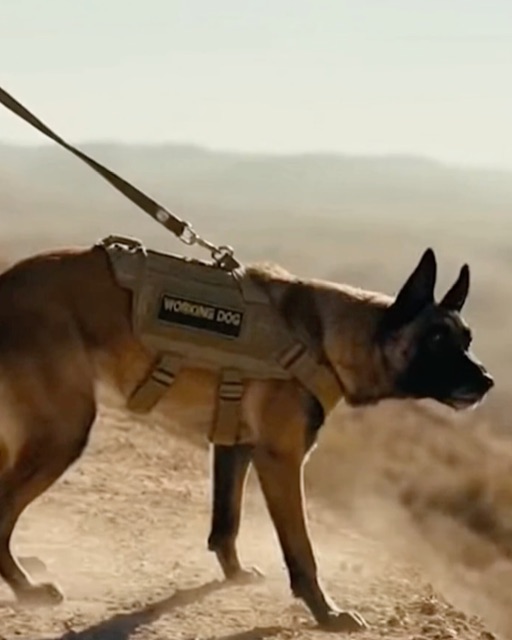
The patrol dog froze dead at the crest of the ridge. Not a normal freeze. He growled low, a sound that made my gut clench. Corporal Megan Cross, his handler, tugged once. Nothing.
We were on a recon drill, dust kicking up under our boots, radios hissing. Just another day in the dry scrub. Then an old retired scout, Gary, who was observing from the ridge, started screaming, “Freeze the patrol!”
Too late. The lead vehicle rolled another three feet. The ground cracked beneath its front tire. Not a full collapse, but enough to show an old drainage culvert hidden under the trail. One hard bounce away from dropping the axle.
Megan pulled the dog back. Engines cut. Everyone was looking at Gary. He crouched at the edge of the washout, while the dog kept staring at a half-buried section of concrete pipe.
“He’s not warning on the collapse,” Gary said, his voice flat. “He’s warning on scent.”
“Scent of what?” the patrol leader frowned.
The dog lunged again toward the pipe opening. Engineers brought pry tools. We cleared brush. Gary crawled in with Megan and the dog, flashlight beam cutting through the dirt.
Ten feet in, the dog sat hard, staring at the left wall. Gary dug with both hands. His fingers hit metal. An ammo can. He dragged it out. Inside were an old troop route card, an American flag patch, and a K9 training lead wrapped around a grease-pencil note.
Megan read it aloud. Dog hit on the tunnel because the bypass route was changed after briefing.
Gary’s expression went flat. My blood ran cold. The handwriting belonged to his troop commander, Dennis Miller. The one officially killed before the patrol even entered that valley.
Then the military dog twisted, ears forward, staring deeper into the culvert. Something was moving in the darkness behind them.
Megan’s hand went to her sidearm. Gary held up a hand, silencing her. The dog, Buster, didn’t bark. He let out a low, questioning whine.
That whine changed everything. It wasn’t a sound of aggression. It was a sound of confusion, of recognition almost.
Sergeant Evans, our patrol leader, crept to the opening. “What is it, Cross?” he whispered, his voice tight.
“Something’s back there, Sarge,” she said. “Buster’s not hostile, but he’s locked on.”
A faint scraping sound echoed from the pipe. Like cloth dragging over rough concrete. Gary shone his light deeper. The beam caught on a pair of ragged boots, then traveled up a pair of tattered trousers.
A man was curled up at the far end of the culvert, where it narrowed to an almost impassable choke point. He was thin, impossibly so. His face was obscured by a wild, matted beard and filthy hair.
He flinched away from the light, raising a skeletal hand to shield his eyes. A weak, raspy sound came from his throat. It might have been a word.
Gary crawled forward, slow and deliberate. “Easy now,” he said, his voice calm, the way you’d talk to a spooked horse. “We’re friendlies.”
The man didn’t respond. He just trembled.
Megan brought Buster forward on a loose lead. The dog crept cautiously, his nose working overtime. He stopped a foot from the man and whined again. Then he did something none of us expected.
He licked the man’s hand.
A choked sob broke from the stranger’s chest. It was a sound of pure, gut-wrenching despair. Gary reached him then, placing a gentle hand on his shoulder.
“It’s alright, brother,” Gary said softly. “We’ve got you.”
As Gary helped the man sit up, the flashlight beam caught his face fully. The dirt and beard couldn’t hide the structure of his jaw, the shape of his eyes.
Gary froze. His breath hitched. “Dennis?” he whispered, the name a fragile puff of air. “It can’t be.”
The man looked at Gary. For a second, a flicker of recognition, of the man he used to be, lit his exhausted eyes. “Gary,” he rasped, his voice a dry crackle. “You came.”
My mind refused to process it. Dennis Miller. KIA. We’d seen the reports. We’d attended the memorial briefing. It was a fact, as solid as the ground we stood on.
Except the ground wasn’t solid, and Dennis Miller was alive.
We got him out of the culvert. He was light as a child. Dehydrated, malnourished, and disoriented. Our medic, a quiet guy named Peterson, went to work immediately, starting an IV, checking his vitals.
He kept his eyes fixed on Gary, like he was the only anchor in a spinning world. Megan kept Buster close, and the dog sat faithfully by Miller’s side, nudging his hand every so often as if to say, “I’m still here.”
Sergeant Evans got on the radio, his voice strained. He reported the structural instability of the trail. He reported that we had found a civilian in need of medical evacuation. He didn’t say the name. Not yet.
He knew, as we all did, that you don’t just find a man who was officially declared dead. This wasn’t a simple rescue. This was something else entirely. Something dangerous.
While we waited for the medevac, Gary sat with Miller, giving him small sips of water. Slowly, in broken pieces, the story came out.
The original mission, the one Miller was leading, was a setup. The intel was bad from the start. “It felt wrong,” Miller whispered, his voice gaining a little strength. “The route, the timing. Everything.”
He had a bad feeling, so he did his own recon the night before. He found signs of a planned ambush. A big one. Too big for his small unit to handle.
He couldn’t break radio silence without giving away his position. He had no way to warn command without tipping off whoever was listening. He knew someone on the inside had to be involved.
So he did the only thing he could. He created a new route card. A safe bypass. He hid it in the ammo can in that culvert, a landmark he knew his scout, Gary, would recognize. He wrapped it with a K9 lead, hoping a patrol dog would scent it.
“I hoped it would be you, Gary,” Miller said, looking at his old friend. “I knew you’d trust a dog’s nose over a map.”
He planted the can and was heading back to his unit when the ambush was sprung early. They were waiting for him. He was alone. There was an explosion. He was thrown into a ravine, wounded and left for dead.
When he came to, his unit was gone. He heard the radio chatter later. The official story. His entire team, wiped out. Him, the commander, killed first. A neat, tidy story.
He knew he couldn’t just walk back to base. The person who set him up was still out there, in a position of power. To them, he wasn’t a survivor. He was a loose end.
So he hid. He lived in that culvert, surviving on what little he could find, watching patrols go by, waiting. He didn’t know for what. Maybe just for the end.
“Who was it?” Gary asked, his voice like stone. “Who sold you out?”
Miller’s eyes darted around, full of a fear that ran deeper than starvation. “You can’t trust them,” he rasped. “Major Stratford.”
The name hit us like a physical blow. Major Stratford. He was the deputy commander of operations. A real by-the-book officer, respected and feared. He had signed off on our training drill today.
He had personally briefed Sergeant Evans on the route. The old route. The one that went right over the culvert.
The air grew thick and heavy. Our simple recon drill suddenly felt like the dead center of a spider’s web.
The medevac chopper was ten minutes out. Sergeant Evans made a decision. He pulled me and Megan aside. “I’m changing the evac point,” he said, his voice low. “I’m not sending him to the main base.”
He was overriding protocol, a career-risking move. “We’re taking him to the auxiliary landing zone near the old comms tower. Stratford won’t have direct oversight there.”
“What about the report, Sarge?” I asked.
“The report says we found a John Doe with amnesia,” he stated, looking me dead in the eye. “Until I can verify Commander Miller’s story, he is a ghost. We keep him a ghost. It’s the only way to keep him safe.”
When the chopper landed, we loaded Miller. Gary went with him. As the chopper lifted off, kicking up a storm of dust and grit, the weight of what we’d stumbled into settled on us.
We had found a dead man. And in doing so, we had likely made an enemy of a very powerful living one.
Back at base, the questions started. Major Stratford himself came down to our debriefing. He was a tall man with a sharp, angular face and eyes that seemed to miss nothing.
He listened to Sergeant Evans’ report about the “John Doe” with an unnerving stillness. “Amnesia, you say? How convenient,” Stratford said, a thin smile on his lips. “And you rerouted the medevac against standing orders, Sergeant?”
“The primary LZ was compromised by the washout, sir,” Evans said smoothly. “I made a command decision based on operational safety.”
Stratford’s eyes narrowed. He looked from Evans to Megan, then to me. “And the dog? What’s your report, Corporal?”
“Buster alerted on the culvert, sir,” Megan said, her voice steady. “His training is to indicate anything out of the ordinary. The ammo can, the scent of a human in distress. He performed as expected.”
“I see,” Stratford said, turning to leave. “See to it this John Doe is transferred to the main medical facility as soon as he’s stable. I want to personally oversee his interview.”
The unspoken threat hung in the air. He wanted Miller in his grasp.
We had a few hours, at most. Gary called from a secure line at the auxiliary station. Miller was stable, but weak. And terrified.
“He’s right, Evans,” Gary said, his voice urgent. “Stratford is behind this. Dennis told me Stratford was skimming operational funds. Using shell companies to divert supplies. Dennis found the proof. He was going to turn Stratford in the day after that patrol.”
Suddenly, it all made sense. The ambush wasn’t just to silence Miller. It was to wipe out his whole team, the men he trusted, and blame it on faulty enemy intel.
“Proof is one thing, Gary. We need it now,” Sergeant Evans said.
“Dennis said he kept a backup,” Gary replied. “A data chip. He said he hid it somewhere no one would ever look.” A pause. “In the ammo can. He said it was in the K9 lead.”
My heart pounded in my chest. Megan still had the can and its contents in evidence lockdown.
We got the can from the evidence locker. Megan took the old, worn K9 training lead. It was a simple flat nylon strap. She ran her fingers over it, feeling for any abnormality.
She found it near the clasp. A tiny slice in the stitched seam. Using her multi-tool, she carefully snipped the threads.
Inside, wrapped in a small piece of waterproof plastic, was a tiny memory chip.
We didn’t have the equipment to read it securely. We had the smoking gun, but we were in a room full of people who answered to the man who wanted to bury it.
Just then, an orderly appeared at the door. “Sergeant Evans? Major Stratford has ordered Commander Miller’s immediate transfer. An armed escort is on its way.”
Time was up. Stratford was making his move.
Sergeant Evans looked at the chip, then at us. His jaw was set. “He’s not taking him.”
We raced back to the auxiliary station. Stratford’s escort, two military police vehicles, were already pulling up to the gate.
We met them at the entrance to the small clinic. Stratford himself stepped out of the lead vehicle. He wasn’t smiling anymore.
“Sergeant,” he said, his voice cold as ice. “You are interfering with a direct order. Stand your men down and hand over the patient.”
“I can’t do that, sir,” Evans said, standing his ground. Two of our guys stood with him, rifles held ready but not aimed. It was a tense, silent standoff.
“This is insubordination. This will be your career,” Stratford hissed.
“My career is the least of my concerns right now,” Evans shot back.
Then, the clinic door opened. Gary stepped out. Beside him, leaning on him for support, was Dennis Miller. He was cleaned up, wearing a fresh uniform. He looked frail, but his eyes were clear. And they were locked on Stratford.
“It’s over, Thomas,” Miller said, his voice stronger now.
Stratford laughed, a harsh, ugly sound. “Dennis. Look at you. A ghost. A deserter who lost his nerve and his whole unit. No one will believe a word you say.”
“They won’t have to,” Megan said, stepping forward. She was holding the small data chip between her thumb and forefinger. “They can just read the files.”
Stratford’s face went pale. He stared at the chip, then at Miller, his mask of command crumbling to reveal the desperate man beneath.
“That’s a fabrication,” he snarled. “Seize them! That’s an order!”
The MPs with him hesitated. They looked from their furious Major to our calm Sergeant, and to the legendary commander who was supposed to be dead. They saw the truth in the tableau before them. They didn’t move.
In that moment of hesitation, another vehicle pulled up. A command vehicle. The base commander himself stepped out, a colonel with a grim expression. Sergeant Evans had made one last call.
The story unraveled quickly after that. The chip contained everything. Bank records, illicit communications, plans. It was undeniable proof of treason and murder. Stratford was taken into custody, his career ending not with a bang, but with the quiet click of handcuffs.
A few months later, things had settled into a new kind of normal. Dennis Miller was cleared of all wrongdoing and his true story was told. He was given a hero’s welcome and an honorable medical retirement. He chose to spend his time reconnecting with the family who had mourned him and now had him back.
Gary finally had peace. He had found justice for his friend and commander, closing a painful chapter of his life.
Sergeant Evans received a commendation for his courage and clear-headedness under pressure. He had risked everything on a gut feeling and the word of his soldiers, and he had been right.
And then there was Megan and Buster. The dog who started it all. He didn’t know he’d uncovered a conspiracy. He just knew something was wrong. He trusted his nose, and his handler trusted him. They were given the highest honors a K9 team could receive.
I saw them on the training field a while back. Megan threw a ball, and Buster, the hero who saved a patrol and rewrote history, bounded after it with joyful abandon, his tail wagging furiously.
It’s funny how things work. Sometimes the biggest truths aren’t found in reports or briefings. They’re hidden in the dirt, waiting for someone with enough instinct and loyalty to dig them up. We’re taught to follow orders, to trust the chain of command. But that day taught me a more important lesson.
The truth doesn’t have a rank. And true loyalty isn’t about obeying titles; it’s about having the courage to stand up for what is right, even when it’s the hardest thing to do. It’s about trusting the quiet instincts, whether they come from a decorated commander, a seasoned scout, or a good dog with a great nose.



