
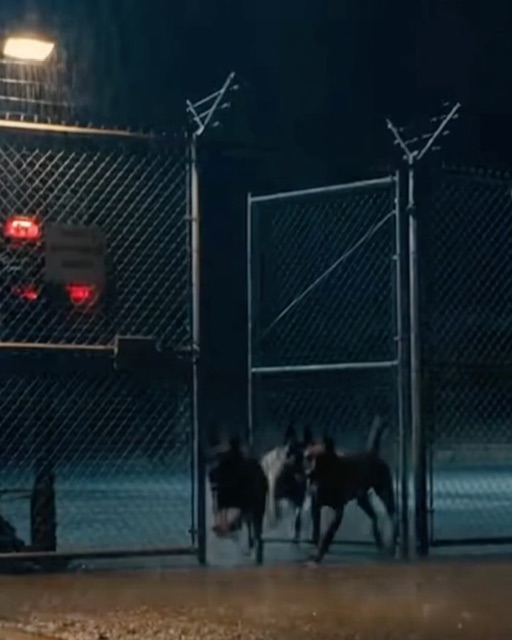
The storm hit, lights flickered, and then I heard the alarm. Three military working dogs, unleashed into the chaos. My blood ran cold when I saw one cut left, not for cover, but toward the old, condemned evidence annex.
I’m Travis, a retired MP, just leaving the station when the K9 compound went into lockdown. Gate radios screamed. Handlers sprinted. But these dogs weren’t running from anything. They were running to something.
I vaulted a chain link and followed. Behind me, Kennel Sergeant Todd caught up, soaked. “They should be running,” he panted. “Why are they here?” The dogs, two Malinois and a Dutch Shepherd, were already at a welded-shut side entrance. Alert. Aggressive. Certain.
We got bolt cutters. The chain dropped. The moment the door creaked open, they surged inside, then stopped. They were staring at a sealed evidence room. “That room was supposed to be empty,” Todd whispered.
We cut the welds. Inside were old Army evidence cartons. I picked one up. A plastic bag contained a K9 harness tag. My heart stopped. It belonged to my partner, Rex. My patrol dog, recorded as killed during an interdiction operation years ago. Taped inside the bag was a note: “Dog indicated on the wrong vehicle because the plates were switched.”
Then, one of the MWDs inside the room snapped towards the rear wall, digging furiously at the cinderblock. Like something was hidden behind it.
The sound of claws on concrete was deafening in the small, musty room. Todd flicked on his heavy-duty flashlight, the beam cutting through a decade of dust. The dog, a powerful Malinois named Nitro, wasn’t just scratching. He was trying to tear the wall apart.
“What is it, boy?” Todd murmured, moving closer.
I stared at the note again, the neat, block letters burning into my memory. “The plates were switched.” That day had haunted me for fifteen years. The official report said Rex had given a false positive on a civilian minivan during a major drug interdiction near the base perimeter.
The minivan was clean. While we were occupied, a nearly identical truck two cars behind it slipped through the checkpoint. The report concluded Rex was distracted or had a simple failure in training. It was a black mark on his record and on mine. A week later, on a different operation, Rex was reported killed in action.
They told me he’d chased a suspect into a ravine and a firefight had broken out. They said they couldn’t recover his body. I was given his folded flag and a commendation for his service. It felt hollow then, and it felt like a lie now.
“Travis, look,” Todd said, his voice tight. He pointed the light where Nitro was digging. A faint outline, almost imperceptible, traced a section of the wall. The mortar was a slightly different color. It wasn’t part of the original construction. It was a patch. A big one.
We needed a sledgehammer. Todd radioed for one, his voice deliberately calm, avoiding any mention of what we’d found. He just said we had a structural concern in the annex due to the storm.
Minutes later, a young MP, barely out of training, arrived with the hammer. His eyes were wide, taking in the scene – two senior NCOs, three high-strung military dogs, and a room that smelled like ancient paper and secrets.
I took the sledgehammer. The weight of it felt right in my hands. It felt like I was about to swing at fifteen years of unanswered questions.
The first strike sent a shockwave up my arms. Cinderblock dust exploded into the air. Nitro and the other dogs backed up, barking in a frenzy of encouragement. They knew. They smelled the history buried in the concrete.
I swung again. And again. A crack appeared. Then another. With a final, guttural yell, I brought the hammer down and a large section of the wall crumbled inwards, revealing a dark cavity.
An odor wafted out. Not of decay, but of something else. Old vinyl, dust, and the faint, unmistakable smell of aged currency.
Todd shone his light into the hole. Inside was a large, black duffel bag. It was military-issue, the kind we used for deployment. It was covered in a thick layer of dust and cobwebs.
My hands trembled as I reached in and pulled it out. The zipper was stiff, but it gave way with a screech.
We both peered inside. It was filled with cash. Bundles of hundred-dollar bills, bound with old, brittle rubber bands. There had to be hundreds of thousands of dollars in there.
Tucked into a side pocket was a small, leather-bound ledger. I opened it. Inside were dates, locations, and payment amounts. It was a detailed record of drug money moving through this base. The last entry was dated the day before Rex’s supposed “false positive.”
The story was becoming painfully clear. Someone high up had been running a protection racket, using the base as a waypoint for a cartel. The interdiction operation had been a threat to their business.
Rex hadn’t been wrong. He had hit on the correct vehicle, the one with the drugs. But someone had switched the plates with an identical, clean vehicle right before it reached our checkpoint. They didn’t just want the drugs to get through; they wanted to discredit the one asset they couldn’t control: a dog who couldn’t be bribed.
“They set him up,” I said, my voice hoarse. “They set us both up.”
“And they used this evidence room to hide the payoff,” Todd added, looking around. “No one’s been in here for years. It was the perfect place.”
The dogs had settled down, panting now, their job done. It was as if they had been guided by a ghost, by the lingering injustice that had seeped into the very walls of this place.
We called the station commander, a by-the-book Major named Kendrick. He arrived, took one look at the money, the ledger, and my face, and his expression hardened. This was a mess that reached far back into the past.
“This annex was sealed on the order of Major Collins,” Kendrick said, flipping through the old station logs we’d pulled. “He was the station commander back then.”
The name hit me like a physical blow. Major Collins. He was the one who had personally debriefed me after Rex’s failure. He had been so understanding, so sympathetic. He’d put his arm around my shoulder and told me that sometimes, even the best dogs make mistakes. He’d signed off on the official report.
And he was the one who had signed Rex’s death certificate.
“Where is he now?” I asked, my voice dangerously quiet.
Kendrick did a quick search on his tablet. “Retired. Colonel Samuel Collins. Lives about two hours from here. Sits on the board of some private security firm. Very successful.”
Of course he was. He had a hell of a retirement fund, sitting right here in this duffel bag.
The next few days were a blur of official procedure. CID took over. The money was counted. The ledger was analyzed. But it was all circumstantial. The money was old, the handwriting in the ledger was unidentified. Collins would have a dozen high-priced lawyers who could tear it apart.
They had the what, but they didn’t have the who. The note in the evidence bag was anonymous. It was the missing link. We needed the person who wrote it.
“I need the personnel roster from that year,” I told Todd one evening. We were in his office, the K9 kennels quiet for the night. “Everyone who worked at this station.”
It took some doing, but we got it. A list of names, most of whom I barely remembered. We started going through them one by one, looking for anyone who left the service under strange circumstances shortly after the incident.
We found him on the third page. Specialist Peterson. He’d been one of the junior MPs at the checkpoint that day. A quiet kid, always seemed a little spooked. According to his file, he was given an honorable discharge a few months later under a hardship clause. His family had suddenly come into some money, and he was needed back home.
“Came into money?” Todd said, raising an eyebrow. “Or was given money to disappear?”
We found a last known address for a Daniel Peterson in a small, rural town in the next state. It was a long shot, but it was the only one we had.
I took the drive alone. I needed to do this myself. The whole way there, I rehearsed what I would say. How I would approach him. Would he be scared? Hostile? Would he even remember?
The address led me to a modest, well-kept farmhouse at the end of a long gravel road. A man was on the porch, repairing a rocking chair. He was older now, his hair graying at the temples, but I recognized him instantly. It was Peterson.
He looked up as my truck pulled in, his face clouding with a look of wary recognition that confirmed I was in the right place.
I got out and walked toward him slowly, holding up my hands to show I meant no harm. “Specialist Peterson?” I asked.
He just nodded, his eyes darting around as if he was looking for an escape route he knew he didn’t have.
“My name is Travis. I was a Sergeant here back then. We worked the checkpoint together. The day my dog, Rex…” I trailed off.
Peterson sank into the chair he’d just been fixing. He looked defeated, as if he’d been waiting for this conversation for fifteen years.
“I knew this day would come,” he whispered. “I always knew.”
I pulled the ziplock bag from my jacket pocket. The one with Rex’s tag and the note. I held it out to him. “Did you write this?”
He stared at it, and his shoulders slumped. “Yes.”
“Why?” I asked, my voice cracking with emotion. “What happened, Peterson?”
He took a deep breath, the country air filling his lungs, and the story came pouring out. He’d been on duty at the secondary gate when he saw Major Collins talking to a civilian in a black sedan. Then he saw Collins himself walk over to the two identical vehicles – the minivan and the truck—and swap the license plates. Peterson was just a kid. He knew something was wrong, but it was a Major. You didn’t question a Major.
He watched in horror as Rex correctly alerted on the truck, and I, following procedure, waved the minivan with the switched plates over for inspection. He saw the truck with the drugs sail through. He heard the fallout, the whispers about the “bad dog.”
“But that’s not the worst part,” Peterson said, his voice trembling. “A week later, during that training op… there was no firefight. Collins took Rex out himself. He had a civilian with him. I saw them lead Rex toward the ravine. I knew what they were going to do.”
My vision tunneled. A white-hot rage I hadn’t felt in years rose in my chest.
“I couldn’t let it happen,” Peterson continued, tears welling in his eyes. “He was a good dog. He did his job. So I did something stupid. I hot-wired a jeep and drove out there. I fired a few rounds into the air to spook them. They ran off, probably thinking they’d been discovered.”
He’d found Rex alone, confused but unharmed. He couldn’t bring him back to the base; Collins would just finish the job. So he hid him in the back of his car. That night, he drove him to his cousin’s farm, hours away.
He fabricated the hardship story, took the quiet money Collins offered him to keep his mouth shut, and disappeared. But before he left, he couldn’t stand the thought of the lie being the final word. He snuck into the evidence annex, which he knew was slated to be sealed. He created his own little time capsule—Rex’s spare tag, the note explaining the truth, and the duffel bag of money he’d seen Collins hide there.
He hoped one day, someone would find it.
“He’s alive?” I choked out, the words barely audible. “Rex is alive?”
Peterson looked at me, a sad smile on his face. “He’s old, Travis. Very old. But he’s alive. He’s been here the whole time.”
He led me around the back of the house to a large, fenced-in yard. Lying in a patch of sun was an old German Shepherd. His muzzle was completely white. His hips were stiff. But his eyes were bright and intelligent. The same eyes I had looked into every day for six years.
I couldn’t breathe. My legs felt weak.
“Rex?” I whispered.
The old dog’s ears twitched. He slowly lifted his head. He looked at me, confused for a moment. His tail gave a single, uncertain thump against the grass.
I took a step closer. “Rex. It’s me, boy.”
His ears shot straight up. A flicker of recognition sparked in his eyes. He struggled to his feet, his old body trembling with effort. He took a hesitant step, then another. A low whine escaped his throat.
And then he remembered.
He let out a bark, a sound I hadn’t heard in fifteen years, and hobbled toward me as fast as his old legs could carry him. I dropped to my knees and caught him in my arms, burying my face in his fur. He licked my face, my ears, my neck, whining and crying, a sound of pure, unadulterated joy.
All the pain, all the anger, all the years of unresolved grief melted away in that moment. My partner was home.
With Peterson’s sworn testimony, everything changed. CID moved fast. They arrested Colonel Samuel Collins at a charity golf tournament. Faced with irrefutable evidence and his former subordinate’s testimony, he confessed to everything—the drug running, the cover-up, the conspiracy. His empire, built on a foundation of lies, came crashing down.
My official record, and more importantly, Rex’s, was corrected. The report was amended to show that Military Working Dog Rex had performed his duties flawlessly. His status was officially changed from “Killed in Action” to “Honorably Retired.”
Rex lived for another two years. They were the best two years of my life. We didn’t go on patrol anymore. Our days were spent on quiet walks, with him limping happily beside me. He slept on a bed at the foot of my own, and sometimes, I would wake up in the night just to listen to the gentle rhythm of his breathing, a sound I once thought was lost forever.
When he finally passed, he did so peacefully, in his sleep, with his head in my lap. This time, there was no doubt, no hollow feeling. Just the quiet sadness of saying goodbye to a friend who had come back to me against all odds.
Sometimes, the truth gets buried deep. It gets locked away behind welded doors and sealed behind concrete walls. People will try to cover it with lies, convinced that time will make everyone forget.
But truth has a strange way of surviving. It waits, patiently, for a storm to break, for the right ears to hear its call. And loyalty—the pure, unwavering loyalty of a good dog—is a force that even time cannot defeat. It never gives up, and it will always, always lead you home.



