
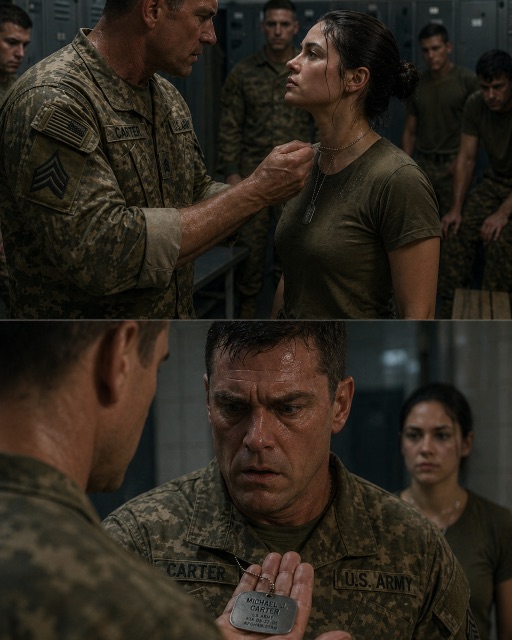
“READ THE TAG. NOTHING IN THAT LOCKER ROOM WAS WHAT IT SEEMED.
“Take it off.”
The words hit the metal like a slap. Conversations died. A towel thudded to the tile and nobody even blinked.
I stood there in my boots, hair still damp, dog tag warm against my skin.
The Staff Sergeant stepped in close. He didn’t need to yell. His voice felt colder than the floor. “You didn’t earn that name.”
His fingers touched the chain at my collarbone – barely a tug, just enough to make thirty people hold their breath.
I didn’t flinch.
“Go on,” he said. “Take it off.”
So I did. Calm. Slow. The chain slid free with a tiny scrape of metal. I set the tag in his open palm.
He smiled, small and mean. “See? That wasn’t so – ”
“Read it,” I said.
His smile stalled. “What?”
“Read. It.”
A few heads tilted. He glanced down, annoyed, turned the tag over –
—and the color drained from his face like someone pulled a plug.
He froze. The room went dead quiet.
“Everyone out,” he snapped, too fast, too loud. Boots scrambled. Lockers slammed. In ten seconds, it was just us and the hum of the lights.
He didn’t look so tall anymore. “You do not wear that tag.”
“I do tonight.”
His fist tightened around the metal. “Where did you get this?”
“You tell me.”
He opened his hand again. The letters caught the light. He swallowed. “That’s not possible.”
“Interesting word,” I said. “Possible.”
He stared at the engraving like it might burn him. Guilt flickered across his face—real, raw, the kind you can’t bury under rank.
I took one step closer. “Say it out loud, Staff Sergeant.”
He lifted his eyes to mine, finally broke, and said, “Reyes, Halden P.”
The tag looked weirdly small in his hand, like it could vanish if he blinked.
I watched his throat move. “Say the rest.”
He closed his eyes and recited the lines like a prayer he’d avoided for too long. “O positive. Protestant. Fort Moore.”
“You wrote the report,” I said.
He flinched at the word report like it had weight.
“I signed it,” he said. “I didn’t write it alone.”
“I didn’t say you did.”
The lights hummed on a delay, a faint stutter that made my skin crawl.
He kept glancing at the door like someone might walk in and save him.
Nobody was coming.
“You weren’t on that roster,” he said. “You weren’t even in the state.”
“I was in a different uniform,” I said. “Civvies. Attending a memorial with my mom.”
He shut his mouth like he’d just tasted metal.
“You want to know how I got it,” I said. “Let’s go step by step so you don’t act surprised again.”
He didn’t move, but his shoulders sagged.
“A package showed up this spring,” I said. “No return address. Just a dog-eared envelope with my name. Inside, this tag and a note that said ‘READ THE TAG.’”
His right hand twitched, a quick spasm he tried to hide.
“I did,” I said. “I read it. I read it a hundred times.”
He exhaled hard, like something inside him had finally cracked.
“The back,” I said softly. “You don’t get to act like you forgot about the back.”
He turned it over with his thumb like he was touching something radioactive.
Numbers scratched into cheap stainless steel glinted under the fluorescent wash.
They were rough and shallow, but you couldn’t miss them if you were looking.
Keating—because I finally said his name in my head—whispered, “Grid.”
“That’s the first honest thing you’ve said tonight,” I said.
He closed his fist around the tag like he wanted to crush it.
He stared at the floor for a long time.
The tile was clean because Specialist Watts was obsessive and hated grime.
I noticed weird things when I was nervous.
“You are not supposed to have that,” he said.
“I’m not supposed to need it,” I said.
He winced like I’d slapped him.
“You think I don’t carry him?” he said, voice low. “You think I sleep right?”
“You at least sleep,” I said. “My mother does not.”
He dragged a hand over his face.
He looked older in that bad light, like the last few years had been rough landings and no real takeoffs.
“We can’t do this here,” he said finally. “Not with walls that talk.”
“Where then,” I said. “Where you don’t run.”
He slipped the tag into his pocket like it belonged to him and I shot out a hand.
He paused.
“Keep it close,” I said. “It’s not a souvenir.”
He nodded, shame hot on his skin.
“Range shed,” he said. “Give me ten to clear a path.”
I didn’t move.
The room still smelled like bleach and wet canvas.
He stepped around me and left without looking back.
I listened to his boots fade down the hall and wondered if I was about to blow up my entire life.
It’s funny how fast you find your line in the sand when someone tells you to move it.
I leaned into a locker and felt the cool metal press into my forehead.
My ribs ached from morning rucks and holding my breath around men who could break me with a shrug.
But right then, I felt steady.
I was done letting other people hold the story by its throat.
I left the locker room and took the long route around the gym to the side door.
The night air tasted like cut grass and old smoke.
It was Fort Moore, which still felt weird to say out loud, like your mouth wasn’t sure.
The range road was a ribbon of dirt that loved to punch holes in your shins.
I knew it better than I knew my own street back home.
The shed sat out by the treeline, a squat rectangle with a broken gutter and a door that stuck if the humidity chewed on it.
I kept my hands out of my pockets and counted my steps to stop thinking.
Headlights cut across the berm and I ducked without meaning to, old instincts talking louder than my brain.
Keating killed the engine and waited a beat before getting out.
He’d changed into a thin jacket and cap like that would erase rank or choices.
His face looked different in the dark.
He looked like a man instead of a machine.
“You came alone,” I said.
He nodded. “Did you?”
I held his eyes and said nothing.
He didn’t push it.
He took a key from his pocket and slid it into the stubborn lock.
It resisted and then gave in with a sigh.
He held the door for me and I stepped into air that remembered oil and sweat and quiet arguments.
The shed was lit by a single bulb that had no business still working as well as it did.
It made the place feel like a confession booth and a broom closet had a kid.
Keating closed the door and leaned his head against the wood for a second.
“You know the story in the file,” he said. “You know what we told the brass.”
“I know the version you were willing to put ink on,” I said. “I also know the version my mother got with her folded flag.”
He flinched like I’d thrown that flag at him.
He took the tag from his pocket and set it on the workbench.
He didn’t look at it.
“Live fire night,” he said. “Weather rolling in but ops saying it’s fine.”
“Ops says a lot,” I said.
He nodded like that hurt too.
“Second squad rotating through,” he said. “Reyes fresh, but not green where it counts.”
“He wasn’t dumb,” I said.
“He wasn’t dumb,” he agreed.
The bulb hummed and a moth banged against it like a drunk in a hurry.
“Lanes needed reflagging,” he said. “We’d had contractors out during the day. Stakes weren’t where they were supposed to be.”
“Should’ve shut it down,” I said.
“I argued it,” he said. “I lost.”
He said the word lost like it came with a price tag.
“Who made the call,” I said.
“Broder,” he said. “First Lieutenant with more ambition than sense.”
I held my face still.
It took effort.
“Reyes made a joke about the moon being a busted headlamp,” he said. “He was trying to cut the tension.”
“That sounds like him,” I said.
Keating’s mouth moved like he wanted to smile and decided he didn’t deserve to.
“We were running a stagger,” he said. “Nothing flamboyant. Dry fire checks, then live. Comms were spotty. Tower was a mess.”
“All of which should have shut it down,” I said.
“I know,” he said.
The moth thudded and fell to the floor, jittered like a broken toy.
Keating rubbed his eyes with two fingers.
“I sent him to pull a snagged target,” he said. “He clipped his line and stepped out, and the wind shoved smoke across the lane like a curtain.”
My heart made a noise inside my chest that I swear both of us heard.
“He had a strobe on,” I said.
“He did,” Keating said. “But the batteries… the cold chewed through them. It went dim, then died.”
Silence pooled around my boots.
“Where were you?” I said, slow.
“At the post,” he said. “Yelling at Broder for five seconds that cost us ten.”
“Cost him,” I said.
Keating’s jaw worked.
“He was in the wrong place when the wrong impact came down,” he said. “Friendly round got flagged from a lane that wasn’t supposed to be hot.”
He didn’t say the word accident.
He didn’t say the other word either.
“We called cease,” he said. “We ran. The dust made everything look like the bottom of a lake.”
“He was breathing,” I said.
He nodded.
“He said your name,” I said.
Keating’s eyes widened like I’d slapped him awake.
“How do you—” he started.
“The med tracker had an audio log,” I said. “You turned it in with the kit.”
He stared at me for a second and then looked away like the wall had something to say.
My throat hurt.
“He asked if you were there,” I said. “He sounded like he wasn’t sure if you were real.”
Keating pressed his hand flat against the bench.
“You think I don’t hear that when my shower’s too hot,” he whispered. “You think I don’t hold that like it owes me money.”
We stood there with our ghosts stacking up between us.
“What does the grid point to,” I said.
Keating blinked.
“The back of the tag,” I said. “You scratched numbers in. I looked them up. They land here.”
He nodded.
“You hid something,” I said.
He nodded again, slower.
He walked to the wall and reached behind an old clipboard that had been hanging there since the last unit painted over the last unit’s paint.
He slid out a thin metal vent cover that didn’t match the screws holding it.
He set it on the bench and put his thumb under the lip of the panel behind it.
A click echoed soft as breath.
The panel swung open.
Inside, wrapped in an oilcloth, sat a plastic binder that did not want the light.
He put it on the table and unrolled it like a relic.
The title page said nothing anyone wanted to say out loud in case the building changed the subject.
Tower Comms and Range Control Log, Night Fire 2305.
My skin felt too small.
Keating didn’t reach for it.
He stared like it could still bite.
“I pulled this after Broder told me to file the streamlined version,” he said. “He said the tapes were corrupted. He said the calls didn’t matter. He said… he said we needed a clean line.”
“You left a dirty one,” I said.
“I left the truth,” he said. “I left it somewhere I could find when my courage grew back.”
I looked at the tag.
“Why scratch it on him,” I said. “Why make his name carry it.”
“I had the tag when I cut his gear off,” he said. “It snagged my glove and I—” He swallowed. “I put it in my pocket and I did not mean to keep it.”
“You meant to send it to us,” I said.
“I meant to,” he said. “But every time I picked up an envelope, my hands shook and I found a reason not to.”
“You sent it,” I said.
He shook his head.
“I told Sims where I’d hidden the binder,” he said. “He… he didn’t stay. He left the Army last fall. He called me from an airport and said he couldn’t sleep without knowing I’d do the right thing.”
“Then he found me,” I said.
He nodded.
“You show anyone,” I said.
“No,” he said. “I kept thinking I had time.”
“You don’t,” I said.
The moth got tired of dying and lay still on its back.
I flipped open the binder.
Static hissed on the first page like paper could remember sound.
Transcripts were clean and neat, typed by someone who had the patience to organize panic.
I found the line with the range change and the tower override.
I found Broder’s initials by the authorization.
I found Keating’s voice asking for a hold.
I found Range Control stamping green when it should have screamed red.
I found the minute where they lost his strobe and someone said, “We’re good, run it.”
I found the half-second that split my life into before and after.
I let out a breath I didn’t know I’d been swallowing for three years.
Keating stood there like a man on a cliff with the wind pushing hard at his back.
“We take this in,” I said.
He closed his eyes and nodded like the word take meant climb.
“You’ll burn with it,” I warned.
“I should,” he said.
I looked at him for a long beat.
“You’ll tell my mother,” I said.
He swallowed.
“I will,” he said. “If she’ll let me in the room.”
“She will,” I said. “She’ll let you, not because you deserve it, but because she deserves the truth.”
He bowed his head.
He looked like a boy trying to slip back into a skin that didn’t itch.
We wrapped the binder again and he slid it under his jacket.
He put the tag back into my hand.
The metal felt different after all those words.
I closed my fingers around it and felt the numbers press crescents into my palm.
We stepped out into the night and it smelled like rain pretending to be far away.
The road back felt longer.
Keating drove at the speed of no more lies.
He dropped me at the barracks and said he’d be at the IG office at 0700.
I told him I’d be there before coffee.
He nodded and drove off without any music or excuse.
I lay in my bunk and stared at a ceiling that never learned anything new.
I listened to other people breathe and thought about the first time I saw my brother tie his boots.
He taught me a surgeon’s knot when I was eight and swore it would save me from bad days.
It felt like that now.
A knot strong enough to hold grief without letting it drag me under.
At 0645 I stood outside the IG building with the binder in my arms.
Keating walked up slow, like walking himself to a gallows he’d built.
He didn’t ask me if this was what I wanted.
I didn’t ask him if he was scared.
We went inside and sat across from a major whose hair looked like it had made peace with the day long before he had.
He didn’t say much when we put the binder on the table.
He just opened it and started to read.
The room got quiet except for paper moving.
Keating spoke first.
He didn’t explain or dress it up.
He said what we did and why it was wrong.
He said Broder by name.
He said his own name, then he said it again like he was writing it for the first time.
The major asked questions that didn’t want to be asked but needed to be.
He didn’t let Keating use words like bad luck or mix-up.
He said negligence and he said cover.
I sat and watched two men who’d spent years being told to be tough try to learn a new kind of strong.
By lunch, the binder was logged as evidence and the ball had started to roll like it had been waiting at the top of a hill.
They told us to go home and not talk to anyone but the legal team.
We walked out into sunlight that felt hostile and clean.
Keating looked like he wanted a cigarette and a time machine.
I didn’t put a hand on his shoulder.
I wasn’t there to comfort him.
But I also wasn’t there to destroy him.
I went to see my mother that evening.
She lived in a small house that used to echo with laughter that sounded like scraped knees and burnt toast.
She opened the door and her face did all the things a face does when it’s been practicing for this moment for too long.
I took off my cap and put the tag on the table.
She stared at it and then at me.
“He didn’t send it,” I said. “Sims did.”
She nodded once.
“Who’s Sims,” she said.
“The one who couldn’t sleep,” I said.
She picked up the tag and ran her thumb over the numbers on the back.
She wasn’t surprised to find them there.
She’d always been a step ahead when it came to the things that cracked you open.
“Are you okay,” she said.
“No,” I said. “But I’m not drowning.”
She smiled a little.
She asked if I wanted tea and I did even though tea never made sense to me.
We sat at the old table where we used to build school projects the night before they were due.
She listened when I told her about the binder and the lies and the way the truth had waited like a patient dog at the door.
She didn’t cry.
She took it in the way she took everything in, square on and without flinching.
“Will he come,” she asked.
“Tomorrow,” I said. “If you let him.”
She looked at the tag again.
“I want him to look at the picture on the mantle,” she said. “I want him to say his name in this house.”
“He will,” I said.
She put water in a pot like it was a ritual that kept the world honest.
I sat there with my hands around a mug and felt something loosen in my chest.
Not forgiveness exactly.
But space.
It was enough for now.
The next day, Keating showed up at our door in a shirt that had learned not to wrinkle.
He held his cap like it held him together.
He looked like he had shaved twice just to have something to do with his hands.
My mother let him in.
He stood in the living room and faced the mantle like it was a superior officer.
He looked at the photo we’d all memorized.
My brother in a dress uniform he never wore long enough to find the jokes in.
Keating cleared his throat.
“Halden,” he said.
His voice broke in the middle and found its way back.
My mother nodded like she’d been waiting for a sound to match the shape of the loss.
He told the truth.
He didn’t rush it and he didn’t try to sell it.
He said he was sorry a hundred times and none of them sounded the same.
My mother stood there with her hands folded and then she opened them.
She didn’t touch him.
She forgave the part of him that wanted to be better and left the part that wasn’t to answer for itself.
When he left, he looked lighter and older all at once.
The investigation did what investigations do when they have momentum and the right eyes on them.
Broder fought it.
He hired a lawyer who used words like career and judgment.
He said the weather was outside the scope of human control.
He said everyone did their best.
The log and the tower tapes said otherwise.
People who’d been quiet got called in and the quiet slipped.
Range Control admitted they’d greenlit to keep schedule.
The colonel who wanted a photo call that morning found himself in front of a board with colder coffee than pride.
Keating offered to step down before they told him to.
He lost his stripes and got a reprimand that would live on paper longer than it would live in his skin.
But he didn’t hide this time.
He read a statement at the review board and then he read it again to the families.
The day he spoke at the memorial was hot and windy and everything tried to blow away.
He anchored his notes with a rock he found by the path.
He didn’t talk about himself.
He talked about us and them and how hard it is to tell the truth when the truth can burn you clean.
When he finished, my mother stood and shook his hand.
Then she hugged him like he was a person and not a rank.
I watched the faces in the crowd change shape when they saw that.
They saw that a thing can be complicated and still be right.
Sims flew in a week later to sit on our porch with beer that sweated all over the railing.
He had a new job and eyes that lost the tremor.
He told stories about Halden that made us laugh so hard it felt illicit.
He told one I hadn’t heard.
Halden had kept a notebook of things he didn’t want to forget.
He wrote down names of kids at the youth center where he volunteered before he shipped out.
He had planned to send postcards to all of them from the base.
The notebook had been in his barracks room and someone had mailed it with his things.
I found it in a box and read his handwriting like it could still startle me.
It did.
He had written down mine, like he thought someday he might forget me if he didn’t remind himself, and the idea was ridiculous and tender and it broke me clean open in a way I didn’t hate.
I kept wearing a uniform.
People asked me why.
They thought I would run from the place that broke my family and I couldn’t blame them.
But I wasn’t in it for revenge.
I was in it because I wanted to fix whatever parts of the machine I could reach.
I found myself in rooms with fresh faces and tired instructors and I told this story without naming names when it felt like it would help more than it would hurt.
I told them about a tag with numbers on the back.
I told them about a choice that felt small because the wind was loud and the clock was mean.
I told them about the way a lie can look like a bridge until you start to cross it and it turns into a lake.
People listened.
Some rolled their eyes and later they didn’t.
The shed panel got fixed and the range procedures got rewritten and the tower got a redundant radio and three power sources instead of one.
Those changes didn’t bring anyone back.
They bought a little peace for the people who would come after.
At night, I still heard my brother sometimes.
Not like ghosts.
More like memory working out in the dark.
He sounded like the day we learned to ride bikes, breathless and bossy and alive.
Sometimes I’d wake up with my heart doing drumline practice and I’d put the tag on and sit by the window till the sky got bored with being black.
I didn’t wear it to claim anything anymore.
I wore it to remind myself that truth can be scratched in messy on the back of something and still point you where you need to go.
Years later, they held a small ceremony at the base.
They added a name to a brick and a sentence to a plaque.
It wasn’t a big thing.
It was the right size.
Keating came, older and less stiff in his bones.
He had a job training kids how to listen to bad weather.
He kept the first row open for families.
When my mother walked in, he stood up without someone telling him to and stayed up until she sat.
You learn what matters when nobody is looking.
After, we walked the path behind the field.
A few kids ran by with sticks like they were flagpoles.
It made me smile and want to sit down at the same time.
Keating stopped under a pine tree and took something from his pocket.
It was a tag.
Not Halden’s.
His.
He’d scratched numbers on the back.
Not coordinates.
A phone number to a counselor and the words Call First.
He pressed it into my palm the way I had once pressed the truth into his.
“Insurance,” he said, a little embarrassed.
I turned it over and then back again.
“You planning on jumping the gun again,” I said.
“Trying not to,” he said.
We laughed, soft and useless and right.
On the drive home, my mother fell asleep in the passenger seat with her mouth open a tiny bit like a kid.
Her hand rested on the tag in her lap.
She didn’t clutch it like a lifeline.
She held it like a photograph that finally made sense.
When we got home, we made dinner with too much garlic and burned the bread and ate it anyway.
We put the tag back on the little stand on the mantle.
I kissed my palm and pressed it to the cold metal and felt warmth anyway.
People think closure is a door that bangs shut and leaves you in a quiet house.
It isn’t.
It’s more like a window you remember how to open when the room gets too hot.
It’s a tag you read until the letters stop hurting and start teaching.
It’s a man who thought carrying guilt was the same as telling the truth learning that it isn’t.
It’s a kid who thought anger was the only thing keeping him upright realizing he can put it down and still stand.
If there’s a lesson here, it’s simple.
Do not confuse silence for honor.
Do not let a clock or a rank talk you into forgetting your own name.
And when you’re given a thing that points you toward what’s right, even if it’s scratched in crooked and hard to read, follow it.
It will cost you.
It will give you back more than it takes.



