
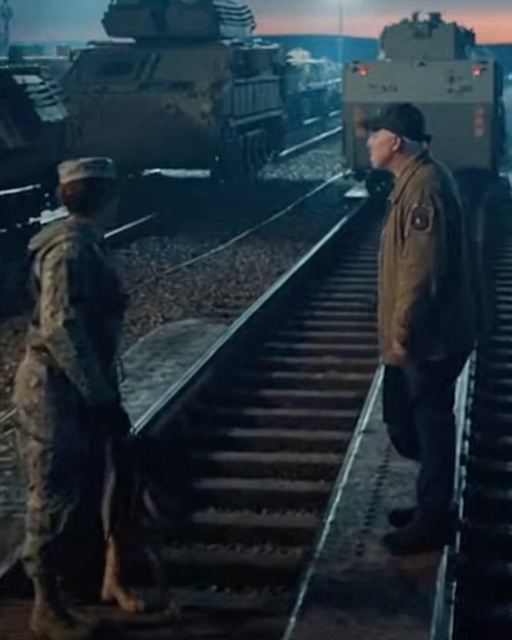
The Army railhead was chaos before dawn. Diesel smoke, clanging flatcars, and shouting ground guides.
I was watching from the inspection platform while a military working dog team swept the lanes for a routine drill.
Then, the German Shepherd broke pattern.
He jerked hard left, nearly ripping the leash from his handler’s grip, and bolted toward an abandoned loading spur no one had used in thirty years.
My stomach dropped. I’m a retired transportation sergeant. I know exactly what’s under that spur.
I jumped off the platform and sprinted after them. By the time I reached the rusted tracks, the dog was clawing frantically at the gravel beside a cracked concrete block. It wasn’t random digging. It was a focused, trained alert.
Soldiers rushed over with shovels. I couldn’t stop them without raising suspicion.
They pulled back the rocks until a rusted steel hatch appeared beneath the ties. With a loud screech, they yanked it open.
Inside was a narrow vault holding a sealed ledger box, a freight tag, and a rolled-up K-9 lead.
The handler, a young kid named Craig, frowned. “Why bury a dog leash in a rail vault?”
My mouth went completely dry. I knew why.
Years ago, a highly classified shipment was rerouted to this exact spot under blackout paperwork. The vehicle count didn’t match the manifest, and the brass just swept it under the rug.
Craig pried the old ledger box open. Inside sat a faded train loading manifest and a handwritten note clipped to the front page.
“The cargo was switched,” Craig whispered, reading the jagged handwriting.
My heart hammered against my ribs. I looked past his shoulder at the signature at the bottom of the page. My legs almost gave out. Because the man who signed off on that missing cargo wasn’t just my old commanding officer. It was my father.
Sergeant Major Elias Price. A man whose name was synonymous with integrity. A legend in the Transportation Corps.
And now, a thirty-year-old secret, buried under gravel and rust, was accusing him of something unthinkable.
Craig looked up at me, his face pale. “Sir? You okay?”
I couldn’t form words. I just nodded, a slow, jerky motion that felt disconnected from my body. My father had passed away five years ago, his funeral attended by generals and privates alike. They all told the same stories, of a man so by-the-book his veins must have run with regulation ink.
This note, this hidden box, it was a ghost from a past I never knew.
The commotion had drawn the attention of the new base commander, Colonel Matthews. He was a sharp, ambitious officer who saw everything in black and white.
He strode over, his boots crunching on the gravel, his eyes already assessing the situation like a tactical problem.
“What is all this, Sergeant?” he asked Craig, his voice cutting through the morning air.
Craig handed him the ledger. “We found this, sir. Buried.”
Matthews took the book, his gaze falling on the note and then the signature. He looked from the page to me, his expression hardening. He knew my last name. He knew who I was.
“Price,” he said, the name hanging in the air like an accusation. “This is your father’s signature.”
“Yes, sir,” I managed to say, my voice raspy.
I tried to regain my footing, to think like the sergeant I used to be. “It’s probably just an old training capsule, sir. They used to bury things for K-9 units to find.”
It was a weak explanation, and we both knew it.
Matthews wasn’t buying it for a second. He flipped through the manifest inside. His jaw tightened. “This manifest lists a classified armored personnel carrier. A carrier that was reported as ‘lost in transit’ thirty years ago. An incident that was never resolved.”
He looked at me, his eyes cold. “This is not a training capsule, Mr. Price. This is evidence in a felony investigation.”
He ordered the Military Police to secure the area. The box and its contents were confiscated. I was told, in no uncertain terms, to go home and not to interfere.
I drove home in a daze. The world outside my truck window seemed fuzzy, unreal. My father, a thief? A man who grounded me for a month for “borrowing” five dollars from my mom’s purse without asking? It didn’t make sense.
At home, I went straight to the attic. I pulled down a dusty footlocker stenciled with his name. Inside were his old uniforms, his medals, and stacks of photo albums and letters.
I spent hours sifting through the memories, searching for a clue, for anything that could explain this. I remembered that time period well. I was a teenager. My father had been different then. Quieter. He’d come home late, smelling of diesel and stress, his eyes holding a distance I couldn’t cross.
My mother said it was just pressure from a big deployment. Now, I wondered if it was the weight of a crime.
Then I found it. A faded photograph tucked into the back of an album. It showed my father, younger and leaner, standing beside another soldier. Between them sat a proud German Shepherd, the spitting image of Caesar, the dog who started all this.
I flipped the photo over. Scrawled in my father’s neat handwriting were the words: “Price & Miller, with Rex. The best partner a man could ask for.”
Miller. I remembered that name. He was my father’s K-9 handler buddy. They were inseparable on base.
My eyes darted back to the items from the vault. The ledger, the note, the freight tag… and the dog leash. It wasn’t just any leash. It was an old-issue K-9 lead. Rex’s lead.
My father hadn’t buried a random clue. He’d buried a message. A message meant for someone who understood loyalty.
I spent the next two days calling in every favor I had left from my time in service. I tracked down old rosters and service records. It wasn’t easy, but I finally found him. Sergeant Frank Miller, retired. Living a quiet life, running a small animal rescue two states away.
I didn’t call ahead. This was a conversation that had to happen face to face.
The drive was long, giving me too much time to think. What if Miller confirmed my worst fears? What if he told me my father was a common crook who stole government property?
I found his place at the end of a long gravel road. It was a modest farmhouse with a series of clean, well-kept dog runs out back. Dogs of all shapes and sizes started barking as my truck pulled up.
An old man with a weathered face and kind eyes stepped out onto the porch. He moved with a slight limp, but his posture was still ramrod straight.
“Can I help you?” he asked, his voice a low rumble.
“Sergeant Miller?” I asked.
He narrowed his eyes. “Who’s asking?”
I pulled the photograph from my jacket pocket and held it out. “My name is Arthur Price. Elias Price was my father.”
Miller’s face went slack. He stared at the picture, then at me, and a lifetime of emotions seemed to cross his face in an instant. Sadness, recognition, and a deep, guarded fear.
“You’d better come inside, son,” he said softly.
We sat at his small kitchen table, a pot of coffee brewing between us. I told him everything. The dog, the vault, the ledger, and the shadow it cast over my father’s name.
When I finished, he was silent for a long time, just staring into his coffee cup.
“Your father was the best man I ever knew,” he finally said, his voice thick. “He wasn’t a thief. He was a hero.”
Then, he told me the real story.
Thirty years ago, they weren’t just moving an armored personnel carrier. That was the cover. Inside that vehicle was human cargo.
A brilliant scientist from an Eastern Bloc country who had decided to defect, bringing his entire family’s research with him. And his six-year-old daughter.
“They were supposed to be on a secure transport,” Miller explained, his voice low. “But your father got a tip, a last-minute whisper from an old contact. The convoy was compromised. An assassination team was waiting for them at the next checkpoint. It was a setup from the inside.”
They had no time. They couldn’t trust the chain of command, because they didn’t know how high the leak went.
“Your father had about five minutes to make a choice,” Miller continued. “Follow orders and send that family to their deaths, or break every rule in the book.”
Sergeant Major Price made his choice.
He used the chaos of the early morning rail loadout to stage a diversion. He had Miller and his dog, Rex, create a false alert at the far end of the yard, drawing everyone’s attention.
In that brief window, my father falsified the manifest, marking the carrier as never having been loaded. He personally drove it off the flatcar and hid it behind an old warehouse.
Under the cover of darkness, he and Miller helped the scientist and his little girl into a waiting civilian car, driven by a trusted friend from outside the military. They gave them all the cash they had in their pockets and a map.
“The note he left, ‘The cargo was switched,’ it was the truth,” Miller said. “He switched a piece of machinery for two human lives.”
He buried the box as an insurance policy. If anyone ever looked too closely, if he was ever formally charged, the ledger and the tag would be the start of a breadcrumb trail to prove what he did. Rex’s leash was a symbol. A promise.
“A K-9’s loyalty is absolute,” Miller said, looking at me. “That’s what the leash meant. It was a symbol of his loyalty not to the paperwork, but to the people he was sworn to protect.”
I felt a wave of relief so powerful it almost brought me to my knees. My father wasn’t a criminal. He was everything I’d always believed him to be.
“And the dog?” I asked. “Caesar. Why did he find it now?”
Miller smiled for the first time. “Rex was Caesar’s great-grandfather. We train these dogs, but some things… some things are in the blood. The scent of that old leather, maybe a lingering scent of your father or Rex himself. Who knows. Maybe some dogs just know when it’s time for the truth to come out.”
We had to clear his name.
Miller agreed to come back with me. We went straight to Colonel Matthews’s office. He was skeptical, his arms crossed as we laid out the incredible story. It sounded like something from a spy movie.
“It’s a fantastic story, Mr. Price,” Matthews said, his tone flat. “But without proof, it’s just that. A story.”
That’s when Miller pulled a small, worn address book from his pocket. “Elias gave me a contact number for the family. For an emergency. I never used it. Never knew if they even made it.”
With a deep breath, he read the number aloud.
Colonel Matthews stared at him, then at me. He picked up his phone and made a call to a number I didn’t recognize, somewhere high up in the intelligence community. He spoke in low, coded phrases, reading off the name of the scientist and the old phone number.
We waited in tense silence for almost an hour. Finally, the Colonel’s secure line rang. He listened, his expression slowly changing from suspicion to disbelief, and then to outright awe.
He hung up the phone and looked at us.
“Everything you said… it’s true,” he said, shaking his head. “The scientist, Dr. Aris Thorne, and his daughter made it. He’s been living in the United States under a new identity for three decades. His contributions to defense technology have been… substantial.”
The official report had listed them as “compromised and eliminated.” My father’s silent act of rebellion had been written off as a failed mission.
A week later, a small, private ceremony was held on that same abandoned loading spur. Colonel Matthews was there. Miller was there. I was there.
Two other people came as well. An elderly man with sharp, intelligent eyes, and a woman in her late thirties with a kind, warm smile.
Dr. Thorne and his daughter, Anya.
Anya, now a successful surgeon, walked up to me, her eyes filled with tears.
“Your father,” she said, her voice choked with emotion, “I don’t remember much from that night. But I remember his hands. They were strong and steady. He lifted me into the car and told me to be brave. He saved my life.”
Dr. Thorne gripped my shoulder. “Your father broke the rules, and in doing so, he upheld the highest honor of his uniform. The world is a better place because he was a good man.”
Colonel Matthews presented me with a medal, the Distinguished Service Cross, awarded posthumously to Sergeant Major Elias Price. He cleared his throat, trying to maintain his military bearing.
“True integrity isn’t always found in the regulations,” he said. “Sometimes, it’s found in the difficult choices a good soldier makes when no one is watching.”
I stood there by the rusted tracks, holding the medal that finally told the true story of my father. I looked over at Craig and Caesar, who was sitting patiently, watching us all. A dog’s loyalty had started this, and a man’s loyalty had finished it.
I finally understood. Our legacies aren’t just the stories people tell about us; they’re the quiet ripples of our actions that continue to spread long after we’re gone. My father didn’t just move cargo or follow orders. He saved a family, protected a future, and left behind a lesson in honor that took thirty years, and one very good dog, to bring into the light.



