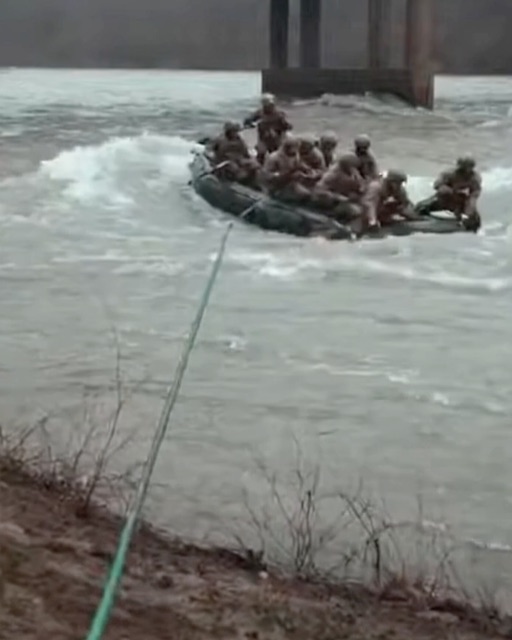
The current was brutal. When the guide line snapped, my heart pounded against my ribs. Three of my guys nearly went under.
Our raft had spun completely broadside in the white water. I hit the muddy riverbank at a dead sprint with Sgt. Wayne, screaming for the squad to anchor low. We hauled on the backup rope with everything we had, fighting the drift before the raft could shatter against the concrete bridge pilings.
We got them in. Everyone was soaked, shivering, and coughing up river water.
But as I was inspecting the snapped line, my blood ran cold.
Lodged deep inside the frayed knot was a sealed orange engineer tag. I ripped it open. Inside was a waterproof card that read: Primary line replaced. No entry logged.
Sgt. Wayne looked over my shoulder and completely froze.
The inspection initials at the bottom of the card were his own.
“Sir,” he whispered, his face turning ash-gray. “I never signed that. That’s not my handwriting.”
Someone had deliberately swapped our line with a faulty one and forged his signature to make it look like a fatal oversight.
Before I could even process the sabotage, Specialist Seth started screaming from the far bank. He was frantically pointing at the dark shadows underneath the bridge support.
There was another rope already tied there. Old, faded, Army green.
I waded into the freezing water to pull it up, but my stomach dropped when I saw what was tied to the other end…
It was a standard issue duffel bag, but it felt impossibly heavy. It was weighed down with something solid, something that had no business being at the bottom of a river.
Wayne helped me drag it onto the bank. The thing must have weighed a hundred pounds. Mud and river slime coated the canvas.
We unzipped it. Inside, nestled among neatly folded uniforms, were three large bricks. They were there for one reason: to make sure this bag never surfaced.
But beneath the uniforms was something else. A hard-sided Pelican case, locked tight.
This wasn’t an accident. This was a drop point. Or a burial.
My mind raced. The faulty rope, the forged signature, the hidden bag. It was a setup. But for what? To kill us? Or to stop us from being here?
I looked at my men. They were cold and scared, but they were soldiers. They were looking to me.
“Alright, listen up,” I said, my voice cutting through the shiver in my own chest. “This exercise is over. We’re heading back to base. Not a word about this to anyone. Understood?”
A chorus of “Yes, sir” met me.
Wayne and I loaded the duffel into our truck. The drive back was silent, the air thick with questions we couldn’t answer. Who in our own unit would do this?
Back in my office, with the door locked, Wayne used a crowbar to pry open the Pelican case. The locks snapped with a loud crack.
We both leaned over. It wasn’t full of money or drugs, like I half-expected.
It was full of military-grade night vision goggles. The newest model. The kind that hadn’t even been fully issued yet. Each one was worth a small fortune on the black market.
There were also shipping manifests. They detailed dozens of similar items, all logged as “damaged” or “lost in transit” over the last six months.
This wasn’t just a disgruntled soldier. This was an organized theft ring operating right under our noses.
Sgt. Wayne traced a finger over one of the manifests. “These are all signed off by the depot quartermaster.”
“The quartermaster can’t move this much gear without help,” I said. “Someone on the inside is helping him.”
And someone in my platoon tried to sink us to keep us away from this spot.
The next few days were the most tense of my career. I had to carry on as normal, leading my men, all while knowing one of them was a traitor.
I watched everyone. Every conversation, every glance felt like a clue.
My first suspect was Private Evans. He was a hothead with a gambling problem and a known grudge against Wayne. He had the motive.
I called him into my office. He was cocky, defensive. He denied everything, but his hands were shaking. He was guilty of something, but I wasn’t sure it was this.
Then there was Specialist Seth. The one who spotted the second rope. Was it a lucky break, or did he know it was there? He was jumpy and eager to please, almost too helpful in the aftermath.
But my gut kept pulling me in another direction.
It pulled me towards Corporal Dunn. He was the quietest man in the platoon. Never caused trouble, always did his job. He was practically invisible.
During our next gear inspection, I saw it. A faint, reddish rope burn on the inside of his left wrist, almost faded. The kind you’d get from pulling a heavy, wet rope without gloves in a hurry.
The kind you’d get setting up a hidden line under a bridge in the dark.
I waited until the barracks were empty that night and found Dunn by his bunk, meticulously cleaning his rifle.
“We need to talk, Corporal,” I said, keeping my voice low.
He didn’t look up, just kept cleaning. “Sir.”
“I found the bag, Dunn. I know someone in this platoon is involved.”
His hands stopped moving. He finally raised his head, and his eyes were full of a weariness that went beyond the field.
“It wasn’t supposed to happen like that, sir,” he said, his voice barely a whisper.
“What wasn’t?”
“The snap. The rope was old, yeah. I knew it would fray under strain. I thought it would just… give way. Make us call off the exercise. I checked the weather. The current wasn’t supposed to be that strong.”
He looked me straight in the eye. “I never wanted anyone to get hurt, sir. I was trying to protect them.”
“Protect them from what? By almost drowning them?” I asked, my voice tight with anger and confusion.
“From them,” he said. “They were planning a drop. Right under that bridge. They told me the platoon’s training schedule had to be cleared for that day. No witnesses.”
My blood ran cold. “Who is ‘they’?”
“The contractors,” he said. “The ones who work with the quartermaster. They’ve been using that river to move stolen gear for months.”
He finally broke. The story came pouring out of him. His younger sister had gotten sick. The medical bills were crushing his family. A civilian contractor he knew from the motor pool offered him money. A lot of money.
First, it was small things. Looking the other way when a crate was loaded onto the wrong truck. Leaving a warehouse door unlocked.
But then they wanted more. They wanted him to be their lookout. They wanted him to manipulate training schedules.
“They have pictures, sir,” Dunn whispered, his face pale. “Pictures of my sister. My mom. They said if I didn’t cooperate, if anyone found out, they’d… they’d visit them.”
He wasn’t a traitor. He was a man in a cage.
The sabotage wasn’t an attempt on our lives. It was a desperate, clumsy attempt to save us. He was trying to create a minor, non-lethal “accident” that would get us off the river before the real criminals showed up. He never intended for the current to be so strong, for the situation to get so out of control.
The forged signature was to throw suspicion on Sgt. Wayne, to create enough internal confusion and investigation that it would keep us busy, away from the river.
I sat down on the bunk opposite him. The anger had vanished, replaced by a heavy weight. I was looking at a good soldier who had made a series of bad choices for the right reasons.
“Who are they, Dunn? I want names.”
He gave them to me. The lead contractor, a man named Marcus, and two of his cronies. And the quartermaster.
I had a choice. I could follow the book. I could report Dunn, end his career, and send him to prison. He broke the code.
Or I could use him. I could use his knowledge to take down the entire ring and protect my men from a threat they didn’t even know existed.
I looked at the kid. He wasn’t a criminal. He was one of mine.
“Alright, Corporal,” I said. “Here’s what’s going to happen.”
The next morning, I brought Sgt. Wayne into my office and told him everything. I saw the anger in his eyes when I mentioned the forged signature, but it softened as I explained Dunn’s situation.
“He’s still one of our guys, sir,” Wayne said, his voice firm. “They put him in an impossible spot. What’s the plan?”
Our plan was simple. And dangerous.
We used Dunn to feed false information back to Marcus. Dunn told him that the “accident” had spooked command, and that all river training was suspended for the next two weeks. He said the area around the bridge would be completely deserted.
They scheduled their next drop for three nights later. They were getting greedy, moving a huge shipment of advanced optics and communication gear.
But we weren’t going to be at the base. We were going to be waiting for them.
I handpicked a team of five. Wayne, Seth, and two other steady, reliable soldiers. I didn’t tell them the full story, only that we were running a special operation to intercept smugglers. They trusted me enough not to ask questions.
The night of the drop was cold and moonless. We moved into position on both sides of the riverbank, hidden in the thick brush. Dunn was with me, his face a mask of terror and resolve. He had done his part. Now it was up to us.
Hours passed. The only sound was the rushing water and the chirping of crickets.
Then, we heard it. The low rumble of a truck engine. Headlights cut through the darkness on the access road above the bridge.
Two men got out, Marcus and another contractor. They lowered two large Pelican cases down with a rope, the same way they’d likely dropped the bag Dunn had tried to retrieve. A third man, the quartermaster, stayed with the truck, acting as lookout.
Downstream, a small johnboat with its engine off drifted into view. It was their pickup team.
“Now,” I whispered into my radio.
Flares shot into the sky, bathing the entire scene in a harsh, chemical glare.
“U.S. Army! Don’t move!” I yelled, stepping out of the brush with my rifle raised.
My team emerged from the shadows, a perfect envelope of armed soldiers surrounding them.
For a second, everyone froze. Then chaos erupted.
Marcus pulled a pistol and fired wildly towards the bank. The quartermaster scrambled back towards the truck. The men in the boat started their engine, trying to speed away.
But they weren’t soldiers. They were criminals. They were sloppy.
Wayne’s team intercepted the boat before it got twenty yards. On the bridge, Seth and another man had the quartermaster on the ground before he could even get the truck door open.
Marcus was the only one left. He was cornered, his back to the bridge piling, pistol still in his hand. He saw Dunn standing behind me.
His face twisted in a snarl of betrayal. “You! You little rat!”
He raised his pistol, not at me, but at Dunn.
I didn’t think. I reacted. I fired two rounds into the dirt at Marcus’s feet. The shots echoed like cannon fire in the night.
He flinched, dropping his aim just enough for me to close the distance. I slammed the butt of my rifle into his wrist. The pistol clattered onto the concrete.
It was over.
The military police arrived and took the three men into custody. The stolen gear was recovered. The investigation that followed was massive, exposing a web of corruption that went deeper than any of us imagined.
Dunn cooperated fully. He told them everything, from the very first dollar he took to the night of the “accident.”
He was facing a court-martial and serious time. But I, along with Sgt. Wayne, spoke at his hearing. I told the full story. I explained the threats against his family. I explained how his “sabotage” was a twisted, desperate act to protect his unit. I told them that without him, we never would have uncovered a multi-million dollar theft ring.
The panel listened. They saw what I saw: not a traitor, but a young soldier who got in over his head, trying to do the right thing the wrong way.
He wasn’t exonerated. He couldn’t be. But he wasn’t sent to Leavenworth. He was given a dishonorable discharge and time served. He was free.
I saw him one last time, the day he was processed out. He was in civilian clothes, looking smaller than he did in uniform.
“Sir,” he said, holding out his hand. “Thank you.”
“Take care of your family, Dunn,” I said, shaking it. “That’s all that matters.”
He nodded, a flicker of the old Corporal Dunn returning to his eyes. Then he turned and walked away, a free man.
My platoon was never the same after that day on the river. We had been tested, not by an enemy on a battlefield, but by something from within. It showed us that the lines between right and wrong can sometimes get blurry. It taught us that loyalty isn’t just about following orders. It’s about understanding the person next to you, and sometimes, fighting for them even when they’ve made a mistake.
The real enemy isn’t always the one you can see. Sometimes it’s fear, or desperation. And the greatest victory is not just winning the fight, but saving one of your own.