My hands were still shaking when I walked out of the recruiting office. I had just enlisted.
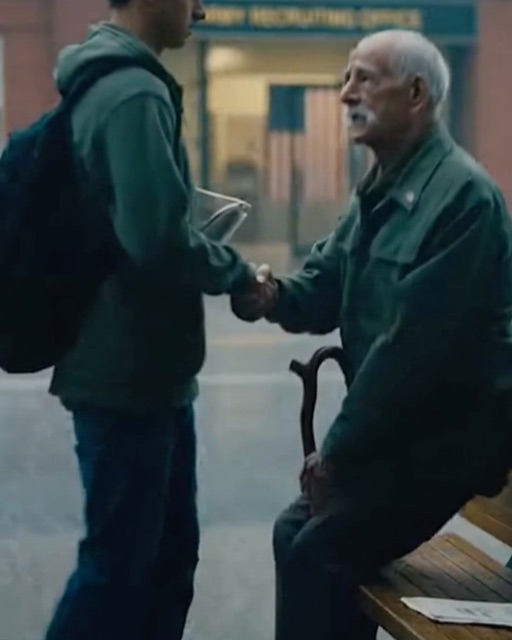
Across the street, an old man sat on a wet bus bench in the drizzle. He had a cane, a folded newspaper, and a faded American flag pin on his jacket. He didn’t look like he was waiting for a bus. He was just watching the office doors.
I crossed the street, chest puffed out, and said, “Sir, I just joined the Army.”
He stood up slowly, leaning heavily on his cane, and offered his hand. His grip was like iron. “Then stand a little taller,” he told me, his voice gravelly. “The flag is expecting things from you now.”
My heart swelled. We sat together for twenty minutes. He didn’t give grand speeches about glory. He just told me that true courage usually means waking up exhausted and doing the right thing anyway.
Then the wind shifted.
A sudden gust blew his folded newspaper off the bench and onto the concrete.
“I got it!” I said, jogging over to grab it.
As I picked it up, a brittle, yellowed envelope slipped out from between the pages and fluttered to the ground. I bent down to retrieve it, but the flap was open, and a single, faded photograph slid out onto the pavement.
My blood ran completely cold. My jaw hit the floor.
It wasn’t a picture of an old war buddy or a military base.
It was a picture of my mother, taken twenty years ago, holding me as a newborn baby. And standing right next to her, wearing his dress uniform, was the man on the bench.
I looked up at him in pure shock, and the old man took a shaky breath and said, “I’ve been waiting a long time to meet you, Daniel.”
The world tilted on its axis. My name. He knew my name.
My own voice was a stranger in my ears. “How… How do you know my name?”
“I was there when your mother chose it,” he said, his eyes glassy with unshed tears. “I’m Arthur.”
The name meant nothing to me. I had never heard it before in my entire life.
I held up the photograph, my fingers trembling so badly the image of my mother’s smiling face blurred. “What is this? Who are you?”
He sank back onto the bench, the strength seeming to drain from his legs. “I’m your father, son.”
The words hit me like a physical blow. I stumbled back a step, the slick pavement nearly sending me to my knees.
“No,” I managed to choke out. “No, you’re not. My father… my father was Mark. He passed away five years ago.”
Arthur nodded slowly, a deep, painful understanding in his eyes. “I know. Mark was a good man. A much better man than me, in many ways.”
“Then you’re lying,” I shot back, the shock curdling into a hot, defensive anger. “This is some kind of sick joke.”
He didn’t get angry. He just looked tired. So incredibly tired. “Your mother’s name is Sarah. She grew up in Oak Creek. Her favorite flower is the sunflower, and she has a tiny scar right above her left eyebrow from when she fell off a swing set at age seven.”
Every detail was a hammer blow of truth. These weren’t things a stranger could know.
“I loved her more than my own life,” Arthur continued, his voice cracking. “And I loved you before I ever met you.”
My mind was a vortex, pulling in twenty years of memories and tearing them apart. The man who raised me, Mark, was my hero. He taught me how to fish, how to drive, how to be a decent person. He was my dad.
This stranger, this ghost from a photograph, couldn’t just show up and claim that title.
“Why?” The word was barely a whisper. “If you’re who you say you are, where have you been for twenty years?”
He looked down at his gnarled hands, resting on the head of his cane. “Serving.”
“I just enlisted,” I said, my voice dripping with accusation. “Don’t give me that. People get leave. People come home.”
“Sometimes they don’t,” he said quietly. “I was deployed two weeks after that photo was taken. Special operations. Deep cover.”
He paused, gathering his thoughts.
“For the first six months, Sarah and I wrote letters every day. Then my assignment changed. We went dark. No communication in or out. It was supposed to be for three months.”
He looked up from his hands, and I could see the raw agony in his eyes, an old wound that had never healed.
“Three months turned into a year. My unit was ambushed. I was captured.”
The air left my lungs.
“I spent three years as a prisoner of war, Daniel. By the time I was liberated, I was a wreck. Malnourished, broken in more ways than I can count. When they finally got me back to a base in Germany, the paperwork was a mess.”
“They had me listed as killed in action,” he said, his voice flat. “They sent a letter to your mother. A folded flag. The whole nine yards.”
I felt sick to my stomach. My mother. She thought he was dead.
“By the time I was healthy enough to travel and straightened out the bureaucratic nightmare, two more years had passed,” he explained. “I came home. I tried to find her.”
“She was gone. The old apartment was empty. Her parents had moved to Florida. I spent months searching. Years, even.”
“I finally found her through an old mutual friend,” Arthur said. “She was married. To Mark. And she had you. You were seven years old, and you called another man ‘Dad’.”
I could picture it. My mom, having mourned and moved on, building a new life. And this man, returning from a living hell to find his world had vanished.
“What was I supposed to do?” he asked, his voice pleading. “Storm in and destroy the life she had built? Uproot the world of a little boy who looked happy and safe? Mark was a good man. I saw them together at a park one day. He was pushing you on a swing. You were laughing.”
The image was so vivid, so painful. I remembered that park. I remembered Mark pushing me on the swings.
“So I did the only thing I thought was right,” Arthur said. “I left you alone. I watched from a distance. I got updates when I could. I saw your school pictures. I read about your football games in the local paper.”
He had been a ghost in my life all along. A silent guardian.
“Then Mark passed away,” he said softly. “And I wanted to come forward. I swear I did. But you were a teenager, grieving the only father you’d ever known. It felt selfish. Cruel, even.”
The anger inside me was gone, replaced by a vast, hollow emptiness. This wasn’t a story of abandonment. It was a story of sacrifice. A different kind of sacrifice than the one I had just signed up for, but a sacrifice nonetheless.
“Why now?” I asked. “What changed?”
He looked across the street at the recruiting office, the same doors I had walked out of with such pride just an hour ago.
“This,” he said, gesturing with his chin. “I’ve been coming here for the last two years. Every single day. I just sit here. I watch the kids go in, full of fire, and come out, full of purpose. I do it because I never got to talk to my own son about what it means to serve.”
My breath hitched. He wasn’t just waiting for me. This was his penance. His quiet mission.
“I told myself that if you ever walked into that office,” he said, his eyes locking onto mine, “that would be my sign. A sign that it was time. That maybe, just maybe, you were ready to understand.”
I didn’t know what to say. The foundation of my world had crumbled, and I was standing in the rubble.
“I have to go,” I mumbled, needing to escape, to breathe, to think. “I have to talk to my mom.”
He nodded, not a hint of pressure in his expression. “I understand. I’ll be right here. Same time, tomorrow.”
The drive home was a silent movie. The world moved outside my windows, but I saw none of it. All I could see was that faded photograph.
I walked into the house and found my mom in the kitchen, humming as she washed vegetables in the sink. The same woman from the picture, just with a few more laugh lines around her eyes.
“Hey, honey! How did it go?” she asked cheerfully, turning around with a smile.
Her smile faltered when she saw my face. “Daniel? What’s wrong? You look like you’ve seen a ghost.”
I couldn’t speak. I just walked forward and handed her the photograph.
She took it, her brow furrowing in confusion. Then her eyes focused. The color drained from her face. She dropped the potato she was holding, and it thudded onto the linoleum floor. Her hand flew to her mouth, and a choked sob escaped.
“Where,” she whispered, her voice trembling. “Where did you get this?”
“From him,” I said, my own voice unsteady. “I met him today. His name is Arthur.”
She sank into a kitchen chair, her knuckles white as she gripped the photograph. The story came pouring out of her then, between sobs and shaky breaths. It was the same story Arthur had told, but filled with the color of her own heartbreak. The whirlwind romance with the handsome, brave soldier. The promise of a future together.
She told me about the letters, how she lived for them. Then how they stopped. The agonizing silence. The visit from the two officers in dress uniform. The crushing finality of the word “deceased”.
“I thought he was gone, Daniel,” she wept. “I mourned him for two years. I never thought I would love again. Then I met Mark. He was so kind, so patient. He knew all about Arthur. He helped me heal. He loved you as if you were his own flesh and blood.”
“He knew?” I asked, stunned.
“Mark knew everything,” she confirmed. “He knew that if Arthur had lived, I would have been with him. He accepted it. He accepted all of it, because he loved us.”
The weight of it all was crushing. The love, the loss, the secrets kept not out of malice, but out of a fierce, protective love.
The next day, I went back to the bus bench. Arthur was there, just as he’d promised.
We didn’t talk about the past. Not at first.
I told him about my plans. Basic training in three weeks. He told me what to expect, not the official version, but the real one. He told me how to take care of my feet, how to deal with a tough drill sergeant, how to find the quiet moments of peace even in the chaos.
We met every day for the next three weeks.
He told me stories of his time in the service, not the ones of battle and horror, but the ones of brotherhood. Of the pranks they pulled, the terrible food they ate, the unbreakable bonds they forged. He was trying to give me a twenty-year crash course in being a father.
And I was listening. I was soaking it all in.
I learned that the cane wasn’t just for show. His leg was badly damaged from his time as a POW. I learned that the gravel in his voice came from an injury to his throat. He carried his service with him every single day, in every single step.
One afternoon, I asked him the question that had been burning in my mind.
“Why the Army?” I asked. “After everything it took from you, how can you still wear that pin with pride? How can you watch me follow you down that same path?”
He was silent for a long moment, watching the young men and women walking in and out of the recruiting office.
“The Army didn’t take anything from me that I hadn’t already agreed to give,” he said finally. “I signed a contract. I gave my word. It took my health, it took years of my life, and it took your mother. But it also gave me a purpose. It gave me a code to live by. Honor. Integrity. Selfless service.”
He turned to me, his gaze clear and steady. “I don’t regret my service. My only regret is that I wasn’t there to teach you those things myself. But Mark did. And now, you’ve chosen this path on your own. That’s not my legacy. That’s yours. And I have never been more proud.”
The day before I was due to ship out, my mom came with me to the bench.
She and Arthur just looked at each other for a full minute, a silent conversation passing between them that spanned two decades of pain, loss, and what-ifs. There were no recriminations, only a profound, shared sadness.
“Thank you, Sarah,” Arthur said, his voice thick with emotion. “For raising such a fine young man.”
“You should have seen him at his fifth-grade graduation,” she replied, a watery smile on her face. “He was so proud.”
They were sharing me. Bridging the gap of all those lost years.
Before I left, Arthur stood up, and for the first time, he pulled me into a hug. It was awkward at first, two strangers trying to feel like a father and son. But then his arms tightened, and I could feel the strength and the history in his embrace.
“The flag is expecting things from you,” he whispered, his voice raspy in my ear. “But your father is just expecting you to come home safe. Make me that one promise.”
“I promise,” I said, my own voice breaking.
I stood a little taller then. I wasn’t just a new recruit anymore. I was the son of two fathers. One had given me my life and my blood. The other had given me my childhood and my character. Both had taught me, in their own profound ways, what it truly means to sacrifice for something you love.
My life wasn’t the simple story I had always believed it to be. It was a complex tapestry, woven with threads of love, loss, duty, and impossible choices. And my enlistment was no longer just about serving my country; it was about honoring the legacies of the men who had shaped me. The journey ahead was my own, but I would not be walking it alone. I carried their strength with me. And that was the greatest inheritance a son could ever ask for.