
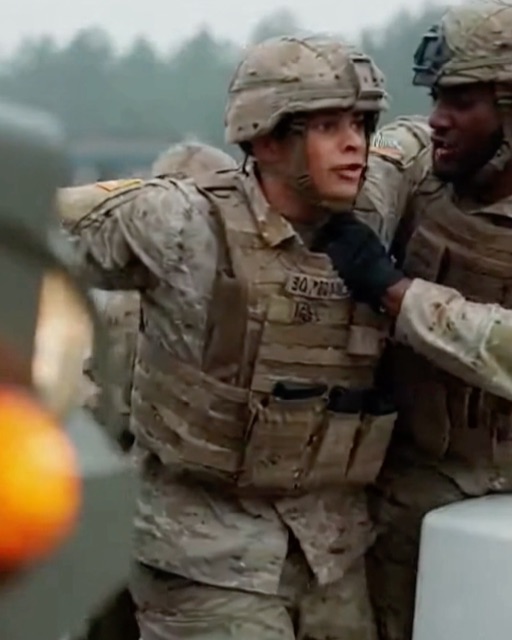
We were knee-deep in a routine training checkpoint, rain turning the gravel to mud. My squad – eight of us on high alert – had the lane locked down: mirrors under chassis, hands on weapons, timers ticking like a bomb.
Then the training truck barreled in. Too fast. Skidding wild on the wet patch, it fishtailed right toward two guys crossing with cones and inspection gear. I could hear the tires screaming, see the barrier buckling.
I didn’t think. Grabbed PFC Ramirez by the collar and yanked him back, shoved Sgt. Ellis behind the Jersey wall. Slapped the hood hard—twice—and bellowed at the driver to cut it.
The team snapped into gear. Flanks covered, rear secured, dismounts frozen. We held the line. No chaos. Just tighter control.
Situation clear, I paced the skid marks. That’s when I spotted it—half-buried in the flung gravel. A sealed plastic sleeve, like something from an old op kit.
I pried it open. Inside: faded checkpoint diagrams, a convoy manifest from years back, and a scribbled note in tight handwriting.
“Vehicle hit here 20 mins early. Not on the log.”
My platoon leader jogged up. “What’s that look like?”
I flipped it over. At the bottom, in faded ink: an ancient code word from battalion lore. Every leader on base knew it by heart—the one tied to that classified breach in ’09.
The driver climbed down then, face pale as the mud. He stared at the card, swallowed hard, and muttered, “That was tucked in the glove box when I signed for this rig this morning. I swear, I never…”
But his eyes darted to the truck cab, and I saw it—a glint of something metallic under the dash that hadn’t been there before.
My PL, Lieutenant Miller, saw where I was looking. He held up a hand, signaling me to stay put.
“Let’s not get ahead of ourselves,” he said, his voice low and steady. He was new, but he was smart.
He walked over to the driver, a young Corporal whose name tag read Sutton. “Son, just stand over here with my sergeant. We’ll sort this out.”
Corporal Sutton looked like a kid who’d just broken his mom’s favorite vase. He nodded, his movements stiff and jerky.
I kept my eyes on the cab, on that tiny spark of reflected light. It wasn’t a standard part of the vehicle. I knew every inch of those trucks.
Miller gave me a slight nod. Permission.
I moved to the passenger side, opened the door, and ducked my head inside. The cab smelled of stale coffee and damp vinyl.
There, wedged between the dashboard and the firewall, was a dog tag on a broken chain.
It was bent, the metal warped as if it had been through hell and back.
I worked it free. The chain fell away, rusty and weak. I held the tag in my palm, rubbing the grime off with my thumb.
The name wasn’t Sutton. It was older, the stamping from a different era.
I read the name aloud. “Sergeant R. Sutton.”
The Corporal flinched like he’d been shot. His eyes locked on the piece of metal in my hand.
He didn’t say a word. He just stood there, rainwater dripping from his helmet, his whole body trembling.
Miller took the tag from me, turning it over in his own gloved fingers. “Any relation?” he asked the driver, his tone carefully neutral.
Sutton just stared at the ground.
The MPs arrived a few minutes later. They handled it by the book, separating Sutton, securing the truck, and cordoning off the area.
It wasn’t a training incident anymore. It was something else entirely.
Later that evening, Miller called me into his cramped office. The plastic sleeve and the dog tag were laid out on his desk like evidence in a courtroom.
“The code word,” he started, tapping the faded note. “Operation North Star. You know the story?”
I knew the barracks version. A checkpoint failure in ’09. An enemy sympathizer slipped through in a supply truck. Two of our guys were killed in an ambush a week later because of the intel that got through.
“The official report blamed human error,” Miller continued, his eyes dark. “Said the NCO in charge of the checkpoint missed the vehicle on the manifest.”
He paused, then pushed the dog tag across the desk toward me. “The NCO in charge was Sergeant Richard Sutton.”
The air went out of the room. “The driver’s father?”
Miller nodded grimly. “Dishonorably discharged. Died of a heart attack two years later. The family was disgraced.”
We both sat in silence for a minute, the hum of the barracks generator filling the space between us.
This wasn’t an accident. It couldn’t be.
The truck coming in too fast, the skid, the conveniently “found” evidence packet. It was all too perfect.
“The driver, Corporal Michael Sutton, has been formally detained,” Miller said. “He’s refusing to talk. They’re looking at charging him with everything from reckless endangerment to sedition.”
Something about it felt wrong. Deeply wrong.
The look in that kid’s eyes wasn’t malice. It was fear. And maybe something else. Desperation.
“Sir,” I said slowly. “That note. ‘Vehicle hit here 20 mins early. Not on the log.’ It sounds like a warning, not a threat.”
Miller leaned back in his chair, rubbing his tired face. “I agree. It’s a breadcrumb. But who dropped it? And why now?”
I picked up the old manifest from the sleeve. The paper was thin and brittle. It was a list of vehicles scheduled to pass through the checkpoint on that day in ’09.
“Can we get the official after-action report from the breach?” I asked.
Miller was already shaking his head. “Classified top to bottom. Sealed. We wouldn’t get clearance in a million years.”
But Corporal Sutton had put this in motion. He wanted something found. He was gambling on us.
The next day, Miller pulled some strings. He got us five minutes with Sutton before he was transferred to a more permanent holding facility.
We met in a sterile interrogation room. Sutton sat at a metal table, his face pale and drawn. He hadn’t slept.
“We know who your father was, Corporal,” Miller began gently.
Sutton didn’t respond. He just stared at the table.
“I don’t think you were trying to hurt anyone yesterday,” I said, leaning forward. “You timed that skid. You knew I was close enough to get Ellis and Ramirez out of the way.”
His eyes flickered up to meet mine. Just for a second. It was all the confirmation I needed.
“You’re taking a big fall for this,” I continued. “If there’s another side to this story, now is the time to tell it.”
He finally spoke, his voice raspy. “My father was a good soldier. He followed every procedure. He didn’t miss anything.”
He swallowed hard, fighting to keep his composure.
“He died trying to prove it. Everyone called him a traitor. A disgrace. Our family lost everything.”
He took a shaky breath. “After he died, I found his old footlocker. It was full of papers. His own private records from his time as a platoon sergeant.”
He explained that his father never trusted the official digital logs. He kept his own handwritten copies of everything. Every manifest, every patrol report, every order.
“He had the original manifest from that day,” Sutton said, his voice gaining strength. “The real one.”
He looked at Miller. “The vehicle that got through wasn’t on it. My father stopped it. He reported it. He was overruled.”
“Overruled by who?” Miller asked, his pen hovering over his notepad.
Sutton’s eyes hardened. “His company commander at the time. A Major who was pushing a new, streamlined checkpoint protocol he designed himself.”
The Major, Sutton told us, didn’t want a delay messing up his efficiency stats. He personally ordered the truck to be waved through, promising to sort the paperwork later.
“That Major falsified the report,” Sutton whispered. “He used a doctored manifest that showed the truck was scheduled to be there. He made it my father’s fault.”
I felt a cold knot tighten in my stomach. I’d seen officers cover their own mistakes before, but nothing like this.
“Who was the Major?” I asked.
Sutton looked me dead in the eye. “His name was Vance. Colonel Vance. Our new base commander.”
The silence in the room was deafening. We were accusing one of the most powerful men on post of a crime that led to the deaths of two soldiers.
Sutton knew he couldn’t go through the chain of command. Vance would crush him. So he created a puzzle he hoped someone honest would solve.
He used his father’s old notes to reconstruct the scene, a high-stakes piece of theater designed to make us look closer. He put his entire career, his entire life, on the line.
“The plastic sleeve,” I pieced it together. “That was from your father’s locker.”
Sutton nodded. “Everything was in there. The note he wrote that day. The flawed diagrams for the protocol Vance designed. The original manifest. He kept it all, hoping one day he could clear his name.”
Miller and I left the room with a choice to make.
We could follow orders, turn in our report, and let Corporal Sutton be court-martialed. It was the safe play.
Or we could do the right thing.
We took the evidence straight to the one person on base who outranked Vance: the Commanding General.
It was the biggest risk of my career. Miller’s too.
We laid it all out on the General’s mahogany desk. The faded note. The two manifests—the fake one from the official report and the real one from a dead sergeant’s footlocker.
We told him the whole story. The kid in the truck, the father who died in shame, the Colonel who built a career on a lie.
The General, a man with three stars on his collar and eyes that had seen everything, listened without interruption.
When we were finished, he picked up the two manifests, holding them side by side. One was a clean, typed document. The other was dog-eared, with Sergeant Sutton’s handwritten notes in the margins.
And at the bottom of the original, next to the entry for the unscheduled truck, was a clear, undeniable signature authorizing its passage.
Major G. Vance.
Colonel Vance was summoned. He walked in confident, smiling, until he saw what was on the desk.
The color drained from his face. He blustered and denied, but the evidence was absolute. The original paperwork, preserved by a wronged man, was his undoing.
An investigation was launched. A quiet, internal one at first, but the truth has a way of making noise.
Colonel Vance was relieved of his command. He was allowed to retire to avoid a larger scandal, but his career was over, his legacy destroyed.
Sergeant Richard Sutton’s case was reopened. His name was posthumously cleared, and his rank and honors were fully restored. A letter of formal apology was sent to his family.
And Corporal Michael Sutton? He faced a Captain’s Mast for what he did. He broke the rules, no question.
But the board took into account the extraordinary circumstances. His sentence was a reduction in rank and 30 days of extra duty. He wasn’t kicked out. The Army gave him a second chance.
I saw him a few months later, back in his regular uniform, just a Private First Class now. He was walking with his head held high.
He saw me and gave me a nod. A nod of thanks.
I nodded back.
It all started with a training accident that wasn’t an accident. With a skid on a wet road and a glint of metal in the mud.
It reminded me that leadership is more than just shouting orders and running drills. It’s about seeing the person, not just the uniform. It’s about having the courage to dig for the truth, even when it’s buried under years of dirt and lies.
Sometimes the most important battles we fight aren’t on some foreign field. They’re for the soldier standing right next to us. And for the honor of those who came before.



