
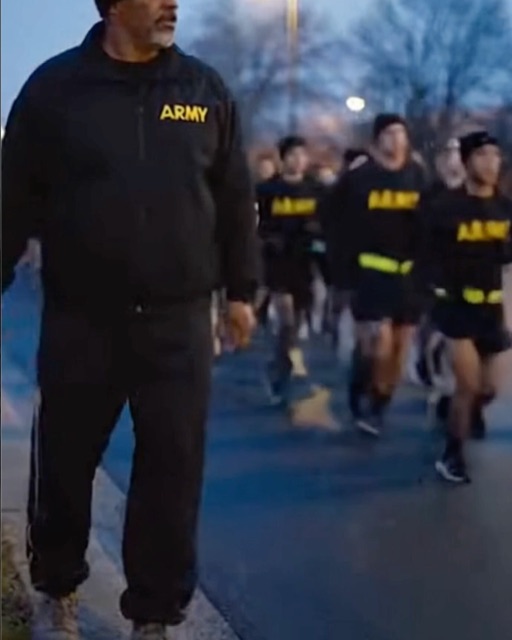
I hadn’t run in a military formation since I retired ten years ago. But when I visited my old battalion for an alumni week, I couldn’t resist stepping off the curb into the cold morning air.
Halfway through the five-mile route, a young private named Travis started fading hard. His breathing went ragged, and he began drifting toward the rear, looking terrified.
My instincts kicked in. I dropped back and matched his stride.
“Eyes up,” I ordered, my old command voice taking over. “Shoulders back. Stay with the Army.”
He tried to nod, but his eyes rolled back.
Travis collapsed onto the hard asphalt. My heart pounded as I dropped to my knees, ripping his collar open to clear his airway and check his pulse.
That’s when his dog tags spilled out into my hands.
Tucked behind the standard-issue metal was a small, custom-engraved silver locket. I recognized the scratches on the back instantly. I had a jeweler make it twenty-two years ago.
The clasp had popped open when he hit the ground.
I thought I was just helping a random soldier. But when I looked down at the faded photograph hidden inside the locket, my blood ran completely cold. Because the woman holding a baby in the picture wasn’t a stranger… she was Sarah.
My Sarah.
The world around me seemed to warp and fade. The shouts of the other soldiers, the rumble of the approaching medic’s vehicle, it all became a dull, distant hum.
All I could see was that tiny, worn photograph. Sarah’s smile, the one that could light up a whole room, was aimed at a tiny bundle in her arms.
Medics swarmed in, their voices sharp and professional, pulling me back to the present. They loaded Private Travis onto a stretcher, their movements efficient and practiced.
One of them asked me a question, but I couldn’t hear the words. I just stared at the locket still resting in my palm.
I had given this to Sarah the day before I deployed for a long tour. It was a promise. A promise that I would come back to her and the future we were planning.
She had been so happy, her eyes shining as she clipped it around her neck. “I’ll never take it off,” she’d whispered.
And now, it was here, around the neck of a boy young enough to be… my son. The thought hit me like a physical blow, knocking the wind out of my lungs.
I must have looked a sight, a retired First Sergeant kneeling on the pavement, looking like he’d seen a ghost. The Battalion Commander, a Colonel I barely knew, put a hand on my shoulder.
“First Sergeant Miller, are you alright?” he asked, his voice laced with concern.
I couldn’t form words. I just held up the locket.
He took me to his office while we waited for news from the base hospital. I sat in a stiff chair, the locket now feeling like it weighed a hundred pounds in my hand.
My mind raced back through the years, a chaotic slideshow of memories and pain. I had come back from that deployment ready to propose to Sarah.
But she was gone. Her family had moved, leaving no forwarding address.
Her father, a stern, unforgiving Major General, had met me at their empty house. He told me Sarah had met someone else, that she’d moved on and didn’t want to see me.
He said I was just a distraction from the life she was meant to have. The words were cold, clinical, and they had shattered my world.
I wrote letters, dozens of them, to every address I could find for her relatives. None were ever answered.
Eventually, the pain became a dull ache. I threw myself into my career, making the Army my wife, my family, my everything.
I had built a whole life on the foundation of that heartbreak. And now, that foundation was cracking wide open.
An hour later, a call came from the hospital. Private Travis was stable. Severe dehydration and exhaustion, but he would be fine.
The Colonel gave me a pass to go see him. “He’s one of yours, Marcus,” he said, using my first name. “Go check on your soldier.”
I walked the sterile hallways of the hospital in a daze. My soldier. Was he more than that?
I found his room. He was sitting up in bed, an IV drip in his arm, looking pale but alert.
He saw me in the doorway and his eyes widened slightly. “First Sergeant,” he said, his voice a little hoarse. “Thank you. Back there on the road.”
I walked in and pulled up a chair, my heart hammering against my ribs. I held out the locket.
“This is yours,” I said, my voice steadier than I felt.
He took it gently, his young fingers tracing the edges. “It was my mom’s,” he explained. “She gave it to me when I shipped out for basic. For good luck.”
My throat felt tight. “She’s a beautiful woman,” I managed to say, gesturing to the photo.
A soft smile touched his lips. “Yeah, she is,” he agreed. “She raised me on her own for a few years, until she met my dad. He was a great man. Passed away when I was sixteen.”
So he had a father. The relief and disappointment that washed over me were confusing.
“What about your, uh, your biological father?” I asked, trying to sound casual.
Travis’s smile faded. He shrugged, looking down at the locket in his hands.
“My mom never talks about him. She just says it was a different time, and that things got complicated.”
Complicated. That was one word for it.
“She always said he was a good soldier,” Travis added quietly, almost to himself. “That’s part of why I joined. To be like him, I guess. Whoever he was.”
The words hung in the air between us. Every instinct in my body was screaming. This was my son.
I needed to know for sure. I needed to see Sarah.
I used my old connections in the battalion’s administrative office. It was a breach of protocol, but I didn’t care. I got the address listed on Private Travis’s emergency contact form.
It was for a small town three hours away. A town I’d never heard of.
I drove with the windows down, the cool air doing nothing to calm the storm inside me. What would I say? What if she slammed the door in my face?
What if her father had been telling the truth? What if she really had moved on and Travis was just a painful coincidence?
But I had to know. For twenty-two years, I’d lived with a ghost. Now that ghost had a face, a name, and he was wearing my uniform.
I found the address. It was a small, neat house with a porch swing and a garden full of late-blooming flowers.
My hands were shaking so badly I could barely unbuckle my seatbelt. I walked up the pathway, each step feeling like a mile.
I raised my hand to knock, then hesitated. I took a deep breath, the kind you take before you step out of a helicopter, and knocked on the door.
I heard footsteps, and then the lock turned. The door swung open.
And there she was.
Sarah.
She was older, of course. There were fine lines around her eyes and threads of silver in her hair. But she was just as beautiful as the day I’d last seen her.
Her eyes widened in shock. Her hand flew to her mouth, and a glass she was holding slipped from her fingers, shattering on the wooden floor.
“Marcus?” she whispered, her voice trembling.
“Sarah,” I said. It was all I could manage.
We just stood there for a long moment, staring at each other across a chasm of two decades. The air was thick with unspoken questions and old hurts.
Finally, she spoke again. “What are you doing here? How did you find me?”
“Our son,” I said, the words feeling foreign and powerful on my tongue. “I found our son.”
Her face went pale. She stumbled back a step, leaning against the doorframe for support.
“Travis?” she asked, her voice barely audible. “Is he okay?”
“He’s fine,” I reassured her quickly. “He collapsed on a run. Dehydration. I was there. I saw the locket, Sarah.”
Tears began to stream down her face. She didn’t try to wipe them away.
“You should come in,” she said, her voice choked with emotion.
I stepped inside, into a home that felt warm and lived-in. Photos of Travis at every age adorned the walls. A little boy with a missing tooth, a teenager in a football uniform, a young man in his Army dress blues.
My son. I had missed it all.
We sat at her small kitchen table. The silence was heavy, but it wasn’t angry. It was just sad.
“Why didn’t you tell me, Sarah?” I asked, my voice breaking. “Why did you run?”
She looked at me, and for the first time, I saw anger flash in her eyes. “Run? I didn’t run, Marcus. You’re the one who left.”
I was stunned. “What are you talking about? I came back for you. Your father told me you’d met someone else, that you wanted nothing to do with me.”
Sarah’s face crumpled. She shook her head, a look of dawning horror on her face.
“No,” she whispered. “He told me you re-enlisted for a special assignment overseas. He said you weren’t coming back for years and that you thought it was best to make a clean break.”
We stared at each other as the awful truth settled over us. We hadn’t been separated by choice or circumstance.
We had been sabotaged.
“My father,” she said, her voice filled with a pain that was twenty-two years old. “He never approved of you. An enlisted man for his daughter, the Major General’s daughter. He couldn’t stand it.”
She went to a small wooden box on a shelf and pulled out a stack of old, unopened letters tied with a ribbon. My letters.
“He gave these to me a few years ago,” she said. “He was sick. He confessed everything. He’d intercepted every letter you sent. He even wrote one himself, pretending it was from you, telling me goodbye.”
It was all there. A lie, carefully constructed, that had cost us our lives together. A lie that had kept me from my own son.
The anger I expected to feel wasn’t there. All I felt was a profound, bottomless sadness for the years we had lost. For the moments I’d never get back.
First steps. First words. First day of school.
“He never knew another man raised his grandson,” Sarah continued, her voice hollow. “I married a good man, Marcus. Robert. He knew Travis wasn’t his, but he loved him like he was. He deserved a better wife than one who was still in love with a ghost.”
The second twist of the knife was somehow worse than the first. She had spent all these years loving me, just as I had spent them loving her.
“Where is your father now?” I asked.
“He’s in a memory care facility downtown,” she said. “The dementia has gotten worse. Most days, he doesn’t even know who I am.”
There it was. The cruel irony of it all. The man who had meticulously stolen our memories was now losing his own. He had created a lifetime of regret for us, and now he was trapped in a prison of his own making, unable to even properly atone for it.
We didn’t need to yell or seek revenge. Life, in its own way, had already balanced the scales.
The next day, we went back to the base together. We found Travis in his barracks, looking surprised to see us.
We sat him down on his bunk, the small room feeling crowded and intensely quiet.
Sarah took his hand, her eyes shining with tears.
“Travis,” she began, “there’s something I should have told you a long time ago. About your biological father.”
She looked at me, giving me the floor.
I looked at this young man, this soldier, this stranger who was my flesh and blood. I saw my own jawline, my own eyes staring back at me.
“It’s me, Travis,” I said, my voice thick with emotion. “I’m your father.”
The shock on his face was absolute. He looked from me to his mother and back again. He was speechless, his mind clearly struggling to process the impossible.
We told him everything. The love, the deployment, the lies, the stolen letters. We laid the wreckage of our past out for him to see.
When we finished, Travis was quiet for a long time. He just looked at his hands, then at the locket, which was back around his neck.
Finally, he looked up at me. There were no tears, just a deep, searching gaze.
“All my life,” he said slowly, “I’ve felt like a piece of me was missing. I just never knew that piece was a person.”
He stood up. I stood up, too. We were almost the same height.
And then, my son, my twenty-two-year-old son, stepped forward and wrapped his arms around me. I held him tightly, burying my face in his shoulder, and for the first time in over two decades, I felt whole.
The weeks that followed were a blur of getting to know each other. We didn’t try to make up for lost time; that would be impossible.
Instead, we started making new memories.
We went fishing, something I’d always wanted to do with a son. I taught him how to properly clean a rifle, and he taught me how to use a smartphone.
Sarah and I found our way back to each other, not as the kids we were, but as two people who had weathered the worst life could throw at them and come out the other side. Our love wasn’t the fiery passion of youth anymore. It was quieter, stronger, forged in loss and tempered by time.
One afternoon, we were all at Sarah’s house for a barbecue. Travis was laughing with some of his buddies from the barracks, and Sarah was humming as she set the table.
I stood at the grill, flipping burgers, and watched them. I watched my family.
My entire adult life had been defined by a mission, a duty to my country and my soldiers. I thought that when I retired, my mission was over.
But I was wrong. My most important mission had been waiting for me all along. It wasn’t about leading soldiers in a run; it was about finding my way back home.
Life doesn’t always follow a straight line. Sometimes it circles back, giving you a second chance when you least expect it. The past can leave scars, but it doesn’t have to be a cage. Forgiveness, not for the one who wronged you, but for yourself, is the key that finally sets you free. The greatest orders you can ever follow are the ones given by your own heart.



