
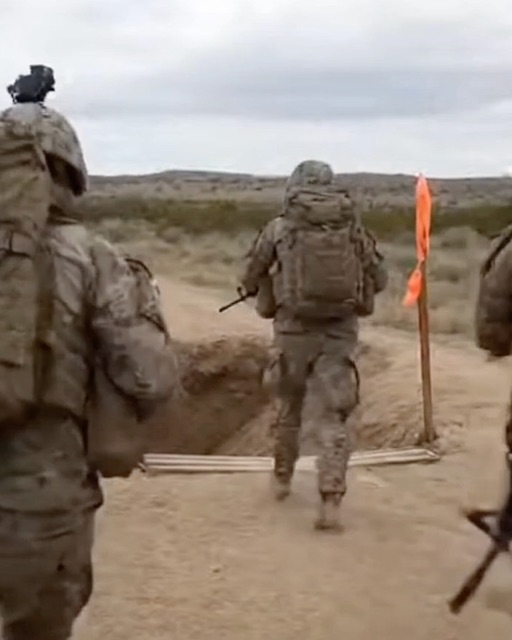
We hit the anti-vehicle ditch expecting the marked crossing plank to be right where the maps said it was.
It wasn’t there.
Momentum crashed instantly. The first two guys checked up hard at the precipice. The rear element nearly plowed right into us, heavy gear bouncing, rifles up. If this were a real combat zone, we’d be sitting ducks.
My heart hammered against my ribs. The plank hadn’t shifted or sunk. Someone had taken it.
Our squad leader didn’t waste a single second.
“Security left and right!” he barked. “Two-man bridge with rucks. Everybody else step light and move.”
Without hesitating, he and Private Gary hurled their heavy rucksacks into the narrowest part of the gap. They formed a bridge with their own gear. The first rifleman scrambled across low, stabilizing the far bank.
Then the next guy. Then me.
Within seconds, our squad leader turned a complete disaster into a textbook drill. No one wasted time whining about the missing plank. The lane kept moving.
On the far side, Gary wiped sweat from his face, looking back at the muddy ditch. “Thought that was going to stop us,” he scoffed.
The squad leader reached down, ripped his soaked ruck out of the mud, and slung it over his shoulder without slowing down. “Then you’re thinking wrong.”
I smiled. It was the perfect tough-guy line.
But then his smirk vanished.
The color completely drained from our leader’s face. He froze, staring down into the deep hole where his ruck had just been resting.
The suction from lifting his heavy bag had pulled away a thick layer of sludge at the bottom of the ditch, revealing the “missing” wooden plank. It hadn’t washed away. It had been intentionally chained to the bottom.
But that wasn’t what made my blood run cold.
Tangled in the heavy steel chains holding the plank underwater was a single, silver dog tag.
It glinted faintly in the weak sunlight filtering through the canopy of trees. Even from ten feet away, I could see the name stamped into the metal. It was a name we all knew.
CROFT.
Sergeant Croft. The leader of Bravo Squad. Our biggest rivals in this whole company-wide training exercise.
A low hiss escaped Gary’s lips. “No way.”
Our squad leader, Sergeant Mills, didn’t say a word. He just slid down the muddy bank, his boots making squelching sounds in the thick muck. He reached into the cold water, his arm disappearing up to the elbow.
His fingers worked at the small chain holding the tag, and with a sharp tug, it came free. He climbed back up, his face a mask of stone, and held the tag in his open palm. The water dripped from it, tracing clean lines through the dirt on his hand.
We all stared at it. There was no mistaking it.
This wasn’t just a prank. This was deliberate sabotage.
Training exercises were competitive, sure. Bragging rights were on the line, and promotions could sometimes hinge on performance. But this crossed a line. A big one.
Chaining down a crossing plank in a timed event was one thing. It was dirty, but maybe within the realm of aggressive competition. But doing it so thoroughly, and leaving a personal calling card like this? It felt personal. It felt malicious.
Sergeant Mills closed his hand around the tag, the metal disappearing into his fist. He and Croft had a history. They’d come up through the ranks together, always neck and neck. Always pushing each other.
Most of the time, it was healthy competition. This time, it felt like something had soured.
“What do we do, Sarge?” Gary asked, his voice barely a whisper. “We should call it in. The evaluators need to know about this.”
He was right. Standard procedure was to report any safety violations or unsportsmanlike conduct immediately. This qualified as both. It would mean an automatic disqualification for Bravo Squad.
But it would also mean stopping. It would mean we’d have to halt our progress, call in the exercise controllers, and write up a report. We’d lose all our momentum, and likely fail the timed objective.
Sergeant Mills stood there for a long moment, the silence of the woods pressing in on us. The only sounds were our own heavy breathing and the distant caw of a crow. I could see the conflict in his eyes.
He was a man who lived by the book. But he was also a man who never, ever quit.
Finally, he looked up, his gaze sweeping over each of us. “We keep moving.”
Gary’s mouth opened, then closed. He clearly wanted to protest, but one look from Mills silenced him.
“We are not going to let this stop us,” Mills said, his voice low and steady, but with an edge of steel I’d never heard before. “We’re not going to give them the satisfaction of knocking us out of the fight.”
He tucked the dog tag into a small pocket on his vest, zipping it up securely. It was evidence, and he was holding onto it.
“From now on, assume everything is a trap,” he commanded. “Check your maps, then check the ground. Trust your eyes, not the markers. Adams, you’re on point. Let’s go.”
My name is Adams. And just like that, I was at the front of the line, my senses on high alert. The game had changed. This wasn’t just about speed and efficiency anymore. It was about survival.
We moved out, but the energy was different. The smooth, confident rhythm we’d had before was gone. Now, every step was cautious, every shadow seemed to hold a threat. The woods, which had just been an obstacle course, now felt hostile.
It didn’t take long to find the next sign of foul play.
About a half-mile later, we came to a creek bed that was supposed to be a simple rock-hop across. The map showed a shallow crossing. But as I peered over the edge, I saw that the rocks had been slicked with something. Oil.
It was almost invisible, a faint sheen on the wet, dark stones. Someone trying to move quickly across them would have gone down for sure, likely twisting an ankle or worse.
I signaled back to Mills. He came forward, knelt, and touched a finger to the rock, then sniffed it. He gave a single, grim nod.
“Find another way across,” he ordered. “Upstream. Look for a fallen log.”
We spent a precious ten minutes finding a safe crossing. Ten minutes we didn’t have. The clock was ticking, a constant pressure at the back of my mind. I could feel the frustration rippling through the squad. We were being toyed with.
Next, it was a trail marker. A small, orange ribbon tied to a tree, meant to guide us to the next checkpoint. Only this one was pointing in the wrong direction, leading towards a dense, thorny thicket that would have torn our uniforms and our skin to shreds.
Gary, our map guy, caught it. “Sarge, this isn’t right. The checkpoint is northeast. This marker is pointing due east.”
Mills didn’t even hesitate. “Ignore it. Trust the compass.”
With each new trick, a quiet, simmering anger grew within our squad. We were being bled, slowed down by a thousand tiny cuts. Croft wasn’t just trying to win. He was trying to humiliate us. He was trying to break our spirit.
But he was underestimating Sergeant Mills.
With every obstacle Croft’s squad threw at us, Mills got calmer. He became more focused. He moved us through the woods with an unnerving intensity, his eyes missing nothing. He was drawing on some deep well of resolve, and it was infectious.
We stopped communicating with words. A hand signal, a nod, a shared glance was all it took. We were becoming a single, silent organism, united by a shared purpose. We would not be beaten.
We knew we were falling behind schedule. The final objective was a simulated village where we were supposed to secure a high-value target. We were supposed to be there an hour ago.
The sun was starting to dip lower in the sky, casting long shadows that made the terrain even more treacherous. We were tired, our muscles ached, and our water was running low. But no one complained.
We were just cresting the last ridge before the village when we heard it.
A single, sharp crack that echoed through the trees. It wasn’t the sound of the blank rounds we used in training. It was something else. A heavy, sickening thud, followed by a scream.
A real scream. Full of pain and panic.
We all froze, dropping to a knee, rifles pointing towards the sound. It had come from the direction of the village. From our objective.
Sergeant Mills held up a fist, signaling for silence. We listened, every nerve ending tingling.
Another shout, this time more frantic. “Man down! I need a medic! Get a medic over here!”
The voice was panicked, and it was familiar.
Sergeant Mills looked at me, his eyes wide. We both recognized it. It was one of the guys from Bravo Squad.
My first thought was cold and hard. It’s a trap. Croft was trying to lure us into an ambush. He was playing dirty, so why wouldn’t he stoop to this?
But the scream… that scream had been real. There was a raw terror in it that you just couldn’t fake.
Mills made a decision. “Gary, Adams, with me. The rest of you, hold here and cover us. Watch our backs.”
We moved forward, low and fast, weaving between the trees. As we got closer, we could hear more shouting. It was chaos.
We crawled the last fifty yards to the edge of the clearing where the mock village was set up. What we saw stopped me cold.
It wasn’t an ambush. It was a disaster.
One of the small, plywood buildings at the edge of the village had partially collapsed. A heavy support beam had fallen. And pinned underneath it was a soldier from Bravo Squad. His leg was trapped, and from the angle, I could tell it was broken. Badly.
Sergeant Croft was there, his face pale with shock, trying desperately to lift the beam. Two other members of his squad were helping, their faces streaked with dirt and panic. The injured soldier was yelling, his voice strained.
They hadn’t seen us yet. They were too focused on their own crisis.
“What happened?” I whispered to Mills.
He was scanning the scene, his tactical brain analyzing every detail. “Look,” he said, pointing to a tripwire near the collapsed wall. A homemade one. It was tied to the pin of a smoke grenade, but also to a support post for the wall.
“They booby-trapped the entrance,” Mills murmured, a look of dawning horror on his face. “They must have set it to pop smoke, disorient us when we came through. But they tied it to a load-bearing post.”
The trap they had set for us had backfired. Horribly.
In their haste to slow us down, they had created a trap that was not only against the rules but structurally unsound. Their own man, probably coming back to check on it, had tripped it.
We had them. Right there.
All we had to do was stay hidden, wait for the evaluators to show up and find this mess. Bravo Squad would be disqualified, probably face a full investigation for safety violations. We could just walk around them, complete the objective, and win.
It was the perfect karmic justice. It was everything they deserved.
Gary looked at Mills, a hungry, vengeful light in his eyes. “Sarge? What’s the call?”
This was the moment. The moment that would define our squad, and our leader. All the anger, all the frustration from the past few hours was bubbling up inside me. Part of me wanted to leave them there. Let them stew in the mess they’d made.
Sergeant Mills looked at the injured man, who was now moaning softly, his face ashen. He looked at Croft, who was failing to budge the heavy beam, his leadership crumbling into frantic desperation.
Then Mills looked at us. “We’re not leaving a man behind,” he said, his voice quiet but absolute. “Ever.”
He stood up. “Bravo! Cease what you’re doing!” he yelled, his voice carrying across the clearing with pure authority.
Croft and his men spun around, their eyes wide with shock to see us standing there. For a second, Croft looked terrified, like a kid caught with his hand in the cookie jar. Then shame washed over his face.
“Mills…” he started, his voice cracking.
“No time for that,” Mills cut him off. “Your man is going into shock. Everyone, on that beam. On my count. We lift together.”
Without a second thought, our squad emerged from the treeline. There was no hesitation. We ran to the collapsed structure. There was no ‘us’ and ‘them’ anymore. There were only soldiers, and one of them was hurt.
“Ready?” Mills yelled, positioning himself at the head of the beam. “One… two… three… LIFT!”
Eight of us, from two rival squads, strained together. The massive wooden beam groaned in protest. For a second, it didn’t move.
“AGAIN!” Mills roared, the veins in his neck standing out. “LIFT!”
With a collective grunt, the beam rose. Just a few inches, but it was enough.
“Pull him out! Now!”
Croft scrambled to drag his injured teammate free. Once he was clear, we let the beam crash back down.
Our medic, a quiet guy named Peterson, was already at the injured soldier’s side, cutting away the pant leg. The bone was clearly broken. Peterson worked quickly and professionally, assessing the injury and preparing a splint.
Mills turned to his radio. “This is Alpha Leader. I have a real-world medical emergency. I have a soldier with a compound fracture. I need an actual medevac at these coordinates. I repeat, this is not a drill.”
He had just officially ended the exercise for us. By calling in a real-world emergency, he was forfeiting the competition.
Croft just stood there, watching, his face a mixture of relief, guilt, and utter disbelief. He looked at Mills, who was now helping Peterson stabilize the soldier’s leg.
“Why?” Croft finally managed to choke out. “After what I did… why are you helping us?”
Sergeant Mills didn’t even look up from his work. “Because that’s the job,” he said simply. “We wear the same uniform. That’s all that matters out here.”
He then reached into his vest pocket and pulled out the dog tag. He walked over to Croft and pressed it into his hand.
“I believe this is yours,” he said.
Croft looked down at the tag in his palm, and his shoulders slumped. He looked utterly defeated. “I… I’m sorry, man. I was under a lot of pressure. They were talking about cutting a Sergeant slot… I just wanted to get an edge.”
“There’s a line, Croft,” Mills said, his voice not angry, but filled with a tired disappointment. “You didn’t just cross it. You blew it up.”
Just then, we heard the sound of a vehicle approaching. It was one of the evaluators, a grizzled old Master Sergeant named Hayes. He rolled up in a jeep, took one look at the scene – the collapsed building, the injured soldier, the two squads working together – and his face hardened.
He walked over to Mills. “Report.”
Mills gave him a quick, professional summary of what they found, and the actions they took to aid the injured soldier. He left out the sabotage. He didn’t mention the plank, the oil, or the markers. He just reported the accident as he saw it.
But Master Sergeant Hayes was no fool. He had been monitoring our progress, or lack thereof. He had seen us delayed. He walked over to the collapsed wall and immediately spotted the tripwire.
He turned to Croft, his eyes like ice. “Your trap, Sergeant?”
Croft couldn’t even speak. He just nodded, his head hung in shame.
Hayes looked from Croft’s defeated squad to Mills’s tired but focused team. He saw Peterson expertly finishing the splint. He saw my guys offering their water to Croft’s men.
He looked at Mills for a long time. “You knew this exercise was timed, Sergeant. You knew calling this in would be an automatic failure for your squad.”
“Yes, Master Sergeant,” Mills replied. “But my mission is to bring all my soldiers home. Today, that included his.” He gestured with his chin toward the injured man.
A silence fell over the clearing, broken only by the distant sound of the approaching helicopter.
Master Sergeant Hayes let out a long breath. “Bravo Squad, you’re done. Report to the command tent for a full review of this fiasco. You’re lucky all you’re facing is a disqualification.”
He then turned to Sergeant Mills and our squad.
“Alpha Squad,” he said, his voice softening just a fraction. “You failed to secure the objective in the allotted time. You are, by the rules, disqualified from the competition.”
We all felt a pang of disappointment, even though we knew it was coming.
“However,” Hayes continued, a rare smile touching the corner of his mouth. “The point of these exercises isn’t just to run fast and shoot straight. It’s to build leaders. It’s to see who you are when things go wrong.”
He walked over and stood in front of Mills. “Today, you didn’t win a training exercise. You demonstrated what it actually means to be a leader. You put a soldier’s life above a competition. You upheld the code.”
He looked around at all of us. “In the official books, no one won today. But in my book, Alpha Squad is the only team that truly understood the mission.”
That was better than any trophy. It was a validation of everything Sergeant Mills had drilled into us. Integrity. Honor. Brotherhood.
The helicopter landed, and they loaded up the injured soldier. As Croft and his squad trudged away toward the command tent, he looked back over his shoulder at Mills. He gave a small, almost imperceptible nod. It was a look of profound respect.
We walked back to our extraction point, exhausted but proud. We hadn’t won, but we hadn’t lost. We had made the right choice when it was the hardest choice to make.
That day taught me a lesson that has stayed with me ever since. True victory isn’t about finishing first or beating an opponent. It’s about who you are when you’re tested. It’s about choosing character over conquest, and compassion over competition. In the end, it’s not the prize that defines you, but the path you chose to walk to get there.



