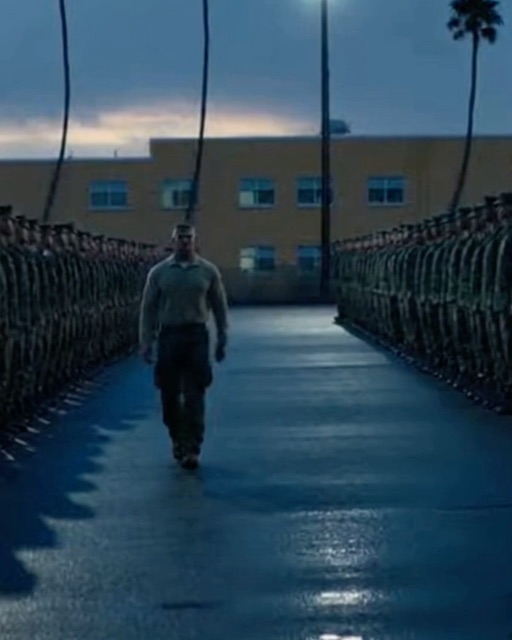
The slap was coming fast, Senior Chief Harlan’s palm slicing through the humid Coronado air like a knife. He’d been gunning for me since day one – extra laps in the surf, skipped chow, glares that promised hell. I was the quiet one, the guy who never broke a sweat during hell week, and it ate at him. Now, with the whole platoon watching, he wanted to humiliate me. Make me flinch. Prove I didn’t belong.
But as his hand whipped toward my face, I locked eyes with him and whispered four words that froze him mid-swing: “You trained me once.”
My name’s on the roster as Brett Harlan – no relation, just a coincidence that made his blood boil from the start. I showed up at BUD/S like any wide-eyed kid, boots caked in sand, heart pounding under the weight of secrets I couldn’t shake. Twenty years as a SEAL had turned me into a ghost: threat scans in grocery aisles, sleep fractured by nightmares of ops gone black. I needed this—back to basics, anonymous, to remember who I was before the shadows took over.
For a week, I blended. Average times on the O-course, short answers in evals. But Harlan noticed. The way I tied knots without looking, the calm under fire drills. He ramped it up: isolated me, turned the platoon against me with subtle threats. “Kowalski here’s a plant,” he’d mutter during night swims. “Gonna wash out the weak links.”
By day 10, combatives, he threw me against a beast of a recruit—easy pin, but I reversed it clean. His face twisted. He stormed the mat, breath hot. “Who the hell are you, really?”
I didn’t dodge. Didn’t fight. Just stood there as the platoon held its breath.
He swung. I didn’t move.
“You trained me once,” I said again, voice steady. “Baghdad, ’09. You were the one who pulled me from that ambush.”
His eyes widened, the color draining like he’d seen a corpse rise. The platoon murmured. Harlan’s hand dropped, trembling.
But then he leaned in, whispering something that made my stomach drop. “If that’s true… then why are you here? And who sent you to watch me?”
The world narrowed to the space between our faces. The salty air was thick with unspoken questions. His accusation hit me harder than his hand ever could have. This wasn’t about me being an imposter recruit; he thought I was an investigator, some spook from Naval Special Warfare Command sent to dig up his bones.
“No one sent me,” I whispered back, my voice low and raw. “I came for myself.”
He stared, searching my eyes for a lie. He found none. He found only the exhaustion of a man who’d seen too much and was trying to find his way back to the beginning. He took a half-step back, his authority fractured for the first time in front of his men.
“Back on the line!” he barked at the platoon, his voice a hammer trying to nail the moment back into place. But the crack was already there. The other recruits looked at me differently now—with a mix of fear, confusion, and a sliver of respect. I was no longer just the quiet guy; I was a riddle.
The war between Harlan and me changed after that. It was no longer a public spectacle. It became a silent, grinding battle of wills fought in the margins of training. He couldn’t physically break me without raising questions, so he tried to break my spirit.
During chow, he’d sit at the table across from me, his eyes burning holes into my tray. On long runs, he’d shadow me, his footsteps a constant, menacing rhythm right behind my own. He was waiting for me to slip up, to reveal the truth he was so terrified of.
And I just kept my head down. I helped the kid next to me, a lanky boy named Martinez from El Paso who was struggling with the swim, showing him a more efficient kicking technique when no one was looking. I focused on the cold of the Pacific, the burn in my muscles, the simple, honest pain of it all. It was the only thing that felt real.
My nights were still haunted, but now the Baghdad nightmares had a new clarity. I’d see the flash of the RPG that hit our Humvee. The dust, the screams, the world turning upside down. I remembered being pinned down, shrapnel in my leg, the taste of blood in my mouth.
In the dream, a hand would grab my vest and drag me through the dirt and chaos. For years, I believed that hand belonged to Senior Chief Harlan. He was a legend even then, and the after-action report confirmed it. He’d single-handedly suppressed fire and pulled me, his wounded mentee, to safety. He’d saved my life.
But now, his paranoia planted a seed of doubt. Why was he so scared? What was he hiding about a day he was decorated for?
The truth began to surface during Hell Week. There is no hiding in Hell Week. It’s five and a half days of non-stop, gut-wrenching, soul-crushing misery. It’s designed to strip away everything you are, leaving only your core. Your true self has nowhere to hide.
We were three days in, running on maybe two hours of sleep total. We were carrying a 200-pound log, our team of six groaning under the weight. Martinez was on the verge of collapse, his face pale and clammy in the pre-dawn gloom.
“Keep moving, Martinez!” Harlan screamed, his voice raw. “Or you can go ring that bell and quit like the worm you are!”
Martinez stumbled, the log dipping dangerously. I shifted my weight, taking more of the strain onto my own shoulders. “Breathe,” I grunted at him. “Just one foot in front of the other. That’s all it is.”
Harlan’s eyes locked on me. He saw what I was doing—not just carrying the weight, but carrying the man next to me. He hated it. He saw a strength in me that he couldn’t comprehend, and it terrified him.
Later that night, we were in the surf zone for what the instructors gleefully called “surf torture.” The Pacific was black and frigid. We lay on our backs in the shallow water, arms linked, as waves crashed over our faces, stealing our breath and our warmth. Hypothermia was setting in, our bodies shaking uncontrollably.
It’s a breaking point for many. Your mind starts playing tricks on you. You see things. You hear things.
And in that cold, dark water, as a wave submerged me, I heard it. A voice from my memory, clear as day. Not Harlan’s voice. Another one.
“Hang on, brother! I got you! We’re getting out of here!”
The memory was a lightning strike. It wasn’t Harlan who pulled me from the Humvee. It was Shepherd. Petty Officer David Shepherd, the team’s quiet medic. The guy who always had a worn-out paperback in his pocket. The guy who died that day.
The official story was that Shepherd was killed in the initial blast. But my memory, unlocked by the trauma of the cold, was telling me something different. Shepherd had been with me. He had saved me.
I sat bolt upright in the surf, gasping, the cold forgotten. Harlan was standing on the beach, a dark silhouette against the pale sand. He was watching me. He knew. At that moment, I think he knew that I finally remembered.
The final day of Hell Week culminates in a long-distance navigation swim in the dark. We were exhausted, disoriented, and barely human. My swim buddy was Martinez. He was running on fumes, but he had grit. We navigated by the stars, our strokes in sync.
About a mile from shore, a squall hit. The sea turned violent, the waves swelling. It became a struggle for survival. I saw one of the instructor boats capsize in the distance. Chaos erupted. Flares were fired, lighting the churning water in hellish red bursts.
My focus was on Martinez. I kept him close, shouting encouragement over the roar of the wind. Then I saw him—Harlan, in a small inflatable boat, his engine dead. A huge wave was cresting behind him, about to swamp him.
Without a second thought, I changed course, swimming toward him. “Martinez, stay with me!” I yelled.
I reached the boat just as the wave hit, flipping it over. Harlan was thrown into the water. For a second, he disappeared under the black waves. I dove down, my hand grabbing the back of his gear, and hauled him to the surface. He came up sputtering, his eyes wide with panic. The legendary Senior Chief looked like a terrified kid.
In that moment, he wasn’t my tormentor. He was just a man drowning.
I got him to the overturned boat, Martinez helping me push him up so he could cling to the hull. The three of us hung there, battered by the waves, a strange trinity in the storm.
“Why?” he coughed, looking at me. “After everything… why did you save me?”
“Because that’s what we do,” I said, my voice hoarse. “It’s what Shepherd would have done.”
His name hung in the air between us, more powerful than the storm. All the fight went out of Harlan. His shoulders slumped. He looked old. Defeated.
“He went back for you,” Harlan finally whispered, his voice cracking. “The RPG hit, and I froze. I was the team leader. I was supposed to be in charge, but I just… froze. I saw him run back to the wreck. He screamed for me to provide cover, but I couldn’t move.”
The confession poured out of him, the words tumbling over each other in the dark. “Shepherd pulled you out. He was dragging you back when a sniper took him down. He died right there.”
He looked away, his eyes staring into the black water. “When the dust settled, I was the senior man left standing. I wrote the report. I said Shepherd died in the blast and that I pulled you out. I took his medal. I took his honor.”
The truth was uglier than I could have imagined. This man hadn’t just made a mistake; he had built his entire career on a dead man’s valor. His cruelty as an instructor wasn’t strength; it was a desperate, pathetic attempt to project the bravery he lacked. He broke recruits because he was broken. He hated me because I represented the man he pretended to be.
“I’ve lived with his ghost every single day,” he choked out. “Every time I look at a recruit, I see his face.”
We were rescued an hour later. The storm passed as quickly as it had arrived. Back on shore, huddled in blankets and sipping hot broth, the world started to come back into focus.
The next morning, Senior Chief Harlan walked into the base commander’s office and told him everything. He resigned his commission and requested a full inquiry into the events in Baghdad in 2009.
I finished BUD/S. I rang no bell. I stood at graduation, not as a recruit, but as a man who had finally faced his own ghosts. I had come back to find the man I was before the shadows, but I found something more. I found that strength isn’t about never falling; it’s about what you do after. It’s about who you help up.
A few months later, I got a letter with a postmark from a small town in Wyoming. It was from Harlan. He was working as a ranch hand, he said. He wrote about the quiet, the hard physical labor, and the peace he was slowly finding. The last line read: “Thank you for not letting me drown. In more ways than one.”
Petty Officer David Shepherd was posthumously awarded the Silver Star his family deserved. His story was finally told the right way.
Naval Special Warfare Command offered me my old rank back, a spot on any team I wanted. I thought about it for a long time. I thought about the thrill, the brotherhood, the mission. But then I thought about Martinez, now a proud new member of the SEAL teams. I thought about helping him find his strength.
I turned them down. Instead, I took a position as a BUD/S instructor.
My methods are different from Harlan’s. I don’t break men to see what they’re made of. I build them up, push them to their limits, and show them that the true measure of a warrior isn’t the absence of fear or weakness. It’s the courage to face it, in yourself and in others, and the integrity to help your brother when he stumbles.
My past is no longer a ghost that haunts me in the dark. It’s a part of me, a lesson carved into my soul. Sometimes you have to go all the way back to the beginning, not to escape who you were, but to finally understand who you’re meant to become. True strength isn’t about being unbreakable; it’s about having the courage to confront your own broken pieces and the compassion to help others mend theirs.