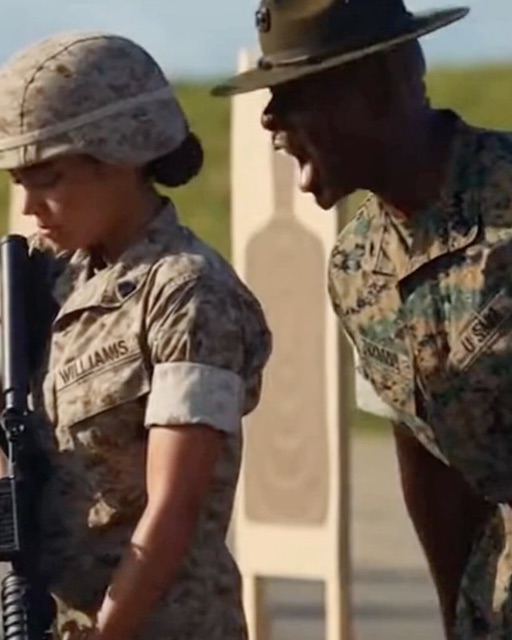
I slammed the discharge papers onto the metal desk. “Pack your bags, Megan. You’re a disgrace to this uniform.”
For three miserable weeks, she had been the worst recruit in my entire platoon. She tripped during morning runs, fumbled helplessly while trying to field-strip her rifle, and during live-fire drills, she completely missed the paper targets. I couldn’t wait to get rid of her.
“Sign the paper,” I barked.
She stared at her boots, her hands trembling, and reached for the pen.
Suddenly, the heavy steel door of my office flew open.
Base Commander Harrison marched in. I instantly snapped to attention, my hand flying up in a crisp salute. He didn’t even look at me. He walked straight to the desk, snatched the discharge papers from Megan’s hand, and ripped them in half.
“Sir?” I stammered. “With respect, she failed every qualification. She couldn’t hit a target from twenty yards away!”
The Commander turned to me, his eyes dead and cold.
“I know,” he said softly. “I personally collected her target sheets from the dirt berm this morning.”
He pulled a rolled-up paper target from his jacket and slammed it flat onto my desk.
“She didn’t miss, Sergeant.”
I looked down at the paper. Just like I thought, there wasn’t a single bullet hole in the center mass.
“Look closer,” the Commander ordered.
I leaned in, and my blood ran cold.
The bullet holes weren’t random misses. They were placed in a mathematically perfect, incredibly tight circle in the extreme top right corner.
“Do you know how much elite precision it takes to group shots like that while pretending to stumble?” the Commander whispered.
He turned to Megan. She wasn’t trembling anymore. Her posture shifted instantly, standing perfectly rigid, staring a hole right through me with terrifying confidence.
“She’s not a recruit, Sergeant,” the Commander said, sliding a thick, red-stamped folder across my desk.
I opened the folder, and when I saw the silver badge pinned to the inside cover, my jaw hit the floor. She wasn’t sent to this base to train… she was sent here to investigate me.
My mind raced, frantically replaying the last three weeks. Had I done something wrong? Cut a corner on a supply requisition? Pushed the recruits too hard? My entire career, a spotless sixteen years of service, flashed before my eyes.
“Investigate… me, sir?” My voice was barely a whisper.
Commander Harrison shook his head, a flicker of something that might have been pity in his eyes. “Not you, Sergeant Miller. Not directly.”
He gestured for me to close the door. Megan, whose real name I now saw was Special Agent Thorne, remained standing at ease, her expression unreadable. She looked like a completely different person. The clumsy, uncertain girl was gone, replaced by a woman of sharpened steel.
“We have a leak on this base,” Harrison said, his voice low. “A significant one.”
He explained that for the past six months, high-grade medical supplies had been vanishing from the base infirmary. We weren’t talking about bandages and aspirin. We were talking about controlled substances, battlefield surgical kits, and expensive medications.
“It’s a ghost,” Harrison continued. “No broken locks, no signs of forced entry. The inventory logs are being doctored by a master. Whoever is doing this knows our systems inside and out.”
I felt a knot of anger and betrayal tighten in my gut. This was my base. These were my people.
“Why the act?” I asked, looking at Megan. “Why go undercover as a recruit in my platoon?”
It was Megan who answered, her voice calm and measured, a stark contrast to the timid mumbles I was used to. “Because no one pays attention to the weakest link, Sergeant. People talk freely around the recruit who can’t even tie her own boots. They forget she’s there.”
She was right. I had dismissed her. The other recruits had pitied her or mocked her. The other instructors ignored her. She had become invisible, and in that invisibility, she had become the perfect observer.
“We believe the thief is someone with high-level access,” Harrison stated. “An officer. Or a senior non-commissioned officer.”
The implications hit me like a physical blow. It had to be someone I knew. Someone I trusted.
“Agent Thorne needed a handler on the inside,” the Commander finished. “Someone with an impeccable record who knows the personnel better than anyone. Someone who can get her access without raising suspicion.”
He looked at me pointedly. “That someone is you, Sergeant Miller.”
My head was spinning. A few minutes ago, I was processing a discharge. Now I was part of a top-secret internal investigation.
“My… my apologies, Agent Thorne,” I stammered, feeling like the world’s biggest fool. “For my conduct.”
She gave a slight nod, a ghost of a smile touching her lips. “You were just doing your job, Sergeant. Your thoroughness in documenting my ‘failures’ actually helped my cover.”
That didn’t make me feel any better.
The next few days were a blur. By day, I was the same hard-nosed Drill Sergeant, yelling at recruits and running them into the ground. But by night, I was meeting Megan in deserted storage rooms and empty briefing halls.
We’d pore over personnel files and duty rosters. She’d feed me scraps of conversations she’d overheard in the mess hall or the barracks.
I started to see her in a new light. She wasn’t just a good shot. She was brilliant. She could recall tiny details from weeks ago, piece together timelines that seemed unrelated, and read people with an unnerving accuracy.
She pointed out discrepancies I had never noticed. A supply clerk, Corporal Davies, who always volunteered for late-night inventory checks. An infirmary medic who had recently bought a brand-new truck on a specialist’s salary.
Our primary suspect, however, quickly became Major Thorne. No relation to Megan, a cruel irony. He was in charge of base logistics, a man known for his expensive tastes and a rumored gambling habit. He had the access, the motive, and the arrogance.
He treated everyone beneath him with contempt, including me. He was the kind of officer who saw rules as things that applied to other people.
“He’s our man,” I said one night, pointing to a requisition form he had signed off on. “The dates match the last known theft.”
Megan was quiet, tracing the signature with her finger. “Maybe,” she said, her brow furrowed. “But it’s too neat. Everything about him is a little too perfect for a common thief.”
I didn’t understand what she meant. To me, he was the obvious choice.
We decided to set a trap. With Commander Harrison’s approval, we logged a new shipment of high-value painkillers into the system but kept the actual medication in a separate, secure location. We put a dummy crate, fitted with a silent tracker, in its place.
Then we waited.
For two days, nothing happened. I was getting antsy. Major Thorne was scheduled to go on leave at the end of the week. If he was our guy, he’d have to make his move soon.
On the third night, the tracker pinged.
It was just after 0200. The crate was on the move. My heart hammered in my chest.
Megan and I, dressed in dark utilities, were positioned in an observation post overlooking the supply depot. We watched on a small monitor as the tracker’s dot moved steadily toward the east gate.
“Got him,” I whispered, reaching for my radio to alert the Military Police we had on standby.
“Wait,” Megan said, putting a hand on my arm. Her eyes were glued to the screen. “Look at the route.”
The dot wasn’t taking the direct path to the gate. It was winding through the back alleys of the base, sticking to areas with poor camera coverage. It was the route of someone who knew the patrol schedules by heart.
“That’s not Thorne’s style,” she murmured. “He’d just drive his car up to the loading dock and bully the guard into looking the other way. This is someone scared. Someone trying not to be seen.”
We left the observation post and moved on foot, using the shadows to our advantage. The tracker led us to a small, forgotten maintenance shed near the perimeter fence. The door was slightly ajar.
Inside, a single bare bulb illuminated a figure hunched over the crate, prying it open with a crowbar.
It wasn’t Major Thorne.
My blood ran cold. It was Corporal Davies. The quiet, unassuming supply clerk who everyone liked. The kid I had personally recommended for a promotion last year.
He looked thin and exhausted under the harsh light, his uniform hanging off his frame. When he finally got the crate open and saw that it was empty, a sound of pure despair escaped his lips. He sank to his knees, his head in his hands.
That’s when we entered.
He looked up, and the color drained from his face. He didn’t try to run. He just looked utterly defeated.
“Davies?” I said, my voice hoarse with disbelief. “What are you doing?”
Tears streamed down his face. “I’m sorry, Sergeant,” he choked out. “I’m so sorry.”
The story came tumbling out, a torrent of grief and desperation. His seven-year-old daughter, Lily, had a rare form of cancer. The standard treatments had failed, and their insurance wouldn’t cover the astronomical cost of an experimental drug that was her only hope.
He wasn’t a criminal mastermind. He was a father watching his child die.
He’d been using his knowledge of the inventory system to steal the supplies, selling them to a black-market contact to get the money for Lily’s treatment. He never took more than he absolutely needed. He was just trying to keep his little girl alive.
My anger evaporated, replaced by a hollow, aching sadness. I had seen the horrors of war. I had seen men break. But I had never seen anything as heartbreaking as the sight of this good, decent soldier broken by a system that had failed him.
Megan was silent, her expression unreadable. She walked over and gently took the crowbar from his hand.
Suddenly, the shed door creaked open. We all froze.
Standing in the doorway, his face a mask of cold fury, was Major Thorne.
“I knew it,” he spat, his eyes fixed on Davies. “I’ve been running my own audit for weeks. I knew supplies were going missing on my watch.”
He stepped into the shed, his presence filling the small space. I tensed, ready for him to pull his sidearm or call the MPs. This was it. Davies’s life was over.
But Thorne just stood there, looking at the sobbing Corporal on the floor.
“Why?” Thorne demanded, his voice rough. “For a new car? For a gambling debt?”
“For my daughter,” Davies whispered, his voice cracking. “She’s sick.”
He told Thorne the whole story, just as he had told us. As he spoke, something strange happened. The anger on Major Thorne’s face began to soften, replaced by a deep, world-weary sorrow that seemed to age him by a decade.
When Davies finished, the Major was silent for a long moment.
“My sister,” he said, his voice thick with emotion. “She had something similar. A rare blood disorder. The insurance company called the treatment ‘experimental.’ We remortgaged my parents’ house. We sold everything. It wasn’t enough.”
He looked from Davies to me, and then to Megan. “She died two years ago. We were holding bake sales to pay for a funeral.”
The air in the shed was thick with unspoken grief. Here were three soldiers and an investigator, bound by a secret that had nothing to do with regulations and everything to do with the burdens people carry.
Major Thorne, the man I had pegged as an arrogant, selfish officer, was not the villain. He was just another person scarred by loss. His arrogance wasn’t malice; it was a shield he used to hide his own pain and frustration with a world he couldn’t control.
He turned to Davies. “You will be held accountable for this,” he said, his voice firm but lacking its earlier bite. “You broke the law. You betrayed your oath.”
Davies nodded, fresh tears falling. “I know, sir.”
“But you will not be a convicted felon,” Thorne continued, shocking all of us. “And your daughter will not be left to die.”
What happened next was a testament to the fact that sometimes, the uniform doesn’t make the man; the man makes the uniform.
Major Thorne, Commander Harrison, and Megan worked out a solution. Davies was given a non-judicial punishment. He was demoted and would be honorably discharged after he paid full restitution for the stolen supplies, a debt Major Thorne anonymously paid a large portion of.
But the real twist, the one that showed me the true meaning of service, came from Thorne. He used his family’s painful experience to navigate the labyrinth of medical bureaucracy. He made calls. He pulled strings I didn’t even know existed. He found a charitable foundation, run by a retired general, that specialized in helping military families with catastrophic medical bills.
Two weeks later, Davies’s daughter was accepted into a fully-funded clinical trial for the very drug he had been trying to afford.
The day Davies was processed out, I went to see him. He was no longer a Corporal, just a man packing his life into cardboard boxes. He shook my hand, his eyes filled with a gratitude so profound it left me speechless.
“Thank you, Sergeant,” he said. “For seeing me. Not just the thief.”
Later that afternoon, I found Megan by the shooting range. She was no longer in a recruit’s uniform but in a simple, practical civilian outfit. She was leaving.
She wasn’t firing at a target. She was just standing there, looking out at the dusty field.
“You knew, didn’t you?” I said. “You suspected it wasn’t Thorne.”
She nodded. “His records were clean. A little too clean. And the thefts were too small, too desperate. It didn’t feel like greed. It felt like fear.”
I stood beside her, watching the heat shimmer off the dirt. For weeks, I had looked at her and seen a failure. I had looked at Davies and seen a good soldier. I had looked at Thorne and seen a corrupt officer. I had been wrong on every single count.
I had spent my career teaching soldiers how to see the enemy, how to strip down a weapon, how to follow orders. But I had forgotten how to see the person right in front of me.
Megan taught me that the greatest threats aren’t always the ones you can see on a battlefield. Sometimes, they are the quiet struggles people fight every single day. And the greatest strength isn’t in the perfection of a salute or the tightness of a shot group. It’s in the compassion you show when someone has fallen.
“You’re a good NCO, Sergeant Miller,” she said, turning to me. “You’re tough, but you’re fair. You just needed to adjust your sights.”
She offered a small, genuine smile, and I returned it. We didn’t shake hands or salute. We just stood there for a moment, two people who had seen the worst in a situation and had, by some miracle, found the best in each other.
As I walked back to the barracks, I realized the most important lesson of my career hadn’t been taught to me by a general or in a manual. It had been taught to me by the worst recruit I ever had. It’s easy to judge the person who trips and falls. It’s much harder, and far more important, to stop and ask why they were stumbling in the first place.