
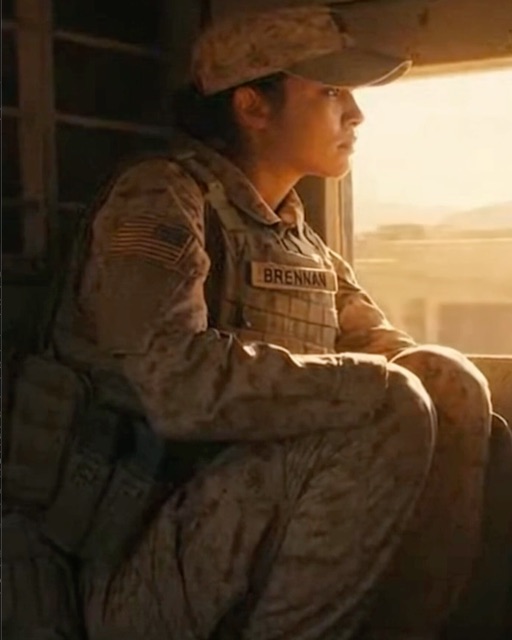
“Stay in the back, Doc,” Corporal Craig sneered, bumping my shoulder. “Just hold the Band-Aids while the real men do the heavy lifting.”
I didn’t argue. At 122 pounds soaking wet, I was used to being treated like the squad mascot. I sat in the back of the Humvee, my knees pulled tight to my chest, the 70-pound weight of my medical ruck feeling like a tombstone against my spine.
My father was a legendary Gunnery Sergeant. He taught me how to read the world like a predator before I could ride a bike. But after we buried him, I made a promise to only heal. My hands were for gauze. Nothing else.
But that morning, the air tasted like burnt diesel and copper. The village was dead silent. Even the stray dogs were hiding.
My blood ran cold. The silence isn’t peace. It’s the enemy holding their breath.
Ten seconds later, the sky tore open.
An explosion flipped our lead vehicle. Heavy machine-gun fire rained down from the rooftops, pinning us instantly in the dust.
I looked at Craig. The arrogant “real man” was pressed into the dirt, frozen in pure shock, his rifle shaking violently. The entire squad was screaming, completely paralyzed by the ambush.
I stayed perfectly calm.
I crawled behind a blown-out wall and quietly unzipped my heavy canvas gear.
But I didn’t reach for the trauma pads. I didn’t pull out the morphine.
Instead, I reached past the medical supplies, unlatched the false bottom of my bag, and grabbed the dark gift my father had given me before he died.
Craig looked over at me, his face pale with terror. But his jaw hit the floor when he realized the “little girl” wasn’t holding bandages, but a custom-built, takedown marksman rifle, its matte-black finish seeming to drink the harsh sunlight.
He just stared, his mouth hanging open, as my hands moved with a fluid grace that felt both foreign and deeply familiar.
The stock clicked into place. The scope mounted with a soft snap. I chambered a round, the sound a crisp, final punctuation in the chaos of gunfire.
It was my father’s last project, a beautiful, terrible masterpiece he called “The Surgeon.” He’d built it for himself, but cancer had taken him before he could ever use it. “Just in case,” he’d whispered, pressing it into my hands a week before he passed. “Sometimes the best way to heal is to stop the sickness at its source.”
I had never fired it. I had promised myself I never would.
But promises, I realized, were a luxury for a world that wasn’t trying to kill you.
The rest of the squad was still pinned, their return fire wild and panicked. They were shooting at ghosts, wasting ammunition on shadows.
I rested the rifle on the broken wall, my breathing slowing to a crawl. The world narrowed, the screams and explosions fading into a dull hum. All that existed was the reticle in my scope.
My father’s voice echoed in my mind. “Don’t look at the chaos. Look for the conductor.”
I scanned the rooftops, ignoring the muzzle flashes of the foot soldiers. I was looking for the one giving them confidence, the one holding the leash.
There. A heavy machine gun nest tucked into the third-floor window of a bombed-out tailor shop. It was the heart of the ambush, the anchor point that had us nailed to the ground.
I adjusted for windage. I let half a breath out and held it. The world became perfectly still.
The gunner’s head filled my scope.
I squeezed the trigger.
The rifle bucked against my shoulder, a solid, reassuring kick. Across the street, the machine gun went silent. The reign of terror that had lasted an eternity but had only been ninety seconds was over.
The sudden quiet was more shocking than the noise. The squad stopped firing, looking around in confusion.
“Diaz, Henderson!” My voice cut through the air, sharp and clear, a voice no one had ever heard from me before. “Second story, building on the left! Suppressing fire, now!”
They stared at me for a half-second, their eyes wide with disbelief. Then, something shifted. They saw the rifle, they saw my calm, and they saw the dead machine gunner. The chain of command had broken, and a new one was being forged in the dust.
They obeyed instantly.
“Sarge! Get on the radio!” I commanded. “Tell them our position is compromised. We need air support and a new extraction point!”
The Sergeant, a man twice my age, simply nodded and started yelling into his comms.
I scanned again, my eyes sweeping the battlefield with cold, analytical precision. The ambush wasn’t broken, just wounded. The conductor was gone, but the orchestra was still playing.
Another position opened up, a sniper in a bell tower to our right, trying to pick off Henderson.
Before he could line up his shot, I put a round through his scope.
The confidence of the enemy attack shattered. Their fire became sporadic, desperate. They had walked into what they thought was a simple kill box, but they hadn’t counted on a ghost in the machine. They hadn’t counted on a Gunnery Sergeant’s daughter.
Craig was finally moving, laying down fire with the rest of them. But he wasn’t looking at the enemy. He kept glancing back at me, his expression a mixture of terror and awe. The “Band-Aid holder” was calling the shots, and everyone, from the private to the Sergeant, was listening.
We had a chance now. A real one. I could feel the momentum shifting, the fear transferring from us to them.
We started moving, leapfrogging from cover to cover. I would move, set up, neutralize a threat, and then signal for the others to advance. I wasn’t their medic anymore. I was their guardian angel, armed with a rifle named The Surgeon.
We were almost to a defensible compound when I saw it. A glint of light from a new direction. It wasn’t a panicked fighter. It was controlled. Patient. Another professional.
This one was different. He was good. He was waiting for his moment.
The new sniper was hunting me specifically. I could feel his eyes on me through his scope.
“Get down!” I yelled, pulling Henderson behind a concrete barrier just as a high-caliber round smashed into the spot where his head had been.
This was a duel now. The rest of the squad was secondary. He wanted me.
“Keep them busy!” I ordered the squad, my voice low. “I need to move.”
I crawled backward, breaking line of sight, and scurried into the shell of a nearby building. It was a deadly game of chess. He knew my general location, and I knew his.
I peeked through a crack in the wall. He was good, concealed in the rubble of a collapsed mosque a few hundred yards away. He was using the shadows perfectly.
Then I saw Craig do something brave and foolish.
He saw the sniper’s attention was on me. He thought he could give me an opening. He stood up from behind his cover and laid down a long, suppressive burst toward the mosque.
“Craig, no!” I screamed, but it was too late.
The enemy sniper was faster. The crack of his rifle was sharp, definitive.
Craig crumpled to the ground, a dark stain blossoming on his chest.
The world stopped.
For a heartbeat, I was frozen. The predator in me screamed to finish the duel. I had the other sniper’s position. I could end him.
But then I saw Craig, choking on his own blood in the dirt. I saw the arrogant man who had sneered at me, now just a scared kid, his life pouring out of him.
The promise I made at my father’s grave came rushing back. My hands are for gauze. Nothing else.
I had broken that promise to save my squad. But what was the point of saving the squad if I let one of them die right in front of me?
The rifle felt impossibly heavy in my hands. The Surgeon. It could cut out the sickness, but it couldn’t stitch the wound.
I made my choice.
I gently laid the rifle down, the warm metal a stark contrast to the cold dread in my gut. I looked over at the squad. “Cover me!”
Without waiting for a reply, I grabbed my medical ruck – the real part of it – and sprinted into the open.
The world erupted. The enemy, seeing me, the primary threat, exposed, threw everything they had. Bullets kicked up dust around my feet. The sniper’s rounds whizzed past my ear.
But my squad, my men, formed a wall of lead. They fired with a ferocity I’d never seen, a desperate, protective rage. They were covering their Doc.
I slid on my knees beside Craig, the ground slick with his blood. His eyes were wide with panic, pleading.
“It’s okay, Craig,” I said, my voice returning to the gentle calm he was used to. “I’ve got you. Just breathe.”
My hands, which moments before had been a sniper’s steady platform, were now a medic’s. I ripped open his vest. The entry wound was high on the chest. A sucking chest wound. Bad. Very bad.
I worked fast, my movements economical and precise. I slapped a chest seal over the wound, my fingers pressing it down firmly. I started an IV, my hands steady despite the bullets still impacting around us.
“You’re… you’re…” he stammered, his words gurgling.
“I’m your medic, Corporal,” I said, looking him straight in the eye. “And I’m not letting you die today.”
The firefight raged on, but for me, it was a world away. My entire focus was on this one life. On the man who saw me as a mascot.
Reinforcements arrived minutes later, thundering in with overwhelming force. The ambush broke completely, the remaining fighters melting back into the alleys.
As the dust settled, the first thing I heard was the sound of approaching boots. I looked up, still holding pressure on Craig’s wound, to see our Lieutenant and the rest of the squad gathered around me.
They weren’t looking at Craig. They were all looking at me. Their faces held no mockery, no condescension. Only a deep, staggering respect.
Back at the Forward Operating Base, the story was already legend. They weren’t calling me “Doc” anymore. They were calling me “Gunny,” my father’s old rank. It felt wrong, like wearing a coat that was too big.
I was brought before our Company Commander, a stern man named Major Pierce. My father’s rifle was on the table between us. I expected to be court-martialed. Unsanctioned weapon, engaging the enemy outside my role… the list of charges was long.
“My father gave it to me,” I said quietly, my voice hoarse. “He said sometimes you have to stop the sickness at its source.”
Major Pierce stared at me for a long time, his eyes unreadable. Then he looked at the report on his desk. “The after-action report says you saved twelve men today, including yourself. It says you neutralized two key enemy positions, broke the back of a coordinated ambush, and then ran through open fire to save the life of the man who was hit.”
He pushed the rifle across the table toward me.
“Your father was a good man. He would be proud.” He closed the report. “This weapon was never here. This conversation never happened. Your squad needs their medic. Dismissed.”
I walked out into the blinding sunlight, feeling a weight lift that I didn’t even know I was carrying.
But the story wasn’t over. Two days later, intelligence came in. The ambush wasn’t random. Our route had been fed to the enemy by a local informant, a shopkeeper named Tariq who we had paid and trusted for months.
A mission was put together to go back into the city and grab him. I wasn’t on the roster, but I went to the Lieutenant. “I need to be on this, sir.”
He hesitated. “It’s not a medic’s job.”
“With all due respect, sir,” I said, meeting his gaze. “We all saw what my job is two days ago. It’s keeping our people alive. I need to know why he did it.”
The squad backed me up. There wasn’t an argument. I went.
We found Tariq not in a hideout, but in the back room of his small shop, huddled with his wife and two small children. He wasn’t a fanatic. He was just a terrified man.
He confessed immediately, tears streaming down his face. Insurgents had taken his eldest daughter. They had told him he could have her back if he told them our patrol schedule. It was an impossible choice.
I looked at the faces of his family, and I didn’t see an enemy. I saw a father who had done a terrible thing for a reason I, who had just broken my own vow for my “family,” could understand.
The Lieutenant looked at me, his eyes asking the question. What do we do?
The old me, the medic, would have stayed silent. The predator my father trained would have seen only the betrayal.
But I was neither of those things anymore. I was something new.
“We get his daughter back,” I said.
The squad didn’t even blink. They trusted my judgment completely.
We turned a capture mission into a rescue operation. Using Tariq’s information, we planned a lightning-fast raid on the house where his daughter was being held. It was risky, unsanctioned, and completely against the rules.
It was also the right thing to do.
We went in hard and fast. We got the girl. We were out before the enemy even knew what hit them. We brought her back to her family, a weeping, joyful reunion that felt more significant than any battle I had survived.
A month later, Craig returned to duty. He had a wicked scar on his chest, but he was alive. He found me cleaning my gear, the medical supplies laid out neatly on a canvas sheet. The rifle was nowhere in sight.
He stood there for a long moment, just watching me. There was no trace of the arrogant corporal left.
“They told me what you did,” he said quietly. “For the informant. For his kid.”
I nodded, not looking up.
“I was an idiot,” he said. His voice was thick with emotion. “I judged you by your size, not your heart. And not… not your skill.”
I finally looked at him. “We all make mistakes, Craig.”
“Yeah, but some mistakes get people killed. My mistake almost got me killed. Your skill saved me.” He took a deep breath. “Will you teach me? Not the shooting part. I know how to do that. The other part. The part you did after I went down. I want to know how to save someone.”
I smiled, a real, genuine smile.
My father taught me how to be a predator. He gave me a weapon and showed me how to take a life from a thousand yards away. But life itself had taught me the real lesson. True strength isn’t found in the power to destroy, but in the courage to heal. It’s about knowing that sometimes, the most important battle is the one you fight to save a single life, even the life of someone who saw you as small. The greatest gift wasn’t the rifle he left me, but the resolve to know when to put it down.



