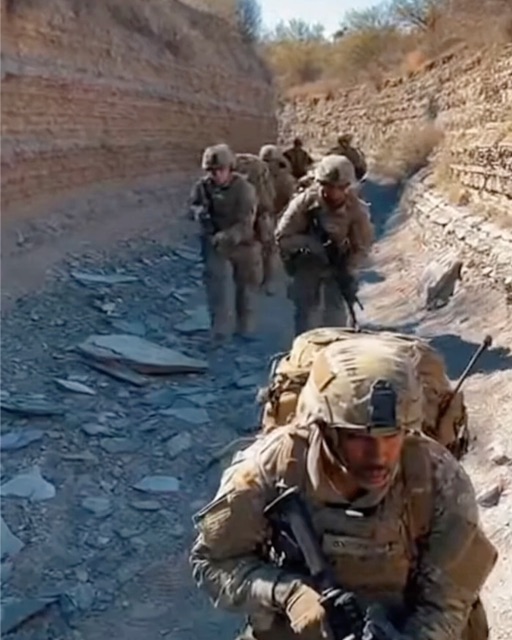
I was screaming at my point man to open his interval when the shale completely gave way.
We were running a standard field exercise. The dry creek bed offered good concealment, but the footing was brutal. Loose sand over jagged rock. Suddenly, Dustin – the newest transfer to my squad – skidded on the rocks, taking out the guy behind him and slamming hard into the creek wall.
“Stop!” I barked. The whole file froze.
I dropped into the dirt and pulled Dustin up by his shoulder straps. He was pale, gasping, and clutching a nasty, bleeding gash on his shin.
I didn’t hesitate. I ripped open the top pouch of his assault pack to grab his trauma kit.
I yanked the bandages out, but a sealed ziplock bag tumbled out with it, spilling his personal items directly into the dirt.
My blood ran completely cold.
Lying face up in the dust was a polaroid photo. It was my wife. She was wearing my favorite shirt, sitting on the couch in our living room, holding up a positive pregnancy test.
My hands shook as I picked it up. I flipped the photo over, and the message written in her exact handwriting said…
“This is for you. Our little miracle. Keep it safe.”
The world tilted. The heat of the sun, the shouts of my men, the sting of sweat in my eyes—it all vanished.
There was only the photo. Sarah. My Sarah. Her smile in the picture wasn’t for me.
It was for him. For Dustin.
“Our little miracle.” The words echoed in the sudden, roaring silence of my mind.
My breath hitched. The air felt thick, impossible to draw in.
“Sarge? You okay?” one of my guys, Peterson, asked from a few feet away.
I couldn’t answer. My throat was a knot of concrete.
I stared at Dustin, who was now propped against the creek wall, his face a mask of pain from his leg.
He looked at me, then at the photo in my hand. His eyes widened slightly.
A wave of pure, unadulterated rage washed over me. It was so potent, so absolute, that I felt my vision tunnel.
This kid. This new transfer I’d barely spoken to. He had destroyed my entire world in a single, careless fall.
My first instinct was primal. I wanted to grab him by the collar of his uniform and demand an answer. I wanted to see the fear in his eyes.
But I was Sergeant Mark Brewer. I had a job to do. My men were watching me.
I shoved the photo into my own pocket with a jerky, unnatural movement. My hands felt like they belonged to someone else.
“Get the pressure bandage on that,” I ordered, my voice a low growl I barely recognized.
I worked on pure muscle memory. I cleaned the wound, applied the dressing, and wrapped it tight. My movements were efficient, cold, and detached.
Every touch of his uniform felt like I was touching betrayal itself.
“Can you walk?” I asked, not looking him in the eye.
He tried to stand, then hissed in pain. “Negative, Sergeant.”
“Right.” I keyed my radio. “Actual, this is Bravo Six. We have one non-ambulatory casualty. Requesting CASEVAC at rally point Charlie.”
The radio crackled a response, but I barely heard it. My mind was a chaotic slideshow. Sarah laughing on our wedding day. Sarah crying during a movie. Sarah wearing my shirt, holding that test.
We had been trying for a baby for two years. Two years of hope and disappointment.
Two years of her telling me it was okay, that it would happen when it was meant to happen.
And now it had happened. With him.
I detailed two of my men to fashion a makeshift litter. We had to carry him out of the creek bed to the extraction point.
The entire time, I was a machine. I gave orders. I checked my sectors of fire. I maintained discipline.
But inside, I was screaming. Every step was a new torture. The weight of his body on the litter felt like the weight of his sin on my shoulders.
He kept trying to catch my eye, a confused and pained look on his face. I ignored him completely.
To me, he was no longer Private Dustin. He was just a casualty. A problem to be removed.
The rest of the exercise was a blur. We made it to the rally point. The bird came and took him away.
I never said another word to him.
We completed the mission. We humped our way back to the transport trucks. We drove back to the base in near silence.
My men knew something was wrong. They could feel the ice radiating off me. But they were soldiers. They didn’t ask questions.
Back in the barracks, I dropped my pack on my bunk. It landed with a heavy thud that seemed to echo the collapse of my life.
I pulled out the photo.
Her smile mocked me. The little blue plus sign on the test was a dagger in my heart.
I should have called her. I should have screamed at her, demanded the truth.
But I couldn’t. I was a coward. I was terrified that hearing her voice admit it would break the last fragile piece of me that was still holding on.
For two days, I was a ghost. I went through the motions of post-exercise cleanup. I cleaned my rifle. I filed my reports.
I didn’t sleep. I just lay on my bunk, staring at the ceiling, the photo clutched in my hand.
I imagined them together. Whispering in our house. Sitting on our couch.
How long had it been going on? Was it before this deployment? Or did it happen while I was gone?
Dustin had only been with our unit for six weeks. It must have been before. My stomach churned.
Finally, I couldn’t take it anymore. I had to know. I had to face him.
I found out he was in the infirmary on base, his leg elevated, set to be on light duty for a few weeks.
I walked there in a daze. The hallway smelled of antiseptic and floor cleaner, a sterile scent that was at odds with the messy, putrid rage in my soul.
I found his room. He was alone, reading a book.
He looked up when I entered. The book fell to his lap.
“Sergeant,” he said, his voice hesitant.
I didn’t say anything. I just walked to the foot of his bed and stood there, a silent, menacing statue.
I pulled the photo from my pocket and held it up so he could see it.
“Explain this,” I said. My voice was dangerously quiet.
He swallowed hard, his eyes flicking from the photo to my face. He looked scared. Good.
“Sarge, it’s… it’s not what you think,” he stammered.
“Isn’t it?” I took a step closer. “My wife. My house. And a note that says ‘Our little miracle.’ It seems pretty clear to me, Private.”
I said his rank like it was a curse.
“Please, Sergeant, you have to let me explain,” he pleaded, trying to sit up straighter.
“There’s nothing to explain. I just want to know one thing. How could you? How could she?” The questions came out as a raw, broken whisper.
A tear actually welled up in Dustin’s eye. It wasn’t a tear of guilt. It was… something else. Pity, maybe? That just made me angrier.
“You don’t understand,” he said, his voice gaining a bit of strength. “Her name is Sarah, right? Sarah Brewer?”
My blood froze again. He knew her name. Of course, he knew her name.
“Don’t you say her name,” I hissed.
“Her maiden name,” he continued, ignoring my threat. “Was it Miller?”
The question was so out of left field it stopped me cold. How did he know that?
“What does that have to do with anything?” I snapped.
“Did she have a younger brother?” he pressed, his eyes now locked on mine, full of an intensity I couldn’t decipher. “Named Liam?”
My mind reeled. Liam. My brother-in-law. Sarah’s baby brother.
He died five years ago. A car accident on a rainy night. He was only nineteen.
The memory was a fresh wound. Sarah had been inconsolable for a year. It was a part of our past we rarely spoke of, the grief was still too sharp.
“What do you know about Liam?” I demanded, my confusion warring with my rage.
Dustin took a deep breath. He unbuttoned the top two buttons of his hospital gown.
There, on his chest, was a long, faded scar. A zipper, running right down his sternum.
A transplant scar.
“Five years ago, I was dying,” Dustin said, his voice soft and steady now. “I had a congenital heart defect. I was on a list, but my time was running out.”
He paused, letting the words sink in.
“Then one night, I got a call. There was a heart. A perfect match. It came from a nineteen-year-old kid who was in a car accident.”
The floor beneath me seemed to disappear. I gripped the footboard of the bed to keep from falling.
“His name was Liam Miller,” Dustin finished quietly. “He saved my life, Sergeant. His heart is beating in my chest right now.”
I stared at the scar, then at his face. It was impossible. It couldn’t be.
“How… how did you find Sarah?” I managed to ask, my voice hoarse.
“She found me,” he said. “Liam was a registered organ donor. The donor network allows families and recipients to connect after a certain amount of time, if both parties agree. She wrote a letter to the anonymous recipient of her brother’s heart about a year ago.”
He gestured to the small locker beside his bed. “I still have it. She just wanted to know that a part of him was still out there. That his gift meant something.”
“We started writing,” he explained. “Emails at first, then calls. She told me all about Liam. I told her about my second chance at life. Because of him, I was able to join the army, something I’d always dreamed of doing.”
He looked back at the photo in my hand. “When she found out she was pregnant, you were already gone for this rotation. She said she felt so alone, and so incredibly happy at the same time. She was scared.”
“She told me you two had been trying for so long. She said it felt like a miracle. A gift from Liam, maybe.”
My legs finally gave out. I sank into the visitor’s chair next to the bed. My head was in my hands.
I had been so wrong. So horribly, monstrously wrong.
“She wanted to tell you in a special way when you got back,” Dustin continued, his voice full of empathy. “But she was bursting to share the news. She told me she felt like I was family. That since I had Liam’s heart, it was like telling her brother.”
He smiled a little. “She sent me that picture. She asked me if I could give it to you, as a surprise, after this field exercise was over. She thought it would be better coming from a buddy than just seeing it on a video call.”
He pointed at the words on the back. “‘Our little miracle.’ She meant her and you, Sergeant. The baby. ‘Keep it safe.’ She was just telling me not to lose the photo.”
I looked at the picture again. The smiling woman was my wife again. Her joy was for me. The miracle was ours.
The weight of my suspicion, my hatred, came crashing down on me. I had accused an innocent man. I had desecrated the memory of my wife and her brother.
I felt sick.
“I… I didn’t know,” I whispered, the words tasting like ash. “I’m so sorry.”
“Don’t be, Sergeant,” Dustin said, and his kindness was the most painful thing of all. “How could you have known? It looks exactly like what you thought it was. I’d have probably thought the same thing.”
I sat there for a long time, unable to speak. The truth was so much more complex, so much more beautiful and heartbreaking than the ugly story I had written in my head.
Finally, I stood up. I had to call her.
I walked out of the infirmary and into the fading sunlight. I pulled out my phone with trembling fingers and dialed her number.
She picked up on the second ring. “Mark! Hi! Is everything okay?”
Her voice, so full of love and concern, shattered the last of my defenses. A sob escaped my lips.
“Mark? Honey, what is it? Are you hurt?” Panic crept into her voice.
“No, Sarah, no,” I choked out. “I’m not hurt. But I am so, so sorry.”
And then I told her everything. I told her about finding the photo, about what I thought, about the rage and the pain. I told her about my monstrous confrontation with Dustin.
She was silent on the other end of the line. When she finally spoke, I could hear she was crying.
“Oh, Mark,” she whispered. “I’m so sorry I put you both in that position. I was just so excited, and I wanted it to be a surprise.”
“It’s not your fault,” I said, tears streaming down my own face. “It’s mine. I should have trusted you. I should have just called you.”
We stayed on the phone for an hour, clearing away the wreckage my assumption had caused. We cried together, and we reaffirmed everything we meant to each other. The connection felt stronger than ever, forged in the fire of a terrible misunderstanding.
The next day, I went back to the infirmary. I brought Dustin a coffee.
We didn’t talk as Sergeant and Private. We talked as Mark and Dustin.
I asked him about his life. He asked me about mine. I asked him about Liam’s heart.
He let me place my hand on his chest.
And I felt it. A steady, strong, rhythmic beat. A part of Sarah’s family, a part of her brother, living on in this young soldier I had almost hated.
It was a connection I could never have imagined, a bond forged in tragedy and second chances.
Months later, I was home. Sarah was beautiful and round with our child.
Dustin came over for dinner. He was a part of our family now, a living link to a brother we had lost, and a friend we had found in the most unlikely way.
He held our newborn daughter, and he cried.
Life has a way of testing you, of pushing you to the very edge of your faith in others. It’s so easy to see a shadow and believe it’s a monster. We build entire stories in our heads based on a single, incomplete picture, and we let that story poison us.
But trust is a choice. It’s a leap of faith we have to take, even when we’re scared. Because sometimes, if you push through the darkness of your own assumptions, you find that the truth isn’t something that will destroy your life. It’s something that will make it infinitely richer, connecting you to people in ways you never thought possible.