
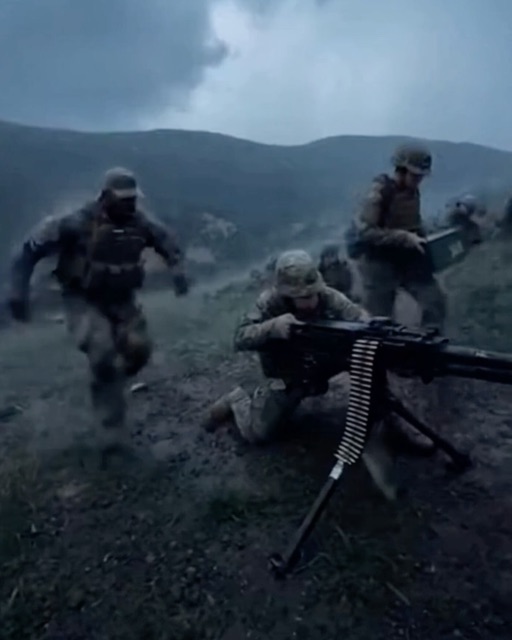
Our platoon hit the ridgeline just as the sky split open. Rain slashed sideways across the high ground, turning every patch of dirt into a steep mudslide.
We were trying to establish a support line. I was the ammo bearer. My boot lost footing on the slick rock, the machine gun tripod kicked loose, and I went skidding downhill into the dark.
I thought I was going over the edge.
But my platoon sergeant, Craig, moved uphill at a dead sprint. He threw himself flat across the slope, catching the heavy ammo can with one hand and the drag handle of my harness with the other. He stopped me right before the drop.
“I got you!” he roared, the rain pouring off his sleeves.
But as he violently yanked me backward to safety, his thick tactical glove caught the paracord tucked under my collar.
It snapped.
My dog tags, along with the small waterproof locket I was never supposed to bring on deployment, tore off my neck and clattered against the rocks. The impact popped the metal latch open.
My blood ran cold. I scrambled in the mud to cover it, but I was a second too late.
A massive flash of lightning lit up the entire ridge like daylight.
Craig didn’t look up at the rest of the gun team. He stared dead at the open locket shining in the rain.
His grip on my harness slowly loosened. Even in the freezing storm, I could see his face turn completely pale.
Because the woman smiling in that hidden photograph wasn’t my girlfriend… she was his wife, Sarah.
His knuckles were white where he gripped my gear. The look in his eyes wasn’t just anger. It was a deep, shattering betrayal that cut through the thunder and the chaos.
He let go of me completely.
I slid a few more inches, my boots finding a small, stable rock just in time. He didn’t even check to see if I was okay.
He just stood up, his face a mask of stone, and turned back to the rest of the team.
“Position secure!” he yelled, his voice strained and hollow. “Set that gun!”
The world around me faded into a muffled roar. The shouts of my squad, the hammering rain, the distant crackle of the radio – it was all just noise.
The only thing I could feel was the ice spreading through my chest. The ice that had come from my sergeant’s eyes.
We spent another hour on that ridge, setting up our observation post. Craig never spoke to me again.
He gave orders to the gunner, who then relayed them to me. I was a ghost. An invisible pair of hands meant to haul ammo and nothing more.
Every time I looked his way, he was staring into the dark valley below, his jaw set so tight I thought his teeth would crack.
The march back to the temporary base was the longest walk of my life. The rain finally stopped, but the air was thick with a new kind of storm, one that was just between the two of us.
Back at the patrol base, the tension was a physical thing. It filled our tent, suffocating the usual tired banter.
The other guys noticed immediately. They’d shoot confused glances between Craig, sitting on his cot meticulously cleaning his rifle, and me, pretending to be busy with my own gear on the other side of the tent.
No one dared to ask what happened. You don’t question a platoon sergeant when he looks like that.
For two days, I lived in a state of suspended dread. I tried to approach him once, when he was alone by the water buffalo.
“Sergeant,” I started, my voice barely a whisper.
He didn’t even turn around. He just filled his canteen, screwed the cap on, and walked away as if I hadn’t spoken.
The rejection was like a punch to the gut. I knew what he was thinking. How could he not?
A young soldier in his platoon, carrying a secret picture of his wife. There was only one conclusion to draw.
And the worst part was, I couldn’t even blame him for thinking it.
I replayed that moment on the ridge a thousand times. The locket popping open. The flash of lightning. The look of utter devastation on his face.
He had just saved my life. He had thrown himself into danger without a second thought, because that’s the man he was.
And my reward for his bravery was to show him the one thing that could destroy his world.
The isolation was crushing. The platoon was a family, and suddenly, I was an outsider. The other soldiers were wary of me, not wanting to get caught in the crossfire of whatever was happening with the sergeant.
Meals in the chow tent were silent affairs. I ate alone. I felt their eyes on me. I heard the whispers.
My mind raced with ways to fix it. Should I tell him the truth? Here? In the middle of a war zone?
It felt impossible. The story was complicated. It was personal. It was something that belonged to a world of front porches and family dinners, not mud-caked tents and the constant threat of attack.
I had promised her I wouldn’t say anything.
“Just let him get to know you as a soldier first, not as my little brother,” Sarah had said, smiling, just before I deployed. “I don’t want him worrying about you or giving you special treatment. Earn your place, Michael.”
It seemed like a good idea at the time. I wanted to prove myself. I didn’t want to be “the sergeant’s brother-in-law.” I wanted to be a good soldier, valued for my own merit.
Now, that simple, well-intentioned promise had curdled into something ugly. It had become a lie that was poisoning everything around me.
A week after the incident on the ridge, we were tasked with a reconnaissance patrol. It was a high-risk mission into a valley we knew had enemy activity.
Craig did the briefing. He stood in front of the map, his voice clipped and professional. He assigned roles, fire teams, and contingency plans.
When he got to my name, he paused for a fraction of a second.
“Michael,” he said, using my first name, which was rare and felt strangely formal. “You’re on point with Corporal Davis.”
My heart hammered against my ribs. Point man was the most dangerous position. You are the first to walk into an ambush, the first to find a trap.
It felt like a punishment. It felt like he was putting me in a place where the odds were highest.
Maybe, a dark part of my mind whispered, he wanted me out of the way for good.
I pushed the thought down. Craig was a professional. He was a good NCO. He wouldn’t intentionally put one of his men in undue danger, no matter what he thought of them personally.
Or would he? I didn’t know anymore. The man who had saved my life was gone, replaced by this cold, calculating stranger.
We set out before dawn. The air was cool and damp. Every rustle of leaves, every snap of a twig, sounded like a gunshot in the tense silence.
Davis and I moved slowly, carefully, scanning every rock and shadow. Behind us, I could feel Craig’s presence, his eyes boring into my back.
Hours passed. The sun climbed, beating down on us. We found nothing. The valley was eerily quiet.
We were making our way up a narrow, rocky pass when Davis suddenly froze. He held up a fist, the universal sign to halt.
I dropped to one knee, my rifle up, my eyes scanning the rocks above us.
Then I saw it. A thin, almost invisible tripwire stretched across the path, barely an inch off the ground. It was connected to an old artillery shell, partially buried and aimed right at the trail.
My blood ran cold. I had almost missed it. My mind had been so consumed with Craig that I was getting sloppy.
Davis slowly backed away, signaling to the rest of the platoon. I stayed put, my eyes locked on the IED.
Craig came forward, moving with a calm, deliberate pace. He knelt beside me, his eyes not on the bomb, but on me.
“You good?” he asked, his voice low and steady. It was the first time he’d willingly spoken to me in a week.
I nodded, unable to speak. My throat was too tight.
He studied the device for a long moment. “It’s a simple pressure-plate trigger. We can disarm it, but we need to clear the area first. The rest of you, fall back. Set a perimeter.”
The team melted back into the rocks. It was just me and him.
He pulled a small toolkit from his pack. He was the most experienced EOD man in our platoon.
“I need you to keep watch,” he said, his voice all business. “Call out anything you see. Anything.”
He began to work, his movements precise and economical. He never took his eyes off the shell.
The silence was deafening. All I could hear was my own ragged breathing and the soft scrape of his tools against metal.
I wanted to say something. I wanted to scream the truth at him. But the words were stuck, lodged behind a wall of fear and regret.
“She looks happy in that picture,” he said suddenly, his voice quiet and rough. He didn’t look up from his work.
The words caught me so off guard I flinched.
“She… she is,” I managed to choke out.
He stopped what he was doing and finally looked at me. The raw pain in his eyes was staggering.
“I haven’t seen her smile like that in a long time,” he said. “Not since before my first deployment. Before I changed.”
He looked back at the bomb. “I know I’m not… easy to live with when I get back. I carry things. Things I can’t talk about. I guess I pushed her away.”
He paused, his hands hovering over the wires. “I just never thought she’d look for comfort from one of my own men.”
This was it. This was my chance. The words came tumbling out, frantic and desperate.
“It’s not what you think, Sergeant. It’s not like that at all. I swear on my life.”
He gave a short, bitter laugh. “What else could it be, Michael? Don’t lie to me. Not now.”
“She’s my sister!” I finally yelled, the words echoing in the narrow pass. “Sarah is my older sister.”
He froze. His hands stilled. He slowly turned his head to look at me, his expression a mixture of complete disbelief and confusion.
“What did you just say?”
“She’s my sister,” I repeated, my voice cracking with a week’s worth of stress and fear. “I’m Michael Renner. Her maiden name. She made me promise not to tell you. She didn’t want you giving me special treatment. She wanted me to earn my place on my own.”
I fumbled in my pocket and pulled out my wallet, my hands shaking. I flipped it open to the small, plastic photo sleeve.
Inside was another picture. It was old and faded. A teenage boy with a goofy grin, his arm slung around a slightly older girl with the same bright smile as the woman in the locket. They were standing in front of a Christmas tree.
“That’s us,” I whispered. “Christmas of ’08. The year before she met you.”
Craig stared at the photo. He looked from the picture to my face, then back again. The pieces were visibly clicking into place in his mind. The resemblance was there, in the eyes, in the shape of the jaw.
He looked back at the locket, which I had retrieved and was still clutching in my hand. Then he looked at me.
The hardness in his face didn’t just crack; it completely shattered. It was replaced by a wave of shame so profound it was painful to watch.
He dropped his head, his helmet clinking against the rock. “Oh, God,” he breathed. “What have I done?”
He stayed like that for a full minute, motionless, while I watched, my heart aching for him, for me, for the terrible mess we were in.
Then he lifted his head, and his eyes were clear. “We’ll talk later,” he said, his voice thick with emotion. “Right now, let’s get out of this alive.”
He turned back to the bomb with a newfound focus, and in less than five minutes, he had it disarmed.
The patrol back was different. The ice between us had been broken, but it was replaced by a heavy, awkward silence. It wasn’t hostile anymore, just full of things that needed to be said.
That night, he found me sitting alone, staring up at the star-filled desert sky.
He sat down next to me on an empty ammo can. For a long time, he just sat there.
“My first marriage,” he began, his voice low. “It ended while I was on my second tour. Found out in a letter.”
He picked up a small rock and turned it over and over in his hands.
“She said I was a different person when I came home. That I was distant, angry. She wasn’t wrong. And she found someone else. I came home to an empty house.”
He looked at me. “When I saw that locket… all of that came rushing back. The only thing I could think was that it was happening again. That I was losing the best thing in my life because of what this job does to me.”
“I’m sorry, Sergeant,” I said. “I should have just told you from the beginning.”
“No,” he said, shaking his head. “This is on me. I let my own demons build a story that wasn’t there. I judged you. I put you in danger today because I was angry and hurt. That’s unforgivable for an NCO.”
He was right, in a way. He had put me on point. But I also knew he would have never let anything truly happen to me. The man who sprinted up a muddy ridge to save me was still in there.
“You also disarmed that bomb and got us all home,” I replied. “That’s the man I see. That’s the man my sister married.”
A small, sad smile touched his lips. He tossed the rock into the darkness.
“She’s a good woman, your sister,” he said softly.
“Yeah,” I agreed. “She is.”
From that day on, everything changed. The wall between us came down, and in its place, we started to build something new.
It wasn’t just a professional relationship anymore. We started talking. Really talking. He told me stories about him and Sarah, and I told him stories about us growing up.
The rest of the platoon saw the shift. The tension was gone. We were a team again. Stronger, even.
Two weeks later, we got access to the satellite phone for calls home. Craig stood with me while I called her.
When Sarah’s worried voice came on the line, I just smiled. “Hey, Sar. I’ve got someone here who wants to say hi.”
I handed the phone to Craig.
I watched as he spoke to her, his voice soft and full of a love I hadn’t seen before. I saw the weight of the last few weeks, and maybe the last few years, lift from his shoulders. He was laughing.
He handed the phone back to me. “Your brother-in-law says he’s sorry he’s been such a jerk,” he said, a real, genuine grin on his face.
On the other end of the line, I could hear Sarah’s sigh of relief, a sound that traveled thousands of miles to stitch our broken family back together.
Our tour ended. We came home. But we didn’t just come home as soldiers who had served together. We came home as family. Craig was no longer just my sergeant; he was my brother.
The heaviest burdens we carry are often the ones we create in our own minds. The stories we tell ourselves, born from fear and past pain, can be far more destructive than any enemy we face. It’s easy to let a misunderstanding fester into a wound, to build walls of silence and suspicion. But the truth, however difficult or complicated, has a way of tearing those walls down. It reminds us that behind the uniform, behind the assumptions, we are all just people, trying our best, and sometimes, all it takes is a single, honest conversation to find our way back to each other.



