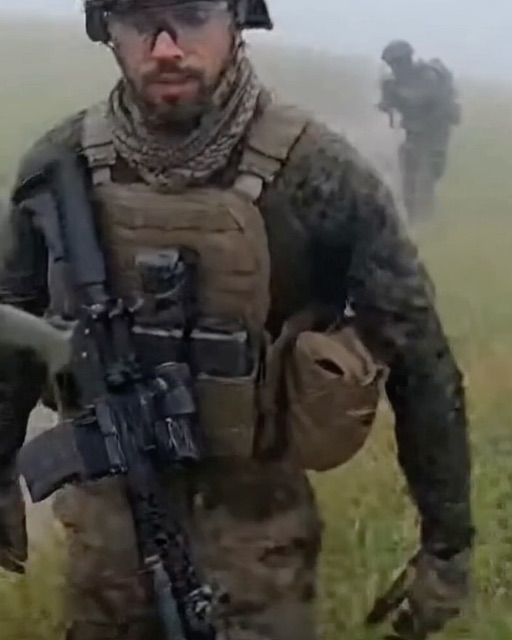
The downpour turned the pastureland into streaks of gray and silver. I couldn’t even see the guy ten feet in front of me.
My fire team was exhausted and losing form. The point man was drifting, and I was closing too fast.
“Open the interval!” our team leader, Travis, roared over the thunder, grabbing my shoulder strap before the file collapsed. “Keep visual!”
Then a gust of wind flattened the grass ahead, exposing what the heavy rain had been hiding: a massive, flooded washout cutting diagonally across our route. It was deeper and wider than the map showed, and the water was churning.
Travis made the call in one breath. We moved. Not fast. Precisely. The first two guys made it across the narrowest point.
Then it was my turn.
I jumped. But I leaped too short.
My boot hit the slick lip of the mud. My right leg dropped hard, twisting as the rushing water grabbed my calves. My rifle pitched forward, and I started sliding into the flood.
Travis lunged across the gap.
He caught my heavy plate carrier just in time, ending up half-sprawled over the washout with his own boot slipping into the open water. The other guys scrambled and locked onto his belt.
For one terrible second, all of us were balanced wrong in the rain, inches from getting swept away.
Then the line held. They hauled me over the edge and slammed me onto solid ground.
Travis rolled onto his back in the mud, soaking wet, his chest heaving. He looked us over with cold, fast eyes. “Everybody good?” he yelled.
I went to nod, but my blood ran completely cold. I couldn’t speak.
When Travis had lunged for me, the velcro on his inner chest rig had violently torn open. A small, waterproof pouch had spilled out, and a single photograph had landed face-up in the dirt between us.
My heart pounded against my ribs. Because the secret picture he was carrying into combat wasn’t of his wife… it was a picture of my wife, Sarah.
I stared at it, my mind refusing to process the image. It was an old photo, one I’d never seen before. Sarah looked younger, maybe a teenager, laughing into the camera with a freedom I hadn’t seen in years.
Travis saw my eyes lock onto it. His face, which had been full of adrenaline and relief, went completely blank.
He snatched the photo from the mud so fast it was a blur. He stuffed it back into the pouch and sealed his rig without a word.
“Let’s move,” he grunted, his voice suddenly hard as rock.
The rest of the patrol was a silent, agonizing nightmare. Every squelch of my boots in the mud was a question. Every rustle of Travis’s gear was an accusation.
He saved my life.
He was carrying a picture of my wife.
The two facts fought a war in my head, and there was no truce in sight. I kept my distance, the six feet of interval between us feeling like a mile-wide canyon.
Back at the patrol base, the world returned to a familiar rhythm of noise and routine. Men cleaning weapons, the hum of a generator, the smell of diesel and damp earth.
I tried to act normal. I stripped my rifle, cleaned the mud out of the action, and reassembled it with mechanical precision.
But my hands were shaking.
Later that night, I saw Travis on the satellite phone, talking to his wife back home. He was smiling, a genuine, warm smile.
“I love you too, Eleanor,” he said, his voice soft. “Tell the kids their dad is fine. Just another day at the office.”
My stomach twisted into a knot. I saw him as a husband, a father, a leader who had just pulled me from a watery grave.
And a man hiding a picture of Sarah against his heart.
I couldn’t sleep. The image of that photo was burned onto the inside of my eyelids. Sarah, with her hair long and wild, standing in front of a beat-up pickup truck I didn’t recognize.
Who was he to her? Who was she to him?
The questions gnawed at me for three more days. On patrol, Travis was the same as always. Focused, decisive, and professional.
He never mentioned the incident. He never mentioned the photo.
And I couldn’t bring myself to ask. I owed him my life. How do you confront the man who saved you about a betrayal you can’t even begin to understand?
My gratitude felt like a poison. It choked me.
I started to watch him, really watch him. I saw the way his eyes would sometimes glaze over when he thought no one was looking. I saw the faint, white scar that ran through his left eyebrow.
I started to see a man, not just a squad leader. A man with a history I knew nothing about.
The not-knowing was worse than anything. My mind created a thousand scenarios, each one uglier than the last. Were they having an affair? Was he some obsessed stalker?
My love for Sarah felt tainted, shadowed by a man I had to trust with my life every single day.
Finally, I couldn’t take it anymore. The silence was a weight I could no longer carry.
I found him alone by the perimeter wire, staring out into the darkness. He was cleaning his sidearm, the methodical clicks echoing in the quiet night.
My heart was hammering against my ribs. I walked up behind him, my boots crunching on the gravel.
“Sarge,” I said, my voice barely a whisper.
He didn’t turn around. He just stopped what he was doing.
“I need to ask you something,” I pushed on, the words feeling like stones in my mouth.
“I know,” he said, his voice flat and tired.
He slowly turned to face me. In the dim security light, he looked older than his thirty-something years.
“The picture,” I managed to say. “The one that fell out. It was my wife. Sarah.”
He nodded slowly, his gaze fixed on the ground between us. He didn’t deny it. He didn’t even seem surprised.
“I need to know why,” I said, my voice cracking with a mix of anger and fear. “I deserve to know why.”
He was silent for a long moment. I could hear the hum of the generator and the distant barking of a dog.
“You’re right,” he finally said, looking up to meet my eyes. “You do.”
He took a deep breath, like a man about to dive into cold water.
“I knew her a long time ago, Michael,” he began. “Before she was your Sarah. Before I was Sergeant Travis.”
He told me about a small town in Ohio, a place with one stoplight and a diner that served coffee that was too bitter. He and Sarah had grown up three houses apart.
They were high school sweethearts. The quarterback and the head cheerleader. It was a cliché, he said with a sad smile, but it was their cliché.
“She was my whole world,” he said, his voice thick with a memory that was more than a decade old. “We were going to get married, buy that old farmhouse on Miller’s Ridge, and have a bunch of kids.”
He described a life so different from the one I knew with her. A life of Friday night football games and lazy summer days by the creek.
He painted a picture of a young Sarah I had never known. Full of dreams and a fierce, untamed spirit.
“What happened?” I asked, the anger in my chest slowly being replaced by a deep, confusing ache.
“I did,” he said simply. “I happened.”
He told me he felt trapped. The town, the future, the expectations. It all started to feel like a cage. He was nineteen, stupid, and scared of a life that was already mapped out for him.
So he ran.
He joined the Army without telling her. He left a note on her porch one morning before the sun came up and got on a bus to basic training.
“It was the most cowardly thing I’ve ever done in my life,” he said, his eyes filled with a shame that was still raw. “I broke her heart because I was too afraid to tell her I was breaking my own.”
He never went back. He heard through a mutual friend a few years later that she’d moved away, gone to college, and met someone new.
He was happy for her. And he was devastated.
“The picture,” he said, tapping a finger against his chest. “She gave it to me the summer before I left. I’ve carried it ever since.”
“Why?” I asked, my voice hoarse. “Why would you carry that? To remember her?”
He shook his head, a single, sharp motion. “No. Not to remember her.”
He looked me straight in the eye, and for the first time, I saw the true weight he was carrying. It was heavier than any pack, any weapon.
“I carry it to remember him,” he said quietly. “To remember the scared nineteen-year-old kid who ran away from the best thing that ever happened to him.”
This was the twist I never saw coming. It wasn’t about her. It was about him.
“That picture reminds me every single day what I lost because I was a coward,” he continued. “It reminds me to never, ever run away from my responsibilities again. It reminds me to run toward the hard things. To be the man I should have been for her.”
His words hit me like a physical blow.
He lunged for me at the washout. He ran toward the danger to save me.
My mind reeled as the pieces clicked into place. He hadn’t just saved his soldier. He had, in some cosmic, roundabout way, saved the husband of the woman he had abandoned.
It was an act of atonement. A debt paid to a ghost.
“Did you know?” I asked, my voice barely audible. “Did you know she was my wife when I joined the unit?”
He shook his head. “Not at first. Then one day, you were showing Marcus a picture from your wallet. I saw her face.”
He said his blood ran cold. The past he had run from for over a decade was suddenly sleeping in the bunk next to his.
“I thought about requesting a transfer,” he admitted. “Running away again. But then I looked at this picture.” He tapped his chest again. “And I knew I had to stay. I had to face it. I had to make sure you were safe. For her.”
We stood there in the dark, two men bound by the love of the same woman, separated by time and a single, life-altering mistake.
The anger was gone. All I felt was a profound, aching sadness for the boy he had been and the man he had forced himself to become.
My resentment was replaced by a deep, humbling respect.
I simply nodded. There was nothing else to say. We had reached an understanding that went deeper than words.
A week later, I was on a plane, heading home for my mid-tour leave. The seventeen-hour flight felt like an eternity.
I walked through the door of our small apartment, and Sarah was there. She looked tired, but she was the most beautiful thing I had ever seen.
She wrapped her arms around me, and I held her tighter than I ever had before. I buried my face in her hair and just breathed her in.
That night, as we lay in bed, I told her everything. I told her about the flood, about Travis saving me, and about the picture.
I watched her face as I spoke. Her eyes filled with tears, but not for the reasons I expected.
She cried for the boy she had loved and lost. She cried for the man he had become. And she cried, I think, for the strange, painful, beautiful way the world works.
“I haven’t thought about him in years,” she whispered, wiping a tear from her cheek. “I hope he’s found some peace.”
I thought about Travis, thousands of miles away, staring out into the darkness with a worn photograph tucked against his heart.
He hadn’t found peace. He had chosen to carry his burden as a reminder. He had transformed his biggest regret into his greatest strength.
Lying there with my wife in my arms, I finally understood the lesson.
We all have ghosts. We all have regrets and pasts that we can’t outrun. But we get to choose what we do with them.
We can let them haunt us, or we can let them guide us. We can let them be a cage, or we can let them be a compass, pointing us toward the people we are meant to be.
Travis saved my life that day in the rain. But the truth he shared with me in the dark saved something more. It saved my understanding of forgiveness, of sacrifice, and of the complicated, messy, and incredible power of the human heart.