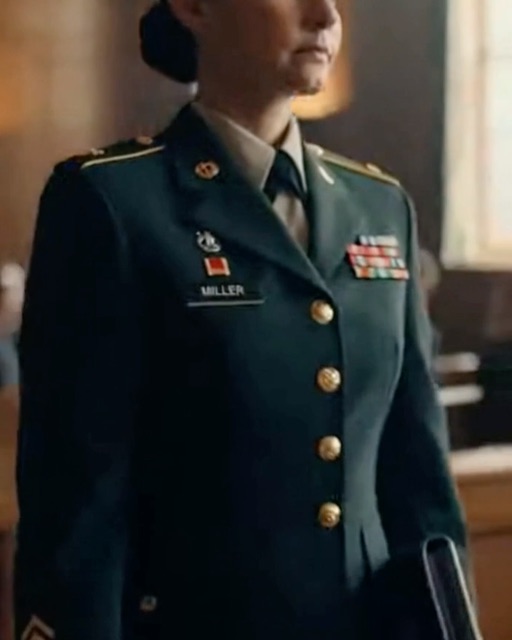
I wore my late husband’s official Army service coat to the hearing. The ribbons, the brass, the unit crest – they were all his.
When I walked through the courtroom doors, the entire room went dead silent.
A massive civic foundation was trying to dissolve his memorial scholarship fund and absorb it into their “general accounts.” They called it endowment restructuring. I called it erasing a soldier’s sacrifice.
“Ma’am, why are you appearing in official uniform today?” the judge asked, peering over his glasses.
I rested my hand on my husband’s medals. “Because the fund they want to dissolve was created in this uniform.”
Todd, the foundation’s lawyer, loudly sighed and stepped up to the podium. He claimed the merger would be more “efficient.” He smirked and asked if I realized opposing this might actually reduce the total number of students helped.
“Not every good cause should be stripped of its name to make bookkeeping easier,” I fired back.
The gallery started murmuring.
Clearly flustered, Todd aggressively clicked his projector remote. “Let me show you the proposed new plaque for the high school,” he said, pulling up a draft on the massive evidence screen. “You’ll see the wording is much cleaner.”
I looked up at the screen. My breath caught in my throat. My blood ran completely cold.
The judge saw my face and immediately stood up. “Counselor, freeze that screen right now!”
They hadn’t just removed my husband’s full Army rank to save space. I stared at the fine print at the bottom of the proposal, and my heart pounded when I realized who the new plaque was actually dedicated to.
Printed in crisp, elegant font, beneath a generic statement about civic duty, were the words: “In loving memory of Private First Class Alistair Finch.”
Alistair Finch.
The name hit me like a physical blow. He was a boy from Daniel’s platoon. A name I knew from hushed phone calls and worried letters.
“Mrs. Gable, what is it?” the judge asked, his voice softer now, sensing this was more than a clerical error.
My own voice was a hoarse whisper. “That name… Alistair Finch.”
I pointed a trembling finger at the screen. “He was in my husband’s unit.”
Todd the lawyer immediately jumped in, his tone dripping with false sympathy. “Yes, Your Honor, a tragic coincidence. Young Mr. Finch also passed away. His family are… significant benefactors to our foundation.”
He tried to make it sound noble. A gesture of consolidation.
But I knew better. The way Daniel used to say that name, with a deep, weary sigh. It was never with the respect he had for his other men. It was with frustration.
“Benefactors?” I said, finding my strength. “You mean the chairman of your foundation’s board is Alistair’s father, Robert Finch.”
Todd’s face paled slightly. The judge’s eyes narrowed, sensing the real story was just beginning to unfold.
“Your Honor,” I pleaded, my voice cracking. “I need a recess. Just a short one.”
The judge looked from my stricken face to Todd’s suddenly nervous one. He banged his gavel. “Thirty-minute recess.”
I stumbled out of the courtroom, the heavy wool of Daniel’s coat feeling like a crushing weight. I found a deserted hallway, my back sliding down the cool marble wall until I was sitting on the floor.
My hands were shaking so hard I could barely unlock my phone. I scrolled through the contacts until I found the one I needed.
Sergeant Marcus Cole.
He had been Daniel’s platoon sergeant, his best friend, the man who had delivered the folded flag to me.
He answered on the second ring. “Sarah? Everything okay?”
Tears I hadn’t let fall in the courtroom now streamed down my face. I explained everything, my words tumbling over each other. The foundation, the plaque, the name.
There was a long, heavy silence on the other end of the line. When Marcus finally spoke, his voice was dangerously quiet.
“They’re dedicating it to Finch’s boy?” he asked, a cold fury in his tone.
“They said his family are benefactors,” I choked out.
Marcus let out a short, bitter laugh that held no humor. “Benefactors. I bet they are. They’ve been buying their way out of trouble since that kid was in diapers.”
“Marcus, what is it? What am I missing?” I asked. I knew there was more. I had always felt it.
He hesitated. For years, he and the other men had held a silent pact. They protected the families. They didn’t reopen wounds.
“Sarah,” he said slowly. “The official report… it’s not the whole story.”
I held my breath. “The story of how Daniel died?”
“Yes,” he confirmed. “We were on patrol. It was supposed to be a standard sweep. Finch was on point. He was always reckless, always trying to play the hero to impress his old man.”
I could picture it. Daniel had told me Alistair was green, but cocky. A dangerous combination.
“He went off-route,” Marcus continued, his voice tight with memory. “Chased a shadow, broke protocol. Walked right into a textbook ambush.”
My hand flew to my mouth.
“Daniel saw it happen. He didn’t hesitate. He never did. He laid down cover fire, drawing their attention so the rest of us could get to Finch and pull him back.”
“He saved him,” I whispered.
“He did,” Marcus said grimly. “Daniel got him out. But in the process… he took the rounds that were meant for Alistair. Daniel gave his life to fix that kid’s stupid, arrogant mistake.”
A wave of nausea and white-hot anger washed over me. All this time, I had believed Daniel died in a random, tragic firefight. A victim of the chaos of war.
But this was different. This was a sacrifice made to correct an error. An error made by the very boy whose name was now replacing my husband’s.
“Why wasn’t this in the report?” I demanded, my grief turning into a sharp, focused rage.
“Robert Finch,” Marcus spat the name like poison. “He has friends in very high places. The story got sanitized. It was easier to report it as a standard engagement. No blame. No formal inquiries. Finch got his son’s body home without a mark on his record, and we were all ‘strongly encouraged’ to stick to the official narrative.”
The foundation wasn’t just absorbing a fund. They were finishing the cover-up. Erasing the man who died, to honor the boy who was responsible.
“They can’t do this, Marcus,” I said, a new resolve hardening my voice. “I won’t let them.”
“What are you going to do?” he asked.
“I’m going to tell the judge,” I said simply. “I’m going to tell him the truth.”
“It’s your word against a billionaire and a doctored Pentagon report, Sarah. They’ll tear you apart.”
“Then I need more than my word,” I replied, my mind racing. “I need yours. I need the platoon’s.”
There was another pause. I knew what I was asking. I was asking them to risk their careers, their reputations, to speak out against a powerful man and the official record.
“The boys were never right about how it went down,” Marcus said, thinking aloud. “It never sat right with any of us. Staying silent felt like we were letting Daniel down twice.”
He took a deep breath. “Alright. Give me a couple of hours. The hearing will probably be postponed until tomorrow morning anyway. Let me make some calls.”
The judge granted my request for a continuance until the next day, citing “new information that has come to light.” Todd and a stern-looking man I now knew was Robert Finch objected furiously, but the judge overruled them.
I spent the night sleepless, clutching Daniel’s service coat. It wasn’t just a piece of clothing anymore. It was my armor. It was his voice.
The next morning, I walked back into the same courtroom. This time, the silence was different. It was electric with anticipation. Robert Finch sat at the foundation’s table next to Todd, his face a mask of cold fury.
The judge entered. “Mrs. Gable, you indicated you have new information pertinent to this case.”
“I do, Your Honor,” I said, my voice clear and steady. “This isn’t about efficient bookkeeping. It’s about an attempt to erase the truth of a soldier’s sacrifice to protect a lie.”
Todd jumped to his feet. “Objection! The widow is making baseless, slanderous accusations!”
“Is she?” the judge asked calmly.
Just then, the grand courtroom doors swung open.
Sergeant Marcus Cole walked in, dressed in his own immaculate service uniform. His chest was covered in medals, his expression grim and determined.
And behind him, another man in uniform. And another.
One by one, five other members of Daniel’s platoon filed into the room. Men I’d met at barbecues and holiday parties. Men who had stood with me at Daniel’s funeral. They walked with purpose, their boots clicking in unison on the marble floor.
They lined up in the aisle, standing at parade rest, a silent, powerful wall of support behind me.
The gallery gasped. Robert Finch’s face went ashen. Even the judge seemed taken aback by the sight.
“Your Honor,” I said, my voice thick with emotion. “I am not alone today.”
The judge looked at the soldiers, then at me. “Sergeant Cole, would you care to approach?”
Marcus stepped forward. He didn’t offer theories or opinions. He simply stated facts. He recounted the events of that fatal day, his voice never wavering. He detailed Alistair Finch’s reckless breach of protocol. He described, in heart-wrenching detail, how Daniel had knowingly exposed himself to save a fellow soldier.
“Why did you sign an official report that contradicted this?” the judge asked.
“We were ordered to, sir,” Marcus stated plainly. “We were told it was better for the unit’s morale and to protect the families from unnecessary detail. We were told it was for the best.”
He then looked directly at Robert Finch. “But we were wrong. Staying silent doesn’t honor our brother. It dishonors him.”
One by one, the other soldiers stepped forward and corroborated the story. Each man added a small detail, painting a full, undeniable picture of what happened in that dusty valley. They weren’t just soldiers anymore; they were truth-tellers.
The foundation’s case crumbled into dust. Todd tried to object, calling it hearsay, but the unified, solemn testimony of six decorated soldiers was a force he couldn’t stop.
Robert Finch sat frozen, his empire of lies collapsing around him in a public courtroom. He had tried to buy his son a sanitized legacy, but in doing so, he had unearthed the very truth he’d worked so hard to bury.
The judge banged his gavel, the sound echoing the finality of it all.
“The foundation’s motion is denied,” he declared, his voice booming with authority. “The Sergeant Daniel Gable Memorial Scholarship will remain intact, independent, and under the sole advisement of Mrs. Gable.”
He wasn’t finished.
“Furthermore,” he continued, his gaze sternly fixed on Finch and his lawyer. “This court finds the foundation’s actions to be a malicious and deceitful attempt to manipulate a Gold Star family. I am ordering a full investigation into their financial practices and board governance.”
He then looked at the line of soldiers. “And I am personally forwarding a transcript of this testimony to the Department of the Army for a formal review of the incident report. Sergeant Gable’s actions, as described here today, sound to me like they warrant a level of recognition far greater than he received.”
Tears streamed down my face, but this time, they were tears of relief. Of vindication.
After the hearing, the soldiers gathered around me. There were no words, just hands on my shoulder, respectful nods. We had done it. We had set the record straight.
Months later, the repercussions were still unfolding. Robert Finch was removed as chairman, and the foundation was completely restructured under new leadership. The Department of the Army officially amended Daniel’s record and posthumously awarded him the Silver Star for valor.
The scholarship fund received a flood of anonymous donations, growing larger than I ever could have imagined. But the most significant change happened at the high school.
The foundation, under its new, humbled leadership, asked to install a new plaque. I went to the unveiling. It was large and made of beautiful, polished bronze.
At the top, in bold letters, it read: “The Sergeant Daniel Gable Medal of Valor Scholarship.”
Below, it told the full, true story of his final moments – a story of courage, of brotherhood, and of a selfless leader who made the ultimate sacrifice to bring one of his own men home. There was no mention of Alistair Finch. There was only the truth.
Looking at it, I realized this was never just about a name on a plaque or money in a fund. It was about the fact that a person’s legacy isn’t defined by how they died, but by how they lived, and the truth of that life is the most sacred memorial of all. Sometimes, the quietest voices, when they finally speak up together, are the ones that echo the loudest.