
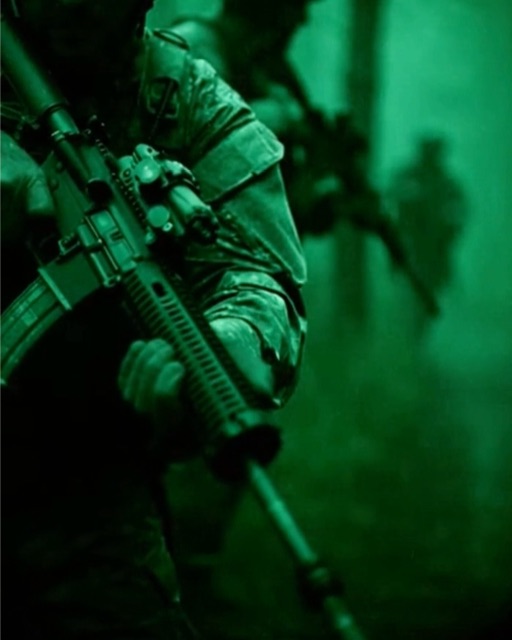
We were deep in enemy territory, blackout conditions, slogging through mud that sucked at our boots like it wanted to keep us there forever. Night vision turned everything into this eerie green glow, but it couldn’t cut through the storm rolling in – rain pelting down, lightning cracking just enough to blind us more than help.
I’m Sergeant Harlan, handler to Rex, our Belgian Malinois. That dog’s got eyes like a hawk on steroids, fitted with his own NVGs that make him see farther than any of us grunts. He’s saved my ass more times than I can count, always one step ahead.
The patrol was single file, hearts pounding under tac vests, when Rex just… stopped. Dead halt, ears perked, no whine, no alert bark. Just locked on something up ahead.
I yanked the lead tight, whispered, “Easy, boy. What you got?”
The squad leader, Corporal Peterson, crept up, his breath hot on my neck. “Wire?” I nodded, spotting the thin line glinting chest-high across the trail – IED setup, no doubt. We peeled back slow, silent, calling in EOD without a sound.
But Rex wasn’t done. His head snapped left, into the thick brush beyond the wire. A low growl rumbled from his chest, the kind that vibrates through your bones.
I followed his stare through the haze—movement. Low, human-shaped, closing fast from the shadows. No heat sig on thermal yet, like it was cloaked or crawling on its belly.
The squad fanned out, weapons up, but Rex lunged forward an inch, straining the lead. That’s when I saw it: the figure wasn’t alone. Behind it, eyes glowing in the green—more of them, flanking us.
My blood turned to ice. This wasn’t just an ambush.
It was a trap for us, and we’d walked right into the kill zone. My thumb flicked the safety off my rifle.
The air crackled with unspoken tension. Every man was a coiled spring, ready to unleash hell on whatever was hiding in that brush.
Rex, though, he did something I’d never seen before. He stopped growling.
Instead, a soft whine escaped his throat. It wasn’t a sound of aggression. It was a sound of concern.
“Harlan, what’s your dog doing?” Peterson hissed, his voice a razor’s edge.
“I don’t know, Corp. He’s never done this.” My mind was racing, trying to process the conflicting signals.
The lead dog in an ambush doesn’t whine. He barks. He snarls. He prepares to fight.
Rex was pulling gently on the lead now, trying to move toward the figure, not away from it. My gut twisted into a knot.
Something was wrong. Terribly wrong with this picture.
I held up a hand, a universal sign to hold fire. Peterson gave me a look that could curdle milk, but he trusted me, and more importantly, he trusted Rex.
Slowly, I lowered my rifle a fraction, keeping my eyes locked on the spot where I’d seen the movement. “Rex, show me,” I whispered.
The dog took a careful step forward, then another. He was a shadow moving through shadows, a master of his environment.
The main figure rose slightly. It wasn’t a soldier in full kit. It was too small, too slight.
A flash of lightning illuminated the entire scene for a split second, a brilliant, blinding white.
And in that flash, my heart stopped. It wasn’t a man.
It was a child. A boy, no older than ten, his face smudged with dirt and fear.
He was wearing rags that barely held together, and in his arms, he was clutching a bundle of something. He wasn’t holding a weapon.
The squad let out a collective, sharp intake of breath. We’d been ready to open fire on a kid.
The flanking “figures,” those glowing green eyes in the dark? They weren’t soldiers either.
As the boy stood, they moved with him. They were dogs.
Not trained military dogs like Rex. They were scruffy, skinny mutts, ribs showing even in the dim light. They flanked the boy like a royal guard, their own low growls a protective chorus.
The tripwire wasn’t for an IED. I could see it better now. It was attached to a series of tin cans filled with pebbles.
A makeshift alarm system. A child’s desperate attempt to protect his sanctuary.
Peterson lowered his rifle completely, shaking his head in disbelief. “Stand down,” he ordered, his voice thick with a mixture of relief and shame.
The boy saw our weapons lower, but he didn’t relax. He held his ground, a tiny, defiant statue in the middle of a warzone.
Rex whined again, this time a clear, pleading sound. He pulled on the lead, his gaze fixed on the bundle in the boy’s arms.
I let some slack in the lead, letting Rex guide me. “Easy, everyone. Let me handle this.”
I walked forward slowly, my hands open and visible. I kept my voice low and calm. “Hey there. It’s okay. We’re not going to hurt you.”
The boy flinched but didn’t run. His eyes, wide and dark, darted from me to Rex, then to the other soldiers.
Rex was the key. The boy’s dogs were tense, but they seemed to be watching Rex, reading his body language. My dog was a diplomat in fur.
Rex sat down, a clear sign of non-aggression. He gave a soft “woof,” a sound I knew meant he was curious, not threatened.
One of the scruffy dogs, a wiry terrier mix, took a tentative step forward and sniffed the air in Rex’s direction.
I knelt in the mud, trying to make myself smaller, less intimidating. “What’s your name?” I asked gently.
The boy just stared, clutching his bundle tighter. Then, a tiny squeak came from it.
My eyes widened. The bundle was moving. It wasn’t supplies. It wasn’t intel.
It was a puppy. A tiny, wriggling thing, no more than a few weeks old.
The boy saw my expression change. He carefully pulled back a corner of the blanket, revealing not one, but four tiny puppies, huddled together for warmth.
Rex let out another soft whine, his tail giving a slow, hesitant wag. He recognized the scent. He understood.
This wasn’t an enemy encampment. It was a nursery.
I looked back at my squad. Their faces, illuminated by the green glow of their gear, were etched with a shared understanding. The hardness was gone, replaced by something softer, something achingly human.
Peterson walked over, his heavy boots squelching in the mud. He was a hard man, forged by years of conflict, but he had kids of his own back home.
He knelt beside me, his voice surprisingly gentle. “Son, where are your parents?”
The boy looked at the ground, his small shoulders shaking. He pointed a thin finger towards a small, crudely-made mound of earth a few feet away. A pile of stones sat on top of it.
A grave.
The story clicked into place without him needing to say a word. His village, his family, all gone. The dogs, the puppies—they were all he had left.
The mother of the pups was probably one of the strays that had adopted him, or perhaps she was the family dog. And now she was gone too.
He was an orphan, protecting a litter of orphan puppies, in the middle of a place God had seemingly forgotten.
My throat felt tight. We see a lot of terrible things out here, things that can turn your heart to stone. But this… this was different.
This was a level of raw, desperate innocence that had no place in the mud and the rain and the war.
“We can’t just leave him here,” one of my men, a young private named Miller, said from behind me.
Peterson didn’t answer right away. He was the Corporal. He had to think about the mission, about protocol. Harboring a civilian, especially a child, was a logistical nightmare and a massive security risk.
“Our orders are to recon the area and report back,” Peterson said, his voice flat, trying to keep the emotion out of it. “We’re not a rescue unit.”
“With all due respect, Corp,” I said, looking him straight in the eye. “Look at him. Look at what he’s been through.”
The boy, whose name we later learned was Samir, shivered, whether from cold or fear, I couldn’t tell. One of the puppies began to cry, a high-pitched, helpless sound.
That sound seemed to break something in Peterson. He sighed, a heavy, weary sound that seemed to carry the weight of the entire war.
“Right. Protocol be damned.” He looked at the boy. “We’re taking you with us. You and your… your squad.”
Samir didn’t understand the words, but he understood the shift in tone. He watched as we began to move, not with aggression, but with purpose.
Miller shrugged off his waterproof poncho and gently draped it over Samir’s shoulders. Another soldier opened a ration pack and offered the boy a protein bar, which he eyed with suspicion before finally taking it.
The biggest challenge was the puppies. They were too small to walk, and Samir couldn’t carry them all on a long trek back.
Without a word, two of our biggest guys, burly men who could carry a hundred pounds of gear without complaint, began emptying their utility pouches. They lined them with soft field dressings, creating makeshift carriers.
They gently took the puppies from Samir, one by one, their large, calloused hands incredibly gentle. They tucked the tiny creatures inside their vests, against their chests for warmth.
Rex seemed to approve, nudging each soldier’s hand with his wet nose as they secured their precious cargo.
The trip back was surreal. We were a combat unit, armed to the teeth, moving through hostile territory while cradling newborn puppies. The scruffy dogs trotted alongside us, no longer hostile, but a part of our strange, expanded patrol.
Samir walked beside me, his small hand occasionally reaching out to touch Rex’s fur, as if for reassurance. The dog heeled perfectly, a steady, calming presence in the chaos.
When we finally made it back to the forward operating base, the guards at the gate just stared, their mouths agape. They saw a tired, mud-caked squad, a silent little boy, a pack of strays, and the unmistakable sight of a grizzled-looking Sergeant cradling a whimpering puppy.
Explaining the situation to the base commander was… interesting. He was a by-the-book officer, and our story was anything but.
Peterson stood tall and took the heat. He explained the tripwire, the initial assessment, and the discovery. He didn’t make excuses. He just laid out the facts and ended with, “Sir, leaving them there was not an option.”
The commander listened, his face an unreadable mask. He looked from Peterson to me, then at Samir, who was hiding behind my legs, and finally at the box where the puppies were now sleeping in a pile.
He was silent for a long time. Then he looked at the base medic. “Get the boy cleaned up and fed. See if any of our vets can check on those… assets.”
It was the most beautiful bending of the rules I had ever witnessed.
Over the next few weeks, the FOB transformed. Samir slowly came out of his shell. The mechanics built him a proper shelter for his dogs. The cooks always had extra food for him. He became a silent, smiling fixture around the base, a reminder of what we were all fighting for.
Rex was his shadow. The big, tough military dog had adopted the boy, and the feeling was mutual.
But we knew it couldn’t last. A military base is no place for a child. Peterson spent hours on the satellite phone, calling in every favor he had, cutting through red tape with the ferocity of a man on a mission.
And then, the first twist of fate happened. A news crew, embedded with another unit, heard the story. They interviewed Peterson and me. The story of the boy who protected the puppies, and the soldiers who protected them all, went viral.
Donations poured in. Offers of adoption for the dogs came from all over the world. But the best offer came for Samir.
A charity that resettled war orphans found him a foster family in England. A good family, with a big house and a yard.
The day Samir left was tough. He hugged every one of us. When he got to Peterson, the stoic Corporal knelt down and pulled the boy into a fierce embrace. I saw tears in the old soldier’s eyes.
He saved his last hug for Rex, burying his face in the dog’s thick fur. I gave him Rex’s spare dog tag as a keepsake.
We thought that was the end of the story. A happy ending, but an ending nonetheless. We went back to our patrols, the base got a little quieter, and the memory of the boy and his dogs started to fade into the background of our daily duties.
But fate wasn’t done with us. This is where the real twist comes in.
About a year later, our tour was over. We were back home, trying to adjust to civilian life. I had adopted Rex, of course. He was retired from service and spent his days chasing squirrels in my backyard.
I kept in touch with Peterson. He was having a hard time adjusting. The silence of the suburbs was deafening after the noise of war. He felt like he’d lost his purpose.
Then he got a letter. It was from the charity that had placed Samir. The foster situation was good, but what Samir really needed was a permanent family. He was thriving in school, learning English, but he was lonely.
The letter mentioned that Samir talked constantly about two people: a dog handler named Harlan, and a tough but kind Corporal who had saved him.
The letter was a formal inquiry. Given his role in the boy’s rescue and the connection they’d formed, would Corporal Peterson and his wife consider becoming Samir’s legal guardians?
Peterson called me the day he got it, his voice choked with emotion. He said it felt like a sign, like a new mission he was meant for. His own kids were grown and out of the house. He and his wife had so much love left to give.
They said yes.
They started the long, complicated process of international adoption. Six months later, I drove with Rex to the airport to welcome Samir to his new, permanent home.
When the boy came through the gate, he was no longer the scared, dirt-smudged child from the jungle. He was clean, healthy, and smiling. But his eyes were the same.
He saw me, and his smile widened. Then he saw the big Malinois sitting patiently by my side.
“Rex!” he yelled, and ran.
The dog met him halfway, tail wagging furiously, covering the boy’s face in happy licks. It was a reunion a year in the making, a bond that had crossed continents and transcended war.
Peterson and his wife stood there, tears streaming down their faces. The man who had once been a hardened soldier, who had almost given the order to fire on this child, was now his father. He had found his purpose not on the battlefield, but in the quiet, profound act of giving a boy a home.
In the end, that night in the jungle wasn’t about an ambush or an enemy. It was about finding humanity in the most inhumane of places. It taught me that sometimes the greatest acts of bravery don’t involve firing a weapon, but opening your heart.
Rex didn’t just spot a tripwire that night. He sensed a cry for help. He saw a lonely boy and a litter of helpless puppies, and he alerted us not to a threat, but to a chance to do something good. He reminded us that beneath the uniform, we are all just human, and that our true mission, in any conflict, is to protect the innocent. That’s the real victory.



