
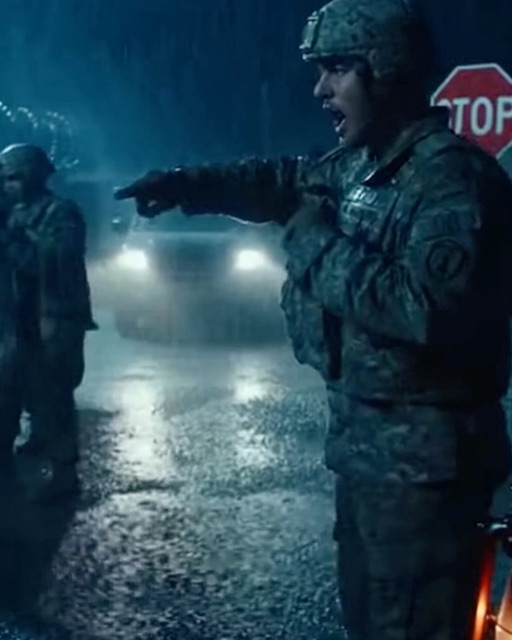
The rain was hammering the Hesco walls so hard we couldn’t hear ourselves think. It was 2 AM at Checkpoint Seven, and my squad was doing routine searches on civilian support vehicles pushing through the rural training corridor.
It was miserable, freezing work. But it was under control.
Until the inspection lantern blew out.
The whole search table plunged into wet, heavy darkness.
“Stop!” my squad leader, Derek, yelled at the next truck rolling up.
But the driver didn’t stop. He hesitated, then the engine revved. The truck lurched forward, blowing right past the painted stop line.
Derek slipped on the wet gravel and went down hard on one knee – directly in front of the massive bumper.
My blood ran cold. I didn’t think. I just stepped into the blinding headlights, planted my boots, and slammed both hands onto the wet hood, screaming at the top of my lungs.
The brakes shrieked. The truck stopped dead, inches from Derek’s chest.
Furious, I marched around to the driver’s side and ripped the door open. The driver was shaking, hiding his face in his hands, stammering about being confused in the dark.
“Engine off! ID! Now!” I barked, clicking on my red-lens flashlight.
He handed me a soaked plastic card with a trembling hand.
I expected some scared, overworked local contractor. But when my flashlight beam hit the name and the photo on that ID, my jaw hit the floor.
I stepped back, my heart pounding in my ears.
Because the man sitting in the driver’s seat wasn’t a civilian contractor… he was General Marcus Wallace.
Four stars. Commander of the entire regional training authority.
The photo on the ID was from a few years ago. The man in the picture looked sharp, imposing, with eyes that could cut through steel.
The man in the driver’s seat just looked old and tired.
My fury evaporated, replaced by a cold, stomach-churning dread. A dread mixed with something else, something hot and familiar.
Rage.
Derek was on his feet now, limping over, his face a mask of confusion. “What’s going on, Sam? Who is it?”
I couldn’t speak. I just held the ID out, my hand shaking almost as badly as the General’s had been.
Derek took the card and his own flashlight beam danced across it. His posture changed instantly. He snapped to attention, a perfect salute, even with the rain dripping off his helmet.
“General, sir! My apologies!”
General Wallace finally lowered his hands from his face. He looked from Derek to me, his expression unreadable in the strobing mix of my red light and Derek’s white one.
“At ease, Sergeant,” he said, his voice raspy. “Is your man alright?”
He was looking at Derek’s knee.
“I’m fine, sir,” Derek said quickly. “Just a slip. Are you… are you okay, sir?”
The question hung in the air. Why was a four-star general driving a beat-up supply truck alone at 2 AM in a storm?
But I didn’t care about that. All I could see was the face that had haunted my family’s dinner table for eight years.
The name that was synonymous with the worst day of my life.
I found my voice, and it was rougher than the gravel under my boots.
“What are you doing here?”
Derek shot me a look that could have melted lead. “Private!” he hissed.
General Wallace ignored him. His eyes, weary as they were, locked onto mine. There was a flicker of something in them. Recognition?
“Soldier,” he said, his voice level. “I could ask you the same question, but you’re at your post. As I should be.”
“That’s not an answer,” I shot back, taking a step closer to the truck door.
“Sam, stand down!” Derek ordered, putting a hand on my chest. “That’s a direct order!”
I barely felt him. My world had shrunk to the space between me and the man in that truck. The man who was a captain when my brother, Michael, served under him.
The man who sent my brother home in a box.
“You have no right,” I said, my voice dropping to a near whisper, thick with years of stored-up poison. “You have no right to wear that uniform.”
The silence that followed was heavier than the storm. The rest of my squad had gathered behind Derek, their faces pale and confused in the gloom. They just knew I was committing career suicide.
General Wallace didn’t get angry. He didn’t pull rank. He just sighed, a deep, tired sound that seemed to carry the weight of the whole world.
“You’re Private Samuel Peterson, aren’t you?” he asked quietly. “Michael’s little brother.”
Hearing him say my brother’s name was like a lit match on gasoline.
Before Derek could stop me, I lunged forward. I didn’t mean to hit him, I just wanted to… I don’t know what I wanted.
Derek and two other guys grabbed me, hauling me back as I yelled things I couldn’t even process. It was just a torrent of pain and anger, words I’d rehearsed in my head a thousand nights when I couldn’t sleep.
The base Military Police arrived a few minutes later. They were professional, quiet. They spoke in hushed tones with the General, who had finally gotten out of the truck.
He never took his eyes off me.
They put me in the back of their vehicle. As we drove away from the checkpoint, I saw General Wallace walking over to Derek, placing a hand on his shoulder and making sure he was really okay.
The sight of it made me sick.
The next twelve hours were a blur. I was processed, placed in a holding room, and left alone with my thoughts. I figured my career was over. Dishonorably discharged for insubordination and threatening a General officer.
I almost didn’t care. For a moment, back there, I had said what needed to be said.
Late in the afternoon, a First Sergeant I’d never seen before opened my door. “On your feet, Peterson. The Base Commander wants to see you.”
This was it. The final nail in my coffin.
He walked me across the base to the main headquarters building, a place I had only ever seen from the outside. We went down a long, polished hallway to a large wooden door. The Sergeant knocked once, then opened it and gestured for me to go inside.
I stepped in and braced myself.
The office was large, with flags standing in the corners and plaques covering the walls. But the big oak desk was empty.
General Wallace was sitting in one of the two smaller chairs in front of the desk. He was out of his wet gear and in a clean uniform, but he looked even more exhausted than he had last night.
There were two steaming mugs of coffee on the small table between the chairs.
“Close the door, son,” he said gently. “Please. Have a seat.”
I hesitated, then slowly shut the door. I didn’t sit down. I stood at attention, my eyes fixed on a point on the wall just over his head.
“I’m not here to discipline you, Private,” he said. “Though by all rights, I should.”
He gestured to the chair again. “Please. My back isn’t what it used to be. It would be easier if we were at eye level.”
Reluctantly, I sat on the edge of the chair. It felt wrong. It felt like a trap.
“I was driving that truck because we’ve had reports of our contractors selling supplies off-base,” he explained, as if we were just having a casual chat. “I wanted to see the process for myself, see where the holes were. No fanfare. No warning. I guess I got my answer. Your squad runs a tight checkpoint.”
He took a slow sip of his coffee.
“You showed incredible bravery last night, Peterson. You saw your squad leader in danger and you didn’t hesitate. You acted. That’s the mark of a good soldier.”
I didn’t say anything. I wouldn’t let his praise soften me.
He put his mug down and leaned forward, his elbows on his knees. The four-star general disappeared, and I was just looking at a man with sad eyes.
“I know what you think of me,” he said. “I know what your family thinks of me. I’ve read the letters your father sent to his congressman.”
My jaw tightened.
“You believe I was reckless. That I sent your brother’s fire team into an ambush out of sheer incompetence. That his life was wasted.”
“It was,” I said, the word tasting like acid.
He nodded slowly, accepting the blow. “The official report supports that conclusion. A captain making a bad call. A tragic, but avoidable, loss.”
He paused, and looked at me so intently I felt like he was seeing right through my soul.
“The official report,” he said, “is a lie.”
I stared at him, my mind refusing to process the words.
“Not a complete lie,” he continued, “but a simplified one. One designed to give closure. One designed to make a hero’s death seem less… complicated.”
He leaned back and rubbed his face.
“We weren’t on a routine patrol, Sam. We were chasing actionable intelligence on a high-value target. But the intel was bad. It was a setup. They weren’t waiting for us where we expected. They were dug in a half-mile south, on a ridge overlooking our only route of retreat.”
He described the scene in crisp, professional detail, but his voice was strained. The sudden, overwhelming fire. The chaos. Two men hit in the first thirty seconds. They were completely pinned down, a dozen of them trapped in a shallow ditch with no cover.
“They had us bracketed,” he said. “It was only a matter of minutes before they wiped us all out. We couldn’t call for air support, our radio man was one of the first hit. We couldn’t move back. We couldn’t move forward.”
He stopped, taking a shaky breath.
“It was your brother who saw it. A small culvert under the road, about fifty yards from our position. It was our only chance. If one person could lay down enough suppressive fire from the far side of that road, it might draw their attention long enough for the rest of us to pull back to better cover.”
My heart started to pound. I knew where this was going.
“It was a suicide mission,” General Wallace said, his voice cracking for the first time. “A guaranteed one-way trip. I refused. I told him no, we’d find another way.”
He looked down at his hands.
“And your brother, Sergeant Michael Peterson, looked me right in the eye. He said, ‘With all due respect, Captain, there is no other way. Let me save these men.’ He wasn’t asking for permission. He was telling me his decision.”
Tears were welling in my eyes, blurring the General’s face.
“I gave him the order,” Wallace whispered. “It was the hardest thing I’ve ever done. And it worked. He drew their fire. He laid down hell on that ridge and every enemy gun turned on him. We pulled our wounded out. All ten of us who were left made it out of that ditch because of him.”
He finally looked up at me again, and I could see the tears tracking down his own face.
“We wrote the official report the way we did for a reason. To spare your parents the agony of the choice. It’s easier to blame a foolish captain than to live with the knowledge that your son chose to die.”
He reached into his breast pocket and pulled out a small, worn envelope, yellowed with age. It was wrapped in a plastic baggie.
“He gave me this the night before. He told me to hold onto it. He said if my decision ever came into question, to give it to your family.”
He slid it across the table. My name was on the front, in my brother’s familiar, messy script.
My hands were trembling so badly I could barely open it. The letter inside was short.
‘Sammy,
If you’re reading this, it means I didn’t make it back. And it probably means Captain Wallace is taking the heat for it. Don’t let him. Don’t be angry. I saw a chance to make sure our guys got to go home, and I took it. It was my choice. Be good to Mom and Dad. Look after them. You’re the man of the house now.
– Mike’
I read it three times, the words swimming in a blur of tears. It was his voice. His words. The anger that had been a part of me for so long, that had defined my decision to enlist, to follow in his footsteps… it didn’t just fade. It was ripped out of me, leaving a hollow, aching space behind.
I finally understood. The weight I had been carrying was hate. The weight General Wallace had been carrying was the memory of my brother’s choice. His burden was so much heavier than mine.
We sat there in silence for a long time. The only sound was me trying to choke back my sobs.
“He saved my life that day,” Wallace said quietly. “All our lives. There hasn’t been a single day in eight years that I haven’t thought about him. About the man he was.”
He cleared his throat. “I saw that same man in you last night, Peterson. That same instinct to protect your own, no matter the cost. That’s not something you can teach.”
When I could finally speak, my voice was a hoarse whisper. “I’m sorry, sir.”
“There’s nothing to be sorry for,” he said, shaking his head. “You were defending your brother’s memory. There’s no fault in that.”
He stood up and walked to the window, looking out over the base.
“Your file says you’ve been putting in for Special Forces selection. You’ve been denied twice. Deemed ‘too volatile’.”
He turned back to me. “I don’t see volatile. I see fire. It just needs to be aimed in the right direction. I’m going to make a call. Your next packet will be approved. Whether you pass the course or not… that will be up to you.”
I was stunned into silence. He was giving me a future, right after he’d completely rewritten my past.
My life didn’t magically get easy after that day. The grief for my brother was still there, but now it was different. It was cleaner, tinged with a fierce pride instead of a bitter anger.
General Wallace and I never became friends, that would have been too strange. But a quiet understanding passed between us. I saw him a few times over the years, a quick nod across a parade ground, a brief handshake at a promotion ceremony. It was enough.
He had given me back my brother. He had given me a purpose. And I learned the most important lesson of my life in that office.
We live our lives based on the stories we tell ourselves. But sometimes, those stories are wrong. We build walls of anger and resentment around people, never knowing the incredible burdens they carry, the impossible choices they’ve had to make. The truth is often more complicated, more painful, and more beautiful than the fiction we create. True strength isn’t in holding a grudge. It’s in having the courage to tear down those walls and see the person on the other side.



