
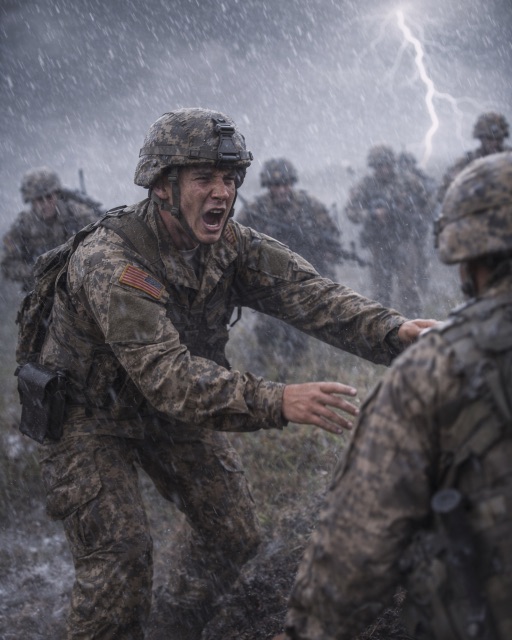
Rain cut across the field in hard silver lines. We were two bad decisions away from becoming a panicked, wet crowd with rifles.
I was an active-duty Army lieutenant trying to keep my platoon moving through a blinding storm. We had to reach the overwatch position on the ridge before dark. But the line broke. The left squad drifted too far, right into a low swale.
Then lightning flashed, revealing the real problem.
A massive, flooded drainage wash had opened up exactly where my left squad was stepping.
The point man, Gary, caught it too late. He went down hard into the rushing water. The soldier behind him slammed into his back. The whole file started to collapse.
My heart pounded. I sprinted through the standing water, throwing myself into the left squad’s path to physically block the next two guys from going over the edge.
I grabbed Gary’s webbing to haul him out of the trench. But he wasn’t trying to climb up. He was staring at the eroded mud bank, his hands shaking.
“Sir,” he choked out over the rain. “Look what the water uncovered.”
He reached into the clay and pulled out a heavy, tarnished lockbox. I dragged him up to the safe ground, took the box from his hands, and wiped the thick mud off the brass plate bolted to the lid.
My blood ran cold. The engraved name didn’t belong to a fallen soldier or an old training casualty. The name on the buried box was…
Sgt. Daniel Thorne.
My father’s name.
The world seemed to tilt on its axis. The rain, the wind, the shivering soldiers – it all faded into a dull roar.
My father had been a sergeant. He had been Daniel Thorne. But he was a motor pool mechanic who served his time two states away, on a dusty base in the desert.
He’d never set foot on this soggy training ground in the woodlands of the East Coast. Or so I had always been told.
“Sir? Lieutenant Thorne?” Gary’s voice pulled me back. “Are you okay?”
I clutched the box to my chest, its cold metal seeping through my wet uniform.
“I’m fine,” I managed, my voice hoarse. “Let’s get everyone moving. Now.”
The rest of the exercise was a blur. I went through the motions, my mind a thousand miles away, fixed on the impossible object in my rucksack. We reached the ridge, set up our position, and waited out the storm.
Every rustle of my pack reminded me of what was inside. It felt heavier than its physical weight, like it was filled with unanswered questions.
Back at the barracks, after the debrief and the weapon cleaning, I finally had a moment alone. I sat on my bunk, the mud-caked box on the floor in front of me.
It was an old military-issue footlocker, but smaller, more personal. The lock was thick and rusted. There was no keyhole, just a three-digit combination dial, frozen with grime.
I spent an hour cleaning it, carefully picking the dried mud from the dial. My father died of a heart attack when I was fifteen. He was a quiet man, a loving father, but a closed book when it came to his time in the Army.
“I fixed trucks, son. That’s all,” he’d say, and that would be the end of it.
My mother confirmed it. He was a master with a wrench, not a rifle. His service was honorable but uneventful.
This box suggested otherwise. Buried in the mud of a place he’d supposedly never been.
I tried the combinations I could think of. His birthday. My birthday. My mom’s. The year he enlisted. The year he died. Nothing. The lock wouldn’t budge.
Frustration gnawed at me. I was holding a piece of my father’s secret life, and I couldn’t get inside.
Days turned into a week. The box sat in my wall locker, a silent testament to a man I was beginning to realize I never truly knew.
I called my mom one evening.
“Mom,” I started, trying to sound casual. “Dad never mentioned serving at Fort Jackson, did he?”
There was a pause on the line. “No, honey. Never. It was always Fort Irwin. Dust and more dust, he used to say. Why do you ask?”
“Just something a guy in my unit said. Must have been a different Thorne.” I couldn’t bring myself to tell her about the box. Not yet. It would only worry her.
That night, I dumped the contents of my own old keepsake box onto my bed, searching for inspiration. Old photos, a lucky coin, a few letters.
And then I saw it.
It was an old, bent dog tag. Not a real one. It was a cheap replica he’d bought me at an airshow when I was a kid. I had worn it until the chain broke.
I picked it up. My name, Marcus Thorne, was stamped on the front. On the back, something he had added himself with a clumsy engraving tool.
He’d told me it was my lucky number. Three digits.
3-8-1.
My breath hitched. It couldn’t be that simple, could it?
I rushed to my locker, pulled out the heavy box, and my trembling fingers turned the dials. Click. Click. Click.
With a heavy thud, the lock sprang open.
My heart hammered against my ribs. I lifted the lid. The air that escaped smelled of old paper and mildew.
Inside, there was no treasure. No money, no valuables. Just a stack of letters tied with twine, a small, leather-bound journal, and a single, official-looking dog tag that was not my father’s.
I picked up the dog tag first. The name stamped on it was Alistair Finch.
I didn’t know anyone by that name.
I opened the journal. The first page was dated twenty-five years ago, written in my father’s familiar, neat block lettering.
It was a chronicle of his time here, at this very base. My mother was wrong. Or she had been lied to. My father had been here.
His entries started out normal. Descriptions of training, complaints about the food, notes about his friends. One name appeared more than any other: Alistair Finch.
They were inseparable, two sides of the same coin. My father, the quiet, steady mechanic. Alistair, the fiery, ambitious infantryman destined for great things.
As I read, the tone of the journal shifted. It grew darker, more frantic. It all centered on a single event: a live-fire exercise that went horribly wrong.
A mortar round had landed short, injuring three soldiers. Not critically, but it was a serious breach of protocol.
An investigation was launched, led by an ambitious young officer, a Major Harrison.
According to my father’s journal, the fault lay with faulty ordnance, a batch of rounds that had been mislabeled by the depot. But Major Harrison needed a scapegoat to close the case quickly and avoid a black mark on his own record.
He chose Alistair Finch.
Alistair had been the one to call in the fire mission. Harrison claimed Alistair had botched the coordinates, that he was reckless. He fabricated reports, coerced witnesses.
My father knew it was a lie. He had been there. He saw the crate the rounds came from. He knew Alistair was meticulous, one of the best soldiers in the battalion.
He fought it. He went to the chain of command, presenting his own testimony. But he was just a sergeant, a mechanic. Harrison was a major with connections.
My father was shut down, told to drop it or face charges of insubordination.
Alistair Finch was dishonorably discharged. His career was over, his name a stain in the records. A man’s life, ruined over a lie.
The last entry in the journal was heartbreaking.
“I failed him,” my father wrote. “I couldn’t make them listen. But I have the truth. The letters from the others who were too scared to speak up. The tag from the faulty crate I pocketed when no one was looking. I’m burying it all. Here. In this place where it happened. One day, the ground will give up its secrets. One day, the truth will come out. This is my promise to you, Alistair. I will not let a lie be the end of your story.”
Tears streamed down my face. My quiet, simple father had been a warrior of a different kind. He had fought for his friend’s honor and lost. He buried the evidence, a time capsule of truth, hoping that one day, somehow, it would be found.
And then his son, a lieutenant in the same army, had stumbled upon it by a one-in-a-billion chance.
The next day, I started digging. I searched the Army archives for Alistair Finch. I found him. Dishonorably discharged, just as the journal said. His last known address was in a small, forgotten town a few hours’ drive from the base.
Then I searched for Major Harrison.
My blood turned to ice. He was still in the service. He wasn’t a major anymore. He was Colonel Harrison.
My current battalion commander. The man I reported to.
The man who had just commended me for my leadership during the storm.
The world felt small and suffocating. The snake who had ruined Alistair’s life and broken my father’s heart was now my boss. The irony was so cruel it was almost laughable.
What was I supposed to do? Walk into the office of a decorated colonel and accuse him of a cover-up from twenty-five years ago based on a journal I found in the mud?
He would crush me. My career would be over before it truly began.
I thought about my father. About his quiet strength. About the promise he made in that journal. He had tried to do the right thing and was silenced. Now, the truth was in my hands. His legacy wasn’t in his quiet life after the Army; it was right here, in this box.
I couldn’t let it be for nothing.
That weekend, I drove to the town where Alistair Finch was supposed to live. I found a small, run-down house with a neat but weary garden out front.
An old man with a tired face and haunted eyes answered the door. He walked with a limp.
“Mr. Finch?” I asked, my voice unsteady.
“Who’s asking?” he said, his tone wary.
“My name is Lieutenant Marcus Thorne. My father was Sergeant Daniel Thorne.”
The man’s eyes widened. He stared at me for a long moment, as if seeing a ghost. Then he slowly opened the door. “You’d better come in,” he said.
We sat in his small living room, surrounded by faded photographs. I told him everything. About the storm, the ravine, finding the box. I took out the journal and the letters.
As I spoke, I saw decades of bitterness and pain melt away from his face, replaced by a flicker of disbelief, and then, a dawning of hope.
He told me his side of the story. The cover-up had destroyed him. He couldn’t find work. His reputation followed him. He had lived a small, quiet life, always under the shadow of a lie.
“Your father,” he said, his voice thick with emotion. “He was the only one who believed me. The only one who fought for me. I thought that fight died with him.”
“It didn’t,” I said, my voice filled with a conviction I didn’t know I possessed. “It’s just been waiting.”
With Alistair’s blessing, I took the box and its contents to the Inspector General’s office, bypassing my own chain of command. I laid out the journal, the sworn letters from other soldiers my father had collected, and the mislabeled ordnance tag. I told them the entire story.
An official investigation was launched, a quiet, internal affair at first.
Colonel Harrison must have heard about it, because he called me into his office a week later. The friendly demeanor was gone. His eyes were cold and hard.
“Lieutenant,” he began, his voice dangerously low. “I hear you’ve been digging up ancient history. Spreading wild accusations.”
I stood at attention, my gaze locked on his. “I presented evidence, sir. The truth doesn’t get old.”
He laughed, a short, ugly sound. “A dead man’s diary and the ramblings of a disgraced soldier? That’s not evidence, Thorne. It’s a fantasy. I advise you to drop this. For the good of your career.”
It was the same threat he had used on my father. But my father didn’t have the proof I held.
“With all due respect, sir,” I said, my voice steady. “My father’s honor and the honor of a soldier you wronged are more important than my career.”
His face turned purple with rage, but he said nothing more. He just dismissed me with a flick of his hand.
The investigation took months. But my father had been thorough. The letters, when cross-referenced with old service records, were damning. The ordnance tag was the smoking gun, its lot number matching a batch that was later recalled for defects.
The truth, buried for a quarter of a century, had finally come to light.
Colonel Harrison was given a choice: face a full court-martial and public disgrace, or quietly retire. He chose retirement. His career ended not with a bang, but with a shameful, silent whimper.
The most important result, however, came in a simple manila envelope delivered to Alistair Finch.
Inside was a letter from the Department of the Army. It was a full, formal apology. His discharge was officially changed from dishonorable to honorable. He was awarded all of his back pay and benefits.
His name was cleared. His honor was restored.
I was there when he opened it. The old soldier sat at his kitchen table and wept, not with sadness, but with the profound relief of a man who had carried an impossibly heavy burden for half his life and was finally able to set it down.
He looked at me, his eyes shining. “Your father kept his promise,” he whispered.
In that moment, I understood my inheritance. It wasn’t a house or money in the bank. It was this. It was a legacy of quiet courage, of unshakeable integrity.
My father was never just a mechanic who fixed trucks. He was a man who stood for what was right, even when he stood alone. He had planted a seed of truth, trusting that, one day, it would find the right soil to grow.
Some lessons aren’t taught in a classroom or a training field. They’re passed down, heart to heart, from one generation to the next. The most important duty we have is not just to the flag we serve, but to the people we serve with, and to the truth, no matter how deep it’s been buried.



