
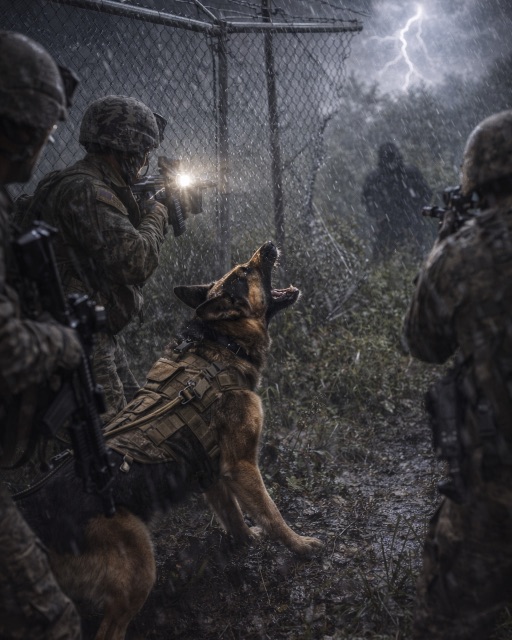
The rain was coming down in sheets, but my working dog, Buster, didn’t care. He suddenly went completely rigid.
We were doing a routine perimeter sweep of the base after a massive storm.
At first, I thought he was alerting to a damaged chain-link panel. Sergeant Russell shined his light on the metal seam. “That’s not storm damage,” he muttered. “That’s been cut.”
Someone had intentionally sabotaged the fence line.
My blood ran cold. But Buster wasn’t looking at the cut fence anymore. He whipped his head toward the deep brush and started barking viciously.
The entire patrol team shifted. Four rifles came up at once, aimed dead at the soaking wet tree line.
“Come out with your hands up!” Russell roared over the thunder.
Nothing moved.
Then, a massive flash of lightning lit up the sky. In the split-second of white light, we all saw it: a human shape, crouched in the mud, hiding behind a fallen utility pole.
My heart pounded against my ribs. I pulled Buster tight, kept my weapon raised, and stepped into the thick brush.
“Don’t move!” I yelled, grabbing the soaked figure by the shoulder and yanking them around.
But the moment my flashlight hit their face, I froze.
It wasn’t a saboteur or a spy. And the object they were desperately clutching to their chest made my jaw hit the floor.
Because the person shivering in the restricted zone was an old woman. She couldn’t have been a day under eighty.
Her face was a roadmap of wrinkles, etched with fear and a strange, stubborn determination. Rainwater streamed down her thin, white hair, plastering it to her scalp.
And the object she was holding, wrapped in a plastic grocery bag, was a thick, leather-bound photo album.
My mind reeled, trying to make sense of the scene. The cut fence. The vicious barking from my highly trained military dog. The terrified old woman in the mud.
“Ma’am?” I said, my voice suddenly losing its authority. I lowered my rifle slightly.
Russell came up behind me, his own flashlight beam falling on her. “What in the world?” he breathed.
The woman didn’t say a word. She just shivered, her knuckles white as she gripped the album. Her eyes, pale and watery, darted from me to Russell, then to Buster, who had stopped barking and was now whining softly, his ears twitching.
It was Buster’s change in demeanor that really hit me. He was trained to detect hostility, aggression, and fear. He was seeing the fear, but the hostility he’d sensed was gone, replaced by a confused curiosity.
“Let’s get her out of the rain,” I said, making a decision. “We can sort this out back at the command post.”
We helped her to her feet. She was surprisingly frail, and her worn-out sneakers were caked in thick, red mud. She stumbled, and I caught her arm to steady her. She felt as light as a bird.
The walk back was silent, broken only by the squelch of our boots and the distant rumble of thunder. The woman never let go of her precious album.
We took her to the small, sterile infirmary first. The base medic, a no-nonsense woman named Corporal Diaz, took one look at the shivering woman and went into action. She wrapped her in warm blankets and checked her vitals, clucking her tongue about pneumonia.
All the while, the woman remained mute. She just stared at a blank spot on the wall, clutching her book.
Major Davies arrived a few minutes later. He was the base commander, a man who valued order and procedure above all else. His face was a thundercloud, darker than the storm outside.
“Sergeant, explain this to me,” he said, his voice low and dangerous. “You found a civilian inside the perimeter next to a deliberately cut fence?”
“Yes, sir,” Russell said, standing ramrod straight. “She’s not talking.”
The Major looked at the old woman, who seemed to shrink even smaller under his gaze. He was a big man, and his uniform, covered in ribbons and insignia, was intimidating.
“Ma’am,” he began, his tone sharp. “I need you to understand the gravity of your situation. You have breached a secure military installation. That is a federal offense. I need your name, and I need to know why you are here.”
She flinched at the harshness of his voice but still said nothing. Her chin quivered, but her eyes held that same flicker of unyielding resolve.
I felt a pang of sympathy. She reminded me of my own grandmother, who had that same quiet strength.
“Sir, with all due respect,” I chimed in, stepping forward. “Maybe a gentler approach? She’s clearly terrified.”
Major Davies shot me a look that could freeze water. “Corporal, your job is to handle the dog. My job is to handle base security. Do we understand each other?”
“Yes, sir,” I mumbled, stepping back.
But I couldn’t shake the feeling that we were handling this all wrong. This wasn’t a criminal. This was a story we didn’t understand.
They moved her to a small, featureless interview room. A “soft room,” they called it, but it was still just a box with a table and two chairs. I was posted outside the door with Buster. I could hear the Major’s and Russell’s muffled voices trying to get answers from her, but she remained silent.
After an hour, they gave up. Russell came out, shaking his head in frustration. “It’s like talking to a brick wall. We ran her photo through the system. No flags, no warrants. She’s a ghost.”
“She’s not a ghost,” I said. “She’s just a scared old lady.”
“Who carries wire cutters in her handbag?” Russell retorted. “We found them in her coat pocket. This was planned, Sam.”
That new piece of information stumped me. Why would this frail woman plan to break into a military base?
The Major decided to hold her overnight, hoping she’d be more cooperative in the morning. She was given a cot and a meal, which she barely touched.
I couldn’t sleep that night. The image of her face, illuminated by the lightning, was burned into my mind. On a hunch, I went back to the infirmary.
“Diaz,” I asked, “when you checked her over, did you see anything unusual? Any old scars, tattoos, anything?”
Diaz thought for a moment, sipping her coffee. “No, nothing like that. But her hands… they were soft, but the knuckles were red and a little swollen. Like arthritis. And she had dirt crammed deep under her nails. Not just surface mud. It looked like she’d been digging with her bare hands.”
Digging. The detail stuck with me.
The next morning, I had an idea. It was against protocol, but my gut was screaming at me. I walked over to the holding area, with Buster at my heel. The guard at the door, a young airman, looked at me quizzically.
“The Major wants me to try something,” I lied. “See if the dog can get a reaction.”
The airman, too green to question me, unlocked the door.
I entered the room. The old woman was sitting on the edge of the cot, the photo album resting on her lap. She looked up, her eyes filled with weariness, but not surprise.
I didn’t say a word. I simply unclipped Buster’s leash.
Buster, who had been trained for years to be aggressive toward unauthorized personnel, did something I’d never seen before. He walked slowly toward the woman, his tail giving a few tentative wags. He stopped at her feet, looked up at her, and laid his big head gently on her knee.
The woman’s composure finally broke. A single tear traced a path down her wrinkled cheek. Her hand, trembling slightly, came down to rest on Buster’s head, stroking his fur.
“His name is Buster,” I said softly, sitting in the chair opposite her.
She looked at me, her first real eye contact. “My Frank,” she whispered, her voice raspy from disuse. “He loved dogs. German Shepherds, just like this one.”
It was the first crack in the wall of silence.
“Who’s Frank, ma’am?” I asked gently.
“My husband,” she said. Her gaze drifted to the album on her lap. “My late husband.”
Slowly, painfully, the story started to come out. Her name was Eleanor Vance. And the ground beneath our feet, the very concrete and steel of the base, held the last piece of her heart.
“This wasn’t always a military base,” she explained, her voice gaining a little strength. “Long before any of you were born, this was farmland. My family’s farm.”
She opened the photo album. The pages were yellowed and brittle. She pointed to a faded black-and-white photo of a young, smiling couple standing in front of a small, white farmhouse. A large oak tree stood beside it.
“That’s me and Frank,” she said, a sad smile touching her lips. “And that was our home. Right over there.” She gestured vaguely in the direction of the perimeter fence.
“The government bought the land during the expansion in the fifties,” she continued. “We had to move. It was for the country, they said. We didn’t fight it.”
Her story was piecing together the ‘what’, but not the ‘why’. “Mrs. Vance,” I asked carefully, “why did you cut the fence? Why now?”
She turned a page in the album. There was a photo of a young man in a crisp army uniform. Frank. He looked so young, full of life and promise.
“Frank went to war,” she said quietly. “Korea. The day before he shipped out, we stood under that old oak tree, the one by the house. We knew he might not come back.”
Her breath hitched. “We made a promise. We took a small tin box, a biscuit tin. Inside, we each put a letter to the other. And we put our wedding rings inside, too. We were going to buy new ones when he came home, as a fresh start.”
She paused, lost in the memory. “We buried it at the base of the oak tree. Our own little time capsule. A promise to find our way back to each other.”
My heart ached for her. “He didn’t come back, did he?”
She shook her head, another tear falling. “He was killed in action. I received a letter, a medal, a folded flag. But I never got my Frank back.”
For years, she lived with the knowledge that their final promise was buried under layers of military concrete. The base was built up, the landscape changed. The farmhouse was torn down, the oak tree felled. The spot was lost to time.
“But the storm the other night,” she said, her eyes lighting up with that fierce determination again. “It was so strong. It knocked down one of the big utility poles near the fence. I saw it on the local news.”
She leaned forward, her voice dropping to a conspiratorial whisper. “That pole… they put it in right where our old oak tree used to be. I remember the spot exactly. When I heard it had fallen, I knew. The ground would be disturbed. It was my only chance. My last chance to get our box back.”
It all clicked into place. The wire cutters. The digging. The desperation. She wasn’t a threat. She was a widow on a sacred mission.
“I had to try,” she finished, looking down at her mud-stained hands. “It’s all I have left of him.”
I knew what I had to do.
I went straight to Major Davies’s office. I didn’t wait to be announced; I just knocked and entered. Russell was there, too. They both looked up, annoyed at my intrusion.
“Sir, I know why she was here,” I said, out of breath.
I laid out the entire story. Eleanor’s farm, her husband Frank, the war, the biscuit tin. I told them everything.
When I finished, the room was silent. Russell looked skeptical, but he was listening. Major Davies’s face was unreadable, carved from stone.
“A touching story, Corporal,” the Major said flatly. “But it changes nothing. She still broke the law. We have procedures.”
“Sir, this is more than procedure!” I argued, my voice rising. “This is about a soldier. One of our own. His last promise to his wife is buried out there. We dig up dirt for construction projects every day. What’s one more hole?”
“It’s a security risk,” the Major countered. “We can’t just have civilians leading us on a treasure hunt on a secure base because of a sentimental story.”
My hope began to fade. He was going to follow the book, no matter what.
Then, something shifted. The Major leaned back in his chair, a thoughtful expression replacing his stern one. “Vance, you said? What was her husband’s full name?”
“Frank. Private First Class Frank Vance,” I said, remembering the detail from Eleanor.
Major Davies turned to his computer and began typing. The clicking of the keys filled the silence. After a moment, he stopped. He stared at the screen, his expression completely changed.
“Sergeant Russell,” he said slowly, never taking his eyes off the monitor. “Pull up the base land acquisition records for Sector Gamma, 1953.”
Russell, looking confused, complied. “Got it, sir. Property purchased from the Henderson family.”
The Major nodded. “Eleanor’s maiden name was Henderson.”
My heart leaped. He was checking her story.
“Sir?” I ventured.
Major Davies swiveled the monitor toward me. On the screen was a digitized military record. It was for PFC Frank Vance. It listed his decorations, his unit, his date of death. And at the bottom, a note: “Posthumously awarded the Silver Star for gallantry in action.”
Frank Vance wasn’t just a soldier. He was a hero.
But that wasn’t the detail that had caught the Major’s eye. It was the name of Frank’s unit: the 2nd Infantry Division, 9th Infantry Regiment.
The Major looked at me, his eyes now holding a profound respect. “My grandfather served in that same regiment, in that same war,” he said quietly. “He used to tell me stories about the heroes who never made it home. He mentioned a PFC Vance once. He said the man saved his entire platoon.”
The air in the room became thick with history, with a connection that spanned generations. This was no longer about a breach of security. It was about honoring a debt.
Major Davies stood up. “Corporal,” he commanded, his voice now filled with a new authority. “Get your dog. Sergeant, form a small detail. We’re taking Mrs. Vance back to the fence line.”
The rain had stopped, and the morning sun was breaking through the clouds. We escorted Eleanor back to the fallen utility pole. She was no longer a prisoner, but an honored guest.
She walked straight to a spot beside the crater left by the pole’s uprooted base. “Here,” she said, her voice certain. “It was right here.”
We started digging. The Major, Russell, me, and two other soldiers. We dug carefully, respectfully. For an hour, we found nothing but mud and rocks. Doubt began to creep in.
Eleanor’s face fell. “Maybe I was wrong,” she whispered, her shoulders slumping. “It’s been so long.”
Just as we were about to give up, Buster, who had been sniffing around the edges of the hole, started barking excitedly. He pawed frantically at one specific spot, digging with a purpose I’d only ever seen in training exercises.
“What’s he got?” Russell asked.
I knelt beside Buster. “He’s on to something,” I said. His nose was twitching, and he was whining. He was alerting to metal.
I took my small entrenching tool and carefully scraped away the last few inches of soil where Buster had been digging. There was a dull thud as the tool hit something hard.
My heart hammered in my chest. Slowly, we cleared the rest of the dirt away. And there it was. A small, rust-covered tin box.
We lifted it from the earth and handed it to Eleanor. Her hands trembled so much she could barely hold it. The latch was rusted shut, but Russell managed to pry it open with the tip of his knife.
The inside was remarkably dry. Lying on a bed of what looked like dried leaves were two simple, thin gold bands. And underneath them, two small stacks of letters, tied with faded ribbon.
Eleanor let out a soft cry, a sound of pure, unadulterated relief and love. She picked up one of the rings, its gold still bright after seventy years in the dark. She slid it onto her finger, where it belonged.
She looked up at all of us, her face wet with tears, but this time, they were tears of joy. “Thank you,” she sobbed. “You brought him home.”
Eleanor Vance was not charged with any crime. The fence was quietly repaired, the report citing “storm damage.”
A week later, Major Davies invited Eleanor back to the base. This time, she came through the front gate. On the main parade ground, in a small, private ceremony, the base honor guard performed a flag-folding ceremony. Major Davies presented the perfectly folded flag to her, not as a commander to a civilian, but as one soldier’s family to another.
It was in honor of PFC Frank Vance, a hero who had finally completed his last mission.
I learned something profound that week. Our job, in uniform, is about more than just protecting fences and following orders. It’s about protecting the people and the memories that make this country worth defending in the first place. It’s about understanding that sometimes, the most important rules are the ones written on the human heart. Duty and compassion aren’t opposing forces; they are two sides of the same, honorable coin. The truest strength is knowing when to lower your weapon and offer a hand.



