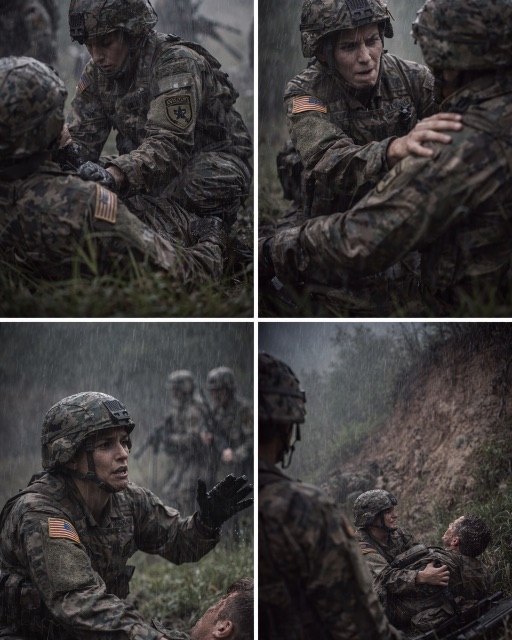
My knees were buried in freezing mud. The downpour was so heavy I could barely see the casualty in front of me.
We were running a brutal military field exercise. A new transfer to our platoon, Craig, had lost his footing on a wet embankment and slammed hard into a rock shelf.
“Security out! Give me room!” I screamed over the rain.
I’m the platoon medic. I slid down the ravine to get to him. His shoulder was completely mangled, and he was drifting in and out of consciousness.
I was trying to stabilize his neck when I heard a sickening crack.
I looked up. The entire hillside above us was slumping. A massive wall of wet earth and debris was coming right at us.
There was no time to call for the litter team. I shoved Craig hard against the rock shelf and threw my body over his, bracing for the impact.
The mudslide hit us like a freight train.
For ten seconds, it felt like being buried alive. When the earth finally stopped moving, I dug my face out of the muck, gasping for air.
Craig was completely unresponsive.
My heart pounded against my ribs. I frantically started ripping off his tactical vest to check his airway and heartbeat.
As I yanked the heavy velcro apart, a small, waterproof ziplock pouch slipped out of his inner chest pocket and landed in the mud.
I wouldn’t have looked twice, but I saw a photo pressed against the clear plastic.
My blood ran cold.
It was a picture of my living room.
My hands shook violently as I unzipped the pouch and pulled out the folded letter tucked behind the photo. I recognized the messy handwriting instantly. It was my husband’s.
I wiped the rain from my eyes and read the first line, and my jaw hit the floor. The letter started with…
“My Dearest Brother,”
The words swam in front of my eyes. Brother?
My husband, Mark, was an only child.
He had told me so on our first date. He’d explained, with a deep sadness, that his parents had passed away in a car crash when he was nineteen, leaving him with no family to speak of.
I had been his family ever since.
My mind was a screaming chaos of confusion and betrayal, but my training took over. I shoved the letter back into my pocket, my fingers numb and clumsy.
Craig was my patient. My world could fall apart later. Right now, his was literally on the line.
I cleared his airway of mud and debris. His pulse was thready, his breathing dangerously shallow.
The rain hadn’t let up. Every drop felt like a tiny needle against my skin.
I worked methodically, assessing his injuries. Dislocated shoulder, possible concussion, several broken ribs, and a nasty gash on his forehead.
“Hang in there, Craig,” I whispered, my voice hoarse. “Just hang in there.”
I didn’t even know if he could hear me.
I administered a shot of morphine for the pain and started an IV line, the bag of saline hanging precariously from a tree branch above us.
Time blurred. It was just me, him, and the relentless storm.
Finally, I heard the blessed sound of shouting. The rescue team had found us.
They worked quickly, strapping Craig onto a spinal board and preparing him for evacuation.
As they lifted him, his eyes fluttered open for a second. They found mine.
He tried to speak, but only a weak gurgle came out.
“It’s okay,” I said, forcing a calm I didn’t feel. “We’ve got you.”
I was airlifted out with him, refusing to leave his side until we reached the field hospital.
The flight was a noisy, turbulent nightmare. Every lurch of the helicopter was a fresh wave of nausea and dread.
The letter in my pocket felt like a block of ice pressed against my skin.
At the hospital, they wheeled Craig away into emergency surgery.
A nurse sat me down, wrapped a shock blanket around my shoulders, and handed me a cup of hot, sweet tea.
“You did good, soldier,” she said kindly. “You saved his life.”
I just nodded, unable to speak. My own life felt like it was fracturing into a million pieces.
I was given two days of compassionate leave to recover from the ordeal. The drive home was a blur.
The familiar turn onto our street, the sight of our little house with the blue door, it all felt alien.
I walked inside, the silence of the house deafening.
Mark wasn’t home from work yet.
I dropped my keys on the entryway table and pulled out the pouch.
I looked at the photo again. It was our living room, alright. Our worn-out leather sofa, the crooked picture frame I always meant to fix, my stack of medical textbooks on the coffee table.
It was a candid shot, as if someone had just snapped it on their phone.
Then I unfolded the letter, my hands steady this time. I needed to know. I had to read it all.
“My Dearest Brother,
I hope this finds you well. I’m sorry it’s come to this, writing a letter after all these years of silence. The truth is, I haven’t known how to reach out. Pride is a terrible thing, Craig. It’s eaten me alive.
I heard you were being transferred to the 101st. To her platoon. When I found out, I knew it had to be a sign.
My wife, Sarah, is the medic there. She’s the best person I’ve ever known. She’s my whole world. I’ve attached a picture so you’ll recognize our place, if you ever decide to come by. A stupid gesture, I know.
Look, I know what I said back then was unforgivable. I was young, and I was angry. I was wrong about everything. I let my temper get the best of me, and I destroyed our family over it. I’ve lived with that regret every single day.
I told Sarah our parents were gone. I told her I had no one. It was easier than trying to explain the mess I’d made. It was a cowardly thing to do, and now she’s my only family because of a lie.
If you read this, please know I’m so sorry. For everything. For what I said about Dad, about the house. About you.
Maybe you could look out for her for me? And maybe, just maybe, if you can find it in your heart, we could talk someday.
Your brother,
Mark.”
I sank onto the floor, the letter falling from my grasp.
My entire marriage, the foundation of my life with Mark, was built on a lie.
He wasn’t an orphan. He had a brother. He had parents, or at least he did at one point.
The pain was a physical thing, a crushing weight on my chest. It felt worse than the mudslide.
When Mark came home an hour later, he found me sitting in the exact same spot on the floor.
He rushed over, his face etched with concern. “Sarah? Honey, what’s wrong? I heard about the mudslide, are you okay?”
I didn’t answer. I just held up the letter.
His face went pale. He looked from the letter to my face and back again. The color drained from his world.
“Where… where did you get that?” he whispered.
“It fell out of Craig’s gear,” I said, my voice flat and empty. “After I dug him out of a mudslide. Your brother, Mark. The one you told me never existed.”
He sank to his knees in front of me, his head in his hands. And then he started to cry.
He told me everything, the words tumbling out in a torrent of guilt and shame.
He and Craig had a terrible fight about ten years ago. Their parents had decided to sell the family farm, their inheritance, to pay off some debts. Mark had seen it as a betrayal.
He said Craig had sided with their parents, encouraging the sale. Mark felt like his own brother was trying to steal his future.
In a fit of rage, he’d said horrible things. He’d accused his brother of being greedy, of manipulating their parents. He’d packed a bag and left, vowing never to come back.
He was ashamed. He was broke. He enlisted in the army to start over, to build a new life where no one knew the boy who had disowned his own family.
“I was going to tell you,” he choked out, tears streaming down his face. “I swear, Sarah. When I found out he was joining your platoon, I knew I had to fix it. I wrote that letter… I was hoping he’d reach out to you, to break the ice.”
“You built our whole life on a lie, Mark,” I said, the words feeling like shards of glass in my mouth. “You let me grieve for parents who weren’t even gone. You let me believe you were all alone in the world.”
“I know,” he sobbed. “And I’m so, so sorry.”
I didn’t know what to do. I loved this man more than anything, but the person I thought I knew had vanished.
I needed space. I needed answers. But not from him.
“I’m going to the hospital,” I said, standing up on shaky legs. “I need to check on my patient.”
I needed to talk to Craig.
The next day, I drove to the base hospital. I found Craig’s room. He was sitting up in bed, his arm in a heavy sling and a bandage wrapped around his head.
He looked exhausted, but his eyes lit up when he saw me.
“Medic,” he said, his voice raspy. “I, uh, I don’t think I ever thanked you.”
“Don’t worry about it,” I said, pulling up a chair. “It’s my job. How are you feeling?”
“Like I got hit by a hillside,” he managed a weak smile. “But I’ll live. Thanks to you.”
We sat in silence for a moment. I took a deep breath.
“Craig,” I started, my heart hammering. “When I was getting your vest off… something fell out. A letter.”
The smile vanished from his face. A deep sadness filled his eyes.
“From Mark,” I finished.
He nodded slowly. “I figured you’d find it. I’m sorry you had to find out that way.”
“His version of the story,” I said carefully, “is that you two fought over your parents selling the family farm.”
Craig let out a long, weary sigh. He looked out the window for a long moment before he spoke.
“There was no farm, Sarah,” he said quietly. “And the fight wasn’t about an inheritance.”
My blood ran cold for the second time in as many days.
“Our dad,” Craig began, his voice cracking with emotion, “he was a good man, but he had a sickness. A gambling problem. He hid it from us for years.”
He explained that their father had secretly taken out a second mortgage on their family home. He’d lost it all. Loan sharks were calling, threatening them.
“He was going to lose the house. Mom was a wreck. Mark was just a kid, he didn’t understand the scope of it.”
Craig, who was a few years older and had just started a decent job, did the only thing he could think of to save his family.
“I took out a massive personal loan,” he said. “Enough to pay off the sharks and the second mortgage. I saved the house.”
But there was a condition from the bank. Because of his father’s history, the deed to the house had to be transferred into Craig’s name. It was the only way they would approve the loan.
“Mark found the paperwork,” Craig continued, his gaze distant. “He didn’t see a loan agreement. He just saw my name on the deed to his home. He thought… he thought I had stolen it. That I’d conspired with Mom and Dad to cut him out.”
The fight was brutal. Mark, feeling utterly betrayed, screamed things he couldn’t take back. He accused his brother of being a thief and his parents of loving Craig more.
“He left that night,” Craig whispered. “And we never heard from him again.”
“But the letter,” I said, my voice thick. “He said he was wrong about everything.”
“He doesn’t even know the half of it,” Craig said, a tear rolling down his cheek. “Our dad… his heart gave out a year after Mark left. The doctor said it was the stress.”
My hand flew to my mouth.
“And Mom… she’s never been the same. She’s in a nursing home now, not too far from here. Her health isn’t good. All she’s wanted, for ten years, is to see her youngest boy again.”
The so-called “inheritance” Mark thought his brother had stolen was actually a mountain of debt that Craig had been silently paying off for a decade, all to protect the family Mark had abandoned.
The photo of my living room?
“I asked him for it in my first email,” Craig said. “I just… I wanted to see he was happy. I wanted something to show Mom, to let her know her son was okay.”
This man in the hospital bed, the one I thought was at the center of my husband’s betrayal, was a hero. He had sacrificed his own financial future and endured his brother’s hatred, all to hold his family together.
And my husband, Mark, wasn’t a monster. He was just a hurt, proud kid who had made a terrible mistake and had been carrying the shame of it ever since.
I went home. This time, I knew what I had to do.
I found Mark sitting at the kitchen table, staring at a cold cup of coffee. He looked like he hadn’t slept in a week.
I sat down across from him. And I told him the truth.
I told him about the gambling debt. About the loan. About how Craig had saved their home.
I told him his father had passed away.
And I told him his mother was alive and waiting for him.
The look on his face is something I will never forget. It was a storm of shock, grief, and a profound, soul-crushing guilt.
He broke down completely, his body shaking with a decade of suppressed pain.
I held him. There were no sides anymore. There was only a family that had been shattered by a misunderstanding and hollowed out by pride.
The next day, the three of us drove to the nursing home.
Mark was so nervous he could barely speak. Craig, leaning on a cane, put a supportive hand on his brother’s shoulder as we walked down the hallway.
We found her in a small room, sitting in a chair by the window, a faded photograph in her lap.
She looked up as we entered. Her eyes, clouded with age, widened. They fixed on Mark.
“Michael?” she whispered, her voice frail. His full name.
Mark fell to his knees beside her chair, burying his face in her lap. “Mom,” he cried. “I’m so sorry. I’m so sorry.”
She just stroked his hair, tears of her own streaming down her wrinkled cheeks. “My boy,” she said over and over. “My boy, you came home.”
Watching them, watching Craig stand beside them with tears of relief in his own eyes, I knew this was more than just a reunion. It was a resurrection.
That day, a family was reborn.
It wasn’t easy. There were years of pain to unpack. But they had each other now.
Mark and I brought his mom to live with us. The light returned to her eyes.
He and Craig spent hours just talking, rebuilding the bridge that pride had burned down so long ago. Mark insisted on taking over half of the remaining loan payments, sharing the burden his brother had carried alone for so long.
Our marriage, once rocked by a lie, was forged anew in the fires of truth and forgiveness. It became stronger and more honest than I ever could have imagined.
Sometimes, life throws a mudslide at you. It buries you, it suffocates you, and it feels like you’ll never see the light again. But sometimes, in that very mud, you find the one thing you never knew you were missing. You find a truth that, once unearthed, can help you grow something new, something beautiful, something stronger than what was there before. The deepest wounds can be healed, but it requires the courage to listen, the humility to admit when we are wrong, and the grace to forgive not only others, but ourselves.