
“Who’s going to save you now, Sergeant?” he murmured.
His voice was low, confident, and dripping with arrogance.
Sergeant First Class Travis had made my life a living hell since I was transferred to Fort Calhoun. He hated that a female soldier was outperforming his buddies. He openly mocked my after-action reports and spread rumors that my deployment medals were just “politics.”
When I stayed silent, he called me weak. He didn’t know my silence was just me quietly documenting every single threat for my commanding officer.
But tonight, he got impatient.
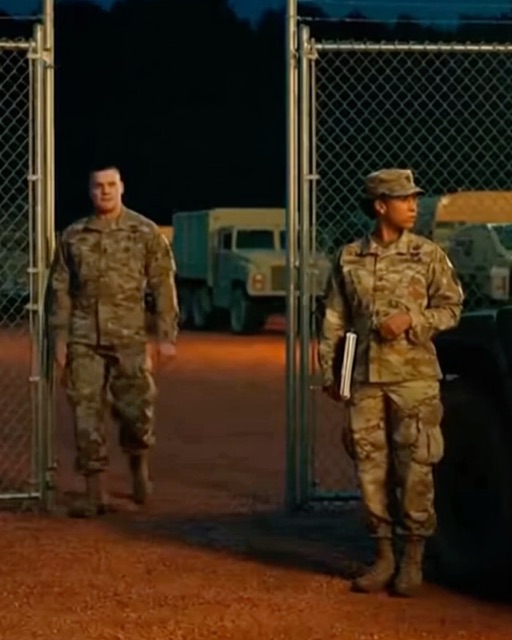
I was doing late-night inventory in the empty motor pool when he slid out of the shadows and locked the heavy chain-link gate behind us. The smell of diesel fuel and wet red dirt suddenly made my stomach turn.
“You’re not so tough without your brass friends around to protect you,” he smirked, stepping uncomfortably close.
My blood ran cold. But my training kicked in.
Travis thought I was just a reassigned desk clerk. He had no idea my previous assignment was four years with a specialized military working dog unit.
I didn’t yell. I didn’t reach for my radio.
I just looked past his shoulder toward the dark treeline and clicked my tongue in a very specific, rapid three-beat pattern.
Travis laughed. “What, you calling for help?”
The laugh died in his throat when a 90-pound Belgian Malinois silently cleared the chain-link fence in one massive leap, landing directly behind him.
But the dog didn’t attack. It just sat, locked onto my eyes, waiting for the release command.
Travis froze, the color completely draining from his face as he slowly turned around. But what made him drop to his shaking knees wasn’t the dog’s bared teeth… it was the name stitched onto the dog’s tactical harness.
In bold, white thread, the single word read: MILLER.
Travis choked on a breath, his bravado shattering like glass. He stared at the dog, but he wasn’t seeing a K9. He was seeing a ghost.
“No,” he whispered, his voice a ragged, broken thing. “It can’t be.”
The dog, Miller, didn’t move a muscle. His focus was entirely on me, a living weapon tethered to my will.
I finally spoke, my voice calm and even, cutting through the heavy silence of the motor pool. “Heel.”
Miller rose gracefully and trotted to my side, sitting perfectly aligned with my left leg. He never took his eyes off Travis.
Travis was a mess, crumpled on the greasy concrete, shaking uncontrollably. All the venom, all the arrogance, was gone. It was replaced by a raw, primal fear I had only seen once before.
It was the same fear I saw in the eyes of insurgents right before they were captured.
I pulled out my phone, my hands steady. I didn’t call 911. I called the on-duty Military Police desk sergeant.
“This is Sergeant Hayes,” I said clearly. “I am in Motor Pool B. I have Sergeant First Class Travis detained. He is unarmed but unstable.”
I paused, then added the crucial detail. “Requesting a patrol to my location. I will meet them at the gate.”
I hung up before they could ask questions.
Travis was still on the ground, muttering to himself. “They said he was gone. They said the dog was gone.”
I looked down at him, not with pity, but with a cold sense of clarity. “Some things never really go away, Travis.”
He finally looked up at me, his eyes wide with a dawning, horrified realization. He was connecting dots that had been scattered for years.
“You,” he breathed. “You were there. In the valley.”
I didn’t confirm or deny it. I just stood there, a silent sentinel with my loyal partner at my side.
The distant wail of a siren grew closer. Headlights cut through the darkness, painting long shadows across the rows of Humvees and transport trucks.
I walked to the gate, Miller trotting beside me, and unlocked the heavy chain. Two MPs stepped out of their vehicle, hands resting on their sidearms.
“Sergeant Hayes?” one of them asked, a young Specialist.
“That’s me,” I replied, nodding toward the pathetic figure still on the ground. “You’ll find Sergeant First Class Travis over there. He locked me in and made a few threats.”
The MPs exchanged a look. They knew Travis’s reputation.
They cuffed him and helped him to his feet. Travis didn’t resist. He was like a puppet with its strings cut, his eyes still locked on the dog sitting silently by my side.
As they led him away, he looked over his shoulder at me one last time. The question in his eyes was clear: How?
I gave him no answer.
My commanding officer, Major Evans, arrived twenty minutes later. He was a good man, fair and by the book. He found me sitting on the tailgate of a truck, Miller’s head resting on my lap as I stroked his fur.
“Sergeant Hayes,” he began, his tone serious. “Care to explain what a civilian K9 is doing on my post, and why it’s involved in an incident with one of my NCOs?”
He was right. Miller wasn’t an active MWD anymore. He was officially my companion animal, retired from service due to trauma. His presence here was a violation of a dozen regulations.
I took a deep breath. It was time for the truth.
“Sir, that’s not just any dog,” I said, my voice quiet. “His name is Miller. He was the partner of Specialist David Miller.”
Major Evans’s expression hardened slightly at the name. He’d been a Captain back then, and though he wasn’t in our direct chain of command, everyone in the theater knew the story. Specialist Miller, a young and promising K9 handler, was killed in action. The official report said he’d been separated from his unit during a firefight after disobeying a direct order to fall back.
The report was signed by his team leader: then-Staff Sergeant Travis.
“I remember Specialist Miller,” the Major said softly. “A good soldier. Tragic loss.”
“The report was a lie, sir,” I stated, my voice unwavering. “Travis lied.”
Major Evans stood there for a long moment, studying me, then the dog. He was a man who trusted his soldiers, and he could see I wasn’t being hysterical or vindictive. I was stating a fact.
“Tell me everything, Sergeant,” he finally said. “And don’t leave a single detail out.”
So I did. I told him how I was attached to their unit as a K9 trainer and medic. I knew Specialist Miller well. He was a kid, really, barely twenty, but he and his dog, who was named Ghost back then, were one of the best teams I’d ever seen.
On that day, they were on patrol when they were ambushed. The firefight was intense. During the chaos, Travis’s comms unit was damaged. He panicked. Instead of falling back to the designated rally point, he ran in the opposite direction.
Specialist Miller and Ghost held their position, providing covering fire exactly as they were trained to do.
But Travis didn’t just run. In his fear, he made a fatal decision. He knew Miller had the more advanced long-range radio. Travis doubled back, but not to help. He ordered Miller to give him his comms unit so he could call for evacuation for himself.
Miller, ever the loyal soldier, obeyed. He handed over his lifeline.
Travis took the radio and ran, leaving Miller and Ghost with no way to communicate, pinned down by enemy fire. He reported Miller as non-responsive and claimed the young Specialist had broken protocol.
By the time we fought our way to their position, it was too late. We found Specialist Miller. He had died protecting his partner. Ghost was huddled beside him, wounded but alive, refusing to leave his handler’s side.
I was the one who had to carry Ghost out of that valley.
The dog was never the same. He was aggressive, broken by what he’d seen. The Vets slated him for retirement, possibly even to be put down. He was too traumatized to work.
I refused to let that happen. I pulled every string I had, filled out a mountain of paperwork, and officially adopted him. I spent a year working with him, earning his trust, helping him heal.
When he was finally stable, I renamed him. I renamed him Miller, so the man who gave his life for him would never be forgotten. So that his name would live on.
“I never had proof of what Travis did,” I finished, my voice thick with emotion. “It was his word against a dead man. But the one other witness was right here.”
I patted Miller’s head. The dog looked up at me, his intelligent eyes full of a deep, unspoken understanding.
“Travis’s reaction tonight… that was a confession, sir,” I said. “He didn’t see a dog. He saw the ghost of the man he left to die.”
Major Evans was silent for what felt like an eternity. He looked from me to the dog, and I could see the gears turning in his mind. He was weighing my word, my record, against that of a decorated SFC.
“Your file says you were a logistics clerk before this assignment, Hayes,” he said slowly.
“My records were partially sealed after my tour with the special units, sir,” I explained. “It was part of my transition back to a regular posting. Easier to just list a simple MOS. I requested it. I was tired of the action.”
He nodded, accepting it. It made sense.
“I believe you, Sergeant,” he finally said. “But belief isn’t proof. The official report is closed. Travis will be reprimanded for tonight’s incident, maybe lose a stripe. But without more, I can’t touch what happened over there.”
My heart sank. It wasn’t enough. Justice for David Miller couldn’t just be a slap on the wrist for Travis.
“There might be more, sir,” I said, a long-shot idea forming in my mind. “There was another soldier there that day. A medic. Sergeant Peters. He was the one who first questioned Travis’s timeline, but he was new to the unit and Travis shut him down. He rotated out a few months later.”
“And where is he now?” Major Evans asked.
“Last I heard,” I said, pulling up a half-forgotten memory. “He was stationed at Fort Benning, working as an instructor.”
The next morning, I was called into the Major’s office. A video call was already set up on his monitor. On the screen was a man in his late thirties with tired eyes and a sergeant’s patch on his sleeve. It was Sergeant Peters.
Major Evans made the introductions. “Sergeant Peters, this is Sergeant Anya Hayes.”
Peters’ eyes widened slightly in recognition. “Hayes. I remember you. You were the K9 handler.”
“I was,” I confirmed.
Major Evans got straight to the point. “Sergeant, I’m reopening an informal inquiry into the death of Specialist David Miller. Sergeant Hayes has made some serious allegations against then-Staff Sergeant Travis.”
Peters’ face went pale. He ran a hand over his short-cropped hair. “Sir, with all due respect, that was a long time ago. The case is closed.”
“Is there anything you failed to mention in your original statement?” the Major pressed. “Anything at all?”
Peters hesitated. He looked at me, then back at his screen. “Travis’s story… it never added up. The angle of the firefight, the time it would have taken him to get from Miller’s last known position to the rally point. It was… off.”
“Why didn’t you say anything?” Evans asked.
“I was a kid, sir,” Peters said, his voice full of old regret. “Travis was my team leader. He told me to stick to the official story or my career would be over before it started. I was scared. I’ve lived with it ever since.”
It was something, but still not enough. It was still just hearsay.
Then I had an idea. “Sergeant Peters,” I asked. “Do you remember Specialist Miller’s K9?”
“Ghost? Of course,” he said. “Best dog in the unit. Heard they had to put him down after… you know.”
“They didn’t,” I said, a lump forming in my throat. I turned my laptop camera around. Miller was lying on a dog bed in the corner of my office, a privilege the Major had granted me that morning.
“I adopted him,” I said. “His name is Miller now.”
On the screen, Sergeant Peters leaned in close, his eyes wide. He was speechless for a moment, just staring at the dog.
“My God,” he whispered. “He’s still alive.”
And then, the final piece of the puzzle clicked into place.
“Sir,” Peters said, his voice suddenly urgent, addressing Major Evans. “There is proof. There has to be.”
“What proof, Sergeant?”
“The gear,” Peters said, speaking faster now. “Specialist Miller’s vest, his helmet… it was all recovered. But his comms unit was never logged into evidence. Travis claimed it was destroyed in the firefight. But the vest… Miller’s K9, Ghost, had a camera on his harness. A small, hardened tac-cam. We all did. It records on a loop. If that camera was still running…”
My blood ran cold. The tac-cams. I had completely forgotten. In the chaos and grief of that day, no one had thought to check the dog’s gear.
Major Evans was already on the phone with the Army’s records division, his voice sharp and commanding, requesting the evidence manifest from the Miller incident report.
Two days later, a secured case arrived from a long-term storage facility. Inside was the tactical harness Ghost had been wearing that day. The camera was damaged, cracked from a ricochet, but the internal memory card was intact.
We watched the footage in the Major’s office. Me, him, and Sergeant Peters on the video call.
The video was chaotic, filled with the sounds of gunfire and shouting. It showed the dirt and rocks of the valley floor from a dog’s perspective. We saw Specialist Miller’s boots. We heard his voice, calm and steady, giving commands to his dog.
And then we saw it.
We saw Travis, his face wild with panic, appearing before Miller. We heard his voice, clear as day, ordering Miller to hand over his radio. We saw Miller, ever the dutiful soldier, comply.
And we saw Travis turn and run, leaving them behind.
The camera kept rolling for another thirty minutes, capturing the heroic last stand of a young soldier and his dog. It was heartbreaking and undeniable.
Travis was brought in for questioning. When confronted with the video, he confessed to everything. The lies, the cowardice, the cover-up. It all came pouring out.
He wasn’t just a bully who harassed a female soldier in a motor pool. He was a coward who had sent a better man to his death and spent years hiding behind a lie.
He was formally charged with dereliction of duty, falsifying an official report, and conduct unbecoming an NCO. He was facing a court-martial that would strip him of his rank, his pension, and his freedom. His career was over. His honor, which he never truly had, was gone.
Specialist David Miller’s official record was amended. He was posthumously awarded the Silver Star for his bravery, and the true story of his sacrifice was finally told. His family, who had lived for years with the stain on their son’s honor, finally had the truth.
A few weeks later, I stood in the quiet green of the base’s memorial garden. Miller, the dog, sat peacefully at my feet, his head resting against my leg.
Major Evans stood beside me. “You did a good thing, Sergeant Hayes,” he said. “You brought a soldier’s honor home.”
I looked down at the loyal animal beside me, the living embodiment of a friendship that transcended even death.
“We both did, sir,” I replied.
True strength isn’t about loud voices or arrogant threats. It’s found in the quiet integrity you hold onto when no one is watching. It’s in the patience to wait for the right moment, and the courage to speak the truth when that moment arrives. And loyalty, the kind that a soldier has for his brother, or a handler for his dog, is a force that can right any wrong, no matter how long it has been buried. Justice, like a good dog, always finds its way home in the end.



