I’ve been a military police officer at Iron Ridge for four years, and I’ve never seen a man smile while being dragged in handcuffs.
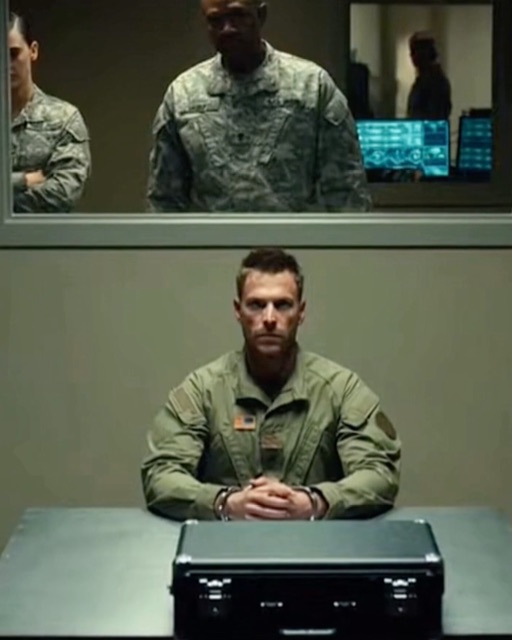
It happened yesterday morning. A guy walked up to the main checkpoint wearing faded desert fatigues with zero rank insignia. His ID badge just said “Todd.”
He carried a heavy, sealed black case and refused to speak to anyone but the Base Commander.
Captain Trevor wasn’t having it. He’s the kind of arrogant officer who loves to flex his authority on the lower ranks.
He immediately ordered us to detain the stranger, convinced he’d caught a rogue spy testing our perimeter.
We stripped his gear and marched him right through the crowded main yard. Everyone was staring.
Todd didn’t fight us. He just looked at Trevor and said quietly, “You’re making a huge mistake.”
Trevor just laughed. He shoved the man into a holding cell, snatched the black case from my hands, and slammed it onto the interrogation desk.
“Let’s see what this nobody is hiding,” Trevor sneered, grabbing a heavy pry bar.
My stomach dropped. “Sir, protocol says we wait to scan that – ”
He ignored me and forcefully popped the locked latch.
The second the lid cracked open, every single computer screen in the command center went black. The heavy steel blast doors slammed shut, locking down the entire sector.
Red emergency sirens started screaming through the concrete walls.
Before Trevor could even react, the armored door to our security room was forced open by the Base Commander’s personal detail.
The Commander walked in, his face chalk-white. He didn’t even look at the breached case.
He marched straight to the holding cell and began frantically unlocking Todd’s handcuffs himself.
He turned to Captain Trevor, his eyes wide with absolute terror.
“Hand over your weapon and your badge immediately,” the Commander whispered, his voice trembling. “Because the man you just locked in this cell isn’t a spy. He’s…”
The Commander choked on the words, his voice barely audible over the wailing sirens.
“…He’s the architect.”
Captain Trevor just stood there, his face a mask of confusion. “Architect of what, sir?”
The Commander, Colonel Wallace, finally got the cuffs off Todd. He helped the man to his feet with a level of deference I’d never seen him show anyone, not even a visiting general.
Todd simply rubbed his wrists, his calm demeanor a stark contrast to the chaos erupting around us.
“The architect of everything, you fool,” Wallace finally roared, his composure snapping. “He designed the entire security grid for this base.”
Wallace pointed a shaking finger at the pried-open case on the desk. “And that’s the kill switch.”
Trevor’s arrogant smirk finally vanished, replaced by the dawning horror of a man realizing he’s standing on a landmine he just armed himself.
“It’s called a Cerberus Box,” Todd said, his voice even and steady. It was the first time he’d spoken in more than a whisper.
“It’s a failsafe. A test.” He looked from the Commander to Trevor, then finally at me.
“If the box is opened by anyone other than a designated user, or without the proper seven-factor authentication, it assumes the command center has been compromised.”
He gestured to the silent computer terminals and the sealed blast doors.
“It triggers Protocol Chimera. A total electronic and physical lockdown. It severs all connections to the outside world. No signals in, no signals out.”
Todd looked at the thick concrete walls around us. “As of right now, Iron Ridge has effectively ceased to exist.”
The weight of those words settled in the room, heavier than the armored doors. We were trapped.
We were trapped by our own defenses, all because one man’s ego was bigger than his common sense.
Colonel Wallace looked like he was about to have a heart attack. “Can you fix it, Todd? Can you shut it down?”
Todd nodded slowly. “I can. But it won’t be fast.”
He walked over to an inert command terminal, his movements unhurried. “Chimera isn’t a light switch. It’s a hard reset of the entire nervous system of this base.”
He explained that every system would have to be brought back online manually, one by one, from a secure terminal inside the core server room.
A server room that was, of course, currently sealed behind three feet of reinforced steel.
Trevor, finally finding his voice, started making excuses. “Sir, I was following procedure! He was an unauthorized individual refusing to identify himself!”
Todd didn’t even turn around. “My identification was on my badge. It said Todd.”
“That’s not a real ID!” Trevor sputtered.
“On this base, for a handful of people, it is,” Colonel Wallace cut in, his voice cold as ice. “It means he has clearance to go anywhere and do anything. Your job was to see that name and immediately call me. That’s the entire protocol.”
The Commander turned to me. “Corporal, what was your role in this?”
I swallowed hard, my throat suddenly dry. “I advised Captain Trevor to wait for a scanner, sir. As per protocol for unidentified packages.”
Wallace gave me a long, hard look, then a slight nod. “Noted.”
He turned his full attention back to Trevor, whose face was now slick with sweat. “You put this entire facility, every soul on it, at risk. For what? To feel powerful for five minutes?”
Trevor said nothing. The arrogant captain was gone, replaced by a scared, cornered man.
The first step was getting into the server room. The override was a physical keypad located next to the main door.
“The code changes every sixty seconds,” Todd explained. “It’s generated by an algorithm I can only access from this terminal.”
He sat down and his fingers began to fly across the dead keyboard. We all watched, confused.
“It’s not connected,” Trevor said dumbly.
“It doesn’t need to be,” Todd replied without looking up. “The keyboard has a kinetic logger. I’m entering a series of master keys. The sequence itself will generate the first rollback command.”
It was like watching a magician perform a trick none of us could comprehend.
After a minute, a tiny green light flickered to life on the terminal. A single line of white text appeared on the black screen.
ACCESS GRANTED: MANUAL OVERRIDE INITIATED.
Todd stood up. “Alright. Colonel, I need you. Corporal,” he looked at me, “you too. The rest of you, stay here and secure this room.”
He then looked at Trevor, who was being guarded by the Commander’s detail. “And keep an eye on him.”
We walked through the silent, red-lit corridors. The only sound was the hum of the emergency power and the distant, muffled sirens. It felt like we were on a ghost ship.
The journey to the server room was tense. It felt like the base itself was holding its breath.
When we reached the massive steel door, Todd pointed to the keypad. “Colonel, you’ll need to enter the code. It’s an eight-digit sequence. I’ll read it out.”
He looked back at the terminal we’d left behind, even though he couldn’t see it. “The system is displaying it there for exactly ten seconds. After that, it’s gone forever.”
“But… you can’t see the screen from here,” I said, confused.
Todd smiled faintly. “I don’t need to. I wrote the code. I know the rhythm.”
He closed his eyes for a moment, as if listening to a silent song. Then he began to recite a string of numbers.
Colonel Wallace’s fingers moved quickly, punching in the digits. The second he finished, a loud hiss echoed through the hall as the door’s magnetic locks disengaged.
We stepped inside. The server room was a cold, dark space filled with rows upon rows of silent, black monoliths.
“This is the brain,” Todd said softly. “And it’s had a massive stroke.”
For the next six hours, I watched a master at work. Todd moved from server to server, plugging in a handheld device, typing furiously, and then moving to the next.
He worked with a quiet, focused intensity that was mesmerizing. He didn’t complain or get frustrated. He just fixed the problem.
Colonel Wallace and I were his assistants. We ran cables, rebooted arrays when he told us to, and mostly just tried to stay out of his way.
During a brief pause, while waiting for a system to cycle, the Commander pulled me aside.
“I read your file, Corporal,” he said in a low voice. “Clean record. Smart. You’re from a small town in Ohio, right?”
“Yes, sir,” I answered, surprised.
“Good people out there,” he mused. “They teach you to respect the rules, but also to think for yourself.”
He sighed, rubbing his tired face. “Trevor… he comes from a long line of decorated officers. He felt entitled to his rank, not like he had to earn it. He always saw protocol as something for other people to follow.”
He looked at the sealed door. “Pride is a cancer in the chain of command. It makes leaders deaf and blind.”
It was the most candid I’d ever heard a commander be.
Finally, after what felt like an eternity, the main lights in the server room flickered on. The constant, deafening hum of the cooling fans returned.
A cheer went up from a speaker in the corner. The command center was back online.
Todd leaned against a server rack, wiping a bead of sweat from his forehead. It was the first sign of fatigue he’d shown all day.
“The lockdown is lifted,” he announced. “But the system is still logging everything. Every single action taken on this base is being recorded on a secure channel.”
“Especially,” he added, looking directly at Wallace, “any unauthorized data transfers from the last six months.”
A strange look passed between Todd and the Commander. It was a look of shared understanding, and it made the hairs on my arm stand up.
There was more going on here than just a failed security test.
When we returned to the security office, it was swarming with high-level personnel. Captain Trevor was sitting in the same cell he’d thrown Todd into, looking completely broken.
But he wasn’t just being detained for his insubordination. Two stern-looking men in dark suits were there, men I recognized as counter-intelligence agents.
They weren’t interested in the Cerberus Box. They were interested in Trevor’s personal computer.
The second twist of the day landed like a punch to the gut.
The lockdown that Trevor had caused was a disaster, but it had an unintended side effect.
When Todd rebooted the entire system from its core, it was like draining an ocean. And when the water was gone, you could see everything lying on the bottom.
Todd’s system diagnostics had uncovered a hidden, encrypted data stream originating from inside the base. It was a slow, subtle leak, designed to mimic routine system traffic.
For months, someone had been selling classified intelligence about troop movements and weapons development to an outside power.
The source of the leak? A terminal in the officers’ quarters, one registered to Captain Thomas Trevor.
His arrogance wasn’t just a character flaw. It was a cover.
He acted like the toughest, most patriotic officer on the base, always accusing others of being lax, to hide the fact that he was the real traitor.
When Todd showed up, a quiet, unknown man with high-level access, Trevor panicked. He didn’t think Todd was a spy testing the perimeter; he thought Todd was an investigator who had come for him.
His loud, public takedown of Todd was a desperate, panicked attempt to discredit a potential threat before he could even get started. He tried to paint the investigator as a criminal.
He pried open that case out of a desperate need to find something, anything, to incriminate the man he feared was there to expose him.
His own paranoia and guilt were what ultimately set the trap that caught him. He pulled the pin on his own grenade.
The final scene in that security office will be burned into my memory forever.
Trevor, stripped of his rank and dignity, was led away by the counter-intelligence agents. He didn’t look arrogant anymore. He just looked small.
As they passed the interrogation desk, his eyes fell on the black Cerberus Box. The box he had opened. The box that had ended his career and his freedom.
In that moment, he understood the crushing irony of it all.
A few weeks later, life at Iron Ridge began to return to normal, but it was a new kind of normal.
There was less bluster in the halls, more quiet respect. The incident had served as a harsh lesson about the difference between authority and leadership.
I was promoted to Sergeant for my conduct during the crisis. Colonel Wallace called me into his office personally.
He told me my adherence to protocol under pressure was exactly what the uniform stood for.
As I was leaving his office, I saw a familiar figure down the hall, dressed in civilian clothes and carrying a simple backpack. It was Todd.
He was on his way out, his work here apparently finished.
He stopped when he saw me. He didn’t say much. He wasn’t a man of many words.
“You kept your head, Sergeant,” he said, offering a small, genuine smile. “That’s rarer than you think.”
He reached into his pocket and pulled out a simple challenge coin. It was plain, heavy steel, with a single word etched on it: “Balance.”
“Pride is loud,” he said, pressing the coin into my hand. “Wisdom is quiet. Try to remember which one to listen to.”
He gave me a final nod and then walked out of the main gates, disappearing as unobtrusively as he had arrived.
I still look at that coin every day. It reminds me that true strength isn’t about the rank on your collar or the volume of your voice.
It’s about character. It’s about doing the right thing, especially when no one is looking, or when someone is yelling at you to do the wrong thing.
Captain Trevor thought the world revolved around him, and in his arrogance, he created a black hole that swallowed him whole. He taught me that sometimes, the biggest threats don’t come from outside the walls.
They come from the unchecked ego within. And the quietest person in the room is often the one you should be paying the most attention to.