“Go sit in the AC, old man,” Captain Todd laughed, tapping his high-tech navigation tablet. “You’re going to slow down the simulation.”
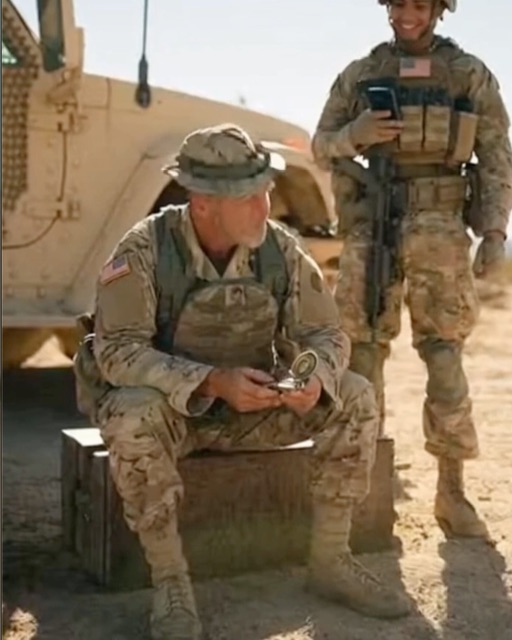
I’m a 68-year-old combat vet. I volunteered to mentor this young platoon in the Mojave desert. But to these kids, I was just a ghost in a faded hat.
Corporal Cody pointed at the antique, chipped lensatic compass hanging around my neck. “What is that, a museum piece? My tablet tracks military satellites. Don’t break a hip trying to keep up.”
The whole squad chuckled. I didn’t say a word. I just nodded, swallowed my pride, and quietly took my place at the absolute back of the file.
I knew exactly what the terrain looked like ahead.
By 1400 hours, we crossed deep into a canyon ridge. The Mojave sun was blinding, baking the ozone right out of their overheating electronics.
Then, it happened.
Every single screen in the platoon went pitch black.
They had blindly marched straight into a massive electromagnetic dead zone. Their multi-million dollar grid was suddenly nothing more than heavy plastic.
Within hours, the sun dropped. The desert turned freezing, pitch-black, and dead silent. Panic immediately set in. These tough, confident Marines were suddenly just terrified kids staring at dead pieces of glass.
Captain Todd was shaking, completely lost, frantically slapping the back of his tablet in the dark.
My heart pounded with absolute vindication. I walked right up to the front of the freezing formation.
I pulled my “useless” piece of antique metal from my shirt, flipped open the lid, and showed the terrified Captain exactly whose territory his tech had just marched us straight into.
The faint, phosphorescent glow of the dial was the only light in our world. It was the only thing that worked.
“North is that way, Captain,” I said, my voice low and steady. It cut through the terrified silence like a knife.
Captain Todd stared at the glowing needle, his face a pale mask in the gloom. He was a leader without a map, a captain without a ship.
“How… how can you be sure?” he stammered, his bravado gone, replaced by the raw fear of a young man responsible for a dozen other lives.
I didn’t answer with words. I just pointed my thumb up at the sky. “See that?”
A sea of stars, brighter than any of them had ever seen, glittered above us. The city lights were a hundred miles away.
“That’s Polaris. The North Star,” I explained. “My compass confirms it. Two constants in a world of variables, son.”
Corporal Cody, the wise guy from before, scoffed, but it was weak. “We can’t get a signal. We should stay put. Protocol says we wait for rescue.”
I shook my head. “Protocol was written for situations with a functioning radio, Corporal. No one knows we’re blind out here.”
“The extraction point is scheduled for 0600,” I continued. “We miss that, and the search party won’t even start looking for another 24 hours.”
“By then, half of you will be suffering from exposure and dehydration. This desert doesn’t give second chances.”
The cold was already seeping into their bones. Their fancy, lightweight gear was designed for quick movements in the heat, not for a long, freezing night in the open.
I could hear teeth chattering. I saw the doubt in their eyes replaced by a dawning, terrifying understanding. They were in real trouble.
Captain Todd finally looked at me, really looked at me, for the first time all day. He saw not an old man, but a lifeline.
“What’s your name, sir?” he asked, his voice barely a whisper.
“Frank,” I said. “Gunnery Sergeant Frank Peterson, retired.”
He swallowed hard, a gesture of pure submission. “Gunny… what are your orders?”
The question hung in the cold air. The platoon looked from their Captain to me. The chain of command had just unofficially, but completely, shifted.
“First order is to get warm,” I said, my voice taking on the command tone I hadn’t used in twenty years. “Everyone, gather any dead brush you can find. Creosote, mesquite, anything. Make a pile right here.”
They hesitated for a second, then scrambled to obey. The simple task, the sense of purpose, cut through their panic.
While they gathered wood, I took out a small metal tin from my ancient ruck sack. It was my survival kit. Inside was a ferro rod and a striker.
Sparks flew into the tinder-dry kindling. Within minutes, a small, crackling fire was pushing back the oppressive darkness and the biting cold.
The relief on their faces was immediate and profound. They huddled around the flames, soaking in the warmth.
I looked over the platoon. They were good kids. Strong, fit, and smart in their own way. They just had a blind spot, a dangerous over-reliance on things with batteries.
“Alright, listen up,” I said, once they’d settled. “The extraction point is twelve miles due east of our current position. The terrain between here and there is rough. Canyons and washes.”
“We move slow and steady. We move together. Nobody is a hero tonight.”
I looked directly at Corporal Cody. “Especially you.”
He had the decency to look down at his boots.
“We’ll navigate by that star until the moon rises. Then we’ll use terrain features. Everyone sound off. Check your water.”
A chorus of “Ayes” and reports on water levels came back. A few were already half-empty, a rookie mistake.
“Water discipline is now in effect,” I commanded. “Sip, don’t gulp. Only when I say so. We’re going to share what we have to.”
I pointed my compass east. “This is our bearing. Single file. Captain, you take the rear. Make sure nobody falls behind. I’ll take point.”
And just like that, we started walking. The only sounds were the crunch of our boots on the gravel and the whisper of the desert wind.
For the first hour, the silence was heavy with resentment and shame. I could feel it radiating off of them. But as we moved, something began to change.
I started talking, my voice just loud enough for the man behind me to hear and pass it back.
“Feel the ground under your feet,” I said. “Is it loose? Is it solid? The desert talks to you, if you know how to listen.”
I pointed out the silhouette of a ridge against the stars. “That’s our first landmark. We’ll aim for the saddle on the left.”
They were learning a new language, one that didn’t run on code or electricity. It was the language of the earth, of the sky, of survival.
After about two miles, a private named Miller stumbled, letting out a sharp cry of pain.
Captain Todd was there in a second, his flashlight finally proving useful. Miller had rolled his ankle on a loose rock.
It wasn’t broken, but it was swelling fast. He couldn’t put much weight on it.
“I can’t make it,” Miller said, his voice choked with frustration. “Just leave me. I’m slowing you down.”
Before Todd could answer, I walked back. I knelt beside the young Marine, who couldn’t have been more than nineteen.
“No one gets left behind, son,” I said, my voice firm but kind. “Ever.”
I looked at two of the bigger Marines. “You two. We’re going to make a fireman’s carry. You’ll switch off every twenty minutes. The rest of us will take your packs.”
Without a word, the squad re-distributed the gear. The two big Marines hoisted Miller up. It was clumsy, but it was a start. Their shared burden was creating a bond.
We continued our slow, grueling march. The moon finally rose, a sliver of silver that washed the landscape in a ghostly light. Now we could see the treacherous footing, the spiny plants that seemed to grab at our legs.
Around 0200, we stopped for a mandated water break. The men collapsed, their breathing ragged. The initial warmth of the fire was a distant memory. The cold was a physical enemy now.
Corporal Cody sat apart from the others, staring into the darkness. I walked over and sat down on a rock beside him. The chipped compass hung between us.
“You’re quiet,” I said.
He didn’t look at me. “Just thinking.”
“About what?” I asked.
He finally turned to me, his young face etched with a conflict of pride and humility. “About this.” He gestured vaguely at the compass. “I was a real jerk, Gunny. I’m sorry.”
I nodded slowly. “Apology accepted. But don’t be sorry. Learn from it.”
He looked down at the compass again. “It looks really old. Does it… mean something to you?”
I reached out and took the compass in my hand. The metal was cold, but familiar. It felt like an extension of my own body.
“It was a gift,” I began, my voice growing softer. “From my best friend. Corporal David Jennings. We were in Vietnam together. Just kids, like you.”
The platoon had gone quiet. They were all listening now.
“We were on a long-range patrol, deep in the jungle. Command had just issued these newfangled radio direction finders. Top-of-the-line stuff for 1969.”
“David was the tech guy. He loved it. He said my compass and paper map were relics. Sound familiar?”
A few of the men shifted uncomfortably. Cody looked like he’d been punched.
“We got hit,” I continued, the memory as clear as yesterday. “Hard. A well-planned ambush. We were scattered. The radios were all jammed. That fancy direction finder of his went dead.”
“We were supposed to fall back to a specific rally point. I knew the way. It was seared into my brain from studying the map. I used this compass.”
“David… he panicked. He trusted his machine more than his instincts. He went the wrong way. He thought a different ridge was the right one.”
I paused, the old pain rising in my chest. “I tried to call him back. He didn’t listen. He and three other guys followed him.”
“We found them two days later. My squad made it out. His didn’t.”
I held up the compass, its glowing needle pointing faithfully east towards our extraction.
“David gave this to me before that patrol. He’d bought it at a surplus store. He said, ‘Just in case your new map gets wet, old man.’ He was joking.”
“This compass isn’t just a tool, Corporal. It’s a promise. A promise to never forget that the basics matter. It’s a promise to never let technology make you stupid. It’s a promise to the memory of a friend I couldn’t save.”
The fire crackled. No one spoke for a long time. The story hung in the air, a lesson far more powerful than any training manual.
Cody looked at me, his eyes shining with unshed tears. “Thank you for telling me that, Gunny.”
“Alright,” I said, my voice thick with emotion. I stood up, my old knees protesting. “Break’s over. Let’s move. Miller, how’s that ankle?”
“I’ll make it, Gunny,” the young private said, his voice full of a new determination.
The rest of the journey was different. The resentment was gone, replaced by a quiet, focused respect. They helped each other without being asked. They pointed out loose rocks. They shared the last of their water.
They weren’t a platoon following an old vet anymore. They were a team.
As the first hint of dawn began to grey the eastern sky, I saw it. A familiar rock formation.
“We’re here,” I announced. “Extraction is just over this rise.”
A wave of exhausted relief washed over the squad. They had made it.
We crested the hill just as the sun broke over the horizon, painting the desert in hues of orange and pink. Below us, two Humvees were waiting, their engines rumbling softly.
The look on the faces of the extraction team was one of pure shock. They had expected to pick up a cocky, triumphant platoon. Instead, they found a group of exhausted, dirty, and humbled young men, carrying one of their own, being led by a 68-year-old man with a compass around his neck.
The debriefing a few days later was tense. A colonel with a chest full of ribbons listened intently as Captain Todd recounted the entire story. He left nothing out. He took full responsibility for the failure of his equipment, his overconfidence, and his blind march into the dead zone.
He gave me all the credit for getting his men out alive.
When he was finished, the Colonel looked at me. “Gunny Peterson, do you have anything to add?”
I shook my head. “The Captain’s report is accurate, sir. His men performed well under extreme duress. They learned a valuable lesson.”
The Colonel nodded, a thoughtful expression on his face. He dismissed the Captain and the rest of the platoon, but asked me to stay behind.
“Frank,” he said, his tone changing from formal to familiar. “You and I go way back. You know this wasn’t just a simple navigation exercise, don’t you?”
This was the twist I hadn’t expected.
“Sir?” I asked.
“That ‘dead zone’ wasn’t a natural phenomenon,” the Colonel explained. “We created it. We have mobile EM jammers. The exercise wasn’t to test the tech. The tech was designed to fail from the start.”
I stared at him, stunned.
“The test,” he said, leaning forward, “was to see what would happen to the men when it did. It was a leadership test. For Captain Todd.”
My mind reeled. The whole thing had been a setup.
“He failed, didn’t he?” I said quietly.
“Spectacularly,” the Colonel admitted. “But then, something unexpected happened. You happened. You taught them more in one night than we could have in six months of training.”
He stood up and walked to the window, looking out over the base.
“We’re becoming too reliant on screens, Frank. Too comfortable. We’re training warriors who know how to operate a drone but not how to read the stars. You reminded us of that.”
He turned back to me. “Captain Todd won’t be drummed out. He’ll be retrained. He learned a lesson in humility he’ll never forget. Corporal Cody has personally requested a transfer to a reconnaissance unit that specializes in old-school land navigation.”
“And you,” he said, a small smile playing on his lips. “I’ve been authorized to offer you a permanent, salaried position. A new role. Senior Field Mentor for the entire base. We want you to teach every single one of these young Marines what you taught that platoon in the desert.”
I was speechless. After years of feeling like a relic, like my skills were obsolete, I was being told they were more valuable than ever.
It wasn’t just a job offer. It was validation. It was respect.
The greatest technology we will ever possess is not a satellite or a computer. It is the wisdom passed down from one generation to the next, the resilience of the human spirit, and the courage to find your way even when all the screens go dark. That is the true north that never fails.