
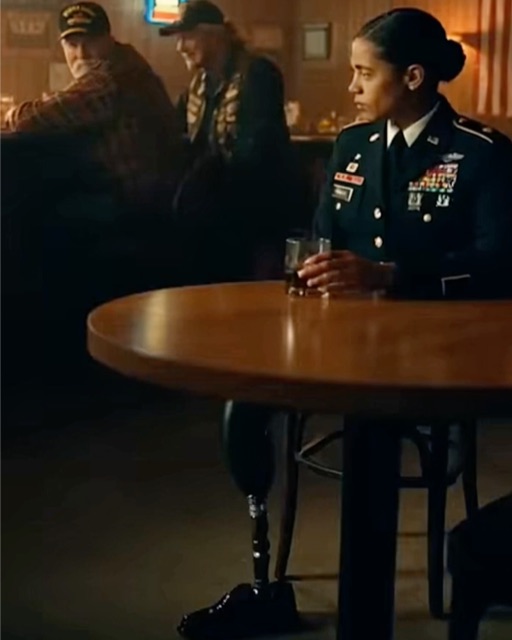
“Look at that. Ranger Barbie needs a crutch.”
The whisper sliced through the veterans’ hall. My neck prickled.
I turned and saw a tight cluster of young Navy SEALs in the back, grinning like they’d discovered a new joke. They were staring at Captain Tara McMillan.
Tara moved down the aisle slow and steady, metal crutch squeaking against the tile, carbon-fiber leg catching the fluorescent light. She didn’t look at them. But I saw her knuckles go white.
“Guess deployment was too much for her,” one of them snorted, stretching his boots into her path like a tripwire.
Tara paused. My blood boiled. The air felt thin.
She lifted her prosthetic, stepped over his boots, and took her seat without a word.
Then the oak doors swung open.
Everyone shot up to attention. Lieutenant General Curtis Hale swept in – three stars gleaming, the room snapping silent.
He didn’t go to the stage.
He went straight for the SEALs.
He stopped in front of the guy who’d blocked Tara. The General’s face didn’t move.
“You think a missing limb makes a soldier weak?” he asked. Not loud. But it echoed.
The SEAL blanched. “No, sir. I was – just – ”
“A laugh,” Hale repeated, tasting the word.
He bent, unbuckled his dress shoe, and rolled up his left pant leg.
Metal. Sockets. Carbon. The gasp hit like a wave.
“I lost this twenty years ago,” he said evenly. “And I’m still standing.”
The SEAL swallowed so hard I heard it from three rows back.
But Hale wasn’t done. He turned to Tara. Nodded once. Then back to the men, eyes narrowing to a blade.
“And before you open your mouth again,” he growled, “you should know exactly who carried me out of that fire…” He reached into his pocket and set a scorched dog tag on the podium.
The metallic clink was the only sound in the universe. It sat there, blackened and warped, a testament to heat and violence.
General Hale tapped it once with his index finger.
“This is mine,” he said, his voice dropping low, pulling every ear in the room toward him. “From Kandahar. Six years ago.”
He looked directly at the young SEAL, whose name I later learned was Nash. “Not from the incident twenty years ago. This was a different kind of hell.”
The General’s eyes seemed to look past us, back to a dusty road under a white-hot sun. “We were visiting an outpost. A simple meet-and-greet. My convoy was hit by a daisy-chain IED.”
He paused, letting the words sink in. “Three vehicles gone in an instant. Fire everywhere. Smoke so thick you couldn’t tell friend from foe.”
“I was thrown from my vehicle. Shrapnel in my side, my good leg pinned. I was a sitting duck.”
The room was so still I could hear the hum of the old fluorescent lights.
“My security detail was scattered, fighting for their own lives,” Hale continued. “The enemy was closing in. They knew who they had in their sights. A three-star general is a prize.”
He looked over at Tara. She was staring at her hands in her lap, her posture rigid.
“Then-Lieutenant McMillan was leading that detail. She was fifty yards away, her own arm bleeding, a concussion that would have put most men on their backs.”
“But she didn’t fall back,” Hale said, his voice thick with memory. “She organized a defense from a ditch, laying down covering fire while half her team was down.”
The General walked slowly from the podium towards Tara’s aisle, his gaze never leaving Nash.
“When the firing lulled, did she call for evac? No. She ran. She ran through open ground, right towards me.”
“She pulled me out from under the wreckage. A hundred-and-twenty-pound woman hauling a two-hundred-pound man with his leg trapped.”
He pointed back to the dog tag on the podium. “The fire from the engine was so hot it melted the chain right off my neck. She grabbed it before it was lost.”
“She half-carried, half-dragged me back to the ditch, all while rounds were kicking up dust at her feet.”
He stopped beside Tara’s chair. He didn’t touch her, but the space between them felt charged with respect.
“She saved my life. She saved the lives of three other men that day. And she did it before she got the help she needed for her own injuries.”
He turned his full attention back to Nash. The smugness was long gone from the SEAL’s face. It was replaced by a waxy, pale sheen of pure dread.
“Her leg,” Hale said, his voice a hammer striking an anvil, “was lost three years later. On a different mission. A mission she volunteered for after being told she could take a desk job.”
“So you tell me, sailor,” the General’s voice was barely a whisper now, but it was sharper than any shout. “Do you see a crutch? Or do you see a pillar?”
Nash looked like he wanted the floor to swallow him. His buddies had subtly shifted away, leaving him isolated in his shame.
“I… I apologize, sir,” he stammered, his eyes darting from Hale to Tara and back again. “And to you, Captain.”
Tara finally looked up. She met his gaze for a second, her expression unreadable, and then gave a short, almost imperceptible nod.
General Hale stared at Nash for a long moment. He didn’t offer forgiveness or understanding. He just held him in that silent, crushing judgment.
“Get out of my sight,” he said finally.
Nash didn’t need to be told twice. He turned, almost tripping over his own feet, and fled the hall. The oak doors swung shut behind him with a soft whoosh.
The General sighed, the tension leaving his shoulders. He addressed the silent room.
“Let this be a lesson. The uniform doesn’t make you invincible. And scars, visible or not, don’t make you weak. They make you a survivor.”
He picked up his dog tag, slid it back into his pocket, and then walked to the stage to begin his scheduled speech. But nobody was thinking about the speech anymore.
We were all thinking about Captain Tara McMillan.
I couldn’t shake it. The look on that SEAL’s face wasn’t just shame. It was something deeper. Something broken.
After the General’s speech concluded and people started to mingle, I slipped out the side door into the cool evening air.
Just as I suspected, Nash was there. He was leaning against the brick wall, head in his hands, his broad shoulders shaking.
I’m not the kind of guy who goes looking for confrontation. But I’m also not the kind of guy who can just walk away.
I walked over and stood a few feet away. I didn’t say anything at first.
“Come to get a few kicks in?” he mumbled without looking up. “I deserve it.”
“No,” I said quietly. “Just wanted to make sure you were breathing.”
He let out a harsh, bitter laugh. “Breathing. Right.”
He finally looked up, and his eyes were red-rimmed and hollow. The arrogance from before was completely stripped away, leaving something raw and painful.
“You think I’m the world’s biggest jerk, don’t you?” he asked.
“The thought crossed my mind,” I admitted.
He nodded, looking down at his polished boots. “My brother, Kevin… he was Army. A Ranger, like her.”
The story started to spill out of him, a torrent of grief he’d been holding back. “He lost his leg in the Korengal Valley. Came home with a chest full of medals and a carbon-fiber foot.”
“We all told him how proud we were. How strong he was. A hero.”
Nash kicked at a loose stone on the pavement. “But we were wrong. He wasn’t strong. He was shattered.”
“He hated the prosthetic,” Nash’s voice cracked. “He called it his ‘dead weight.’ He hated the pity in people’s eyes. Hated the way they’d talk to him like he was a child.”
“He tried. He really did. He did the physical therapy, went to the support groups. But he said the worst part wasn’t the leg he lost, but the man he’d been. He felt like a ghost.”
I stayed silent, letting him talk. This was a confession.
“Two years ago,” Nash whispered, his voice catching in his throat. “He gave up. Took his own life in our parents’ garage.”
The words hung in the air between us, heavy and cold. Suddenly, his cruelty made a terrible kind of sense.
“When I saw her… Captain McMillan… walking in here so calm, so dignified… with that crutch… I just… snapped.”
“I saw my brother,” he said, his voice thick with a toxic mix of anger and sorrow. “And I thought… why her? Why did she get to be strong when he couldn’t be?”
“It was ugly. It was wrong. I was hating her for surviving what he couldn’t.”
He wiped his eyes with the back of his hand, a soldier trying to hide a pain no training could prepare him for.
The side door creaked open.
Captain Tara McMillan stood there, her crutch planted firmly on the pavement. She had her jacket on, ready to leave.
She had heard every word.
My stomach dropped. I expected a storm. An eruption of righteous fury.
But her face was calm. Sad, even.
She moved slowly, deliberately, until she was standing in front of Nash. He flinched, unable to meet her eyes.
“I’m sorry,” he choked out. “For what I said. For what I thought. I had no right.”
Tara was quiet for a long moment. The silence stretched, thin and tight.
“You think this is strength?” she finally asked, her voice soft.
She tapped her prosthetic leg with the tip of her crutch. “This isn’t strength. This is the consequence of something that happened.”
Nash looked up, confused.
“The strength,” she continued, “isn’t in walking on this. It isn’t in showing up here tonight. The strength is getting out of bed on the days the phantom pain is so bad I can’t breathe.”
Her voice was steady, but her eyes held a universe of struggle. “It’s in smiling at my daughter when all I want to do is scream because I can’t chase her across the grass.”
“It’s looking in the mirror and not hating the person staring back. Some days I manage it. Some days I don’t.”
She looked directly at Nash, and for the first time, I saw not a captain or a hero, but a woman who was tired and fighting.
“Your brother wasn’t weak,” she said with absolute certainty. “He was a Ranger. There’s no such thing as a weak Ranger. He was just a man who carried a wound so deep no one could see it.”
“He fought a war over there,” she said, gesturing vaguely towards the east. “And then he came home and had to fight another one. All alone, inside his own head. That second war is often harder.”
Tears were streaming freely down Nash’s face now. He wasn’t trying to stop them.
Just then, the door opened again. General Hale stepped out. He took in the scene – Tara, Nash, and me – with a quick, discerning glance.
He walked over, not with the fire of before, but with a quiet gravity. He put a hand on Nash’s shoulder.
“The war doesn’t end when you come home, son,” the General said, his voice gentle. “It just changes.”
He looked from Nash to Tara. “What Captain McMillan is telling you is the hardest lesson any of us learn. The real battle is forgiveness. Forgiving the enemy is easy. Forgiving yourself is the mission of a lifetime.”
The General’s gaze on Nash was no longer accusing. It was understanding.
“Your brother’s fight is over,” he said. “But yours isn’t. You can let his memory be a ghost that haunts you, or you can let it be a guide.”
He pulled a business card from his wallet and handed it to Nash. “This is a friend of mine. He runs a support network for families. For siblings and parents of the wounded and the fallen. They get it. They’ve been where you are.”
Nash took the card, his hand trembling. “Sir, I…”
“Don’t talk,” Hale said, his tone firm but not unkind. “Listen. And then act. Honor your brother by helping the next family who has to walk that road.”
It wasn’t a punishment. It was a purpose. A way to turn his poison into medicine.
Nash straightened up, wiping his face. He turned to Tara, his eyes filled with a profound, humbling respect.
“Captain McMillan,” he said, his voice clear for the first time. “Thank you. And I am truly, deeply sorry.”
Tara held his gaze. “I know,” she said. And in those two words, there was a whole world of forgiveness.
We stood there for a moment under the dim parking lot lights, three generations of service. A general with old scars, a captain with new ones, and a young SEAL just beginning to understand the nature of wounds.
The lesson of that night settled deep in my bones.
We look at people and we see the surface. We see a crutch, a uniform, a smile, a scowl. We put them in boxes, label them, and think we know their story.
But the most important parts of a person are the things we cannot see. The battles they fight in silence, the weight they carry in their hearts, the ghosts they live with every day.
True strength isn’t about never falling down. It’s not about having no weaknesses. It’s about the courage to get back up, to lean on your crutches, to accept your scars, and to keep moving forward, one slow and steady step at a time. It’s about having the grace to see the humanity in others, especially when they least deserve it.
That night, Captain Tara McMillan didn’t need to prove her strength. She lived it. And in doing so, she saved more than one person.



