
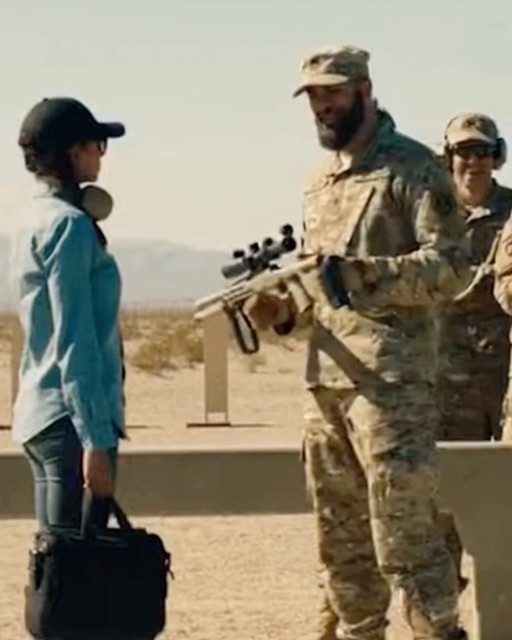
“THEY HANDED ME A SNIPER RIFLE AS A JOKE – THE ECHO THAT FOLLOWED WIPED THE SMIRKS OFF THEIR FACES
“Just hold it,” one of them said, like he was daring a kid to touch a hot stove.
Nevada heat shimmered. The target was a rumor on the horizon. I could feel their eyes on me, waiting for me to fumble, to blush, to laugh it off.
I didn’t. I never do.
I was there with a badge that said consultant. Not shooter. That’s what they believed.
The stock settled into my shoulder like an old friend you pretend you don’t recognize in public. My breathing leveled. My hands stopped shaking. My throat went dry anyway.
“Don’t waste a round,” someone snorted. “She won’t even see it.”
I looked through the glass. Wind flickers. Mirage. A ripple that most people call empty air.
I didn’t speak. I adjusted. I paused.
Click.
The report slapped the valley. We all waited.
Clang.
That sound hit harder than the bullet. Laughter died mid-breath. A clipboard slid out of someone’s grip and slapped the dust.
My pulse spiked. Not from the shot – from the silence that came after.
The range officer stepped closer, squinting at me like he was trying to see under my skin. “Where’d you learn to do that?” he asked, voice too flat to be casual.
I swallowed. “Consulting pays attention.”
He didn’t smile. He said a name I haven’t heard in years. Not my name. My other one.
The guys around us shifted, confused. The officer flipped his clipboard over with a shaky hand, and my blood ran cold when I saw what was taped to the back: a grainy photo of me in uniform, with a different last name and a red stamp across it that read KIA.
The sun seemed to stall over the basin, like even it wanted to see what I’d do.
I kept my face empty, the way you learn to in courtrooms and checkpoints and hospital waiting rooms.
“You’re mistaken,” I said, but it came out soft, like a lie that didn’t even try to be loud.
The officer stood there a second longer, then raised one palm in a small peace sign and backed off two steps.
“Break,” he called to the line, and the men scattered to shade and water and whispers that managed to sound both sharp and wet.
He waited until we were by the coolers, away from the bench, then dipped his head closer like we were thieves hymning in a church.
“I’m not here to burn you,” he said. “Name’s Garvey Holt.”
I didn’t give him mine. Not the real one. Not the new one.
He nodded like he understood the refusal, like he’d rehearsed it with himself a few times in a mirror.
“You show up with a consultant badge and hit a thousand on the first press,” he said. “Any man who knows this sand knows what that means.”
“That I got lucky,” I said, because sometimes playing dumb keeps you safe long enough to get smart again.
“That you’ve been here before,” he said quietly. “Long before the badge.”
A fly crawled across the lip of a paper cup, drunk on Gatorade, and I had the sudden, stupid urge to flick it away so it wouldn’t drown.
“What do you want, Mr. Holt,” I said.
He looked at the photo on his clipboard like it was a photo of a child he failed and then covered it with another sheet as gently as if paper could bruise.
“I want to know if you’re here to rubber-stamp Red Mesa’s safety plan,” he said. “Or if you’re here because someone out there died on a hike and the county needs a real report.”
I let my eyes float over the berm to the ridge line, pale and brittle like a cat’s ribcage under the sky.
“The county hired me to audit,” I said. “That’s all.”
He breathed out through his nose like that told him enough and not enough at once.
“You were declared dead,” he said, and it wasn’t a question, but I heard the question inside it too.
“So were a lot of people who later walked into living rooms and froze a family mid-bite,” I said, and instantly wished I hadn’t, because I’d just given him a shape of my ghosts.
“Fair,” he said, and his eyes softened, then sharpened again like they’d been trained to move on command.
“Just so you know,” he added, “the men who handed you that rifle didn’t do it because they’re dumb. They did it because they were told to.”
“By who,” I asked, and it came out rough, like I’d been chewing gravel.
He looked toward the office where the range’s little flag beat against its pole with that bright, tired rhythm of fabric that’s had the same view too long.
“By a man who doesn’t like loose ends,” he said. “Or dead ones walking.”
I put the cup down, dry as it was, because suddenly even the thought of sugar water made my mouth taste like metal.
“We done here,” I said.
“For now,” he said. “But if you came to do it honest, keep your head up when you leave. Eyes will be on your tires and your mailbox.”
I drove off the range with all the slowness of a person who knows fast draws attention and attention draws fire.
The highway lay like a ribbon of spilled oil, and the heat shimmering over it made the world look like it was breathing.
At the first gas station, I pulled under the awning and just sat there with my hands on the wheel, counting my own fingers like they might run off without me.
A memory tried to climb out of the back of my head, a ridge in a different desert, a radio squeal, a name I’d whispered into the dust until it was a prayer and a punishment.
Theresa, I heard, and the half-second before I killed it was long enough to remind me where that name lived now.
I pumped fuel and scanned the pump’s reflection for anyone’s eyes but my own.
A sandy-haired kid in a faded ball cap came around holding a squeegee and offered to do my windshield, and when I waved him off, he nodded and said, “Be careful out there, miss,” like a line from a song sung by someone who didn’t know what it meant.
I took County Road 8 back to the office, the long way, the way with fewer cell towers and more sky.
By the time I parked in the shaded lot behind the county building, my pulse had slid back into something that could pass for calm.
My badge said Tess Rowan because that’s who I’ve been for five years, and I clipped it on like armor.
The county’s legal office was cooler than outside by about thirty degrees and about three kinds of loneliness.
“Hey Tess,” the receptionist chirped, and I loved her for being oblivious to war stories under small talk.
“Hey, Pam,” I said. “Any messages?”
“DA Wade wants your preliminary by Friday,” she said, passing me a pink slip that smelled faintly like strawberry gum. “And Sheriff Donnelly called asking if you needed any, quote, pointers on what the department expects.”
I smiled with the bottom half of my face and hoped she’d take it as enough.
“Tell the DA she’ll have a draft Thursday,” I said. “And tell the Sheriff I know how to spell policy.”
She laughed the way people do when they like you but don’t quite get you, and I felt a small, ridiculous ache of gratitude about it.
In my office, I shut the door and let my forehead rest against the glass for the length of a held breath.
Then I pulled up the map I’d been building, the satellite view of the range laid over with colored lines like someone has been teaching a child to draw with a ruler.
The hiker’s body had been found north-northeast of Red Mesa, near a wash where kids stack stones into cairns and families take photos pretending the desert is a harmless backdrop.
The coroner’s report was clean and crisp, and the bullet they recovered was a match for a common caliber that a third of the county owned in one form or another.
The range’s logs for that day were clean too, which should have made me happy and instead made my teeth itch.
Clean logs in a place that smelled like cheap bravado and fresh paint made the back of my neck prickle like a word on the tip of the tongue.
I marked off distances, angles, shot positions, and I did the math the way you do when calculators make you lazy and pen and paper make you honest.
The earth didn’t lie. The line from the north berm to the wash was ugly, but it was a line a bullet could ride if no one had thought about backstops and rising terrain and the way wind cheats.
Someone had thought about it. They had thought about it and then written their thoughts in a way that skipped the parts that cost money.
I saved my notes, closed my eyes, and let myself picture the range again, but this time without the jokes and the eyes and the heat.
I saw the flag, the office door, the shaded firing line, the back berm with its telltale scars like acne on old skin.
And I saw how my shot had echoed off the far ridge and back again, a sound that felt too alive to lean on if you’re hiding.
My phone buzzed, and the number on it wasn’t in my contacts, but the area code told me it came from just outside town.
“Rowan,” I said, and kept my voice level.
Silence, then a breath, then a voice that was a stone skipping once, twice, then sinking.
“You still breathe like you’re counting,” the voice said. “It’s you.”
I didn’t answer, because if I started, I might end up saying a name that wasn’t mine.
“It’s Ramos,” he said, and the second I heard it, the memory that had been scratching at the back of my head stopped pretending to be anything else.
Eloy Ramos had been my spotter when the sky was a lid we couldn’t open and the mountains were teeth, and his laugh had been the only soft sound in a place that ate soft sounds.
“What do you want,” I said, and my hand shook, not with fear, but with the shock of hearing a voice you thought you’d only ever bump into in dreams.
“To buy you coffee where no one sits behind you,” he said. “Red Mesa’s canteen if we meet when they’re not watching.”
“They’re always watching,” I said, because men like the ones I’d seen laugh watch even when their eyes are closed.
“Then pick the diner off 14,” he said. “Back booth by the cooler. Two hours.”
I hung up and stared at my hand like it belonged to someone else.
He’d called me once before, years ago, the night before I took the name Rowan for good, and it had been a broken call from a train station with a coin clattering on concrete on the line under his words.
I told myself I would go to the diner because I needed information, because work is smarter with more than one line of sight.
But also, if I’m honest, I went because a part of me that had been asleep since the uniform days had just sat up and said it wanted to look someone in the eyes again who knew the sand the same way.
At the diner, the swamp cooler clacked like a bird with a cold, and the waitress poured me coffee until my cup rode the meniscus line and held just because physics wanted to be kind.
Ramos slid in across from me, older by a decade and a thousand small losses, but still with that face like a map of the place where stubborn came from.
“You don’t use a different face with the new name,” he said.
“I figured I wouldn’t run into anyone who could read it,” I said, and he nodded like that hurt in the way old scars do when the weather changes.
“You hit that steel at a thousand,” he said. “Garvey told me after the fact like he’d just watched a ghost pick up a spoon.”
“Garvey sent me a picture of a dead girl,” I said.
“He’s not your enemy,” Ramos said. “He’s mine if anyone’s, until I fix what I broke.”
“You broke something,” I said, and he flinched like he’d been waiting for someone to ask and hated that someone finally had.
“The day that hiker died,” he said. “We were running a night course for a contract bid that wasn’t supposed to exist on paper.”
I sipped coffee that tasted like pennies and burnt toast, and I didn’t take my eyes off him.
“Someone skipped safe angles,” he went on. “Range control said it was clear. I took their word because my kid needed braces and I didn’t want to miss overtime while I fought it.”
He ran a thumb over a crack in the formica like he could rub it away if he pushed hard enough.
“The shot went wide,” he said. “The logs went clean.”
“Who cleaned them,” I asked.
“Not the guys who handed you the rifle,” he said. “They’re mean, not clever.”
“Red Mesa’s owner,” I said, and he looked at me like he owed me an apology for not saying it first.
“He calls himself Nash,” Ramos said. “That’s not his birth name, but it’s the one he gave the bank.”
I pictured the man who had grinned when the rifle came my way, the grin of someone who loves a bar fight more than a sunrise.
“Why call me,” I asked.
“Because you didn’t die, even when they needed you to,” he said. “Because you won’t rubber-stamp it even when they tell you to spell it their way.”
I thought about Sheriff Donnelly’s message, tidy and helpful, the way people wrap a knife and call it a gift.
“You’re late,” I said. “You called years late.”
He took it like a punch and didn’t dodge because he wouldn’t consider cheating.
“I kept my head down and told myself I’d quit once the braces were paid and the house was sold and the secret felt less like a rock in my shoe,” he said. “Turns out rocks don’t shrink.”
“I don’t forgive you,” I said, because there are some lights you only turn on in a room if you want to see every stain on the carpet.
“I didn’t ask you to,” he said. “I asked you to help me fix it.”
“Fixing it might get you fired,” I said. “Or charged.”
“I’ve been in worse,” he said. “Not because of law, but because of my own reflection.”
He slid an envelope across the table like a bad scene in a movie, and I almost laughed at how cliche it looked until I saw what was inside.
Emails printed out and highlined, and a schedule sheet with whiteout scars that glowed like confession under cheap fluorescent light.
“Copy of range notes the night of,” he said. “And an email from Nash to Garvey telling him to adjust. Garvey didn’t, so they cut him out of the night courses and called it budgeting.”
“He showed me the photo,” I said. “He also told me to watch my tires and my mailbox.”
“That’s his half measure,” Ramos said. “He doesn’t have any full ones left but telling the truth, and he’s starving himself before he gets there.”
“You hungry,” I asked, because sometimes the only way to keep a conversation from becoming too heavy to carry is to hand it a sandwich.
“Always,” he said, and smiled for the first time, and for a second I saw the kid who’d once tried to teach me how to juggle rocks during a twelve-hour wait.
We ate grilled cheese and onion rings like two teenagers wasting gas, and we planned like two thieves trying to steal back something someone stole first.
We decided there was no point bringing it to the Sheriff because the Sheriff had already called my office with a suggestion about spelling.
We’d go to DA Wade, who ate lies like sunflower seeds and spat the shells into a bin with a neatness that made me like her.
But before we did, we’d go back out to the desert and set stakes and pull string and make a geometry the county commissioners could stand inside of and feel their own stomachs drop.
“If I’m right about the angles,” I said, “we can show that the wash and the north berm may as well be a hallway if you ignore the rules.”
“And if we’re wrong,” he asked.
“Then we can say we tried the only honest way,” I said. “With the earth and the sky and the wind calling us fools if we were.”
We met at the range at dawn two days later, when the air was thin and the sun was still deciding if it wanted to scorch or just glare.
Garvey’s truck was already parked by the office, but he wasn’t wearing the range polo, just a flannel over a tee that said some obscure festival’s year.
“You were kids last time I saw you,” he said. “Kids with too-old eyes, but kids.”
“You gonna stop us,” I asked.
He glanced at the stakes in my trunk and the spool of mason line and shook his head.
“I’m gonna watch so if anyone asks me what I saw, I can say I didn’t blink,” he said.
We paced off the distance, marked the spots, set a white plate where the hiker had fallen because the rock was too cold a color for morning.
The desert is a room with a personality, and that morning it was kind but truthful, like a coach who loves you too much to let you cut corners.
We didn’t shoot at the wash, because there’s a difference between proving a thing and hurting it again, but we shot at steel on a line that showed the path like a map.
I took a breath, Ramos called wind in a voice that made a little hole in time for a second, and I took the shot that showed the commissioners’ later that the world lines up even when your heart hopes it won’t.
Clang, and the echo walked out to the ridge and back like a parent leaving a note and then returning to underline it.
Garvey stood with his arms crossed and his chin on his fist and looked like a man who’d been hungry a long time and suddenly smelled soup.
“You’re gonna make enemies,” he said.
“I’ve had enough enemies to know they only count if they can take your sleep,” I said. “I like my sleep.”
The DA came out that afternoon with a paralegal who blinked against the light like a mole dragged into noon, and she listened without interrupting and then said the word deposition the way you spit a cherry pit.
“Put it all in writing,” she said. “No big adjectives. Just what the ground told you.”
“Ground doesn’t lie,” Ramos said, and for a second there was a softness between him and the DA like two people who enjoy things that don’t know how to be anything but true.
I wrote the report that night in my kitchen with my shoes still on and the taste of dust in my mouth like the last sip of a bad drink at a better bar.
I didn’t use any big adjectives. I didn’t need them.
In the morning, my mailbox was open and empty and my tire had a nail in it the size of a candy cane.
I laughed because it felt like someone kept telling the same joke and hoping I’d suddenly find it scary.
I changed the tire while humming a song I didn’t know the name of, and a woman walking her poodle asked if I needed help and I said no, thank you, and meant it.
The Sheriff called and didn’t leave a message, and I didn’t call him back because my report went to the DA, not to him.
Red Mesa’s owner, Nash, called too, and his voice on the voicemail had the thin glaze of a man who had read three articles about empathy and thought he’d swallowed one.
“Hey there, just want to clear up any misunderstandings,” he said. “Love to have you out again as our guest, show you our commitment to safety.”
I deleted the message so fast my thumb ached.
Two days later, a county meeting air was thick with air-conditioning and boredom until the DA stood and asked if she could introduce a consultant to walk folks through a few things.
I stepped up and willed my hands to stay steady, and I spoke like I talk when my life doesn’t depend on it, which helped.
I said what the map had told me, and what the string between the stakes in the desert had said to my eyes, and what the dent in the steel had told my ears about wind and chance and care.
I didn’t say dead girl, because the girl had been a father’s child and a sister’s friend and a person who’d blushed at something last week that I’ll never know, and I wouldn’t turn her into a word that helped anyone else sleep.
Nash stood at the back and smiled like a man who knows how to balance a glass on the tip of his finger until the cameras turn off.
He said words like anomaly and unprecedented and community, and I counted how many times he didn’t say sorry.
After the meeting, he caught me in the hall and leaned close enough that my skin wanted to step backward, but I didn’t give it the pleasure.
“You know people like you don’t stay lucky forever,” he said softly.
“You should print that on a T-shirt,” I said. “You could sell it to your training class.”
He smiled in a way that showed me every small prison he lived in inside his skull and walked away when he realized I wasn’t going to turn around and find him taller when I looked back.
Garvey called that night and told me he’d been fired and relieved in the same breath.
“They sent a courier to collect my keys like I’d been stealing chairs for fun,” he said. “Told me I’d be happier with less liability around my neck.”
“You gonna be okay,” I asked.
“I’ve had worse falls,” he said. “And I’ve landed wrong and gotten up before.”
The hearing came fast after that, the way things speed up once you take the first step and gravity starts helping.
Ramos sat behind me and squeezed my shoulder when they asked questions they hoped would make me fold, and I didn’t fold.
I said what I saw and how I measured and what the data meant, and when they asked me how I knew the shot that hit the steel meant anything at all, I told them the truth.
“Because I’ve made that call before,” I said. “And sometimes you don’t get an echo you want to hear.”
No one asked me who I used to be, not because they didn’t care, but because the DA had drawn a small circle around my past with her body like a bouncer who understands the guest list.
Ramos took the stand and put his head down and told the story the way it needed telling, without taking any of the sugar people like to pour on shame.
He said he was wrong. He said he’d been afraid. He said he wanted to be something better for his son.
Garvey took the stand and didn’t look at me once, because looking would have made his throat close, and said he’d refused to adjust the logs.
He read the email where Nash suggested they rewrite the training ledger to reflect only daylight operations, and there was an audible sound in the room like a group of people had all decided to shift in their chairs at once and then chose not to.
Nash tried to smile when he was sworn in, and then forgot how when the paper hit the projector and his words hit the room.
By the end of the week, the county had cut Red Mesa’s contract, and the DA had opened a case that used words like negligent and reckless and considered, and I slept for fifteen hours the first night after and woke up feeling like a man who hadn’t heard his own name in a year just heard it and remembered liking it.
A small thing happened then that I didn’t expect, and it matters to me more than the headlines.
One of the young men who had laughed when they handed me the rifle found me in a grocery store aisle holding two different brands of pasta sauce.
He cleared his throat and stood there like a boy cheating on where to put his hands.
“Ma’am,” he said, and I almost laughed because I’m not old enough to be a ma’am in my head even if my knees disagree. “I was a jerk.”
“You were,” I said, and then felt a warmth in my chest like someone had put down a heavy box.
“I thought you were there to make us look bad,” he said. “I didn’t know anyone died.”
“You didn’t ask,” I said.
“I didn’t,” he said. “I’m sorry.”
“Then be better,” I said. “Don’t laugh next time you don’t know a thing about what a person’s carrying.”
He nodded and walked off, and I let myself feel good about it because sometimes small things are the first things that make a big thing right.
Garvey got a job teaching safety to kids at the county fairgrounds on weekends, and the way he held the blue plastic guns and showed little fingers where to point and where not to reminded me there are men who never take their nameplates back even if someone pries them off their doors.
Ramos pled to a misdemeanor for obstructing early in the investigation, and it hurt to hear the word guilty near his name, but the judge looked at him like he was looking at someone who had knocked on his own door with his hands up, and he gave him probation and a long talk and a shorter sentence than the rumors had promised.
Nash moved his operations two counties over and found a field to rent and a set of men to hire who didn’t ask why the paint was still wet on the signs, but he didn’t get the state contract he’d wanted, and he didn’t get to stand in rooms and use words like community with a grin anymore.
Sheriff Donnelly announced his retirement early, and the papers used words like seeking new challenges, and I didn’t clap, but I didn’t spit either, because some falls hurt more when you watch them.
DA Wade took me to lunch and asked how I was sleeping, and I told her the truth for once.
“Better,” I said. “Like the echo finally got to the ridge and didn’t feel the need to come back.”
She smiled and touched my wrist for just a second and then pretended to study the menu hard because the room had eyes and roles and she respected both.
I kept my badge, and I kept my kitchen table, and I added two new maps to the wall behind my desk, one of the desert and one of the town.
Sometimes kids stop me in coffee shops and ask if I’m the lady from the article who shot the long shot, and I tell them yes but that the long shot wasn’t the hard part.
“The hard part is telling the right person the right thing even when you know it’s going to mess with your week,” I say, and they nod like they understand and then ask if I can show them how to hold their breath like a secret.
I started going out to the fairgrounds with Garvey on Saturdays and teaching a class called Basics and Better, and I showed a girl how to stand without apologizing with her shoulders and she smiled like a starfish opening.
Sometimes, I look up and see the man whose eyes I knew before I knew how to use them, and he tips his cap and watches his boy run drills, and I think about all the things we survived without asking to and how much of that came from the idea that you don’t always get to keep hiding.
I didn’t change my name back, because names are both armor and baggage, and I’ve learned to wear this one like a coat I chose even if it started out as a disguise.
But I stopped ducking when I heard Theresa in my head, and when it came, I let it stay long enough to talk to it before it wandered off again.
Life didn’t turn into a movie after that. The bills still came, and the faucet still dripped sometimes, and my neighbor’s dog still howled in a way that made the whole street feel like it had a conscience at two in the morning.
But the quiet got kind again, and the air didn’t feel like it was holding its breath to see if I’d lie.
I went back out to the range one day alone and asked if I could use the far bench, and the kid behind the counter didn’t know my story and didn’t need to.
He rang me up, handed me a stapler and a target, and said, “Stay safe,” in a tone like a blessing.
I shot a few groups and smiled at how my hands remembered what my heart didn’t have to fear anymore, and when I left, I thanked the kid and he blushed and said you’re welcome, ma’am, and I laughed at myself for still wanting to argue with that title.
On the drive home, the sky did that thing where the color looks like bruised fruit and the light cuts through in strips like a lasagna made by gods, and I rolled down my window and let my arm ride the wind.
I thought about echoes then, about how they come back, not because the sound is stubborn, but because the world sends you back what you put into it when it hits something solid.
I thought about the men who laughed and learned, and the man who hid and fell, and the boy who now runs between cones in the sun because his dad decided rocks don’t shrink on their own.
I thought about the woman in the photo stamped KIA who didn’t stay dead, and the woman with the badge who wrote the report, and how both of them are mine even if I don’t show them both to everyone.
I don’t know if there’s karma, not the neat kind that fits on a mug, but I know this much now.
Sometimes, you take a shot the world tells you not to take, not because you like the echo, but because someone needs to hear the sound that says the truth hit something that won’t move.
And sometimes the only reward is sleep and a cheap sandwich eaten at a diner with a man who once held your life in his breath, and that’s worth more than a headline.
If there’s a lesson here, it’s this.
Don’t laugh at people when you don’t know their story, and don’t hide from your own when it stops staying hidden.
Courage isn’t the loud move or the long shot; it’s the simple press on the thing you know is right even if your fingers shake.



