
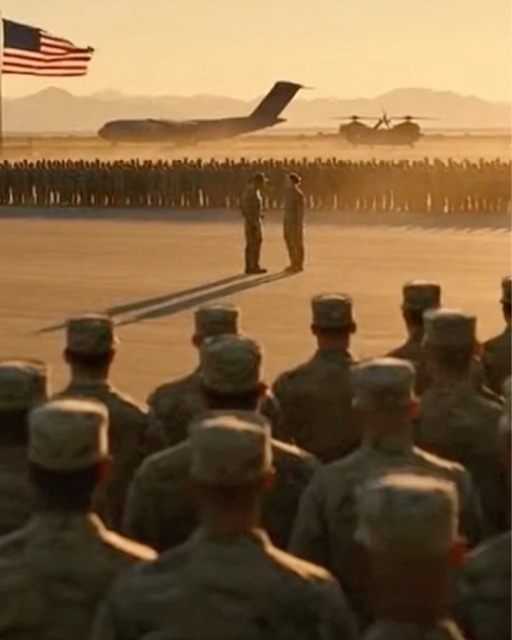
“You’re blocking my runway,” Major Grant Mercer barked. You could hear him before you saw him – boots, voice, ego.
She didn’t even flinch. Just kept her calm hands moving over a comms case like the rotors and shouting meant nothing. No rank. No unit patch. Just plain coveralls.
“I need ten more minutes,” she said without looking up.
It was deployment morning. Eighteen hundred of us lined up like a living machine – birds fueled, briefings done, timers running.
There wasn’t a spare second to breathe, let alone argue. My mouth tasted like coffee and rubber from my headset.
Mercer laughed. That mean, public kind of laugh. “No. You need to move. Now.”
She finally met his eyes. Cool. Steady. “Interrupt this sync, you lose encrypted continuity for the whole launch package.”
My stomach dropped. If she was right, a lot of careers were about to be on fire.
Mercer stepped in, chest to shoulder. “I’m the commander here,” he said, low enough that only the first row heard it.
“Step aside,” he finished, and his breath smelled like stale mints.
“Then act like one.”
The words hit harder than a shove. Faces turned. Radios went quiet.
I felt the air thin as rotors chopped nearby and the sun threw hard lines across the tarmac.
He made the mistake.
He put a hand on her shoulder, just a push to make a point.
In a blink, she wasn’t there – and he was. Flat on his back on the tarmac, 240 pounds of fury hammered into concrete.
The slap echoed. He gasped like the wind had been stolen from inside him.
She didn’t posture. She didn’t gloat. She simply stepped back to her case and clicked a latch like she’d brushed off lint.
That’s when the convoy parted. The line of green trucks and field cases seemed to tug itself open like a zipper.
General Darren Pike walked straight down the center line, eyes on the scene, jaw tight. He had that look that made colonels clear their throats.
He didn’t look at Mercer. He looked at her.
“Everyone stand by,” he said, voice like ice on metal.
He took one more step and raised his hand.
“Stand down,” he said, loud enough to carry to the helos. “That is Command Sergeant Major Rourke.”
You could feel the words cross the flightline and settle on people. Even the birds seemed to pause.
Mercer rolled to his side and pushed up slow, eyes shock-wide, as if someone had swapped the floor out from under him.
“She asked for ten minutes,” the general said, not staring at anybody in particular. “Give her nine.”
No one needed a second lecture. Bodies shuffled back a foot, like they were giving space to an old friend and a hot stove at the same time.
I thumbed my radio and told my pilot we were still green. He told me to keep my head on a swivel.
Rourke never stopped. Her hands danced, pulling fiber, reseating a connector, checking a status bar with a patience that felt like a quiet song in a storm.
Someone close whispered, “I thought she was a contractor.” Another said, “I thought Command Sergeants wore stripes.”
I knew the rules. Command Sergeant Major sometimes wore what worked.
She wasn’t wearing pride. She was wearing what the job wanted.
The sync bar crept, then jumped, and locked in. I saw the tiny light go solid blue, and she let out a breath that fogged for a second in the cool morning.
“Continuity established,” she said to nobody and everybody.
General Pike tipped his chin like he’d known it all along. “Launch in sequence,” he said, and someone hit a timer that had been paused with a finger on the button.
Mercer stood with his fists closed and then opened them. He glanced at me and past me like I was a tree.
He made eye contact with Rourke once, and she didn’t return it. She just reached for a roll of tape and labeled the case with a simple “J6 – Core,” neat as print on a library book.
We loaded up. I climbed into the back of our Black Hawk and gave the all clear with a slap on the pilot’s door.
As we lifted, the earth pulled away smooth, and the field turned into a checkerboard of trucks and people and gleaming rotors.
Over the net, I heard a voice I didn’t know well say, “Package green,” and then General Pike’s even tone, “Execute.”
We banked southeast toward the airfield at Pope to stage in chalks for the airlift. The world below was all pine and long shadows and highways like veins.
I watched our little antennas and listened to the digital chirps that meant the network was up and breathing. Normally it popped and lagged with cutouts like hiccups.
This time it was steady. Like someone had tuned a radio station to land on a song right as the chorus came.
“Lot smoother than usual,” the pilot said, eyes on the horizon. His name was Warren, and he chewed gum like it owed him money.
“That Rourke fix,” I said. “It’s sticking.”
He grunted his thanks without saying the word, hands light on the yoke, the cabin smelling like cordite and dust.
We dropped into Pope like a coin into a jar, settled on marked lines, and waited while the next plan lined up behind us. Big birds waited to carry us while we waited to carry someone else.
I grabbed a water bottle and leaned out the door to cool my face. The spring air was chilly but already pushing toward warm, and sweat forked down my spine.
Down the line, I saw Rourke standing on the skid of a Little Bird, talking with her hands, two fingers drawing invisible circuits in the air. The pilot nodded like a kid learning a trick.
Mercer slid by like a shadow trying to be a wall. He kept his eyes forward and his jaw set.
General Pike was there with a clipboard and a cell phone, moving blocks of time around like he was playing chess and everyone else had checkers.
Two MPs rolled past in a cart and slowed by the general. Everything was quiet noise and busy hands and the kind of waiting that isn’t restful at all.
That’s when a call cracked over the net from Range Control. A medevac request came in hot from the training area west of the highway.
One of the engineer soldiers had smashed his leg between a loader and a jersey barrier. Tourniquet on. Bleeding controlled.
We weren’t the medevac company, but we were the closest with blades spinning. Our chalk had warm engines.
“Any aircraft available,” the voice said, steady but tight. “Patient condition urgent. Coordinates to follow.”
For a second, nobody said a word because all the words were heavy. Everyone looked left and right to see who would jump.
“Black Three, say fuel,” a voice on our internal asked, and Warren rattled off numbers with the calm of a guy ordering breakfast.
“We can do it,” he said to me without looking, already dialing in a heading. “We pick him and swing back.”
“Command, Black Three,” he said on the net. “We can take the dustoff.”
Mercer’s voice cut in, trimmed and cold. “Negative, Black Three. Hold position for load plan.”
I saw Rourke pivot where she stood and point to the sky like she was pointing to a thing we all couldn’t see.
General Pike didn’t hesitate. “Black Three, execute medevac,” he said, and then he turned his head toward Mercer like a teacher waiting for a good student to explain a bad grade.
“Copy, execute,” I said, and I strapped in, heart already a step ahead.
We were in the air in less than a minute, nose pointing west, blades clawing at the space between need and help. I caught Rourke hop onto the skid of the Little Bird, then drop back, deciding in a heartbeat to let us go alone.
As we lifted, my comm panel flashed something I didn’t like. A jitter line through our link, just a prayer-bead flicker that said the network was about to hiccup.
Then it didn’t. It smoothed, like a rough board had been planed while we weren’t looking.
“That sync,” I muttered. “Holding solid.”
We followed the GPS breadcrumb to the range and spotted the loader like a bright toy in a sandbox. A flare smoked up pale against the trees.
I saw a handful of figures waving and one on the ground who wasn’t waving at all. We flared and hovered and set down on a patch of dirt that wasn’t meant for parking.
The smell of oil and hot metal hit me like a memory. I hopped out with the medic, and we moved like a drill everyone wishes they never have to perform.
The kid on the ground was younger than my little brother, eyes big but mind clear. “I’m good,” he lied between his teeth, and the medic nodded like lying was the key we needed to hear.
We got him on board while dust tried to crawl into our eyes and mouths and lungs. I held his hand because somebody should.
“What’s your name,” I asked him as we lifted, and he said, “Reed,” like it took all the air left in him to say just that word.
“You’re going to the hospital, Reed,” I said. “You’re going to have a mean scar and a better story.”
He laughed once, the kind that makes you worry and want to cry.
I checked comms and relayed our ETA to the hospital helo pad. The link was perfect, like a string pulled taut between us and every antenna in the county.
“Command, Black Three. Patient stabilized, inbound,” I said, and I added the vitals and the meds because the medic had only two hands.
On the way back, Warren slipped us between two towers like a coin through fingers. I looked out and saw that the world looked the same as it had an hour ago, but I didn’t.
We put Reed down on the pad and watched as nurses and a doc in a hoodie took him into bright lights. He threw me a thumbs up as he went through the sliding doors.
“That was clean,” Warren said as we climbed back into pattern. “Cleaner than clean.”
“Rourke’s work,” I said, and I believed it like you believe your own name.
When we touched back down at Pope, I felt eyes on us. Some were warm and some cooled quick like they didn’t want to be seen being warm.
Mercer was there, and he didn’t look furious. He looked like the breath had been taken out of him in a different way.
He approached the general and gave a tight nod that looked like it hurt him. Rourke stood off to the side, arms crossed, reading the sky.
There was a small pause while a lot of people decided what kind of day it was going to be now. Then we snapped back to loading like we’d never left.
An hour later, after pallets had been kissed and weighed and pushed into bellies of aircraft big enough to have their own weather, I ducked into the hangar for a bathroom and a moment of not-shouting.
She was there. Command Sergeant Major Rourke, alone with her case, wiping it down with a damp rag like it was a kitchen table.
“That was your work,” I said, and it felt too simple for what I meant.
She looked up and smiled just a notch. “That was everybody doing what they’re supposed to do,” she said, and her voice had a rasp from breathing too much dust and not enough sleep.
I stuck out a hand and she shook it like a handshake should be, not too hard and not too long, just exactly right.
“Hector,” I said. “Crew chief, Black Three.”
“Rourke,” she said, even though I knew who she was now. “Kenna if you’re not yelling at me.”
“I’m not,” I said, and that made her smile again.
She picked up a screwdriver and started to check a plate that didn’t need checking. People like her didn’t waste movement for no reason.
“You really only needed nine,” I said. “Why did you say ten?”
She tilted her head like a mechanic listening for a noise. “People hear the number ten better than nine,” she said. “It’s a human thing.”
“That sync bar,” I said. “I thought we were past the point of fragile.”
“We are,” she said, and then she sighed. “Mostly.”
I waited because it felt like the kind of wait that gets rewarded.
“We had a known attempt on an earlier exercise,” she said, eyes on the case. “Someone tried to brute a handshake during a power cycle last month.”
“You think they were going to try today,” I said, and it wasn’t a question.
“I know they were,” she said. “The general knows too.”
“Why not tell everyone,” I asked, and I could hear my own tone get a little sharp, like a kid asking why the grownups skip parts of the story.
“Because sources burn like paper when you light them,” she said. “And we needed to know who was going to strike the match.”
I thought of our net smoothing out like a calm lake and felt a cold finger move between my shoulder blades.
“You think they’re inside,” I said, measuring my words.
“I think they got help from someone who doesn’t know they’re helping,” she said. “That’s even more common.”
We stood in the quiet for a second while the big hangar made little noises and the world did its work around us.
She looked at me and held my eyes like it was a dare to look away. “You handled Reed well,” she said. “You kept your voice level.”
“It was the medic,” I said. “I just held a hand.”
“Sometimes that’s the best job in the building,” she said, and I believed her.
The door banged open and Mercer stepped into the hangar like he was walking into a storm he’d already checked the radar for. He stopped three paces away.
“CSM Rourke,” he said, using all the letters like a man who values letters right this second. “A word.”
She set her screwdriver down and faced him with her hands visible. I respected that in a way I couldn’t quite explain.
“Go ahead,” she said, and it wasn’t trained or polite. It was open like a field.
“I was out of line,” he said, and every syllable scraped. “I thought you were…not what you are.”
“You thought I was a problem you could push,” she said. “And it would move.”
He took it like a punch and didn’t swing back. “Yes,” he said. “I apologize.”
She watched him like she was reading a label. “Okay,” she said. “But you don’t owe me.”
He blinked like he hadn’t expected that call. “I put a hand on you,” he said. “I do owe you.”
“You owe your people,” she said. “To slow down the part of your brain that lives in your shoulders.”
He nodded once and looked away. “I got spooked by the clock,” he said. “The schedule looked like it was going to swallow me.”
“The clock isn’t the mission,” she said. “The mission is the mission.”
He looked tired all of a sudden, the kind of tired you feel in your jaw and your knees. “I know that,” he said softly. “I forgot for a minute.”
“It happens,” she said. “Don’t let it happen twice.”
He gave a short breath of a laugh that didn’t feel like a laugh and then squared himself. “I told the general I was wrong,” he said. “In front of my staff.”
“That’s the start,” she said. “Now tell the privates.”
He nodded again, and his face changed in a way I hadn’t seen before. It lost ten pounds of anger and gained five of humility.
He walked out, and as the door swung shut, I heard him say to someone in the hallway, “Find me a mic.”
Rourke picked up her rag again and wiped a streak of grease away that probably she had left herself as a reminder. Then she turned to me.
“You’re riding to Wilmington tomorrow,” she said. “Bring two extra headsets.”
“Why,” I asked, and she half-smiled.
“Because I can’t be everywhere,” she said. “But I can be in your bird.”
We didn’t fly to Europe that week. We were ferrying to the port to load onto a ship that would be stuck behind a storm anyway.
The next morning, the road to the port jammed in a way nobody planned on. A tanker had jackknifed on a bridge and spilled the day onto everything.
Our convoy snaked for miles, green after green after green, and it felt like an idiot’s parade. I could see the ocean in the distance, blue and fake-looking.
Comms started to clog with every driver and every officer and every doubt. People stepped on each other and the net turned into a noise that had teeth.
Rourke climbed into our back seat with a cable over her shoulder and clipped into the box like she was plugging into a heartbeat. Her coveralls had a little stitched name tag that just said “K. Rourke.”
She spoke low and even and told three units to switch to an alt channel. She told a fourth to relay for the fifth because the fifth was in a dead zone.
“Use the rail spur,” she said into the mic to the movement officer. “It’s been inspected for flatbeds.”
“You can’t just use a rail spur,” somebody snapped back, and the voice sounded like the kind of person who had never used a rail spur.
General Pike came on and said, “Use the rail spur,” and then there was an organized silence that meant everybody was about to do what should have been done an hour ago.
We watched as the drivers eased the trucks off the highway and down toward the industrial park and then lined them onto a short spur like they were grown-ups playing with toys the right way for once.
Mercer rolled up in a dusty SUV with a map folded to the wrong page. He jumped out and didn’t yell.
He put the map on the hood and called three names. When they came over, he pointed and asked questions instead of giving orders.
It was so regular and so smooth that it felt like a trick. Then it just felt good.
We loaded the lighter pallets onto the flatbeds, moved the heavy ones last, and made the bridge delay someone else’s problem.
At the port, the air smelled like salt and diesel and money. Cranes moved like tall birds bending their knees.
I saw a man with a camera tucked into his jacket take shots he shouldn’t. One of the MPs yawned and looked the other way.
Rourke didn’t. She walked toward him like she was going to ask for the time and took the camera easy as you take a cup from a table. The guy went pale like a ghost who’d been reminded he had a body.
“He’s fine,” she told the MP when she handed him over. “He’s just in the wrong place with the wrong reason.”
Later, I found out the camera had a chip full of very specific curiosity. It wasn’t just pictures of cool helicopters.
The general had known someone would try. Rourke had made sure it hadn’t been worth their day.
That night, in a warehouse with lights that hummed and coffee that fought back, I found a magazine in a stack of old reading material. It was years old and had an article about a ham radio club that had relayed messages during a hurricane.
There was a headshot of a younger woman with the same eyes and the same not-trying haircut. The caption said, “Kenna R., architect of the patch that kept the frequency from folding.”
I walked over and put the magazine down next to her while she was eating a beef jerky that had given up. She glanced at the picture and rolled her eyes.
“Old life,” she said. “Same job.”
“You’ve been doing this a long time,” I said, and it sounded dumb as soon as I said it.
“Long enough to know where the tape goes,” she said, tapping the case.
The port had a small ceremony the next morning. It wasn’t official, not really, just a bunch of people who needed to say something to someone while trying not to look like they were needing it.
Mercer stood in front of a forklift and some pallets and spoke into a handheld like it was a church.
“I got humbled this week,” he said. “I forgot who the runway belongs to.”
He swallowed in a way that looked like he was swallowing a stone. “It doesn’t belong to me. It belongs to the mission.”
He turned to Rourke and lifted a coin from his pocket. It was worn and had a nick on one side like it had been dropped a thousand times or thrown once when it shouldn’t have been.
He held it toward her and looked like a man who wanted to make a big thing small and a small thing right. “I was wrong,” he said again, like the words did a job he respected.
She took the coin and turned it in her palm. “I don’t keep officer coins,” she said, simple and true. “They make my pocket too heavy.”
A nervous laugh ran through the group like a breeze that didn’t know if it could be trusted. She held the coin out and put it back in Mercer’s hand.
“Hold onto that,” she said. “And every time you feel it, remember not to grab people.”
Then she reached into her own pocket and pulled out a coin that looked cheap. It wasn’t shiny or official-looking. It had a burn mark.
“A private gave me this in Kandahar,” she said. “He wrote ‘thanks for the radio that worked’ on it with a Sharpie that died halfway through.”
She handed it to Mercer and shrugged. “You can hold that,” she said. “It’s not heavy, but it weighs something.”
He took it and stared at it longer than anyone needed to, and then he slid it into his chest pocket like he’d been given a tiny, bossy heart.
We shipped the birds. We shipped the trucks. We shipped the cases with the tape on them that said things like “Bubba’s Tools” and “J6 – Core” and “Don’t Touch Unless It’s Yours.”
Weeks later, we flew off a ship in gray light, practiced an assault on a place that wasn’t our place, and came home without the kind of stories that take sleep away.
On a Sunday between that and the next, I saw a post go up on our unit page. It was a picture of Reed standing with a cane and a grin that made his mom’s eyes look like they were going to leak out of the screen.
The caption said he’d keep his leg. It said he’d be back, not as fast as he’d like, but back.
I sat on my cheap couch and thought about the way his hand felt in mine, cold and trying not to be. I thought about the way Rourke’s hands had moved over that case on the runway like they were doing a prayer.
A week after that, someone in the mess tent told me that General Pike had known Rourke since he was a captain picking up pieces in a different war. She had been his radio when the other one was smoke.
He trusted her because she’d saved him, sure. But more because she’d done it without saying she was saving him.
We see people like her and tell little stories to ourselves. Contractor. Tech. Just a person in coveralls.
Then the person in coveralls lets a major taste the floor and the general says six words that make our brains remember the parts we skipped.
I saw Mercer months after that, and he looked like a piece of metal that had been heated and bent and then cooled in the right shape. He was at a range, watching a private explain a gear change to an older sergeant.
He waited his turn to talk. Then he asked a question.
He caught me watching and nodded like two men do across a street when neither of them really knows the other, but both remember a thing the same way.
“How’s your head,” I asked him, pointing to the spot where he’d bounced that day. He smiled, small and real.
“It took longer to fix my head than my skull,” he said. “But it’s working.”
Rourke retired that winter, if you can call it that. She left with a box and a hug from a general who didn’t hug people like a habit.
She came back the next month as a consultant because sometimes retiring looks like a different badge on the same toolbox. Her name on the email was still just “Kenna R.”
At her sendoff-that-wasn’t, she said something I wrote down and tucked into my wallet next to a receipt for a burger I shouldn’t have bought.
“Slow is smooth,” she said, holding her paper cup like it was a toast. “And smooth is fast. But only if you listen before you speak and look before you lean on someone.”
We all said it back in our heads, like maybe that would help us do it when the noise was louder.
Now, when I sit on a flightline and feel the air stick to my neck and the sun bounce off metal hard enough to throw a headache, I think about coveralls and names we don’t bother to ask.
I think about a tiny blue light going solid when you need it to, and a kid named Reed telling me he’s good when he’s most definitely not. I think about a general making a space wide enough for everyone to stand without getting pushed.
I think about how authority can sound like a loud thing and competence can look like a quiet thing. And how the mission can’t tell the difference unless we make room for both to do what they’re supposed to.
The real twist wasn’t that she outranked him. It was that she out-listened him.
She heard the network, the room, and the clock, and she picked the right one to obey. None of that shows up on a patch.
We like to tell stories where karma walks in like a sheriff with a hat and a star. Sometimes it’s just a person who says, “Give me nine minutes,” and means it.
Respect isn’t a medal and it’s not a rank. It’s a choice you make before you grab somebody and after you realize you almost did.
People will wear what the job asks them to wear. Sometimes that’s coveralls with no stripes and no name.
If you need a lesson from that morning, it isn’t about who can put who on their back. It’s about who keeps their head when everybody else is letting theirs turn into shoulders.
We all get those moments when the clock looks like it’s standing on our chest. That’s when you breathe once, listen to the quietest voice in the room, and decide that the runway belongs to the mission, not your fear.
Because that choice keeps radios talking when it counts. It lets a tourniquet do enough. It takes a train track nobody thought of and turns it into a road.
It hands a cheap coin to a man who thought his pocket was full already and makes space for one more thing to matter.
In the end, the words that stopped a bad minute and started a good day were simple. They were just names and ranks, said over the sound of spinning blades and human pride.
But the work after that was quieter. It was apology and learning and doing the right thing when nobody was there to clap.
And that, more than who fell and who stood, is what made the rest of the story end the way it should.



