
The man in the navy suit stopped so close Khloe could see the perfect stitch at his cuff. She smelled clean cologne and train metal.
“Ms. Rollins?” he said softly.
Her heart kicked. He knew her name.
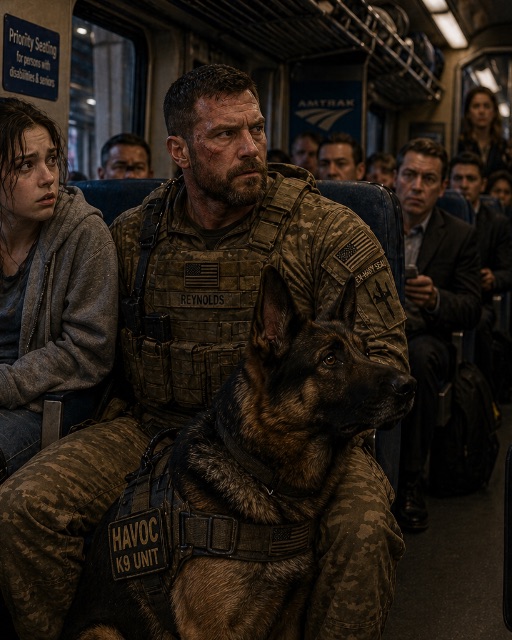
The Shepherd’s body rose like a tide, pressing harder into her legs. A sound rolled out of his chest – low, steady, ancient.
“Keep moving,” the SEAL said without looking up. Calm voice. Not calm eyes.
The man in the suit didn’t move. His gaze slid to the dog, then back to Khloe. “I don’t want any trouble,” he murmured. “But you weren’t supposed to be on this train.”
Her mouth went dry. “What?”
His hand dipped toward his jacket.
“Hands,” the SEAL snapped.
The hand froze. The man swallowed, lifted both palms. A briefcase dangled from his fingers. “Then I’ll show you,” he said, tone flat. “So you understand why he’s doing that.”
The Shepherd’s paw edged over Khloe’s boot.
Around them, the car stayed weirdly normal. People scrolling. A kid with headphones. Somewhere up front, a baby squeaked.
“Set it down,” the SEAL ordered.
The man crouched, slow. The case hit the aisle carpet with a soft thud. He unlatched it. One. Two. The clicks sounded too loud.
Khloe’s hands wouldn’t stop shaking. She stared at the dog’s amber eyes because the man’s were worse.
The lid lifted an inch.
“Don’t,” the SEAL warned, and the dog’s rumble rose.
“I have to,” the man whispered, not to them – like to himself. Then he tipped the lid toward Khloe, just enough for her to see what was inside.
Her blood ran cold when she saw the top item peeking out – thick paper, a raised seal, and a clipped photograph with her face staring back at her from another name.
He let the lid close again, but not all the way. His fingers stayed there, white-knuckled. “You weren’t supposed to board here,” he said. “You were supposed to be at Newark, under escort.”
Khloe glanced at the SEAL. He kept his body angled to block her. His dog leaned like a brick wall.
“I don’t know you,” Khloe said. “I didn’t agree to anything.”
“I know,” the man murmured. “Which is why I’m here.”
“Name,” the SEAL said.
The man’s jaw shifted. “Graham Vale.”
“Agency,” the SEAL said.
“Justice,” he said. “Special detail.”
Khloe took a breath that burned. “That’s my face,” she whispered. “Why does it say Mara Whitlow.”
The man looked away like the name had weight. “Because it was yours,” he said finally.
Something cold unspooled inside her. She could feel each vertebra in her back like a bad memory.
The train slid into a shadowed stretch, the river a slate ribbon beside them.
“To your right,” the SEAL said under his breath. “End of the car.”
Khloe didn’t turn her head. She saw it in the man’s eyes anyway. He’d seen the same thing.
A second suit. Standing casual. Not casual eyes.
“Say one more word like you’re in charge,” the SEAL said evenly, “and I will put you on the floor until Transit Police get here.”
Graham nodded once. “Fair.”
The dog shifted his weight. His fur was warm against Khloe’s ankle. He smelled like sun and laundry soap.
“Who are you?” Khloe asked the SEAL, finally.
He turned his head just enough for her to see the scar by his hairline. “Harlan,” he said. “This is Pax.”
She wanted to ask a hundred questions and none. Her leg throbbed where the brace dug. She realized her fingers were still around the cane like it could do anything.
“You two don’t know each other,” Graham said quietly. “And yet his dog is guarding you.”
“Sit,” Harlan told Pax, and Pax’s growl softened to a hum.
The train hissed over a junction and the car clicked in a way Khloe felt in her teeth.
“You expect me to believe I have another name,” she said, “because you show me a piece of paper on a train.”
“I expect you to step into the next car at the next stop,” Graham said. “Where my partner is stationed with proper ID.”
Harlan’s laugh was one breath long. “You brought a partner and let him wander off.”
“He’s covering the rear,” Graham said. “We thought you’d board at Newark.”
“I couldn’t afford the cab,” Khloe snapped before she could stop herself. “So I came in from Trenton.”
Harlan’s gaze ticked to her. Something softened.
Graham nodded like that matched something in his head. “The change set off a cascade,” he said. “You tripped three federal alerts.”
“Why?” Khloe said again. “What are you saying?”
Graham tapped the briefcase. He kept his voice low, almost steady. “Your mother didn’t tell you,” he said. “I didn’t expect she ever would.”
Khloe swallowed hard. “My mother died last year.”
Graham closed his eyes like that hurt him too. “I know.”
She hated him for saying that. She hated that he knew anything.
“End of the car man is moving,” Harlan said, voice even.
Khloe saw him now without looking straight—his shoulder in the window faint mirrored, the shape of an earbud wire.
Graham leaned forward like he wanted to reach her and thought better of it. “You grew up Khloe Rollins in Bucks County,” he said. “Before that, you were Mara. We moved you twice before you were five.”
“We?” she said.
He looked at his hands. “Your mother and me.”
The floor under Khloe went light and strange. She had a sudden memory of a cheap motel comforter she used to trace with a plastic dinosaur when she was small.
“My father is dead,” she said.
Graham nodded, once. “That’s what you were told.”
Harlan didn’t move. He breathed slow like he was telling his own body what to do.
“My name is Alan,” the man said finally, still staring at his hands. “Alan Raines.”
Khloe stared at him. The name meant nothing. It felt like a pebble dropped down a well with no sound.
He looked up. He didn’t look like a liar now. He looked like somebody who had run a long time and had no idea how to stop. “I was the reason we hid,” he said. “Not because of what I did. Because of what I saw.”
Pax’s rumble faded to something like listening.
“What did you see,” Harlan said.
“Money,” Alan said. “City money. Contracts that weren’t contracts. I gave names to people I thought would protect us.”
“They put you in Witness Security,” Harlan said. “And then they moved you twice.”
“They moved us three times,” Alan said. “And the last time your mother told them enough.”
Khloe shook her head. The world felt too bright and too dull at once. “She was a cashier,” she said. “She packed lunches. She taped my school ribbons on the wall.”
Alan took that like a blow and then like a gift. “I know,” he said. “She made it ordinary. That was the point.”
Khloe’s breath hitched. She hated crying in public. She hated the sound of her own voice shaking. “So why now,” she asked. “Why a train.”
Alan touched the case. “Because the men we named finished prison,” he said. “And someone paid someone to find you.”
Harlan’s head tipped a fraction. “And you’re sure they found her.”
Alan nodded, slow. “Her mother slipped once,” he said, almost a whisper. “She kept a shoebox with the wrong driver’s license in it, because she couldn’t throw away the picture where you were laughing with cake on your face.”
Khloe tasted frosting and grief and something like metal.
The car creaked as the train leaned. Outside, warehouses rolled by like backs of whales.
“You followed her online,” Harlan said, like he was filling in the picture. “Obituaries. Guest lists. Facebook search.”
Alan’s mouth twisted. “I had help,” he said. “I told the Marshals I was going to hand myself back in, and they said fine, and then they moved the meeting and I panicked when she wasn’t where she was supposed to be.”
“So you came alone,” Harlan said. “To a public train. With a briefcase.”
“I didn’t come alone,” Alan said, flicking his eyes toward the back of the car. “He did.”
Harlan didn’t look. He didn’t need to.
“Next stop is Metropark,” Harlan said. “There’s a Transit Police office on the platform.”
Alan exhaled like he could finally do that. “Then do it.”
“Don’t pretend you’re steering,” Harlan said.
Alan lifted his hands again. “I’m not.”
Khloe tried to pull her breath into some kind of shape. Her leg ached deep in the bone. “If this is true,” she said to Alan, “what’s in the case.”
“Proof,” he said. “And a letter.”
The word letter slid into her like a thin blade.
“From her,” he said softly.
Khloe put her hand on Pax’s ruff so she wouldn’t fold in on herself.
Harlan leaned, slow, until his shoulder brushed hers. It was like a hand at her back when she was eight and too scared to jump in the pool.
“On my count,” he murmured. “We’ll move forward. Pax will block.”
Khloe nodded once. She didn’t trust her legs, but she trusted weight and fur.
Harlan stood smoother than any man that big had a right to. Pax rose with him like a hinge.
Alan lifted the case and held it like a bomb.
They stepped into the aisle, three beats like a dance.
The man at the back of the car looked up just enough to let Khloe know he had been watching the whole time.
Harlan’s face didn’t change. His hand skimmed his phone like he was checking the time.
They moved.
Khloe felt Pax’s flank against her shin and followed the line of him like a handrail.
The end of the car came up faster than she expected. The door’s seal hissed faintly, and cold air lapped over her knees.
They slid into the in-between like a wash of white noise. The wind there always smelled like electricity.
Harlan held the door to the next car without looking back. “Eyes forward,” he said.
Khloe kept them forward. She had to.
The next car felt brighter and emptier. A woman in a red coat slept with her head on a gym bag. A pair of college kids whispered at the far end.
Harlan guided them to the vestibule by the exit stairs. He kept his body between them and the aisle. His shoulders were a wall.
The intercom clicked and the conductor’s voice came low and bored. “Next stop, Metropark.”
Harlan glanced at Alan. “If you run,” he said, “I send him.”
Alan’s smile was tired and weirdly gentle. “I wouldn’t make it far.”
“Because you’re old,” Harlan said.
“Because I’m tired,” Alan said.
Pax stood steady like he’d been poured there and hardened.
The brakes eased on. The world outside rose up like a gray mouth.
When the doors slid open, cool platform air hit Khloe’s face like a coin for luck.
Harlan lifted his chin toward a glass-walled office. “There,” he said.
They walked. It felt like everyone on the platform had bright eyes and papers in their hands. It felt like nobody was watching at all.
An officer in a navy windbreaker looked up as they came. Her hair was in a bun so tight it made Khloe’s head hurt.
Harlan stopped a pace back. He kept his hands where she could see them. “Transit,” he said calmly. “We need a room and a call to USMS. Now.”
The officer’s gaze cut to Pax, to the case, to Alan’s face. “You do, huh,” she said dryly.
Alan held up the case like a library book. “This says we do.”
The officer let them into a small room with white walls and a table that had seen better sandwiches. She shut the door, picked up the phone, and said words that sounded like codes to someone who answered fast.
They sat.
Pax lay at Khloe’s feet with his head pointed toward the door. His ears tipped like tiny radar dishes.
Alan set the briefcase on the table and backed his hands away from it by inches.
“Can I see the letter,” Khloe said, surprising herself.
“Wait for the Marshals,” Harlan said.
“She died in pain,” Khloe said quietly. “She died without ever telling me any of this. Whatever is in there can’t hurt me more than not knowing did.”
Harlan’s eyes went darker. “You’re not wrong,” he said.
Alan opened the case like it was a coffin and a gift. He pulled out a stack of manila folders with labels that made Khloe’s stomach flip. He slid one envelope free. It had her name on it in a hand she would have known in a crowd with her eyes closed.
Her fingers wouldn’t work for a second, then they did. She slit it with the corner of a laminated card.
The first line was so her mother she almost laughed, a sound like breaking. You are not going to like me very much by the end of this, it said.
She read. The words were simple and terrible and kind.
They moved when Khloe was small because a man had pointed at Alan with a cigarette and said the wrong thing. Her mother had packed in a night and learned to make oatmeal on a hot plate and how to say no to everyone who asked where they were from.
She said she was sorry more than once and then wrote that sorry didn’t feel big enough.
She wrote about the time Khloe fell at the playground and a stranger picked her up and her mother couldn’t breathe for two hours.
She wrote about a name she didn’t use and one she chose because it sounded like something you could grow inside.
She wrote that she wanted to tell her every year and couldn’t because the fear was bigger than the words.
When Khloe got to the end, her hands shook so hard the paper made a noise like leaves in the wind.
Harlan didn’t touch her. He just sat there and let the room hold her up.
The door opened then and two people in gray suits came in like weather. The woman had soft brown eyes and a badge on a chain. The man had a tie that had tried too hard and a haircut he didn’t really want.
“Deputy Soria,” the woman said, showing the badge. “US Marshals. This is Deputy Lang.”
Harlan nodded once. “You’re late,” he said.
Soria looked at Alan. “And you’re early,” she said. “And on the wrong platform.”
Alan spread his hands. “I panicked.”
Soria sighed, then smiled like she did that sometimes. “And you admit that out loud,” she said.
“I’ve been pretending to be brave for twenty years,” Alan said. “I’m tired of pretending.”
Lang glanced at Pax. “That’s a big dog,” he said, like he was trying to be human.
“Good eyes,” Harlan said.
Soria looked at the papers on the table. Then she looked at Khloe. Her gaze was like a soft blanket and a steel bar at once. “Ms. Rollins,” she said. “We’re sorry for the shock.”
Khloe folded her hands so she would have something to do with them. “My name isn’t even mine,” she said.
Soria winced gently. “It is yours,” she said. “It’s just not the first one you had.”
Khloe wanted to argue with that logic, but all her air seemed busy elsewhere.
Soria set a slim black phone on the table. She pushed it toward Harlan. “You did the right thing,” she said. “I’d like to call your handler and thank them for training you to be a pain.”
Harlan shrugged one shoulder. “Self-taught.”
Soria looked at Alan. “Mr. Raines,” she said. “You are supposed to be in a car to Newark, not on a platform in Metuchen playing train tag.”
Alan’s smile was brief and tired. “Yes, ma’am.”
Lang took a small step to the left like he was making room for something in the air. His notebook was out. He didn’t write.
“Who was in your car,” Soria said to Harlan. “End of the car, watching.”
Harlan’s mouth moved like he was tasting something bad. “We thought one of yours.”
Soria shook her head. “Ours would have flashed light,” she said. “You saw someone trailing?”
Alan nodded. “Tall,” he said. “Hair too neat. Shoes from a place with valet parking.”
Lang nodded like the description had a street address. “We pulled footage from Trenton,” he said. “We’ll know by dinner.”
Soria took a breath that felt like a safe door closing. “Here’s where we are,” she said. “Ms. Rollins, you are a person of interest to individuals who do not have your safety in mind. You did nothing wrong. You were a child when this started, and you are an adult now. You get choices.”
Khloe blinked. Choices sounded like a word from a brochure. “Okay,” she said.
“We can relocate you temporarily,” Soria said. “We can assign short-term protection if you don’t want to budge. We can escort you today to whatever appointment you were trying to make when you decided to terrify my office.”
“It’s in New Haven,” Khloe said. “A consult.”
“Medical,” Soria said.
Khloe nodded. “Spine,” she said, quiet. “They’re going to tell me if I get to give up my cane or not.”
Soria’s face went soft at the edges. “Then we’re going to New Haven,” she said. “Lang, call the field office there.”
Harlan looked at Khloe. “I can ride along,” he said. “I’m headed the same direction.”
Soria raised an eyebrow at him. “You a problem,” she said.
“Only for problems,” Harlan said.
Lang smiled behind his notebook and it made him look like a person again.
Soria tapped the table near the briefcase. “This is the part where we untangle your life,” she said to Khloe. “Slowly. Carefully. With people in the room.”
Khloe nodded, and then she looked at Alan. She hated that she wanted to reach for him and hated that she didn’t know how. “Did you ever…,” she started, then stopped.
“Every birthday,” he said, voice small. “Six in the morning. I ate pancakes alone and made a wish I wasn’t allowed to make.”
Her mouth hurt from holding in whatever might come out. “Okay,” she said.
Soria stood. She was all motion again. “We move in five,” she said. “We use back stairs. We don’t make a parade.”
They went.
Pax trotted beside Khloe like he’d been given the job and took it personal. His tail flicked like a metronome set to her steps.
They climbed into a government sedan that smelled like hot plastic and peppermint. Harlan slid in beside her like it was the most normal thing in the world to switch seats with a federal deputy because the dog wanted the floor.
Alan sat up front next to Soria like a kid near the principal. He kept his hands on his knees where everyone could see them.
The ride north felt like a slow breath. Highways hummed under them. Green signs with white numbers passed like polite strangers.
Soria talked softly into a shoulder mic that wasn’t there. Lang read her gestures without words.
Khloe stared straight ahead and tried to put her thoughts in a row. They kept walking off.
Harlan leaned against the window like he could nap in a hurricane. “You get motion sick,” he asked after a while.
She shook her head. “Just tired.”
He nodded. “That too.”
He told her Pax’s age and how he liked broccoli better than most steak. He said he trained him for work that ended and now they invented work so Pax would know who he was.
It wasn’t small talk. It was a rope thrown across a gap you couldn’t see the bottom of.
By the time the car slid into the hospital loop, Khloe could almost breathe like a person.
Soria got them inside like they belonged. Lang stayed back with Alan and a very patient magazine with a golfer on the cover.
The consult room was beige and kind on purpose. A poster with a spine they wanted you to call yours hung a little crooked.
Dr. Levin came in with the face of a woman who had seen too many kinds of pain and still cared. She read the chart and then looked at Khloe like the paper and the person were the same language.
They asked about the fall at twelve, the car that didn’t stop in time when she was sixteen, the morning pains that made her want to ice herself from the inside out.
They did a test that made her toes tingle like bees. Dr. Levin frowned but it wasn’t a bad frown. It was the kind that meant thinking.
Then she asked to see any old imaging, which Khloe had on her phone like a teenager with a thousand sunsets.
She tapped and zoomed and made a face Harlan cocked his head at.
“I want to redo this,” Dr. Levin said finally. “At a different angle.”
They did it.
The machine hummed and clicked like something making bread. Khloe closed her eyes and thought of Pax’s breath through the crack under the door.
An hour later, Dr. Levin sat across from her and said, quiet, that the line of pain she had called hers for half her life was not exactly where everyone thought it was.
She said the word tethered and then said the words we can release.
Khloe forgot how to breathe. Then she remembered so fast she laughed and choked and put both hands over her eyes.
Harlan’s hand landed on the back of her chair like a lighthouse. He didn’t say anything. He didn’t need to.
“It won’t be magic,” Dr. Levin said. “It won’t be fair. It will be work. But it can be different.”
Pax’s ears perked from where he’d been waiting with Lang. It was like he knew.
They set a date.
On the way out, Soria walked beside Khloe like they were just two women leaving a dentist. “Sometimes the thing that saves your life makes you furious,” she said. “Sometimes it gives you a second one.”
Khloe nodded. The hallway smelled like lemon and something sharp.
They put Alan in a hotel with two locks and a man in a polo pretending to be a cousin in the lobby. He signed something with shaking hands.
That night in the hotel for witnesses who weren’t supposed to have names, Alan told Soria everything again. He told her about the man with the cigarette and the list in the shoebox and the time he watched his little girl through a window at a school play and had to stand in the alley until his legs went to sleep.
Soria wrote it all down and then didn’t write anymore when it stopped being useful and started being something else.
Two days later, the man from the train with neat hair turned out to have bad friends. They picked him up in a garage with fake plates and a phone full of other people’s lives.
He didn’t say a word except a name that wasn’t his. He didn’t have to. His shoes did. His shoes cost what a rent check cost, and that was a kind of confession.
Cases moved like boulders, but they moved. The ones who had started it all learned that time on a calendar could be followed by more of the same if you didn’t change.
Alan took a deal that wasn’t easy. He knew where one body was and two wasn’t. He knew which clerk liked cash more than sleep. He said the words in a room where they rang.
He started to look like a person again for hours at a time. He ate with his hands not shaking sometimes. He watched a Mets game on a screen with Soria sitting exactly three chairs away on purpose.
On the morning of Khloe’s surgery, Harlan was there like he said he would be. He wore a shirt with sleeves for once and a look that said he wanted to break the hospital in half and also hug it.
Pax wore his vest. He put his head on her knee outside the OR and closed his eyes like he was praying.
Khloe woke up to a light that wasn’t mercy and wasn’t not. She woke up in a body that hummed quietly different.
Healing was a long road you couldn’t walk faster by wanting to. It was moving your foot a little and then sleeping like you’d climbed a hill.
Harlan taught her to hold her breath at the top of a count and let it out at the bottom like fog. Pax taught her to laugh when he decided the PT rubber band was a snake.
Soria came by with coffee and dull pencils for the crossword that were too funny if you were very tired.
Alan didn’t come that week. He wasn’t allowed.
He wrote letters. He wrote about pancakes and the night he sat in a car outside a house he wasn’t supposed to know and watched the light in the kitchen flicker because the bulb needed changing and it almost killed him not to fix it.
He wrote about being twenty-five and fifty at the same time.
When Khloe walked down the hospital hall the first time with the cane under her arm and not in her hand, she cried like a person and didn’t care who saw.
Harlan cried later in a stairwell where no one could ask him about it.
Months moved in ways that surprised her. Some days she forgot for two hours that everything had changed, and then she remembered and it was like a gust of warm wind in her chest.
She went home to an apartment with plants that were very forgiving. She put the cane by the door and told it thank you anyway.
Soria kept in touch the way only someone with a system and a heart could do. She sent an email when a name from a folder turned into a sentence said out loud in a courtroom.
Alan moved to a place with green in it. He reported to an office with glass that made him look weirdly clean in the reflection, and he didn’t mind.
They met in a park with too many dogs and picnic tables that leaned. Pax pretended to be there by accident and Harlan pretended to be on a jog.
Alan brought a paper bag with two sandwiches and three napkins and eyes that kept getting wet and then not.
He didn’t hug her first. He waited and let her pick. When she stepped forward, he made a noise that came from someplace that had been locked a very long time.
They spoke about nothing for fifteen minutes. Then they talked about the letter and the shoebox and the motel with the dinosaur bedspread.
He said he was sorry and this time it sounded like a word that had found its size.
She said she was angry and it didn’t break anything. It like oiled a hinge.
They didn’t become something easy. They became something honest.
Harlan and Pax visited enough that the woman at the coffee shop started putting a biscuit in a napkin without asking. She told Pax he had very kind eyebrows and Pax agreed with his whole body.
Khloe went back to school nights to finish a class she had left on a shelf because climbing stairs had been a choice she didn’t get to make. She took a seat in the front and the boy in the hoodie next to her didn’t let the door smack her backpack. It made her like him more than he deserved.
On the anniversary of the day in the train, Khloe rode the Northeast Regional again. She sat by the window because she could. She watched a father with a little girl count freight cars in a whisper and something healed hard and right in her chest.
She wrote a letter to herself then. She said you didn’t know and then you did and you didn’t break.
She said you are loved in a way you didn’t recognize when it wore a badge and a schedule and a very large dog.
She met Soria for lunch one Saturday in a place with too many lamps. They had soup and bread you could hit someone with. Soria raised her spoon like a toast and said, very serious, to the power of stubborn women.
Khloe raised hers. It felt like church.
People asked sometimes in small ways why a strange man had known her name on a train once or why a dog who wasn’t hers got up when she did and a man with a scar put his shoulder where it needed to be.
She said because sometimes you get a table full of names and you have to rearrange the place cards. She said because sometimes the world is trying to warn you and protect you at the same time, and you have to let good people stand between you and the ones who aren’t.
The thing about protection is it doesn’t always look soft. Sometimes it looks like a dog’s ruff up and a man’s jaw down and a woman with a badge telling you you get to decide.
The thing about truth is it will find its way into the room even if you put a chair against the door. It comes with letters and old photographs and a new way to stand up.
The life lesson she learned the hard way and the best way was simple. Trust your gut, but also trust the people who show up when they don’t have to, and the ones who give you a choice when you thought you had none.
And if the path takes a sharp turn on a day you thought would be ordinary, take the turn. It might be the road that brings you home.



