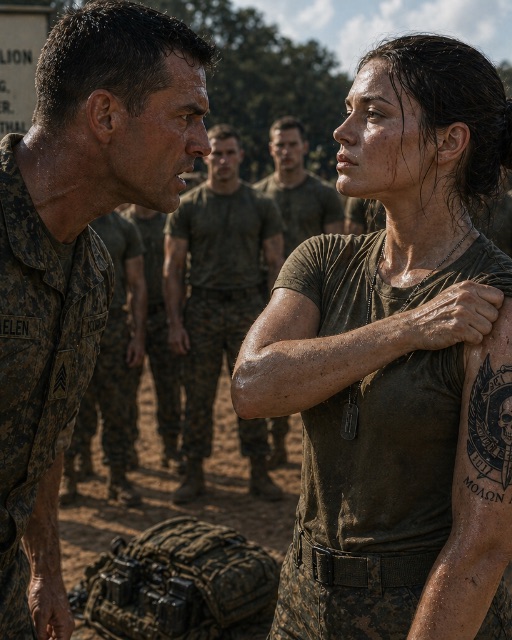
He punted my assault pack so hard the canteen clanged off someone’s boot and wobbled out in the dust.
“Pick it up,” he barked.
“Pick it up,” I said back, calm.
Not a whisper.
Just level.
The whole formation froze.
Thirty people holding their breath, waiting to see if I’d get smoked into the ground.
He squared up on me, chin out, finger already coming at my chest.
“You think you can talk to me like that? I’ll bury you in paperwork. I’ll have you scrubbing tile with a toothbrush ’til your nails bleed. You’re a nobody – ”
I didn’t flinch.
Didn’t blink.
The heat pressed down so hard my vision swam, but inside, I felt… cold.
“Pick. My. Gear. Up,” I said.
Something flickered across his face – annoyance tripping over doubt.
I didn’t raise my voice.
I didn’t need to.
I just reached for my sleeve and started to roll it.
He smirked at first, like this was some defiance he could stomp out.
The fabric scraped against my skin, loud in the quiet.
Past my wrist.
Past the white lines that never healed smooth.
Higher.
And then the tattoo hit daylight.
A jagged black crest.
A skull biting down on a dagger.
Numerals braided along the blade.
Ink old enough to blur at the edges, but not enough to hide what it was.
The Staff Sergeant’s jaw clicked shut.
He didn’t touch me.
He didn’t even breathe.
Around us, they couldn’t see it yet.
They just saw him… stop.
He squinted, trying to make the letters out.
He didn’t know the language.
He didn’t have to.
Because when his lips sounded out the first word under that skull and dagger, his face went white – like he finally realized who actually signed my orders… and why that crest on my forearm wasn’t just a tattoo.
He bent, slow, like his spine had turned to rope.
He lifted my pack with both hands and brushed the dust off the flap with the cuff of his sleeve.
When he straightened, the shade of his hat couldn’t hide how his ears burned red.
His voice came out rough, almost like a cough.
“Fall in,” he muttered.
We did.
For a full minute, only the flags snapped in the wind and somebody’s dog barked beyond the wire.
I rolled my sleeve back down and let my fingers rest on the old ink like a habit I never broke.
Names were called.
Details were assigned.
I got sent to the motor pool with three privates to inventory jacks and ratchet straps.
He kept his distance, eyes flicking to me and away again like he was afraid eye contact would set something off.
On paper, he outranked me.
In practice, paper didn’t always tell the whole story.
It was July in the Central Valley and the air tasted like pennies and burnt rubber.
We worked in the shade line of the hangar, where someone had painted over graffiti with the wrong color and now it looked like a ghost of letters bleeding through.
Nobody talked much.
The two kids from Alabama pretended not to stare.
The one from Liverpool didn’t even try to pretend.
He drifted closer like a moth.
“Ma’am,” he whispered, which made me grin because nobody calls enlisted women ma’am, but he was too new to know.
I kept my eyes on the logbook.
“What’s up,” I said.
His gaze darted over my shoulder like the Staff Sergeant might materialize.
“That thing on your arm,” he mumbled. “Is that… is it what I think it is?”
“What do you think it is,” I said.
He chewed his lip.
“The mountain guys,” he said softly. “The ones with that weird motto none of us can say.”
I closed the book on my thumb and looked at him.
“What have you heard,” I asked.
He swallowed.
“That they don’t exist,” he said, and went a little pink. “Which obviously they do if it’s on your arm, but. You know.”
“You can’t tattoo myths,” I said, and his mouth twitched like he wanted to laugh but wasn’t sure if he was allowed.
We went back to counting straps.
I let the silence do the heavy lifting.
The thing about true stories is, you don’t have to tell them loud for them to land.
We were stacking the last jack when boots thudded behind us and the Staff Sergeant’s shadow covered the checklist.
“Specialist,” he said tightly. “Walk with me.”
I didn’t make him ask twice.
I set the jack down and dusted my palms off on my trousers.
He led me around the corner, away from the fans, into a slice of sun so hot the air warped.
He stood there with his arms crossed and the vein in his neck talking.
I waited.
“I didn’t know,” he said finally, which wasn’t an apology but wasn’t nothing either.
“You didn’t ask,” I said.
He looked past me at the road, at a bird that looked like a shred of tire surfing the wind.
“You can’t pull that out,” he said after a second. “Not with them. Not like that.”
I let my breath out and watched dust spin.
“You kicked my pack,” I said. “I told you to pick it up. You decided to make it something.”
His jaw worked.
“Respect goes both ways,” I said. “But so does rank. You can run us hard and set a standard. You can’t make it personal.”
He flinched so small you’d miss it if you weren’t looking.
For a heartbeat, I saw something else in his eyes that wasn’t anger.
It was fear with a uniform on.
“You think I don’t know that,” he said, trying on a laugh that didn’t fit. “You think I don’t hear myself?”
I didn’t answer.
He wiped his palm on his pocket like it was sweaty.
“What even is that,” he asked, tipping his chin at my sleeve.
“It’s a reminder,” I said.
“Of what,” he said.
“Who bled so you and I can stand here and argue about nothing,” I said.
His mouth opened and closed.
I could have given him the whole story right there.
I could have watched it buckle his knees and maybe made him feel two inches tall.
But there’s a difference between teaching someone and breaking them, and I’d seen too many good ones get broken and left where they fell.
He cleared his throat and looked at the slab of sky like there was anything up there for him.
“You got orders on this?” he said, more like a question, less like a threat.
“On me,” I said. “Yeah.”
“From who,” he said.
“From the person whose name sits three lines above yours on the roster,” I said.
That earned the first true smile I’d seen crack his face, quick and sharp and embarrassed.
“Copy,” he said.
He didn’t try to explain it to the platoon at lunch.
He didn’t mention it later when we were hand-stacking MREs and swatting flies.
He kept his distance but not like I was a bomb.
More like he was trying to figure out how the fuse worked.
By the end of the week, the story had patched itself together in a way rumors love—half right, half movie, all loud.
They said I’d been black-ops and had a license to tell officers to salute me.
They said the tattoo was from a prison.
They said I’d washed out of something secret and the brass felt bad, so now I got to do whatever I wanted.
They said a lot.
What I said was nothing.
It was a Friday when the first letter came.
It was just a plain white envelope with my name typed and no return address, slipped under my door while I was at the gym.
I picked it up and felt the weight of it, light as a moth’s wing, heavy as a coin you can’t stop flipping.
Inside was a single photograph and one line of type.
The photo was grainy.
It showed a doorway blasted to powder, a line of men like ghosts in the chalk dust, and one person kneeling over a man on the ground with their hands so deep in his chest it looked like prayer.
The typed line said: We never forget our dead, or who tried to keep them from becoming one more name.
I sat on the edge of my bed and listened to the pipes in the wall waking up.
I had known something might follow me here.
I had not expected it to knock so softly.
At first, I thought it was a threat, like a finger on my shoulder reminding me which way to look.
Then I turned the photo over and saw a faint thumbprint I knew wasn’t mine.
It was two lines over my right wrist on the old ink.
When I closed my eyes, I could smell the dust again.
Not the clean chalk of a baseball field, but the mineral stink of walls after you pull them down with a winch and your sleeves.
Next morning, we were out in the training area walking point-to-point with dead radios and live mosquitoes.
I moved third in the file and counted breaths and watched the light change on the weeds.
Staff Sergeant walked second.
The kid from Liverpool dragged last like a kite they tied to us.
Around noon, the heat turned from a problem to a personality, and someone’s brain got cooked enough to step wrong.
It wasn’t heroic.
It was stupid.
He went ankle-deep into a sinkhole that looked like solid dirt until it wasn’t.
He yelped like a dog stepped on and went down.
He tried to jump up right away because pride is a stupid bodyguard, and he almost passed out.
We formed a loose ring and did the dance.
Staff Sergeant took a knee and said words that rhymed with calm but weren’t.
I crouched by the kid and looked at his ankle.
Swelling was already climbing his boot like ivy.
I put my hand in my pocket and came up with nothing, because this wasn’t a medic lane and I wasn’t supposed to be anything except a pair of boots.
“Breathe,” I told the kid, and he did because he knew how to take orders even if his lungs were tight with pain.
“Sergeant,” I said without looking up. “You got tape.”
He hesitated, then swore at himself like why didn’t he have tape, then tore his ruck open.
He handed me a roll like it was a medal.
I taped the ankle with more care than speed, and the world narrowed to skin and pressure and the tiny adjustments your hands remember when your head forgets.
The kid’s face went gray and he leaned into it.
When I finished, I palmed the wrap and looked up and caught Staff Sergeant watching my hands like someone had told him the ending of a movie and he was trying to see where the clues were.
He cleared his throat.
“You done this before,” he said, and I couldn’t help it, I laughed.
“Once or twice,” I said, and the ring of soldiers shifted like they all took the same breath.
We humped him back on a makeshift crutch and I stayed just behind his bad side so he could lean into the wind I made for him.
At the trucks, the medics took over and the kid waved at me from the bench with a pain-sweet smile that made him look nine.
After chow, I found Staff Sergeant sitting on the low wall by the motor pool like he was waiting for a bus.
He had his cap off and his hair stuck up like a thistle.
He didn’t look up when I sat down.
“You saved him a bad week,” he said.
“That’s the job,” I said.
“Not your job anymore,” he said, then shook his head and made an annoyed noise in his throat. “Sorry. That came out sideways.”
“It’s all the same job,” I said. “Hold the line. Keep people walking.”
He rubbed the back of his neck.
“You know,” he said, and then stopped.
“If you’re about to ask what that crest really is, I’m going to make you say please,” I said.
He snorted, short and surprised.
“Fair,” he said. “Please.”
“It’s a partner force crest,” I said. “Not ours. We borrowed each other a long time ago and never gave the parts back.”
He blinked like that picture didn’t match the one in his head.
“You were… with them,” he said.
“For a while,” I said. “Long enough to learn how to say their jokes and how not to die in their hills.”
He looked at his hands.
“You ever spend a week thinking about the person you used to be and wishing you could go shake them,” he said.
“Shaking doesn’t help,” I said gently. “It just makes them dig in.”
He nodded, small and miserable.
There are people who get mean because they’re bad.
There are also people who get mean because they’re bleeding and nobody taught them how to hold pressure.
He didn’t ask anything else, and I didn’t offer.
He stood and put his hat back on and gave me a nod that looked like a promise he did not know how to keep yet but wanted to.
Monday rolled around chalky and loud, with the flag wrung tight in the morning wind and coffee that tasted like metal shavings.
We ran the range and everyone’s sleeves were rolled because they’d learned by now that sunburn is a fool’s lottery.
A Captain I didn’t recognize walked the line with the First Sergeant like a shark moving through minnows.
He was lean and silver-edged at the temples and carried a clipboard like a weapon.
He stopped in front of me and smiled like we were old friends.
We weren’t.
“Specialist,” he said. “Good to see you upright.”
“You too, sir,” I said, which made him grin bigger.
“Specialist O’Rell,” he said, and there was the twist—he knew my last name, not just the piece of cloth.
The First Sergeant watched us like a man who sees lightning and knows that thunder is next.
The Captain’s eyes flicked to my forearm.
He did not point at it or make a big noise.
He just nodded at it like you might nod at a headstone.
“Got a note from an old friend of ours,” he said pleasantly. “He says you have mail.”
I kept my face smooth because I can follow a lead.
“Sir,” I said.
He handed me a thin brown envelope.
It was stamped with the kind of stamp the mailroom doesn’t see unless someone walks it through.
My name was on it in a hand that used to shake with adrenaline and now only shook with age.
I slid a finger under the flap and eased out a piece of paper that smelled like a tent and cigarettes.
It was a copy of a roster with some names blacked out and one circled.
Over the circle, someone had written: Found him.
Under the circle, someone had scrawled a number and a town.
Not here.
Not now.
Not even a nearby state.
I folded it once and slid it into my pocket and nodded at the Captain, who nodded back like we had talked about grocery lists.
The First Sergeant cleared his throat because he had to say something to puncture the bubble.
“Back to it,” he said, and we did.
That night, I sat at the tiny desk in my barracks room and read the number into my phone with my finger over the call button.
Mercer, I thought, and tried to picture his face ten years younger and dustier.
I had not known his name on that day.
If you’re busy holding a heart in one hand and an airway in the other, names are a luxury.
But later, in the quiet part when the stretchers were stacked and the blood dried weird and brown on your knuckles, I had looked for it.
I had not found it.
I pressed call.
It rang three times.
A woman’s voice answered, older and careful.
I told her my name and she went very quiet and then said, “Oh.”
Then she called down the hall, voice breaking, “Marshall, come here please.”
He came on the line with one word like a question.
“Yeah?”
I had a dozen speeches queued in my mouth, all of them terrible.
None of them were what I said.
“Hey,” I said, and my throat did something soft and stupid. “You owe me a cigarette from the day your whole world fell down.”
There was no sound for a second, and then he laughed, shocked and bright and close to crying.
“You,” he said, with awe and apology folded together. “I thought you were a myth.”
“Still very much not,” I said.
We talked for an hour and a lifetime.
He told me he’d carried a scar under his left collarbone where my thumb had been, like a dent in a spoon.
He told me he had kids now, a dog that hates thunder, a job where nobody shoots at him.
He told me he came home and made mistakes and learned how to be sorry without being crushed by it.
I told him what I could without breaking anything still held together with string.
I told him about the letter and the photograph and the thumbprint that matched.
I told him I was fine, which was half a lie on even the best days and completely true on the rest.
When we hung up, it was midnight and the corridor smelled like someone had exploded a microwave dinner and air freshener over it.
I pressed my face to my knees and let the tears hit the floor where nobody could slip on them.
Two days later, something shifted in the platoon like a hinge that finally gets oil.
Staff Sergeant called us into the bay after motor stables and stood in front of us with his hat in his hands.
He did not ask us at ease or parade rest.
He didn’t seem to know where to put his arms.
“I’m going to say something,” he said, and you could see his courage climb from his toes to his mouth like a tiny soldier in a huge wall.
“I’ve been running this place like the only way to lead is to push down,” he said. “That’s not what I learned. That’s what I took out of being scared.”
A wrench clinked somewhere like punctuation.
He looked at me for one beat and then back at the bunch of faces he was supposed to keep from breaking.
“I’m going to do better,” he said. “You are not nobodies. You’re mine, and that means I don’t get to talk to you like trash.”
There was a cough and a sniff and then someone said, “Hooah,” soft and real.
He set his hat on his head and nodded once like that took a different kind of muscle than he used at the gym.
After, he caught me by the door.
He didn’t thank me, and I didn’t want him to.
He just said, “You were right,” and walked away like the ground was different under his feet and he was learning how to walk on it.
The second twist came a week later like the curve of a road you didn’t know was there until you were already in it.
Supply called and said there was an issue with my pack.
An issue with government property is like a cough in winter—it could be nothing, it could be pneumonia.
I carried it in and set it on the counter and the clerk, a grumpy lance corporal who had been in long enough to retire three times in his head, squinted at it.
He turned it over and tapped the inside seam where the manufacturer’s label was half detached.
“You know this is not our issue, right,” he said, prodding the faded black marker initials stitched under the flap.
“Whose initials,” I asked.
He spelled them out and my stomach dropped like I’d missed a step.
M. E. R.
I took the pack back to my room and sat with it like it was a person.
It was one of those battered rucks that go from private to private like old hymns.
Someone had colored in a frayed spot with a Sharpie.
Someone had looped paracord around the chest strap buckles so they wouldn’t bite.
There was a tiny notch on the left hip where someone had cut tape off in a hurry and taken the fabric with it.
I checked the inside pocket I never used.
There was a plastic bag rolled so tight it looked like it had been swallowed.
I fished it out and slid the zipper back with my thumbnail.
Inside were two things.
One was a pair of earplugs, still connected by a thin plastic string, one side sun-faded, the other side orange like candy.
The second was a folded scrap of a torn MRE box with words scratched on it in a cramped, left-handed scrawl.
If you find this in here, tell the next me to be kind, it said.
The date under it was twelve years old.
I sat very still for a while and then I laughed so hard I scared myself, because life loves a loop and sometimes it ties a bow when you aren’t even looking.
I called the number again and when Marshall picked up, I told him I had something of his.
I told him if he wanted it, he’d have to do a day’s drive and half of it through nothing but corn and billboards.
He said yes so fast he tripped over it.
He showed up on a Sunday with a sunburn on his nose and a cooler in the back that rattled every time he hit a pothole.
He looked like a man who’d taken the weight off his own chest and realized he could lift other things now too.
We stood under the shade of the eaves and I handed him his old ruck.
He put his hands on it like you touch an animal you used to know and waited for it to remember you.
He dug into the pocket and pulled out the earplugs and the note.
He read it and then read it again and then looked up at me like he’d found a mirror where he least expected one.
“I wrote this,” he said, half wonder, half grief.
“You did,” I said.
“I don’t remember being that smart,” he said, and we both smiled, the same kind of tired, the same kind of glad.
We sat on the curb and ate sandwiches from the cooler and watched ants find us and declare us a landmark.
He told me about the day he wrote it, which he never intended to be a big day.
He told me about a Staff Sergeant back then who was a better man than his boots and how he still heard him when he did something dumb and needed to walk it back.
He told me about a firefighter in his town who’d lost a kid and still showed up and cleaned the rigs and never told anyone else how to carry it.
I told him about our new Staff Sergeant and how I thought maybe he’d remembered his own note without ever having written one.
He shook his head like the universe was a comedian with a cruel streak and then he laughed, full and free.
When he left, the world felt tilted and right at the same time.
I waved until his taillights were dust, and then I went back inside and put the tiny scrap of cardboard under the tilted photo frame on my desk so it would stop wobbling.
It was training holiday the next day, and I spent it wading through laundry and the kind of administrative boredom that makes you grateful you’re not sleeping in a hole.
At dusk, the Captain with the silver at his temples knocked on my door and leaned in the jamb like a man who carried too much on his feet to ever lean on anything else again.
“I heard you closed a loop,” he said, eyes flicking to the pack by my bed.
I shrugged because if you act like it was lightning, people start thinking you called the storm.
He walked in and sat on my desk chair like it was a barstool.
“You know what I like about you,” he said, and I made a face like, please don’t make me say it.
“You don’t make fireworks out of flint,” he said anyway. “You make campfires. You warm people. You don’t blind them.”
“Sir,” I said, awkward and weirdly moved.
He scratched his jaw and looked at my sleeve, then met my eyes.
“Word from the other side is they’re proud of you,” he said.
“Word from this side is you can have what you want next.”
I looked at the little slice of wall where the paint bubbled because the AC unit worked when it felt like it.
“What does that mean,” I asked.
“School,” he said. “Slot. Or a quiet billet. Or an early out with a handshake that actually means something. Your choice.”
I stared at him because the thing about choices is, they sound like freedom until you hold them.
Then they weigh what you lost.
“What would you pick,” I asked.
He smiled without showing his teeth.
“I picked this once and it picked me back,” he said. “You might not get that lucky twice.”
I thought about Marshall’s dented spoon scar.
I thought about the kid from Liverpool learning to say hooah without sounding like he was making fun of us.
I thought about my old friends with the mountain jokes.
I thought about the Staff Sergeant and his hat in his hands like a confession.
“I want to stay,” I said.
He nodded slowly like he’d bet that way.
“You can,” he said. “But stay cheap. Don’t pay with blood you no longer have.”
I laughed because sometimes the only way to keep from crying is to laugh in the face of someone who understands why that’s funny.
We shook hands.
He left.
Weeks passed and folded in on themselves like maps.
Our Staff Sergeant kept his promise.
He didn’t get soft.
He got honest.
When he snapped, he walked it back.
When he pushed, he pulled up too.
He stopped saying nobody like it was a word that fit over any of us, because it never had, not really.
The last twist came when we did a family day and the base opened its gates and the PX sold out of everything that could be worn once and never again.
There was a dunk tank and a face-paint booth and a performance by a band that managed to make three chords sound like rescue.
I was sitting on a camp chair watching kids throw foam footballs when an older man in an old ball cap shuffled up and squinted at me.
“You’re O’Rell,” he said, and his voice was a gravel road.
“Yes, sir,” I said, and tried to place the face.
He held out his hand and I took it, and then he flipped my forearm over like a very polite arrest and looked at the ink.
He breathed out.
“Do you know my son,” he asked.
He said a name and the world paused because that name was a prayer I’d said once in a dark room that smelled like bleach and fear.
I remembered the kid who had that name and a hole you could almost make a fist through and the way he smiled with one side of his mouth because the other side didn’t remember how yet.
“I do,” I said, and my voice did that stupid thing again.
“He told me if I ever met you to say thank you for not letting him die stupid,” the old man said, and laughed like the world had given him permission to.
“He told me I’m not allowed to be proud of the scar but I can be proud of the story.”
I swallowed around the lump and nodded, because sometimes your body is better at yes than your mouth is.
He squeezed my hand and then he went and stood in line for a hot dog and flirted with the lady with the tongs and the sun fell all the way down like it meant it.
When I loaded my chair into my trunk and turned to head back in, I saw Staff Sergeant leaning on the hood of his truck, arms folded, watching the last kids play chase in the emptying lot.
He looked at me and raised his chin.
“We making it,” he said.
“We’re making it,” I said.
He nodded like he’d decided to believe me and that was that.
You don’t always get justice in this life.
You don’t always get closure.
But sometimes, if you stay a little longer than is comfortable and ask for less than you think you deserve, you get something quieter and deeper.
You get mercy.
You get the chance to pick up the thing you kicked and brush off the dust and carry it the rest of the way.
I keep my sleeve down when I can, not because I’m hiding, but because I’ve learned how to let people meet me before they meet the ghosts who walk beside me.
I roll it up when I need to, and only then.
When I walk into formation now, heads don’t tilt down the line like I’m a rumor with boots.
They look forward.
They look at our flag and the old shade trees and the sky that doesn’t know our names.
We stand together, nobodies and somebodies, the living and the dead, all of us held together by the simplest order anyone ever gave me.
Pick it up.
Pick each other up.
Pick yourself up when you can, and let someone else lift you when you can’t.
The lesson is this: respect goes both ways, and so does grace, and none of us are nobodies when we do the work to see each other as whole.
If this story meant something to you, share it with someone who needs a hand, and give it a little love so it can find the next person down the line.