
Ruth, please. Just wear a nice dress. My mother’s voice was tight, the way it gets when she’s pretending something isn’t a big deal. David says the venue is elegant. The bride’s family is… refined.
I held the phone away from my ear for a second. Thirty-two years. Two stars. Three combat deployments. And my own family still called it “military stuff.”
The uniform is part of who I am, Mom.
She sighed. It’s just one night.
I hung up and stared at the dark blue coat in my closet. Every medal had a story. Every ribbon cost something. I ran my thumb across the stars on the shoulder board and made my decision.
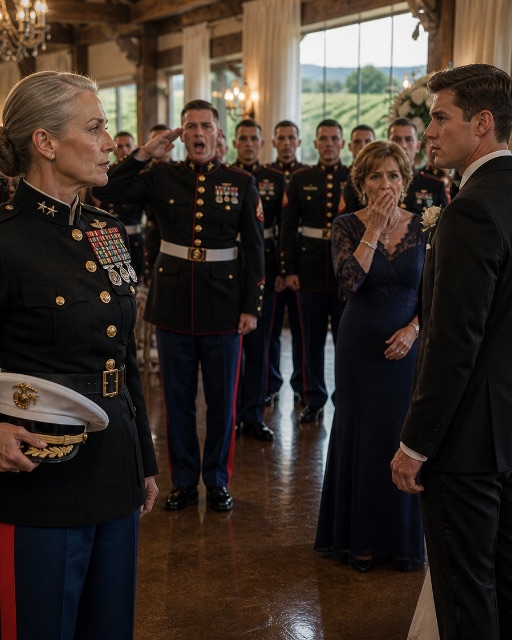
The vineyard hall was all white linen and string quartets. I walked in with my officer cap tucked under my arm, back straight, chin up. The way I’d entered a thousand rooms before.
Conversations didn’t stop. They evaporated.
My mother’s champagne glass froze halfway to her lips. The bride’s father adjusted his glasses like he was seeing something wrong. My brother crossed the room in four steps, his smile gone.
Ruth. David’s voice was barely above a whisper. You actually wore it.
I did.
His jaw tightened. This is Sophia’s day. You’re making a scene.
I kept my voice level. I’m standing here, David. That’s all I’m doing.
He leaned closer. You always do this. You always have to be the –
A chair scraped across the hardwood. Loud. Then another. Then five more.
David stopped mid-sentence. His eyes moved past my shoulder.
I turned.
Across the hall – at tables scattered throughout the reception – twenty Marines were rising to their feet. One by one. Dress blues. Medals. Rigid posture. Some I recognized from Pendleton. Others from Quantico. A few I hadn’t seen in a decade.
The string quartet went silent.
A voice cut through the room like a blade. Clear, commanding, absolute:
General on deck!
Every one of them snapped to attention. Two hundred civilian guests sat frozen, mouths open.
My brother’s face drained of color. He looked at me, then at them, then back at me.
The oldest Marine in the group—a Master Gunnery Sergeant named Terrence Wadlow, who I’d served with in Fallujah—stepped forward. He was holding something behind his back.
He stopped three feet in front of me, locked eyes, and said loud enough for the entire hall to hear:
Ma’am, we weren’t invited. But we heard what your family said about the uniform. And we need you to know something.
He pulled out what he was holding.
It was a framed photograph. Black and white. Old.
I looked down at it, and my throat closed.
Because the woman in the photo—wearing the exact same dress blues, standing in front of the exact same vineyard—was someone I’d never been told about.
It was my grandmother.
And the inscription at the bottom read, “For Eleanor, who forged her own path. With love, Thomas.”
Eleanor. My grandmother’s name. Thomas. My grandfather.
The frame felt impossibly heavy. My own breath was gone. The world, which had been so sharp and clear a moment ago, now felt hazy and unreal.
I looked from the photo to my mother. Her face was ashen. Her hand was over her mouth, and her eyes, for the first time I could ever remember, were filled with a kind of terrified shame.
My father, usually so stoic and quiet, simply sat down in the nearest chair. He put his head in his hands.
David just stared, his mouth slightly open, confusion warring with the anger that had been there moments before.
Master Gunnery Sergeant Wadlow spoke again, his voice softer now, meant only for me.
My grandfather served with her, Ma’am. In the forties. After the war, she was one of the first women to make it through Officer Candidates School. He always said she was the toughest person he ever knew.
He paused. He passed last year. I was going through his old footlocker and found this. He’d kept it all this time.
Wadlow gestured to the other Marines.
When one of the guys heard about… the request… about the uniform… I made some calls. We pieced it together. We thought you should know who you were walking behind, Ma’am.
My legs felt weak. I wasn’t the first. I wasn’t the trailblazer in my family. I was just following a path that had been deliberately hidden from me.
I turned back to my brother. The anger in his eyes was gone, replaced by a dawning, horrified understanding.
Mom? David’s voice was shaky. What is this?
My mother couldn’t speak. She just shook her head, tears finally starting to stream down her face, ruining her perfect makeup.
It was my father who finally looked up. His voice was hoarse.
Let’s go somewhere private. Please.
The bride, Sophia, had come to stand beside David. She put a gentle hand on his arm, her eyes wide with a mix of shock and something else… respect. She looked at me, at the uniform I wore, then at the photo, and then back at me.
She nodded towards a small office off the main hall. In here.
The five of us—me, my parents, David, and a silent, supportive Sophia—shuffled into the small room. The distant murmur of the confused wedding guests was the only sound.
I placed the photo of my grandmother on the desk. She looked so young, so fierce. The same determined set of her jaw that I saw in my own mirror every morning.
My mother finally broke down completely, sinking into a chair and sobbing.
My father took a deep breath, the sound of a man about to unload a burden he’d carried for a lifetime.
Your grandfather, Thomas… he made your grandmother promise.
He looked at me, his eyes pleading for me to understand.
He served in Korea. At the Chosin Reservoir. He saw things… things men are not meant to see. He lost his entire platoon in three days. Froze to death, most of them. He came home a different man. A broken man.
Dad’s voice cracked. He carried that frozen hell with him every single day.
He walked over to my mother and put a hand on her shoulder.
Your grandmother, Eleanor, she was his rock. She got him through it. But the one thing he couldn’t bear… was the thought of his children, or their children, ever having to see what he saw.
A memory flickered in my mind. Faded, from when I was very small. My grandfather, a kind but distant man, who would go silent whenever his time in the service was mentioned. We were all told he was a hero, but no one ever told us why.
He made her promise on his deathbed, my father continued. He made her swear to pack it all away. The uniform, the medals, the stories. He wanted his family to have a safe, simple, civilian life. He thought he was protecting us. Protecting you.
My mother looked up, her face blotchy and stained with tears.
I was just a girl when he died. But I remembered the promise. I saw how much pain it all caused him. When you decided to enlist, Ruth… I was so scared.
Her voice was a whisper.
I thought I was honoring my father’s final wish. I thought I was protecting you. I didn’t want you to carry that same weight.
She gestured vaguely towards my uniform.
Every time I see you in that, I don’t see a General. I see my little girl walking into the same fire that burned my father down to his soul.
The silence in the room was immense. All my life, I’d thought their disapproval was about me. That I wasn’t feminine enough, not “refined” enough. That my life’s work was an embarrassment to them.
But it was never about shame. It was about fear.
A twisted, suffocating, all-consuming fear born out of a love so deep it couldn’t see straight.
David stepped forward, his own eyes wet.
Ruth… I am so, so sorry. I didn’t know. I just… I went along. I thought it was what Mom and Dad wanted. I was trying to make Sophia’s day perfect, and I was just… an idiot. A complete idiot.
Sophia squeezed his arm. She looked at me, her expression soft.
No, you weren’t. You were just part of a family story you didn’t have all the pages to.
She then looked me directly in the eye.
Your uniform isn’t a scene, Ruth. It’s an honor. It was an honor the moment you walked in. I just didn’t understand the depth of it.
I finally found my voice. It came out quiet, but steady.
All these years. All these years I thought you were ashamed of me.
My mother flinched as if I’d struck her.
Never, Ruth. Never ashamed. I was proud. So proud it terrified me.
My father went to a small credenza in the corner and pulled out a dusty, wooden box. He brought it over and placed it on the desk next to Eleanor’s picture.
He lifted the lid.
Inside, nestled in faded velvet, were my grandmother’s medals. A Bronze Star. A commendation ribbon. Service medals. And underneath them, stacks of letters written on frail, yellowed paper, all in her elegant script.
He saved everything, my father said. He couldn’t bear to look at it, but he couldn’t bear to throw it away either. It was her. It was the woman he fell in love with.
I reached in and picked up the Bronze Star. It was cool and solid in my hand. A tangible piece of a history I never knew was mine.
A soft knock came at the door. It was Master Gunnery Sergeant Wadlow.
He held my officer’s cap in his hands.
Ma’am. Forgive the interruption. But the string quartet is playing again. And your Marines are refusing to sit down until their General is back on deck.
He glanced at my family, his expression unreadable but not unkind.
The guests are asking questions. We figured they might as well get the right answers.
A slow smile spread across Sophia’s face. She turned to me.
General. I believe my wedding needs a proper guest of honor. Would you do me the honor of walking me down the aisle? My father already did his part. I think it’s time for the other side of the family to be represented.
My brother looked at his bride, his eyes shining with love and pride. He nodded at me, a silent, heartfelt apology.
I looked at my mother and father. My mom slowly nodded, a watery but genuine smile finally breaking through her tears. My father reached out and placed his hand over mine, squeezing it gently. For the first time, we weren’t a family divided by a uniform. We were a family united by one.
I took my cap from Wadlow. I placed it back under my arm.
Let’s not keep them waiting, I said.
When I walked back into that reception hall, it was to a different world. The confused whispers were gone. In their place was a profound, respectful silence.
The twenty Marines, still standing ramrod straight, snapped to attention once more. But this time, as I passed, their faces held something more than just military deference. They held a shared understanding. A shared legacy.
Sophia looped her arm through mine. As we walked towards the dance floor, the guests—strangers, the bride’s “refined” family, my own relatives—began to rise to their feet. Not in confusion, but in applause. A slow, rolling tide of appreciation that washed over the entire room.
My mother and father stood together, watching, no longer hiding in the shadows of the past. David stood beside them, his chest puffed out with a pride I’d never seen him show for me before.
That night, my uniform wasn’t a costume. It wasn’t a statement or a scene. It was a story.
It was the story of my grandfather’s pain and my grandmother’s strength. It was the story of my mother’s fear and my father’s silence. It was the story of twenty Marines who wouldn’t let a legacy be forgotten. And it was the story of a family that finally learned how to be whole.
The greatest honors we earn are not the medals we pin on our chests, but the truths we have the courage to carry for those who came before us. Sometimes, the path we think we’re forging on our own is simply the completion of a journey someone else began, waiting for us to find our way home.



