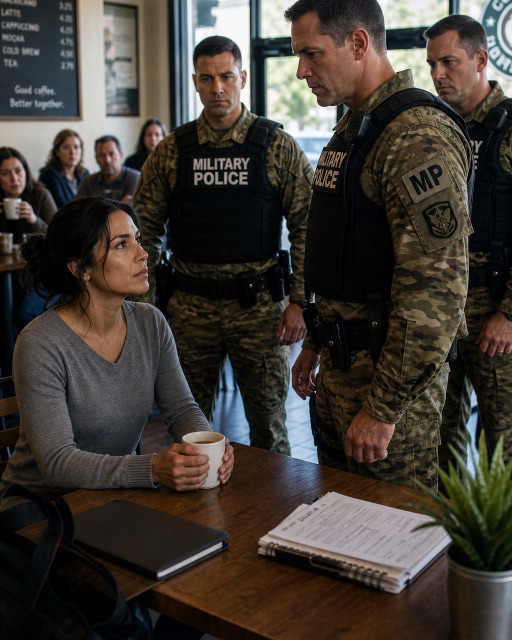
SARAH didn’t move. She just studied Captain Ellis’s face the way she used to study a wound – looking for the thing underneath the thing.
“On what grounds?” she asked.
Her voice was so quiet Jenny, twelve feet behind the counter, leaned forward to hear.
Ellis’s jaw twitched. That was the tell. Whatever this was, he didn’t want to say it out loud. Not here. Not with eighteen civilians holding their breath over lukewarm lattes.
“Ma’am, I’d prefer we discuss this privately.”
“I’d prefer to know why three MPs walked into my coffee shop on a Tuesday.”
The younger MP on Ellis’s left shifted his weight. His hand drifted – not to his sidearm, but to the cargo pocket on his thigh. Sarah clocked it. Pocket meant paperwork. Paperwork meant this wasn’t an arrest.
It was worse.
Ellis exhaled through his nose. “Staff Sergeant Martinez. It’s about Kandahar. October 14th, 2016.”
The mug in Sarah’s hand didn’t shake. But the coffee inside it did – a single, betraying ripple.
October 14th.
The day that didn’t exist. The day that wasn’t in any report. The day four men walked into a village and only two walked out, and the official record said she’d been forty miles away running a vaccination clinic.
“That operation was classified,” she said carefully.
“It was.” Ellis’s voice dropped. “Until last week.”
The younger MP pulled a folded paper from his cargo pocket. He didn’t hand it to her. He set it on the table, face down, like it might bite.
“Staff Sergeant, we’re not here to arrest you.”
Sarah’s eyes didn’t leave his. “Then what are you here for?”
Ellis glanced at the door. At Jenny. At the old man by the window pretending to read a newspaper he’d stopped turning three minutes ago.
Then he leaned down, close enough that only she could hear.
“We’re here because the man you left in that village…”
“…is sitting in a federal holding cell in Coronado. And he’s asking for you by a name nobody in this country is supposed to know.”
He slid the paper across the table.
She turned it over.
And the moment she read the name written in block letters across the top, the mug finally slipped from her fingers—
It shattered on the floor, the sound unnaturally loud in the suddenly silent coffee shop. Dark brown liquid spread across the polished concrete, a messy stain on her clean, orderly life.
ANYA.
Just that one word. Four letters that dismantled six years of carefully constructed peace.
Anya wasn’t her name. It was a ghost. A whisper from a boy in a dusty alley who thought she was a protector, not a soldier.
“I need five minutes,” Sarah said, her voice a stranger to her own ears.
Ellis nodded, stepping back, giving her space that wasn’t really space at all. He and his men were a cage that had just materialized around her.
She walked behind the counter, her legs moving on autopilot. Jenny’s eyes were wide with worry.
“Sarah, what’s going on? Should I call someone?”
“No, Jen. Just… just a mix-up.” A lie. The biggest lie she’d told since she signed the official report that sanitized October 14th from history.
She grabbed her apron, untying it with trembling fingers. She took out her phone and called the only person she could. Her sister, Maria.
“Hey, can you cover for me at the shop? Something’s come up.”
Maria, bless her, didn’t ask too many questions. “Of course. Is everything okay?”
“It will be,” Sarah said, another lie piled on top of the first. “I love you.”
She hung up, took a deep breath that didn’t quite reach her lungs, and walked back out to the men who had come to excavate her past.
The drive to the private airfield was silent. Sarah stared out the window, watching the familiar streets of her town blur into an abstract painting of normalcy. A life she’d fought so hard to build, to deserve.
The coffee shop had been her sanctuary. The hiss of the espresso machine, the smell of freshly ground beans, the simple transactions of pastries and lattes—it was the opposite of Kandahar. It was life, simple and warm.
But the ghost was back. His name was Tariq. A boy, no older than fifteen, who had been their local informant. He was sharp, and his family had been killed by the very warlord they were sent to capture.
He’d trusted them. He’d trusted her.
She remembered giving him a nutrition bar. His eyes had lit up. He couldn’t pronounce ‘Staff Sergeant,’ so he pointed at a worn-out storybook he carried and then at her. The heroine in the book was named Anya. A guardian.
She had smiled, a rare, genuine smile in that sun-baked hell. For a moment, she wasn’t a soldier. She was just a person being kind to a kid. She was Anya.
The plane was a small, unmarked government jet. The luxury of the leather seats felt obscene. The last time she’d been on a military flight, she was on a stretcher, pumped full of morphine, with Master Sergeant Owens in the seat beside her, his face a mask of heroic grief.
Owens. The other survivor. He’d been the one to drag her out of the kill zone after the RPG hit. He told the debriefing team they were ambushed, overrun. That Corporal Davies and Sergeant Miller died instantly.
He said they had to fall back. Had to leave the informant, Tariq, behind. He was presumed dead in the ensuing firefight.
Owens had been given a medal. Sarah had been given an honorable discharge and a gag order. She’d built a new life. He’d built a career.
“Why now?” she finally asked Ellis, the roar of the engines a dull backdrop to her own internal chaos.
Ellis looked up from the tablet he was reviewing. His face was tired. “He turned himself in at the embassy in Pakistan two months ago. Said he had information vital to U.S. security. Wouldn’t talk to anyone. Just kept repeating that name. Anya. And a date.”
“And you found me,” Sarah finished. It wasn’t a question.
“It wasn’t easy,” Ellis admitted. “Your records were buried deep. October 14th was scrubbed clean. But a name like Anya, connected to a black-ops mission? It sets off alarms. Eventually, it landed on my desk.”
“Why your desk?”
A flicker of something—regret?—crossed his face. “I was the Intel officer who signed off on the intel for your mission. The intel that said the target would be there. The intel that was wrong.”
Sarah felt a cold stone drop in her stomach. Ellis wasn’t just a messenger. He was part of the story.
Coronado was a sterile world of blue and gray. The holding cell wasn’t a dungeon, but a clean, white room with a table and two chairs bolted to the floor. A one-way mirror lined one wall.
When he walked in, she almost didn’t recognize him. The skinny, bright-eyed boy was gone. In his place was a man in his early twenties, with a lean, hard face and eyes that held the same ancient sadness she saw in the mirror every morning. A long, thin scar ran from his left eyebrow down to his cheek.
He sat down opposite her. For a long moment, there was only the hum of the air conditioning.
“Anya,” he said, his voice raspy, the English still accented but clearer than she remembered.
“Tariq,” she replied, her own voice barely a whisper. “They told me you were dead.”
He gave a hollow, mirthless laugh. “They were wrong. The warlord’s men… they found me in the rubble. They took me.”
Sarah braced herself. For the anger. The accusation. The story of years of torture that would be her fault.
“They thought I was one of you,” he continued, his gaze drifting to the white wall, to the past. “But I was just a boy. After a while, they grew tired of hurting me. They made me a servant. I cleaned. I carried things. For years.”
He looked back at her, his eyes locking onto hers. There was no hatred in them. Only a profound, weary sorrow.
“I am not here to blame you, Anya. You were a soldier. I was an informant. We both understood the risks.”
The relief that washed over Sarah was so intense it made her dizzy. “Then why? Why come here? Why ask for me?”
He reached into the pocket of his issued jumpsuit, but it was empty. He looked at the one-way mirror. “They took it from me. A book. Small. With a brown leather cover.”
Sarah’s blood ran cold. “A journal?”
He nodded. “It belonged to the soldier with the kind face. The one who was always writing. Davies.”
Corporal Davies. The rookie. Twenty-two years old, fresh from Ohio, writing down everything so he could remember it for the book he planned to write when he got home.
“How did you get it?” Sarah asked, leaning forward.
“After the explosion,” Tariq said, his voice dropping, “I was buried. When I woke up, it was night. Everyone was gone. I searched the ruins of my house. For my family. For… anything. I found his body. The book was in his pack. I took it.”
He paused, taking a shaky breath. “I thought… it was important. He was always writing in it. I thought his family would want it. I have tried for years to find a way to return it.”
This was the twist. Not revenge. Not betrayal. Just a promise a young boy made to a dead man. A promise he had risked everything to keep.
“Where is the journal now?” Sarah demanded, turning to the one-way mirror.
The door opened and Ellis walked in, holding a plastic evidence bag. Inside was Davies’s weathered journal. He placed it on the table.
“We’ve had it analyzed,” Ellis said. “Most of it is what you’d expect. Observations. Letters to his girl. But the last entry… the one from October 14th. You need to read it.”
Sarah’s hands trembled as she opened the bag and carefully took out the journal. She flipped to the last page, the handwriting hurried, almost frantic.
October 14, 1600 hours. Something feels wrong. Intel says the target is in the main house. But the village is too quiet. Owens is jumpy. Keeps checking his comms. Just saw a signal flash from the ridge to the east. A mirror. Our overwatch is supposed to be on the west ridge. It looked like a standard ‘mission abort’ signal. Told Miller. He told Owens. Owens said it was just a kid playing with glass. But he looked… pale. We’re moving in anyway. God, I hope I’m just being paranoid.
Sarah read it again. And a third time.
A signal flash. From the wrong ridge. An abort signal.
Owens had seen it. And he’d lied.
The pieces clicked into place, forming a picture so ugly it stole her breath.
It wasn’t a surprise ambush. It was a setup. The warlord had been tipped off. The ambush was meant for them.
And Owens knew. He knew, and he walked them into it anyway. He’d used the chaos to get out, leaving three of them—Davies, Miller, and a local boy—for dead. He had manufactured his own heroic narrative on the bodies of his men.
“Owens,” she breathed, looking up at Ellis.
Ellis’s face was grim. “He’s a Lieutenant Colonel now. Pentagon. A rising star. He built his entire career on that day.”
“He murdered them,” Sarah said, the words tasting like ash. “He murdered Davies and Miller.”
“And without this,” Ellis said, tapping the journal, “it was just your word against a decorated war hero’s. But this… this is corroboration from a dead man. And we have a living witness.” He gestured to Tariq.
The final piece of the puzzle slotted into place. Ellis hadn’t just been the Intel officer. He’d been running this informal investigation in the background for years, haunted by the mission he’d signed off on. He’d suspected Owens but had no proof.
Until Tariq walked into an embassy with a ghost story and a secret name.
The days that followed were a blur of official proceedings. Sarah gave her testimony. Tariq gave his. The journal was the silent, irrefutable star witness.
Lieutenant Colonel Owens was quietly taken into custody. The story that broke was one of misfiled reports and a tragic but understandable battlefield error, but Sarah knew the truth. Justice, in its slow, grinding way, was being served. The families of Davies and Miller would finally know what really happened to their sons.
A week later, Sarah was back at her coffee shop. The morning sun streamed through the front window. Jenny was frothing milk. The old man was reading his newspaper. Everything was the same, but everything was different. The ghost had been faced. The weight on her soul felt… lighter.
The bell over the door chimed. Ellis walked in, out of uniform, looking like just another customer. He was holding a small, official-looking envelope.
“Tariq has been granted asylum,” he said, sliding the envelope across the counter. “For his service. He’s a free man.”
“Where is he?” Sarah asked.
“In a hotel downtown. Wondering what to do next.”
Sarah looked around her coffee shop. At the life she had built. A life of peace and order. It was a good life. But maybe it could be more.
“He can start here,” she said, a new kind of certainty in her voice. “I can teach him how to work the register. He needs a new beginning.”
Ellis smiled, a genuine smile this time. “I thought you might say that.”
He turned to leave, but paused at the door. “You know, Martinez, what you and that boy did… bringing the truth to light after all this time. It’s one of the bravest things I’ve ever seen.”
Sarah watched him go, the words settling in her heart.
She had run from her past for six years, believing it was a source of shame and guilt. But it turned out that buried in the wreckage of that terrible day was a story not just of betrayal, but of incredible loyalty. A young boy’s promise to a dead soldier had crossed continents and years to deliver a truth that set them all free.
The past is never truly dead. You can’t outrun it. But if you have the courage to turn and face it, you might find it’s not the monster you remember. Sometimes, it holds the keys to your peace, a lesson in forgiveness, and the proof that even in the darkest of places, a single act of honor can eventually find its way to the light.