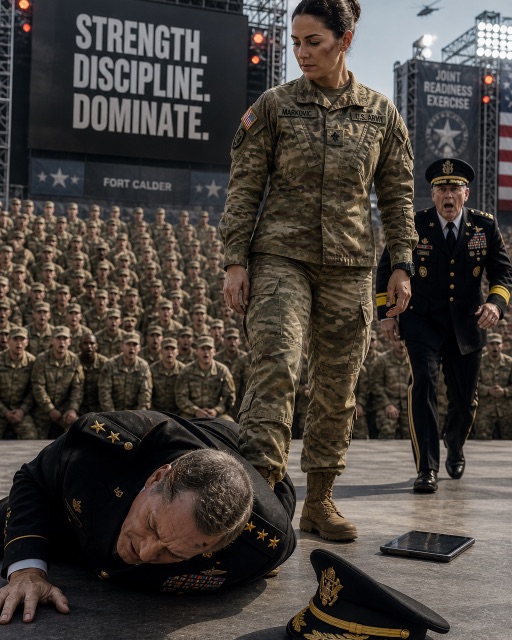
I was running the projector feed at Fort Calder, headset on, palms sweaty. General Todd Voss was doing his usual mind-games lecture, strutting with the mic like a showman.
He pointed at a woman working comms at stage right. “You. Up here.”
She stepped up. Plain uniform. Tablet tucked to her side. Name tag: Sgt. Monica Hale. No flare, no fuss. She just stood there, too calm.
Voss circled her like a shark. “See this? Support staff. Paper-pusher. You break them with a look.”
My stomach turned. She didn’t flinch. Didn’t blink.
He smirked – and slapped her so hard the sound cracked through the speakers. Five thousand people went silent. I froze.
She set her tablet down like it was glass. One step. A shift I couldn’t even track. Voss hit the deck, lights out, before his aides realized gravity existed.
Nobody cheered. Nobody moved. My heart pounded in my ears.
Sgt. Hale didn’t smile. Didn’t posture. Just adjusted her sleeve and waited while security panicked and the med team sprinted in.
That’s when an older commander in marshal’s stars walked up the aisle, not rushing, not angry. Ice-calm. He climbed the steps and took the mic from the lectern like this had been scheduled.
I recognized him – Marshal Dennis Carr. The man people whisper about and never tag in emails.
“Stand easy,” he said. The entire field obeyed.
He didn’t look at Voss. He looked at Sgt. Hale. “Sergeant, thank you for your restraint.”
Restraint.
A ripple went through the ranks.
Carr faced the troops. “You were told this was a mindset lecture,” he said. “It is. But not the one you thought.”
He glanced at me. “Put up Slide Zero.”
My blood ran cold. Slide Zero wasn’t on the run-of-show. It was buried, locked behind a code I’d only seen on redacted memos. My fingers shook as I typed it in.
Carr laid a small black folder on the podium, the kind stamped with a diagonal red stripe. He tapped the mic once. “You’re looking at a ‘clerk’ who doesn’t wear her other title in public.”
The projector hummed. The screen began to change.
Carr turned to Hale. “Sergeant,” he said softly, “tell them your callsign.”
And when the codename appeared across the thirty-foot screen, the entire brigade gasped.
The word was simple. Stark white letters against a black background.
CUSTODIAN.
It hung there in the silence. It didn’t sound heroic. It didn’t sound like a callsign for a fighter jet or an infantry squad. It sounded…domestic. Mundane.
And that made it ten times more terrifying.
Marshal Carr let the single word soak into the crowd. He let them whisper. Let them question.
“A custodian,” Carr’s voice boomed, quiet but filling the entire field, “is someone who takes care of a place. Someone who cleans up messes.”
His eyes swept over the five thousand soldiers, and then settled on the unconscious form of General Voss being loaded onto a stretcher.
“Some messes,” he said, “are bigger than others.”
Then Slide Zero began to play.
It wasn’t a PowerPoint presentation. It was a series of images, each one on screen for only a few seconds, with no context given. Just raw data.
The first was a grainy satellite photo of a tense standoff at a foreign embassy checkpoint. In the corner, barely visible, was a woman in civilian clothes, talking down a man with a bomb strapped to his chest. It was Hale.
The next slide was a photo of a war room. Four-star generals stood around a map, all looking tense. And sitting at the head of the table, a laser pointer in her hand, was Sergeant Hale, looking no different than she did right now on stage.
Another slide. Hale, in a simple black dress, shaking hands with a foreign dignitary at a gala. The next slide showed the same dignitary being led away in cuffs an hour later. The intel had come from her.
Another slide. A map of a mountain range, overlaid with troop movements. A red circle highlighted a hidden route. A handwritten note at the bottom read: “Voss’s plan is suicide. Use this path. – M.H.”
My hands were glued to my console. The air in the field was thick, unbreathable. These weren’t war stories. This was the stuff that happened in the shadows, the quiet moves that prevented wars from ever starting.
Carr narrated, his voice never rising.
“The Custodian isn’t a title for a soldier who wins battles. It’s for the professional who ensures certain battles are never fought.”
He gestured to the screen.
“In the last five years, Sergeant Hale has personally stopped three separate terror cells, averted two international incidents that you’ll never read about, and identified security flaws in this very base that your commanders ignored.”
A low murmur rolled through the crowd. This was more than a lecture. It was an indictment.
“She does not do this with a rifle. She does this with observation. With intelligence. With the quiet, thankless work that no one wants to do.”
He looked back at Hale, who still stood perfectly still, her hands clasped behind her back. She wasn’t looking at the crowd. She was looking at Carr, a silent communication passing between them.
The final image on the screen was a heavily redacted personnel file. Most of it was black ink. But one line was clear.
Title: Special Asset Liaison, Office of the Marshal.
There it was. She wasn’t just support staff. She was the Marshal’s own. His eyes and ears on the ground.
Carr cleared his throat. “General Voss was given a file on Sergeant Hale this morning.”
My mind raced. The file. Voss must have read it. He must have known.
“A file,” Carr continued, “that described her as a disgruntled, barely competent clerk with a history of insubordination. A file that suggested she was a weak link, a problem to be solved.”
My stomach dropped. I understood. The slap wasn’t a random act of cruelty. It was a calculated one.
Voss thought he was punching down at a nobody he had a file on. He thought he was making an example of a problem soldier.
Carr let the implication hang in the air.
“A man’s character is not defined by how he treats his equals. It is defined by how he treats those he perceives to be beneath him.”
He turned and looked directly at the stretcher carrying Voss, who was just starting to groan, coming back to consciousness.
“General Voss was not given a test of leadership today. He was given a test of character. And he failed. Spectacularly.”
The silence that followed was absolute. It wasn’t the silence of fear anymore. It was the silence of understanding. Of revelation.
Every single person on that field, from the lowest private to the highest-ranking colonels, was re-evaluating every interaction they’d ever had with the people who served them food, fixed their vehicles, or handled their paperwork.
How many ‘Hales’ had they overlooked? How many custodians had they dismissed?
Carr walked over to Hale. The medics had finally cleared the stage, taking the disgraced General with them.
“Sergeant,” he said, his voice now gentle, for her alone, but still carried by the mic. “I believe you were demonstrating a basic disarming technique.”
Hale finally broke her silence. Her voice was steady, calm.
“Yes, Marshal. A block and a targeted strike to the temporal nerve. It induces immediate, temporary unconsciousness. Minimal force required.”
Minimal force. That was restraint. She could have broken his jaw. She could have done a hundred different, more permanent things. She chose the most efficient, least damaging option.
She didn’t want to hurt him. She just wanted him to stop.
Carr nodded slowly. “An excellent demonstration of de-escalation.”
He turned back to the thousands of watching eyes.
“This was the real lecture on mindset. This is the lesson. Your rank gives you authority. It demands respect for the position. But it does not grant you the right to disrespect the person.”
He paused, letting his words sink in.
“Power is not in the stars on your collar. It’s in your competence. It’s in your character. It’s in the quiet professional who does their job to the best of their ability, whether anyone is watching or not.”
He looked at me in the control booth. I almost jumped out of my skin.
“Son, kill the projector.”
I fumbled with the switch, plunging the screen back into darkness. The field was now lit only by the morning sun.
Carr’s voice became softer, more personal.
“We are an army. We are a team. And a team is only as strong as its most overlooked member. Sergeant Hale here is not an anomaly. Our forces are filled with quiet experts. Mechanics who can rebuild an engine in the dark. Medics who perform miracles under fire. Cooks who can feed a battalion with dwindling supplies. They are the foundation this army is built on.”
He was speaking to every person there. He was telling them that they mattered. Not their rank, not their title. Them.
“General Voss forgot that,” Carr said, a hint of steel in his voice now. “He saw a Sergeant’s stripes and a name tag, and he assumed he knew the whole story. He saw a ‘desk sergeant’ and felt entitled. He believed his rank gave him permission to humiliate.”
Two Military Police officers walked purposefully onto the stage, their faces grim. They didn’t look at Hale. They looked at Carr, awaiting orders.
“General Voss,” Carr announced, his voice ringing with finality, “is hereby relieved of his command, pending a full investigation into his conduct and leadership history. His philosophy of ‘breaking’ people has no place in this army.”
The MPs nodded and marched off the stage, heading in the direction of the medical tent. The message was clear. There would be no quiet recovery. There would be public accountability.
The crowd was frozen. We were watching a career, a legend of bravado and belligerence, evaporate in real time.
That’s when the first twist, the one I thought I’d figured out, got another layer.
A young Captain in the front row, someone clearly from Voss’s inner circle, found his voice.
“Marshal, with all due respect… General Voss is a decorated commander. Was this… this entrapment?”
Carr looked at the Captain, his expression unreadable.
“Entrapment, Captain? An interesting choice of words.”
He walked to the edge of the stage, his tone shifting from lecturer to something more like a prosecutor.
“Is it ‘entrapment’ to give a man a choice? We gave General Voss a file full of lies. Lies that painted Sergeant Hale as weak and unprotected. We knew his reputation. We’d seen the reports. The formal complaints that were quietly buried. The brilliant officers who suddenly requested transfers out from under his command.”
He pointed a finger toward the direction Voss had been taken.
“We gave him a choice. He could have read that file and decided to mentor the ‘problem’ soldier. He could have chosen to ignore her. He could have done a thousand different things. He chose to strike a woman in front of five thousand of his troops to make a point about power.”
Carr’s voice dropped to a near-whisper, yet it seemed to echo across the field.
“He made his point. And now I’m making mine.”
The second twist landed in my gut like a punch. This wasn’t just about exposing Voss. It was a loyalty test for everyone. The whole morning was a carefully constructed play. They didn’t just set a trap for Voss; they set a trap for the culture he represented.
They were seeing who was loyal to a man, and who was loyal to the principles he was supposed to uphold.
Marshal Carr turned back to Sergeant Hale. For the first time, he smiled. A genuine, warm smile.
“Monica,” he said, the formality gone. “I think that’s enough public exposure for one decade. Why don’t you go get some coffee? My treat.”
She finally smiled back, a small, tired flicker of light. “Yes, sir. Thank you, sir.”
She picked up her tablet from the stage, gave the crowd a single, sweeping glance that held no malice and no triumph, and then walked down the steps as if she were just an ordinary NCO heading off for a break.
But no one saw her that way anymore. We saw the Custodian. The woman who cleaned up messes.
As she passed the front row, soldiers, officers and enlisted alike, instinctively straightened up. Some offered a nod. One or two even rendered a quiet, respectful salute, not to her rank, but to her. To what she represented.
She just nodded back, a silent acknowledgment, and kept walking.
Carr watched her go, his expression full of something that looked a lot like fatherly pride. He took one last look at the audience, his job done. His lesson had been delivered, not with a PowerPoint, but with a real-life demonstration of failure and integrity.
He left the microphone on the lectern and walked off the stage, leaving five thousand of us in a new kind of silence. A thoughtful silence.
I sat there in my little booth, the world feeling bigger and smaller all at once. I spent my days in the background, a techie nobody noticed. But today, I had a front-row seat to history. I had helped put up Slide Zero.
I started packing up my gear, my hands no longer shaking. Something had shifted in me, too. I looked at the soldiers filing out of the field, not in chaotic chatter, but in quiet, contemplative groups of two and three. They were all talking about it. They were all changed by it.
The lesson was simple, but it was profound.
It’s that true strength doesn’t need to announce itself. It’s quiet. It’s competent. It’s found in the people who do the hard work in the shadows, who value integrity over applause. It’s the reminder that you should treat everyone with dignity, not because you might get in trouble, but because it’s the right thing to do.
You never know whose file you’re looking at, and you never know when you’re the one being tested.