
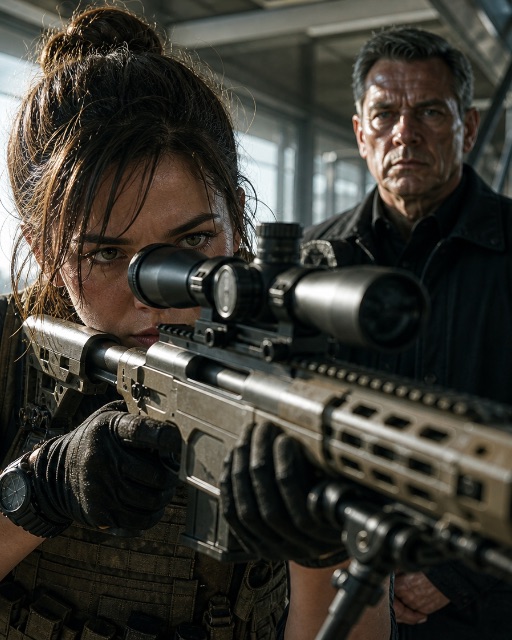
My name used to mean something in the Army. Then I disobeyed a direct order, saved three lives, and lost my career in a single afternoon. I buried my sniper codename in a classified file I wasn’t supposed to ever see again.
Until last week, when I found it signed at the bottom of a kill list.
The stairwell went black the second I stepped inside. Not a power failure. A controlled blackout. Somebody wanted me in the dark.
Three floors up, I heard a rifle bolt cycle. Clean. Unhurried.
“Security breach, stairwell B,” I whispered into my mic.
Nothing. Jammed.
Then the footsteps. Slow. Measured. Military cadence I’d recognize anywhere.
“Whoever you are,” I said, “you picked the wrong building.”
“No, Dana.” The voice froze me where I stood. “I picked the only building you’d walk into without backup.”
Colonel Raymond Kesler. The man who signed my discharge papers. The man who should’ve been on a porch in Tucson watching his grandkids.
A flashlight clicked on three steps above me. He looked exactly the same. Calm. Like he was running a briefing.
“You’re supposed to be retired,” I said.
“So were you.”
Another shot cracked above us – not at me. At the emergency exit. He was locking us in.
Then he stepped aside.
Behind him stood a second figure. Sniper rifle. Laser sight painting a red dot directly over my sternum. But the scope was wrong. Not military issue. Civilian black project tech – the kind that reads heart rate, breathing, the pause between inhales.
The reticle was already synced to my lungs. Already moving with me.
“You trained them too well,” Kesler said softly.
And that’s when I understood. This wasn’t a hunt. It was a test. A graduation.
“Take the hood off,” Kesler told the figure.
The sniper reached up. Slow. Deliberate.
When the fabric came away, my knees almost gave out. Because I’d buried him. I’d folded the flag myself. I’d watched them lower the casket in the rain eleven years ago.
He lowered the rifle just enough to speak.
“Hi, sis.”
My little brother. Alive. Breathing. Holding the codename I thought died with him.
Then he tilted his head – that same tilt he used to do when we were kids, right before he told on me – and said:
“They didn’t fake my death to protect me, Dana. They faked it to protect you. From what you did in Kandahar. From what you don’t remember doing.”
He reached into his vest and pulled out a photograph. Slid it down the railing toward me.
I caught it.
My hands went numb.
It was me. In a place I’ve never been. Holding a weapon I’ve never fired. Standing over a body I’ve never seen.
And written on the back, in my own handwriting – a handwriting I haven’t used since I was nineteen — were six words that made Kesler look away…
Those six words changed everything I thought I knew about my own life.
“I remember everything. He deserved it.”
My own script stared back at me, a ghost from a past I couldn’t access. The air grew thick, heavy with the smell of concrete and a lie eleven years in the making.
“Thomas?” My voice broke on his name. It felt like a stone in my throat.
He didn’t flinch. His eyes, the same ones that used to be full of mischief and scraped knees, were now flat. Empty.
“That’s not my name anymore,” Thomas said.
Kesler stepped forward, placing a hand on my brother’s shoulder. A proprietary gesture. Like he owned him.
“He’s an asset now, Dana. The best we’ve ever had. Just like you were.”
My brain was a storm of non-sequiturs. The funeral. The twenty-one-gun salute. My mother’s wails.
“What is this?” I asked, my voice barely a whisper. “What did you do to him?”
“We saved him,” Kesler said, his tone infuriatingly reasonable. “And in doing so, we saved you. That photograph… that was your unofficial retirement party.”
He explained it like he was ordering lunch. The man in the picture was a threat, a loose end. And I, his premier operative, had tied it up.
“It was a mission you couldn’t be allowed to remember,” Kesler continued. “The psychic toll would have been… inconvenient. So we gave you a gift. A new memory.”
The discharge. The disgrace. The story I’d lived with for years. It was a fabrication. A clean slate they’d written for me.
“You’re lying,” I said, the words feeling weak even to my own ears. “I would never forget something like that.”
Thomas shifted his weight. The rifle came up a fraction of an inch. “You would if it meant forgetting what you did to get the shot.”
His words hit me like a physical blow. There was more. There was always more.
“You see,” Kesler chimed in, smiling that thin, cold smile of his, “we needed a clean break. For Thomas to join us, his old life had to die. For you to live, your old self had to be put to sleep.”
He called it an anesthetic for the soul. A procedure to dull the edges of a necessary evil.
I looked from Kesler’s smug face to my brother’s hollow eyes. This wasn’t protection. This was a cage. They had built a cage around my mind and put my brother on guard duty.
“And now?” I asked, pushing the photograph back toward them with the toe of my boot. “What’s this graduation for?”
“We need you back, Dana,” Kesler said simply. “There’s a problem, and you’re the only one who can fix it. We just had to be sure you were… receptive.”
Thomas, my brother, was the key. He was the leverage and the locksmith all in one. If I saw him, alive, working for them, how could I refuse?
The laser dot on my chest felt like an anchor. It wasn’t just tracking my breathing; it was a reminder of the leash they held.
But then Thomas blinked. Just once. A long, slow blink. Left eye first.
It was a signal. A signal we hadn’t used since we were kids, hiding in the woods behind our house. It meant: Play along. I have a plan.
The smallest flicker of hope ignited in my chest. He was in there. My brother was still in there somewhere.
So I did what any good soldier would do. I played along.
“A problem,” I repeated, letting a weary resignation creep into my voice. “What kind of problem?”
Kesler’s smile widened. He had me. He thought he had me.
“Let’s get out of this stairwell,” he said, “and we can discuss the terms of your reenlistment.”
He turned to lead the way up. That was his mistake.
In the fraction of a second his back was to me, I moved. I dropped low, slamming my shoulder into the railing and vaulting over it. I fell ten feet, landing in a crouch on the floor below with a force that rattled my teeth.
A shot rang out, but it wasn’t from Thomas’s rifle. It was Kesler’s sidearm. The bullet sparked against the concrete wall where my head had been.
“Contain her!” Kesler roared.
I didn’t wait. I sprinted down the stairs, taking them three at a time. I heard them coming after me, their heavy boots echoing in the confined space.
I hit the ground floor and slammed my shoulder into the main door. Locked. Of course.
Another shot from above. I dove to the side, rolling behind a concrete pillar.
“You can’t run, Dana!” Kesler’s voice boomed. “There’s nowhere to go!”
I glanced at my useless radio. I was alone. Cut off. But Thomas’s signal… it meant something. It meant I wasn’t fighting for just myself anymore.
I scanned my surroundings. Maintenance closet to my left. Fire extinguisher on the wall. An idea, desperate and thin, began to form.
Thomas and Kesler appeared on the landing above. The red laser danced across the floor, searching for me.
“Talk to her,” Kesler ordered my brother. “Remind her what’s at stake.”
I heard Thomas draw a breath. “Dana, don’t make this harder. He just wants to talk.”
But it was how he said it. The cadence was off. A slight hesitation before the word ‘harder’. Another signal. A distress code from our childhood games. Trap.
I ripped the fire extinguisher off the wall. It was heavy, solid.
I waited for the laser to sweep past my position. Then I broke cover.
I didn’t run for the door. I ran straight back toward the stairs.
Kesler fired twice. The bullets whizzed past my ear.
I aimed the extinguisher not at them, but at the sprinkler head on the ceiling directly below their position. I squeezed the handle.
A thick cloud of white foam erupted, blasting the sprinkler. The metal casing broke.
For a second, nothing happened. Then a torrent of foul, stagnant water rained down. The fire alarm blared, a deafening shriek that echoed through the stairwell.
It was the chaos I needed.
Kesler was sputtering, momentarily blinded. Thomas, I noticed, had already taken a step back, as if he knew what was coming.
Under the cover of the alarm and the downpour, I charged up the stairs. I bypassed them, heading for the floors above. My only way out was up.
“The roof!” I heard Kesler yell through the noise.
I reached the sixth floor, my lungs burning. The door to the main office hallway was supposed to be locked. I slammed my weight against it. It flew open.
Thomas had unlocked it. He’d given me an escape route.
I ran through the deserted office complex, alarms blaring and emergency lights flashing. I knew this building. It was a secure data facility. A place I’d scouted for a freelance security gig months ago. A place Kesler knew I’d be familiar with.
I found what I was looking for: a hardline terminal in a server room. I smashed the glass with my elbow, ignoring the pain, and plugged in a bypass key I always carried.
Two minutes. That’s all I had.
I accessed the building’s external network. No time to call for help. I needed information. I typed in Kesler’s name. A wall of classified firewalls. Typical.
Then I typed in the codename. My old codename from the file. The one on the kill list.
A single, encrypted file appeared. It was firewalled six ways from Sunday, but there was a back door. A protocol I recognized. One I designed myself.
My fingers flew across the keyboard. As the decryption software ran, I glanced back at the door. I was running out of time.
The file opened. It wasn’t a mission dossier. It was a medical report.
Patient: Dana Hayes. Procedure: Mnemonic Ablation. It detailed the selective erasure and implantation of memories. My discharge wasn’t real. The saves, the insubordination… all of it was a script they’d uploaded into my head.
But the most chilling part was the date of the procedure. It wasn’t right after the event in the photograph. It was two years later.
For two years after that mission, I’d worked for them. I’d been one of Kesler’s assets. A ghost.
The kill list I found wasn’t a list of future targets. It was a list of past ones. All signed by me.
The thud of a boot against the server room door brought me back to reality. I yanked the key from the terminal and fled through a back maintenance corridor.
The report proved it. I wasn’t just a sniper who did one bad thing. I was a monster they’d built and then put on a shelf, and now they were trying to take me out for a second spin.
I made it to the roof. The city lights spread out below me, a universe of people living normal lives. Lives I couldn’t imagine anymore.
The door to the roof burst open. Thomas stood there alone, rifle held at a low ready. The rain from the sprinklers had slicked back his hair. He looked younger. More like himself.
“He’s on his way up,” Thomas said, his voice urgent. “We don’t have much time.”
“Why, Thomas? Why go along with this for so long?” I asked, my heart aching.
“They came to me after that mission,” he explained, stepping closer. “They said you’d gone off the rails. That you were a danger to yourself and others. They showed me the photo.”
He said Kesler offered him a deal. Join his program and they would ‘fix’ me. They’d give me a quiet, normal life. Thomas would serve in my place. He thought he was saving me.
“I believed him,” Thomas said, shame in his eyes. “For years, I believed I was protecting you by staying away. By becoming one of them.”
“What changed?”
“The kill list you found,” he said. “It wasn’t for you. It was for me. A final test. Your name was at the bottom. My graduation was supposed to be executing my own sister.”
The final piece clicked into place. Kesler wasn’t trying to recruit me. He was cleaning house. My brother and I were his last two loose ends.
“He wants the program to disappear,” I realized aloud. “He’s retiring for real and scrubbing the evidence.”
Heavy footsteps echoed from the stairwell. Kesler.
“There’s a service lift on the north side of the roof,” Thomas said quickly, pressing something small and heavy into my hand. A data drive. “Everything is on it. The real mission logs. Medical files. His offshore accounts. Everything.”
“What about you?” I asked, looking back at the door.
“He thinks I’m loyal. I can buy you time,” Thomas said. He raised his rifle, this time aiming past me, toward the door. “Now go, Dana. Live the life I thought I was giving you.”
I hesitated. I wasn’t leaving him behind. Not again.
“We go together,” I said firmly.
Before he could argue, Kesler emerged from the stairwell door, sidearm raised. He saw us, a flicker of surprise in his eyes that quickly turned to cold fury.
“I should have known,” Kesler snarled, his aim settling on Thomas. “Blood is thicker than indoctrination.”
“It’s over, Colonel,” Thomas said, his voice steady, his rifle unwavering.
“It’s never over,” Kesler replied.
He didn’t fire at Thomas. He fired at the massive electrical transformer near the edge of the roof.
Sparks erupted. The rooftop lights flickered and died, plunging us into near darkness, lit only by the distant city glow.
Kesler was a shadow, moving in the dark. He knew our training. He knew we were at our best in the dark. He was using our own strengths against us.
“You see, this is the problem with assets,” his voice echoed from somewhere to my left. “They start to think a conscience is a part of the standard-issue kit.”
I pulled Thomas back behind a large air-conditioning unit. “I can’t get a shot in this light.”
“You don’t have to,” Thomas whispered. He tapped the high-tech scope on his rifle. “This sees in the dark.”
“He knows that,” I countered. “He’ll be expecting you to look for him.”
“Exactly,” Thomas said, a ghost of his childhood grin on his face. “So you’re going to be my eyes.”
He handed me a small eyepiece connected by a wire to his scope. “It’s synced. You’ll see what I see. Call out his position.”
I put the eyepiece on. The world bloomed in the green and white of thermal vision. I could see the heat signature of pipes, vents… and a man.
“He’s moving along the west railing,” I whispered, my voice a calm command. “Ten meters.”
Thomas adjusted his aim, smooth and silent.
“He’s ducking behind the satellite array,” I said.
The world was just shapes and heat. Abstract. It was like a training exercise. Just like the ones he’d built us for.
“He’s going to circle around to our flank,” I said. “He expects you to stay put.”
“What do you suggest?” Thomas murmured.
“The opposite.”
We moved in perfect sync, a silent dance we’d perfected years ago in paintball fields and training grounds. I guided, he aimed. We were two parts of the same weapon.
We circled the large AC unit, coming at Kesler from the direction he least expected.
I saw his heat signature first. He was crouched, his weapon pointed at our old position. A predator waiting for his prey to move.
“Now,” I breathed.
The shot was not a deafening crack, but a suppressed cough. The rifle jerked in Thomas’s hands.
Through the eyepiece, I saw Kesler’s heat signature flare, then crumple to the ground. He didn’t fire at the man. He’d hit the weapon, shattering it in Kesler’s hand. Disarmed. Neutralized.
Silence descended on the rooftop, broken only by the hum of the city.
We approached cautiously. Kesler was on the ground, clutching his broken hand, his face a mask of disbelief and pain.
“I made you,” he gasped, looking from me to Thomas. “Both of you.”
“And you forgot the most important lesson you ever taught us, Colonel,” I said, looking down at him. “Always know your target.”
He had seen us as weapons. He never understood we were a family.
We left him there for the authorities we’d already called. The data drive Thomas gave me contained more than enough to put Kesler away for life and dismantle his entire shadow network.
Our names would never be officially cleared. To the world, I was still a disgraced soldier, and Thomas was still a ghost.
But it didn’t matter.
Standing there on that rooftop, with my brother by my side, I felt a sense of peace I hadn’t felt in over a decade. The holes in my memory were still there, but they no longer defined me. They were just scars from a battle I had finally won.
Our pasts were a mess of lies and manipulations, written by a man who saw us as pawns. But our future was a blank page. And for the first time, we were the ones holding the pen. Who we were wasn’t about the memories forced upon us, but about the choices we made from that moment forward. We were more than our codenames and our files; we were survivors, and we were family. And that was a truth no one could ever erase.



