
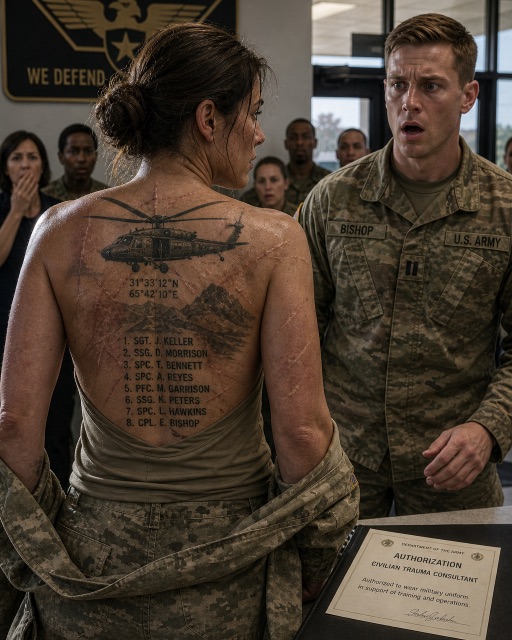
…the man in the framed photograph sitting on his father’s desk back home.
His own older brother.
“Captain… Captain D. Bishop,” he choked out. He stumbled back and caught himself on the counter, his knuckles going white. The whole lobby was holding its breath.
I didn’t move. I just stood there, the afternoon sun cutting across the raised scar tissue on my shoulder, the ink of his brother’s name right there in black script over a wound that had never fully healed.
“You knew him?” he whispered.
I finally spoke. My voice was quieter than his had been, but it carried further. “I was the medic on that bird, Lieutenant. I was the last person to hold his hand.”
A woman behind the desk covered her mouth. A master sergeant who had walked in halfway through slowly removed his cap.
Bishop’s eyes were glassy now, darting across the eight names like he was seeing ghosts line up in formation. “They… they told my family a medic pulled him out. That someone carried him almost a mile under fire before – ” His voice broke. “They never told us who.”
“That’s because the Army redacted the report,” I said. “Because of what happened after.”
I reached down, picked up my jacket, and folded it neatly over my arm. I wasn’t going to put it back on. Not yet. He needed to see it.
“Your brother gave me something before he stopped breathing, Lieutenant,” I said. “He made me promise I’d deliver it. In person. To his little brother. The one who was fifteen at the time and swore he’d join up the second he turned eighteen.”
Bishop’s knees almost buckled. “He… he gave you something? For me?”
I nodded once.
“I’ve been carrying it for eleven years, kid. I didn’t know your first name. I didn’t know your unit. I only knew you’d be wearing bars someday, and that I’d know you when I saw you.”
I reached into the inner pocket of the folded jacket. My fingers closed around the small, dull object I had carried into every deployment, every move, every hospital stay since the day I came home in pieces.
I pulled it out and held it up between us.
The entire lobby leaned forward to see what it was.
And when Lieutenant Bishop saw what was resting in the palm of my hand, he dropped to his knees right there on the polished floor and started to sob like a child.
It wasn’t a medal. It wasn’t a dog tag.
It was a single, unfired 5.56mm round. The brass was tarnished from more than a decade of being held in my anxious, sweaty hands. The copper-jacketed tip was still pristine.
It wasn’t a bullet that had been dug out of him. It was a bullet that had never been fired at all.
Two colonels and a major, who had been standing near the entrance, turned on their heels without a word and walked out. They understood, or thought they understood, the implication immediately. A soldier’s last testament being an unfired round was not a story they wanted to be a part of.
The master sergeant, however, stayed right where he was, his head bowed.
I knelt down in front of the sobbing young officer, my own knees protesting after all these years. I gently pushed the round into his clenched fist. His fingers were cold.
“His name was David, right?” I asked softly, keeping my voice low so only he could hear.
He managed a ragged nod, his face buried in his free hand.
“Come on, Michael,” I said, guessing his name from the ‘M. Bishop’ on his uniform. “Let’s go somewhere else. Let’s get you off the floor.”
He didn’t seem to have the strength to stand. I put a hand under his arm, and the master sergeant was suddenly there, taking the other one. Together, we hoisted the young lieutenant to his feet. He was shaking like a leaf.
The sergeant looked at me, his eyes full of a knowledge I didn’t expect. “Use the family briefing room. Down the hall, second on the left. It’s empty.” He gave a slight nod. “I’ll make sure you’re not disturbed.”
I murmured my thanks, and guided Michael down the quiet hallway. The lobby behind us was silent as a tomb.
The briefing room was small and windowless, with a round table and a few chairs. It smelled vaguely of stale coffee and stress. I sat him down in one of the chairs and pulled another one up close, sitting across from him.
He just stared at the unfired bullet in his palm, turning it over and over. His sobs had quieted down to shuddering breaths.
“Why?” he finally managed to ask. “Why this?”
I took a deep breath. This was it. The moment I had replayed in my mind a thousand times for eleven years.
“Your brother was the best officer I ever served with,” I started. “Not just a good leader. A good man. He cared. He knew every soldier’s name, their wife’s name, their kids’ names.”
Michael nodded. “That was him.”
“That day… it was a mess from the start. Bad intel. We flew into a valley we should have stayed ten miles clear of. The bird went down hard. I was lucky, just got thrown clear. Some of the others… weren’t.”
I could see it all again. The dust, the rotor wash kicking up sand and stones, the smell of burning fuel.
“David rallied us. The survivors. He got a perimeter set up. He was directing fire, calling for evac, and patching up the wounded alongside me, all at the same time. He was a force of nature.”
I paused, my throat getting tight. “We were pinned down. Taking heavy fire from a ridge line. There was a small cluster of buildings between us and them. An old farmhouse, mostly rubble. We thought it was empty.”
“Then we saw movement. A spotter on our flank called it in. A single figure, running from the farmhouse toward the enemy position. Orders came down the line. ‘Neutralize the target.’ It was David’s sector of fire.”
I looked at Michael, who was now looking at me, his eyes wide with dawning, horrified understanding.
“Everyone had their rifle up. We were all ready to light that person up. David had the clearest shot. The call came again, more urgent this time. ‘Captain, engage the target!’”
“But David didn’t shoot,” I said. “He just stayed there, looking through his scope. I was right behind him, trying to stop the bleeding on another guy. I could hear him breathing. He just kept watching.”
“Seconds felt like minutes. The sergeant next to him was yelling at him to fire. David just lowered his rifle. He reached up, pulled the charging handle back just enough to eject the live round from the chamber, and let it fall into his hand.”
“He put it in his pocket,” I whispered. “He chose not to shoot.”
Michael’s face was pale. “But why? Was it a… a child?”
“We don’t know,” I admitted. “Right after he pocketed the round, a mortar shell landed about ten feet from his position. Shrapnel. It was… it was bad.”
The memory hit me like a physical blow. The ringing in my ears, the world turning into a cloud of smoke and red.
“I got to him first. There was nothing I could do to stop it, you know? I was just a medic with a bag of tricks, and this was beyond any trick I had. All I could do was try to make him comfortable. Hold his hand.”
“He was lucid, for a minute or two. The pain hadn’t fully kicked in. He knew. He looked at me, and his eyes were so clear. He said, ‘Doc… my pocket.’”
“I reached in and felt the round. It was still warm. He closed his fingers over mine. ‘Give this to my brother,’ he said. ‘My little brother, Michael.’”
The name, spoken aloud after all this time, felt strange on my tongue.
“He made me promise. He said, ‘Tell him it’s the most important shot I never took. Tell him the bravest thing a soldier can ever do is know when not to pull the trigger.’”
Tears were streaming down Michael’s face again, but this time they were silent. He was listening to his brother’s last words.
“His voice was getting weaker. He said, ‘Tell him not to make my ghost his compass. Tell him to find his own direction. Tell him… this uniform isn’t worth his soul.’”
“And then he gasped. He tried to say something else. ‘The letter…’ he whispered. ‘The letter in my pack…’ And then… he was gone.”
I let out a breath I’d been holding for a decade. “I carried him, Michael. I carried him for what felt like forever, trying to get to the evac point. That’s the part they put in the report. They left out the rest.”
“They left out the part about him disobeying a direct order to fire. They couldn’t have their hero, Captain David Bishop, posthumously decorated for valor, having a record of insubordination in his final moments. So they buried it. They redacted my testimony. They created a myth.”
Michael stared at the bullet in his hand. It wasn’t a symbol of failure or cowardice. It was a symbol of profound, unimaginable strength. It was the weight of a human life, spared.
“The letter,” he finally said, his voice raspy. “You said there was a letter.”
My heart sank. “There wasn’t one, Michael. I looked. When we got back to the FOB, I went through his entire pack. Every pocket, every pouch. There was no letter. I think… I think he meant to write one. And he just ran out of time.”
That was the lie I had told myself for years. The comfortable lie. The truth was worse.
The door to the briefing room opened. The master sergeant stood there, holding a worn, green military-issue notebook.
“I believe you’re looking for this, Lieutenant,” he said, his voice gentle.
He walked over and placed the notebook on the table between us. My blood ran cold.
The master sergeant looked at me. “I was the sergeant yelling at him to shoot, Doc. My name is Peterson. I was his platoon sergeant.”
This was the twist I never saw coming. Not in a million years.
“I saw him eject the round,” Peterson continued, his gaze fixed on Michael. “I saw him die. And afterwards, when they were building the official story, they asked me what happened. I told them he was a hero. I lied. I helped them create the myth, because I was ashamed. Ashamed that he had a clarity that I lacked.”
He tapped the notebook. “After you were flown out, Doc, I was tasked with gathering his personal effects. I found this. I read it. And I kept it. I knew the Army would just make it disappear. I’ve been waiting for the right person to give it to ever since.”
He looked from me to Michael. “I think today is the day.”
With that, he turned and left, closing the door softly behind him.
My hands were trembling as I picked up the notebook. It was David’s. I recognized his handwriting on the first page. It was full of tactical notes, patrol schedules, mundane details of a war.
But tucked into the back, on a page ripped out and folded, was the letter. The shaky, hurried script was barely legible. It was dated the morning of the day he died. He had written it, after all.
I took a shaky breath and began to read it aloud for his brother.
“Mikey,” it began.
“If you’re reading this, it means I didn’t get to come home and tell you myself. I’m sorry. I’m sorry for all the stories I told you, all the talk about honor and glory. It’s not what you think.”
“Today, I almost did something I could never take back. We had a target. A runner. The order was given. But my scope was better than theirs. I saw her face. She couldn’t have been more than twelve, running for her life. She was just a kid, Mikey. A scared kid in a war zone.”
“They told me to shoot. In that moment, I could hear your voice in my head, the way you used to talk about me, like I was some kind of comic book hero. And I knew that hero would have pulled the trigger. But I couldn’t.”
“I ejected the round. It’s in my pocket now. If I get out of this, I’m going to give it to you. It’s the best medal I’ve ever earned. It’s the one for remembering we’re human.”
“This life… it grinds you down. It takes the best parts of you and turns them into scar tissue until you can’t feel anything anymore. I see it in the eyes of the men around me. I see it in my own when I look in the mirror.”
“Don’t follow me, Mike. Don’t wear this uniform because of me. You have a good heart. Don’t let them train it out of you. Your grandfather’s compass is in the top drawer of my desk. Take it. Find your own true north. Whatever you do, make it something that builds, not breaks.”
“Be a better man than I was. Be the man who doesn’t have to choose whether or not to shoot a child.”
“I love you, little brother.”
“David.”
The room was utterly still when I finished. The only sound was the hum of the ventilation.
I folded the page and slid it back into the notebook, pushing it across the table to Michael. It was his now. The promise was fulfilled. The burden was lifted.
He took the notebook, his fingers tracing his brother’s name on the cover. He looked at the unfired bullet still resting in his other hand. Then he looked at me.
The glassy, hero-worshipping look in his eyes was gone. In its place was a quiet, profound sadness, but also a new strength. An understanding. He wasn’t a kid trying to live up to a ghost anymore. He was a man who had just been given a second chance at his own life.
“Thank you,” he whispered. His voice didn’t crack. “For carrying him. For carrying this. For eleven years.”
“He was my brother, too,” I said. And in that moment, I knew it was true.
Michael stood up, and this time his posture was steady. He was still a Lieutenant in the United States Army, but he was different. He tucked the letter carefully into his breast pocket and closed his fist around the bullet.
He wasn’t going to quit. I could see that. David’s letter hadn’t told him to run away. It had told him to be a different kind of soldier. A better kind of leader. A man who builds.
We walked out of that room together, back into the quiet lobby. Master Sergeant Peterson was waiting. He didn’t say a word, just gave Michael a long, steady look and a slow nod of respect. Not for the bars on his collar, but for the man he was about to become.
My promise was kept. I was finally free of the weight I had carried for so long, but I hadn’t lost it. I had passed it on. And in doing so, I had watched it transform from a burden of grief and secrecy into a compass for a young man’s soul.
True courage isn’t always found in the heat of the fight. Sometimes, it’s found in the quiet moments of choice. It’s in the shot not taken, the difficult truth spoken, and the promise kept, no matter how heavy it is to carry.



