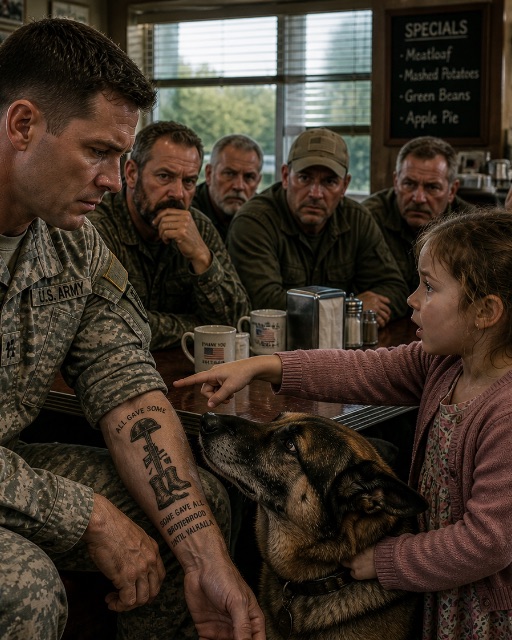
“My daddy had that same tattoo… and my dog says he knows you.”
The words were barely a whisper, almost drowned out by the sizzle of the diner’s grill. But they hit my table like a flashbang.
My buddies and I were passing through rural Virginia, stopping for black coffee before making our annual drive to the military cemetery. We do it every year for Mitchell. He was the sixth man on our team, the one who never made it back.
I had just reached for my mug, exposing the faded military tattoo on my forearm. That’s what the little girl was staring at.
She was maybe seven years old, wearing a frayed sweater and dirt on her shoes. Next to her stood an old, heavily scarred German Shepherd with a gray muzzle.
“What did you say, kid?” I asked, my voice suddenly dry.
“My daddy had that one,” she repeated, pointing at my arm. “His name was Mitchell Cross.”
The entire table went dead silent. Derrick dropped his fork. It hit the floor with a loud clang.
Mitchell died seven years ago pulling us out of an ambush. The official file said he was an orphan. No family. No wife. No kids.
Then, the old dog stepped forward.
He sniffed my boot, let out a high-pitched, broken whine, and pressed his heavy head into my lap. His whole body was shaking with deep, desperate recognition.
I stared at the ragged, jagged scar over his left eye and my blood ran cold. It was Buster. Mitchell’s combat dog – the one our commanding officer swore perished in the exact same blast.
If the dog was alive, and this girl was here…
“Honey, who are you bothering?” a woman’s voice called out from the kitchen.
The girl’s mother pushed through the swinging doors, wiping her hands on a grease-stained apron. She stopped dead in her tracks when she saw the five of us sitting in Booth Seven.
My jaw hit the floor. The coffee pot slipped from her hands, shattering glass and hot liquid all over the tile.
I couldn’t breathe. Because the terrified woman wearing the waitress apron wasn’t a stranger… she was the person the military told us died in that same explosion. The person whose casket we carried. The person whose name is carved into that headstone we visit every single year.
She looked at me. Her lips trembled. And the first words out of her mouth weren’t an explanation.
They were a warning.
“You need to leave. Right now. All of you.” Her eyes darted to the window. “They’re watching. They’ve always been watching.”
Derrick stood up slowly. “Who’s watching, Tammy?”
She grabbed her daughter and pulled her behind the counter. The dog started growling – not at us. At the door.
That’s when I noticed the black SUV parked across the road. It hadn’t been there when we walked in.
She looked me dead in the eyes, tears streaming down her face, and whispered: “Mitchell didn’t die saving you. He died because of what he found out about your commanding officer. And if you don’t walk out that door right now and forget you ever saw me…”
The bell above the diner entrance chimed.
Someone was walking in.
Buster lunged in front of the little girl and bared every tooth he had left.
I turned around. And standing in the doorway, in full dress uniform, medals gleaming under the fluorescent light – was a man we buried eight years ago.
He smiled. “Hello, boys. Long time.”
It was Sergeant Evans. A man whose funeral I’d attended a year before we even met Mitchell. Car accident, they said. Tragic. We were the honor guard at his service.
My mind was a tangled mess of confusion and adrenaline. Evans was alive. Tammy was alive. Buster was alive. A whole graveyard’s worth of people we’d mourned were standing, breathing, and looking at us in a greasy spoon diner.
“Evans,” I managed, my voice a low growl. “What the hell is this?”
His smile didn’t waver. It was cold, predatory. “Just checking in on an old friend, Captain.” He nodded toward Tammy, who was trembling behind the counter. “Looks like she’s been a little too friendly.”
Derrick, Sam, and Will were on their feet now, a silent, solid wall of muscle beside me. We were older, a little slower, but the training never leaves you. We instinctively formed a defensive line between the door and Tammy.
“You need to walk away, Evans,” Derrick said, his hands clenched into fists at his sides.
Evans chuckled, a dry, humorless sound. “I don’t think so. The General likes to keep his assets accounted for.” He took a step inside. “And she,” he said, pointing a thumb back at Tammy, “is a very valuable asset.”
The “General.” He had to mean our old CO, Major Thompson back then. The man who’d climbed the ranks, stepping on an untold number of backs—and apparently, graves—to get there.
“Mommy,” the little girl cried, her voice muffled by Tammy’s apron.
That sound broke the spell. It wasn’t about us anymore. It was about her. Mitchell’s daughter.
“You’re not taking them,” I said. It wasn’t a question. It was a fact.
Evans sighed dramatically. “I was hoping this could be civil. But you boys were always so stubborn.” He reached inside his immaculate dress coat.
But he was too slow.
Tammy was faster. She must have been living this moment in her head for seven years.
She didn’t grab a weapon. She grabbed a cast-iron skillet off the grill’s warming rack. With a guttural scream, she swung it over the counter and slammed it into the side of Evans’s head.
He went down like a sack of bricks.
For a second, the only sound was the clatter of the heavy skillet on the tile floor.
Then, all hell broke loose.
Two more guys in dark suits burst out of the SUV across the street and started sprinting toward the diner.
“Back door! Now!” Tammy screamed, already pulling her daughter toward the kitchen.
We didn’t need to be told twice. Will and Sam grabbed the unconscious Evans and dragged him with us. He was evidence now.
Derrick cleared the path, and I grabbed Tammy’s hand, pulling her along as Buster herded the little girl, whose name I still didn’t know, between his legs.
We burst out into a back alley that smelled of old grease and garbage. Tammy’s beat-up sedan was parked right there.
“Get in!” she yelled, fumbling with the keys.
We piled in, a clumsy mess of large men, a terrified woman, a crying child, and a very angry dog. I threw the groaning Evans in the trunk and slammed it shut just as the two goons rounded the corner of the alley.
Tires squealed as Tammy floored it, the old car groaning in protest. I looked back and saw one of the men pulling out a phone, not a gun. They weren’t trying to stop us. They were tracking us.
“They won’t shoot,” Tammy said, her voice shaking but steady. “The General wants us alive. That’s his leverage.”
“Leverage for what?” I asked, crammed in the back with Will and Buster, who had his head on the little girl’s lap, calming her down.
“His whole career,” she said, glancing in the rearview mirror. “Everything is built on a lie. Mitchell found the proof. I’m the one who knows where it is.”
We drove in silence for a while, just the hum of the engine and the little girl’s soft sniffles. Finally, I had to ask. “What’s your name, kid?”
She looked up at me with big, brown eyes. Mitchell’s eyes. “Sarah,” she whispered.
My heart broke and mended itself in the same beat.
We drove for hours, Tammy taking back roads she knew by heart. She explained everything in disjointed, painful pieces.
She and Mitchell were secretly married before the deployment. They knew he was an orphan and wanted to start their own family, their own story. She found out she was pregnant a week before he left.
He wrote her every day. But then the letters got darker. He’d stumbled onto something. Our CO, Thompson, was using their unit’s deployments as cover for a weapons smuggling ring. The ambush that killed Mitchell wasn’t an ambush at all. It was a deal gone bad with some local warlords. Our squad was just collateral damage, a convenient way to erase any witnesses.
But Mitchell was smart. He knew he was in over his head. He’d started collecting evidence against Thompson—coded messages, transaction logs, coordinates. He’d hidden it all.
When Thompson realized Mitchell knew, he set up the explosion to eliminate him. But it was a messy job. Buster was badly injured but survived, crawling away from the blast site. And Tammy… Thompson’s men got to her first.
They didn’t kill her. They told her Mitchell was dead. They showed her faked photos. They told her that her name and his were now linked to a treason investigation, and the only way to protect her unborn child was to disappear. They faked her death, gave her a new identity, and a small allowance to keep her quiet.
Evans, who had been Thompson’s first “ghost,” became her handler. He’d check in every few months, move her to a new town, a new dead-end job, just to remind her she was a prisoner. She was living in a cage without bars.
“He told me if I ever talked, he’d find Sarah,” Tammy choked out, her knuckles white on the steering wheel. “He said he’d make it look like an accident. Just like Sergeant Evans.”
I looked at Will, who was checking on our guest in the trunk. The irony was so thick you could cut it with a knife.
“So, where is it?” Derrick asked from the passenger seat. “The proof.”
Tammy took a shaky breath. “Mitchell was paranoid, but he was brilliant. He knew they might come for me. He left me a message, hidden in the last letter I ever got from him. It was a nursery rhyme.”
She recited it from memory, her voice trembling. “‘The dog with the key guards the soldier’s dream, where the old river bends and the sunlight gleams.’ I thought he’d lost his mind from the stress. I never understood it.”
We all fell silent, thinking. A nursery rhyme. It was classic Mitchell. He loved puzzles and codes.
“Wait a minute,” I said, leaning forward. “Buster. The dog with the key.” I looked at the old shepherd. There was a small, tarnished metal tag hanging from his collar, separate from his ID. I’d seen it a hundred times but never paid it any mind.
I gently reached for it. Buster didn’t flinch. On the tag, etched so small you’d miss it if you weren’t looking, was a single word: “JUPITER.”
“What’s Jupiter?” Sam asked.
“Not what,” I said, a slow smile spreading across my face. “Where. It’s the name of Mitchell’s old boat. A leaky little fishing boat he kept docked on the Shenandoah River. He said it was his retirement plan.”
“Where the old river bends,” Tammy whispered, her eyes wide with realization.
It was a long shot, but it was all we had. We found a map at a gas station and located the marina Mitchell used to talk about. It was two states over, but we had a full tank of gas and an unconscious sergeant in the trunk. We were committed.
When we pulled into the deserted, rickety marina hours later, the sun was beginning to set. There, covered in a tattered blue tarp, was a small boat with the word “JUPITER” peeling off the side. It was exactly as I remembered it.
“Okay, so we’re here,” Derrick said. “Now what? ‘Guards the soldier’s dream’?”
We searched the boat top to bottom. We checked under seats, in storage compartments, even pulled up the floorboards. Nothing.
Sarah, who had been quiet for most of the ride, was now standing on the dock next to Buster. “Buster’s thirsty,” she said matter-of-factly.
We were all frustrated and tired, but Tammy knelt down. “Okay, sweetie. Let’s get him some water.”
As Buster lapped water from Tammy’s cupped hands, Sarah pointed to the boat’s engine compartment. “The soldier is sleeping in there.”
I looked at Tammy. She just shrugged. At this point, what did we have to lose?
Will and I pried open the engine cover. Tucked away beside the motor, wrapped in oilcloth and sealed with duct tape, was a metal lockbox. It was Mitchell’s old footlocker from basic training. His soldier’s dream.
It was locked. No key.
“Let me see that tag,” Derrick said. I handed it to him. He examined the small metal plate. “This isn’t just a tag. It’s a key.”
He was right. The word “JUPITER” was etched onto a small, flat piece of metal that had been machine-cut with jagged edges, like a modern car key. It slid perfectly into the lockbox.
Inside was a hard drive, a stack of papers, and a single photograph of Mitchell and Tammy, both of them beaming. On the back, in Mitchell’s handwriting, it said, “For Sarah. So you know who your daddy was.”
I felt a lump form in my throat.
We took the box and a still-unconscious Evans to a secluded cabin Sam’s family owned in the mountains. We tied Evans to a chair. When he woke up, the five of us were standing there, waiting.
He tried to bluster and threaten, but his eyes kept darting to the hard drive sitting on the table. He knew the game was up.
We didn’t need to torture him. We just needed to talk. We told him we had the proof. We told him Thompson’s empire was about to crumble. We gave him a choice: go down with the sinking ship or help us take down the General and maybe, just maybe, salvage a piece of his own soul.
His soldier’s pride, long buried under years of dirty work, flickered. He told us everything. Thompson’s network, his contacts, his security protocols. He even knew about a secret ledger Thompson kept in his office safe at the Pentagon.
The plan was insane. But we were soldiers, and our brother’s honor was on the line.
Using Evans’s security credentials and our own unique skill sets, we mounted our own little operation. Getting into the Pentagon wasn’t an option, but Evans knew Thompson was paranoid. He kept a digital backup of everything at his secured private residence.
Will, our tech expert, used the hard drive Mitchell had left to gain access to Thompson’s network. It was filled with backdoors Mitchell himself had built. Sam and Derrick staged a “power outage” a few blocks away, disabling the home’s primary security.
And me? I had the simplest job. I walked up to the front door with a pizza box. When the private security guard opened it, Evans was right behind me to neutralize him. We were in.
We found the safe, just where Evans said it would be. Inside was the ledger, detailing years of illegal arms deals, offshore accounts, and a list of men he’d had silenced. Men like Mitchell. Men like Evans was supposed to be.
We didn’t just take the ledger. We took everything. And we left something behind for him: Mitchell’s dog tags, placed right in the center of the empty safe.
The fallout was immediate and spectacular. We anonymously dropped the evidence with a journalist Will knew from his time in corporate security. The story broke, and General Thompson’s career, and his life as he knew it, ended overnight. Federal agents raided his home and office. He and dozens of his cronies were arrested.
Mitchell’s name was officially cleared. He wasn’t just cleared; he was hailed as a hero who died trying to expose corruption. He was posthumously awarded the highest honors.
Tammy and Sarah were finally free. The shadows they had lived in for seven years vanished in the light of the truth. Tammy used a settlement from the military to buy the little diner, renaming it “The Sixth Man.”
The following year, our annual drive was different. We drove to the cemetery, but this time, the headstone with Tammy’s name was gone. And Mitchell’s wasn’t a place of quiet grief anymore; it was a shrine of honor.
Afterward, we didn’t drive home. We drove to the diner.
The place was warm and bright, filled with the smell of fresh coffee and bacon. Sarah, now eight, ran our orders back to the kitchen, with Buster trotting faithfully at her heels. Derrick, Sam, and Will were arguing about football in Booth Seven.
Tammy brought me my coffee, a real smile reaching her eyes. “Thanks for stopping by, Captain,” she said.
“Wouldn’t miss it for the world,” I replied.
We had faced down death together, but in the end, it wasn’t our guns or our training that won the war. It was the whisper of a little girl, the love of a good woman, and the undying loyalty of a soldier who refused to let the truth be buried with him. Some bonds are stronger than betrayal, stronger than fear, and even stronger than death.