
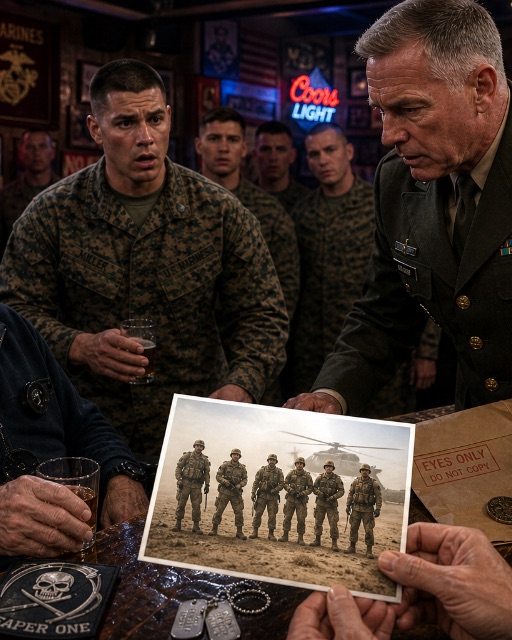
The name on the back was my father’s.
My father – who died in a “training accident” in 1987 when I was four. My father, whose casket my mother was told to never open. My father, whose dog tags the Corps swore were “lost in transit.”
I couldn’t breathe. The neon buzzed. The rain hammered the tin roof.
“That’s not possible,” I heard myself say. “He’s buried in Oceanside. Section G. Plot 14. I visit him every Father’s Day.”
The general’s jaw tightened. He looked at the old man in the wheelchair, and something passed between them – a whole war, fought in a single glance.
“Son,” the old man finally said, lifting his eyes to mine for the first time all night. They were wet. Gray. Familiar in a way that made my knees go weak. “Section G, Plot 14 – there’s a casket in the ground. But there’s no body in it.”
I gripped the edge of the bar so hard my knuckles went white.
The general pulled out a second envelope. Thicker. Older. The tape on this one was yellowed, cracking at the edges. Stamped across the front in faded red ink were three words I’d only ever seen in movies: EYES ONLY – CLASSIFIED.
“We buried a lie in 1987,” the general said quietly. “Six men went into that valley. The Corps told six families they died heroes. But only five of those families were told the truth.”
He slid the second envelope toward me.
“Your mother was the one we lied to. And she’s the reason we’re all still breathing.”
My hands were shaking so bad I could barely hold the flap. I tore it open. Inside was a single black-and-white photograph, paper‑clipped to a handwritten letter in my mother’s handwriting – dated two weeks ago.
I read the first line, and the whiskey glass slipped right out of the old man’s hand.
The glass hit the sticky floor with a dull thud, not even shattering. The sound barely registered over the roaring in my ears.
The first line of the letter read: “My dearest Daniel, if you are reading this, I am finally at peace, and it is time for you to meet your father.”
I looked up from the page, my vision swimming. My gaze fell on the man in the wheelchair. My father. Robert. He wasn’t looking at me, but at the puddle of amber liquid spreading on the floor, his face a mask of grief so profound it seemed to pull all the air from the room.
He wasn’t grieving the spilled drink. He was grieving my mother.
I sank onto the barstool beside him, the classified envelope feeling impossibly heavy in my lap. The general, a man named Hemmings, slid a glass of water toward me. I ignored it.
“Read it, son,” my father’s voice rasped. It was thin, wrecked by time and things I couldn’t imagine. “She wanted you to. She wrote it for you.”
I unfolded the letter. My mother’s cursive, usually so neat and perfect, was shaky, the loops a little wider than I remembered. It was the script of a woman who knew her time was short.
“My Danny,” it began again. “I have lived my whole life with a secret that was both my greatest burden and my most precious gift. That secret was keeping you safe.”
“Your father was not just a Marine. He was one of the best. So good, in fact, that he was recruited for a special intelligence unit. His job was to go to places that didn’t officially exist on any map, to deal with men the government couldn’t acknowledge.”
“In 1986, he went undercover. He infiltrated the organization of a very dangerous man in Colombia, a man they called ‘El Alacrán’ – The Scorpion. This man wasn’t just a drug lord; he was a political force, with spies and assassins everywhere. He was responsible for the deaths of American journalists, aid workers, and even politicians.”
“Your father’s mission was to get close to him, to map his network, so they could dismantle it. For over a year, he lived that life. He became someone else. He spoke their language, ate their food, and watched them do unspeakable things. He sent back information that saved dozens of lives. He was a true hero, Danny, but the kind of hero who never gets a medal.”
My eyes flicked to the black-and-white photo. It was of two men, both in worn fatigues, laughing in some jungle clearing. One was younger, grinning, with a familiar cocky smile. Me. I had that smile. The man next to him was older, with a thick mustache and cruel, dark eyes. The Scorpion.
My father had been living in the lion’s den.
I continued reading the letter. “The mission was coming to an end. They had enough. They planned an extraction for your father and his team of five protectors. But something went terribly wrong. El Alacrán was suspicious. He laid a trap.”
“The ‘training accident’ was the ambush. It happened in a remote valley. The team fought back, but they were outnumbered. Five of them made it out, carrying what they thought was your father’s body. He’d taken multiple rounds to the chest and legs. He wasn’t breathing. They believed he was gone.”
“That was the story they were going to tell me. That was the truth.”
“But then a miracle happened. On the flight to the naval hospital in Germany, your father started breathing again. He was alive, but barely. His body was shattered. The doctors said he would never walk again, that his life would be one of constant pain.”
I looked at the wheelchair. At the thin, blanket-covered legs. The reality of those words was a physical blow.
“That night,” the letter went on, “two men came to our house in Oceanside. One was General Hemmings, a young captain back then. They told me everything. They told me Robert was alive. I remember falling to my knees, right there in the hallway, thanking God.”
“But then they told me the rest. Your father hadn’t just been an operative; he had become El Alacrán’s trusted lieutenant. He knew everything — the man’s routines, his family’s names, his secret hideouts. The Scorpion had escaped the ambush, and he was enraged. He believed Robert had betrayed him and died for it. He put out a bounty, not on your father, but on his family. On me. And on you, my four-year-old boy.”
My blood ran cold.
“They gave me a choice, Danny. A choice no woman should ever have to make. We could announce that Robert was alive, bring him home. We could live under constant guard, in witness protection, always looking over our shoulder. They told me El Alacrán’s reach was long. His people were already in the States. They couldn’t guarantee our safety. They could never guarantee your safety.”
“Or,” my mother wrote, and here a tear had fallen, smudging the ink. “Or, we could let the world believe he was dead. We could bury an empty casket. Robert would disappear into a secure medical facility, and later, into the ‘black’ world of intelligence he came from. The Scorpion would believe his enemy was dead and his vengeance complete. The bounty would be lifted. You would get to grow up. You would get to have a normal life. You could ride your bike, go to school, fall in love, all without a sniper’s crosshairs on your back.”
“I had one night to decide. Do I choose my husband, or do I choose my son? I looked at you sleeping in your little bed, with your superhero pajamas, and I knew it wasn’t a choice at all.”
“I chose you, Daniel. I always chose you. And your father, the bravest man I have ever known, he chose you too. He agreed. He gave up his name, his home, and his family, all so you could live.”
I had to stop reading. The bar, the rain, the neon sign—it all dissolved into a blur of tears. My whole life, my entire identity, was built on a foundation I never knew existed. My mother’s quiet sadness, the way she would sometimes stare into the distance, the times I’d find her holding his Marine Corps portrait. It wasn’t just grief for a dead husband. It was the active, daily pain of missing a living one.
My father placed a trembling hand on my arm. His skin was like paper. “She was the strong one,” he whispered. “I just followed her lead.”
I took a ragged breath and finished the letter.
“So we buried a lie in Oceanside. I mourned a man who was still breathing, and I hated myself for it every single day. General Hemmings became our lifeline. Once a year, he would deliver a letter from your father. And once a year, I would send back a school photo, a drawing you made, a story about you losing your first tooth. That’s how he watched you grow up. In grainy photographs and second-hand stories.”
“He saw you graduate. He saw the woman you married. He even has a picture of his granddaughter, Sarah, in his wallet. He has loved you every single day from a world away.”
“The doctors were wrong about one thing. He did more than just survive. From his wheelchair, in a classified facility in Virginia, your father became a legend. He took all his knowledge of El Alacrán’s network and, piece by piece, he helped the government tear it apart. He became a ghost, a whisper in the intelligence community known only as ‘Oracle.’ He spent thirty-six years hunting the man who took his life away. For you.”
“Two months ago, a CIA drone strike found its target in the Venezuelan highlands. El Alacrán is dead. His entire network has collapsed. The threat is gone, my love. Finally gone.”
“My cancer has returned, you know that. My fight is almost over. But before I go, I am setting you both free. General Hemmings has his instructions. He will bring you to your father. There is so much time to make up for.”
“Don’t be angry, Danny. Don’t be sad for what was lost. Be proud. Be proud of the father who sacrificed his life to give you yours. And try to forgive the mother who had to lie to protect her whole world.”
“I love you more than words can say. Now and forever. Mom.”
I folded the letter, my hands no longer shaking. A strange calm washed over me. The anger I expected to feel wasn’t there. There was just a vast, hollow space filled with a profound sense of awe.
I looked at General Hemmings. “You were there? You were the one who brought her the letters?”
The general, a man who commanded thousands, looked down at his hands. “It was the greatest honor of my career, son. Your mother… she was a soldier in her own right. She never wavered. Not once.”
Finally, I turned to the man beside me. I really looked at him. The gray hair was thin, but it was the same sandy brown from the photos. The jawline was softer, but it was his. And the eyes… the eyes held the same warmth I saw in my own daughter’s.
“You have a picture of Sarah?” I asked, my voice thick.
Without a word, he fumbled with a worn leather wallet. He pulled out a small, slightly creased photo. It was Sarah’s second-grade school picture, the one with the missing front tooth.
Seeing it in his hands broke the last wall inside me. This wasn’t a ghost or a lie. This was my dad.
“They called you Oracle?” I said.
A small, sad smile touched his lips. “It was better than ‘the guy in the chair in room 4.’”
We both let out a wet, choked laugh. It was a fragile sound in the quiet bar.
“I have so many questions,” I said.
“I have thirty-six years to answer them,” he replied, his eyes shining.
But there was one more piece that didn’t fit. A twist I hadn’t seen coming.
“The letter,” I began, looking at the general. “My mom died two weeks ago. You got this two weeks ago. Why wait until now? Why this bar? Why tonight?”
General Hemmings sighed, a deep, weary sound. “This was another part of your mother’s plan. A final piece of protection. Your father wasn’t the only one who made enemies.”
My father’s face darkened. “Hemmings…”
“He needs to know, Robert,” the general insisted. “After dismantling El Alacrán’s network, your father made a new enemy. A corrupt intelligence contractor named Marcus Thorne. Thorne was getting rich selling intel to cartels, and your father’s work exposed him. Thorne was dishonorably discharged and vowed revenge on ‘Oracle,’ whoever he was.”
“When your mother passed, Thorne must have been watching. He somehow learned that her death was the trigger for… this reunion. He thought a grieving son might lead him to the ghost who had ruined him.”
My stomach clenched. “So I was bait?”
“You were the prize,” my father corrected, his voice suddenly hard as steel. “And he was following you tonight. Hemmings’ men have been watching him watch you all day.”
The general nodded grimly toward the front of the bar. “He’s been sitting in a car across the street for the last hour, waiting for you to leave. We just needed to keep you here long enough.”
As he spoke, the flicker of red-and-blue lights painted the rain-streaked windows. The quiet murmur of the bar was broken by the sound of muffled shouts from outside and the slam of car doors.
“It’s over now,” the general said. “For good this time. Your mother’s last act was to protect you one final time, by flushing out the last snake.”
It was all too much. A father I thought was dead. A mother who was a silent warrior. A life built on a heroic lie. A secret enemy I never knew I had. It was the stuff of spy novels, not the life of a suburban architect.
I pushed the water glass away and poured two fingers of whiskey for myself and pushed one toward my father. He took it with a grateful nod. We didn’t say anything. We just sat there, two strangers who shared a face and a history, listening to the rain.
After a long time, I stood up. I walked around the bar and stood behind his wheelchair.
“Is your home accessible?” I asked.
He looked confused. “My home? I live in a government apartment in Virginia.”
“No, you don’t,” I said, my voice steady. “Not anymore. Your granddaughter has a room she’s outgrown that would be perfect. The doorway is wide enough. We can build a ramp.”
Tears openly streamed down his face now, but he was smiling. “Okay, son,” he choked out. “Okay.”
I put my hands on the grips of his wheelchair. It felt both strange and perfectly natural.
The sacrifice wasn’t just in the big moments. It wasn’t just in a valley in 1987 or in a secret room in Virginia. It was in every single day that followed. It was every missed birthday, every scraped knee he wasn’t there to patch up, every school play he couldn’t attend. My mother’s heroism wasn’t just in her choice; it was in her silent endurance, year after year. My father’s heroism wasn’t in dying, but in living a ghost’s life to give me a real one.
Pushing the wheelchair toward the door, out of the darkness of the bar and into the washed-clean night, I realized I hadn’t lost a father at Section G, Plot 14. That was just an empty box. It was here, tonight, that I had finally found him. Our story was just beginning.



