His hand came for my shoulder again.
Yesterday, he shoved me into the dirt after a hundred push-ups and a whisper meant to make me snap: “They always quit.” I didn’t. I ate grit and got back up.
This morning he made me circle the yard with a pack that felt like a cinderblock. “Front and center.” Pack off. Pack on. Faster. My lungs burned. Sweat stung my eyes. He wanted a show.
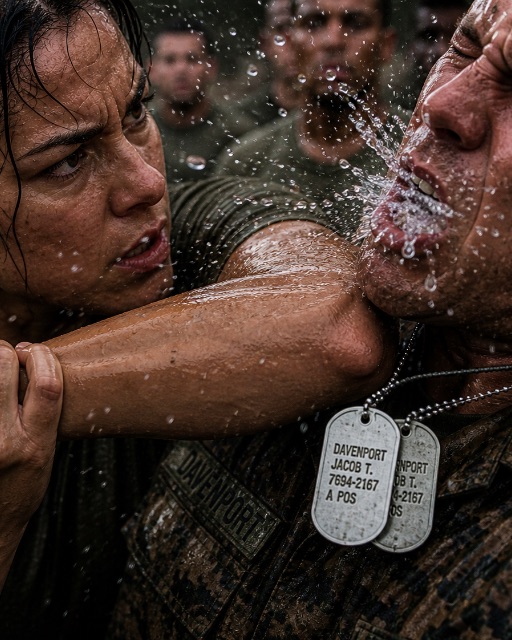
He lunged, boots chewing mud, going for the same spot like he owned it.
Reflex took over. I trapped his wrist, turned my hip. His balance slipped. The formation sucked in a single, sharp breath.
His sleeve bunched. His dog tags swung out and smacked his chest. The name tape on his blouse folded just enough for two letters to peek.
I froze. My heart pounded so hard I could hear it over the cicadas.
Because the last name stamped on his dog tags… was mine.
Not “same last name” coincidence. The same spelling. The same hyphen. The rare one my mother gave me after a man she said walked out before I was born.
I looked up at his face – really looked – for the first time without flinching.
His jaw tightened. His eyes locked onto mine. Something shifted behind them. Not anger. Not surprise.
Recognition.
He dropped my wrist like it burned him. Stepped back. The platoon was dead silent.
His mouth opened. Closed. Opened again.
Then he said five words that rearranged every memory I ever had about why I enlisted, why my mother cried at the bus station, and why this man had been riding me harder than anyone else since day one.
He said: “Your mother told me you’d come.”
I stared at him. The cicadas screamed. Forty recruits held their breath.
And then he reached into his collar and pulled out a second set of tags – smaller, older, scratched to hell – and held them out to me.
The name on those tags wasn’t his.
It was my mother’s maiden name. And the date stamped underneath wasn’t a birthday.
It was the day she reported him dead.
I looked at the tags in his shaking hand, then back at his face – my jaw, my brow, my crooked nose staring right back at me.
My mouth went dry. Because if he wasn’t dead… then the man buried in my grandmother’s backyard under that unmarked stone was…
“Someone else,” Sergeant Miller-Jones rasped, his voice a low gravel that didn’t carry past me.
He finally tore his gaze from mine and scanned the platoon. Their faces were a mixture of fear and wild curiosity.
“Dismissed!” he barked, his command voice returning instantly. “Get to the mess hall! Now!”
No one moved for a second. Then, as if a spell was broken, they scattered like startled birds, their whispers chasing them across the parade ground.
He didn’t look at me again. He just jerked his head toward the low, drab building that housed the company offices.
I followed him, my legs feeling like they were moving through water. My own dog tags felt heavy and cold against my chest.
The office was exactly what you’d expect. A metal desk, a filing cabinet, two hard chairs. The air smelled of stale coffee and floor wax.
He closed the door behind us, and the click of the latch sounded like a gunshot in the silence.
He leaned against the filing cabinet and finally looked me in the eye. All the fire, all the hard-as-nails Sergeant was gone. In his place was just a man who looked bone-tired.
“My brother,” he said, his voice cracking on the word. “My twin brother, Michael. He was your father.”
I just stood there, unable to speak. Twin brother. The same jawline. The same crooked nose. It all clicked into place with horrifying clarity.
“Your mother… Sarah…” he continued, running a hand over his shaved head. “She met Michael right after we finished our first tour. He was… everything. The life of the party. The one everyone loved.”
He said it without jealousy. It was just a fact, like saying the sky was blue.
“I was the quiet one. The planner. He was the bolt of lightning. She fell for him hard. And he fell for her.”
I sank into one of the chairs without being asked. My whole life, my father was a ghost, a villain who walked out. Now he was a man named Michael, a soldier, a twin.
“So what happened?” I finally managed to ask, my voice sounding foreign to my own ears. “My mom said he left.”
The Sergeant—my uncle—shook his head slowly. The pain in his eyes was a raw, open thing.
“He didn’t leave, Private. He never would have left you or your mother.”
He walked over to his desk, fumbled in a drawer, and pulled out a small, worn photograph. He slid it across the desk toward me.
It was two young men, arms slung around each other’s shoulders, both in uniform, both grinning with an invincibility that only youth can provide. They had the exact same face. My face.
“That was taken a week before it happened,” he said.
“Happened?” I echoed.
He took a deep breath. “We were on a live-fire training exercise. State-of-the-art simulation. It was supposed to be as real as it gets without actually being in combat.”
“There was a malfunction. A miscalculation in the targeting system. A round went where it wasn’t supposed to.”
His voice dropped so low I had to lean in to hear it.
“Michael was the fire-team leader. He made the call. A young private, a kid named Peterson, was in the wrong place at the wrong time. The round hit the structure he was using for cover.”
I held my breath. “Did he…?”
“He lived,” my uncle said. “But he lost his leg. They said it wasn’t Michael’s fault. It was an equipment failure. Everyone cleared him. The inquiry, the commanders, everyone.”
He paused, his eyes looking at something far away, something I couldn’t see.
“Everyone but him.”
“He couldn’t shake it,” he whispered. “He saw that kid’s face in his sleep. He heard the explosion. He’d call me in the middle of the night, just rambling. He said he had a flaw, a crack inside him that let the bad things in.”
The picture of the smiling soldier on the desk seemed like a cruel joke.
“Your mother tried. God, she tried so hard. She was a few months pregnant with you. She told him he had a son coming, that he had to hold on for you.”
“But the guilt… it was like a sickness. It ate him from the inside out.”
He finally let out the breath he’d been holding. “Two months before you were born, I got a call. He’d taken our father’s old hunting rifle…”
He didn’t have to finish the sentence. The silence in the room finished it for him.
The unmarked stone in my grandmother’s yard. The whispered stories of a man who just disappeared. It was all a lie. A terrible, heartbreaking lie.
“So the tags?” I asked, pointing to the old set he still held. “The date she reported him dead?”
“When he… when it happened, the Army listed the cause of death. It was clinical, brutal. Your mother couldn’t stand it. She didn’t want you to ever carry that,” he explained. “So she filed a separate report. A missing persons that eventually became a declaration of death. She buried him under her maiden name, in a place only she and your grandmother knew.”
“She erased him,” I said, the words tasting like ash. “She erased my father.”
“She was trying to protect you,” he said, his voice fierce. “She wanted you to start clean. She didn’t want you to think your father was weak, or broken. So she told you a simpler story. A story about a man who left. In her mind, that was less damaging than the truth.”
I stood up, the chair scraping against the floor. I felt a rage I’d never known before. All those years, feeling abandoned. All those years wondering what was wrong with me that my own father would just walk away.
“I need to call her,” I said, my voice tight.
He just nodded. “There’s a payphone outside the mess hall. I’ll make sure you have some privacy.”
Walking across the base, everything looked different. The sky seemed too bright, the sounds too loud. I felt like a stranger in my own skin.
I dialed the number I knew by heart, my hand shaking so much I almost dropped the receiver. She picked up on the second ring.
“Thomas? Honey, is everything okay?” Her voice was warm, familiar, and it cracked something open inside me.
“Why did you lie to me?” I asked, no prelude, no greeting.
Silence. I could hear her sharp intake of breath on the other end of the line.
“What are you talking about?” she asked, but there was a tremor in her voice.
“His name was Michael,” I said, my own voice breaking. “He was a soldier. He was a twin brother. And he didn’t leave us.”
A sob broke from her, a gut-wrenching sound that tore through the phone line. “Thomas… how?”
“He’s my Sergeant,” I said flatly. “His brother. My uncle. He’s been here the whole time, breaking me down, and I finally know why.”
“Oh, David,” she whispered. “I told him… I told him you might enlist one day. You always had that look in your eye. Just like Michael.”
The rage I felt earlier was dissolving into a deep, hollow ache.
“Why, Mom?” I pleaded. “Why would you let me think he abandoned me?”
“Because I didn’t know how to tell you he abandoned himself!” she cried, the words tumbling out. “I didn’t know how to tell my son that his father was a hero who died thinking he was a coward! I wanted to give you a clean slate, a life without that shadow. The story of a man who left was easier than the story of a man who couldn’t stay. It was wrong, I know it was wrong, but I did it out of love.”
Her words hit me harder than any physical blow. It wasn’t malice. It was misguided, broken-hearted love. She was trying to build a shield for me, but the shield had become a cage.
“He loved you so much, Thomas,” she said through her tears. “Even before you were born. He would talk to my belly for hours. He picked out your name. He was so excited to teach you how to fish, how to throw a ball.”
I leaned my head against the cool metal of the payphone booth, closing my eyes. For the first time, my father was real. He wasn’t a monster or a ghost. He was a man who loved me, a man who broke.
We talked for a long time. She told me stories about him—how he loved bad movies, how he put too much sugar in his coffee, how he would sing off-key in the car. She filled in the black hole in my past with color and sound and life.
When I hung up, the sun was starting to set. I walked back toward the barracks, but I took a detour. I found Sergeant Miller-Jones—David—sitting on the steps of the office, just staring out at the empty parade ground.
I sat down next to him. We didn’t speak for a few minutes.
“She wanted to protect me,” I said finally.
He nodded. “That’s Sarah.”
“And you?” I asked, turning to him. “Why were you so hard on me? ‘They always quit.’ What did that mean?”
He sighed, the sound heavy with the weight of years.
“When I looked at you,” he began, “I saw him. I saw Michael. The same fire, the same stubborn streak. And I was terrified you had the same crack inside you that he did.”
“I thought… I thought if I could push you to your absolute limit, if I could break you down and build you back up stronger than anyone else, then you’d be unbreakable. I thought I could make you into the soldier he couldn’t be when it mattered most. I was trying to save my brother by abusing his son.”
He looked at me, his eyes filled with a profound, aching regret. “It was wrong. I see that now. I was punishing you for his ghost.”
In that moment, all the resentment I held for this man vanished. He wasn’t a monster either. He was just a brother who had lost his other half and was trying desperately, clumsily, to keep the last piece of him from shattering.
The rest of basic training was different. David was still my Sergeant, but the cruelty was gone. He pushed me, yes, but now it was to teach, not to punish. He’d pull me aside at the rifle range, showing me a breathing technique he said Michael used. During marches, he’d fall into step beside me and talk about their childhood, painting a picture of the father I never knew.
He was giving me back my past, piece by piece.
On graduation day, my mother was in the stands. She looked nervous until she saw David walk over and give her a stiff, awkward hug. It was the first time they’d seen each other in almost twenty years.
When my name was called and I walked across the stage, I didn’t look at the commanding officer who handed me my diploma. I looked out at them. My mother, her face wet with tears of pride. And my uncle, his back ramrod straight, giving me a slow, deliberate nod. A nod that said everything.
The following weekend, the three of us drove out to my grandmother’s house. We walked through the overgrown garden to the back, where a simple, flat stone lay hidden in the grass, bearing no name.
We stood there in silence for a long time. It wasn’t sad. It felt… peaceful.
David reached into his pocket and pulled out a set of dog tags, cleaner and less worn than the others. “These were his,” he said, pressing them into my hand. “His real ones. I’ve kept them all this time.”
I looked down at the metal tags. Private Michael Miller-Jones. My father.
“Mom,” I said, turning to her. “I think it’s time he had his name back.”
She looked from me to David, and a real, genuine smile touched her lips for the first time that day. “I think you’re right.”
My life didn’t magically become simple after that day. The truth of my father’s death is a heavy thing to carry. But it’s a weight I can bear because it’s real. The lies were a burden; the truth is a foundation.
I learned that people don’t always do things for simple reasons. My mother’s lie was born from a fierce, desperate love. My uncle’s cruelty was born from a deep, abiding grief. They were both just trying to navigate the wreckage of a tragedy in the only way they knew how.
Forgiveness isn’t about forgetting what happened. It’s about understanding why it happened, and choosing to see the love, however broken, that lay beneath it all. I have a father now. Not the one I could throw a ball with, but one I can know, I can honor, and I can finally understand. And in finding him, I found the missing pieces of myself.