
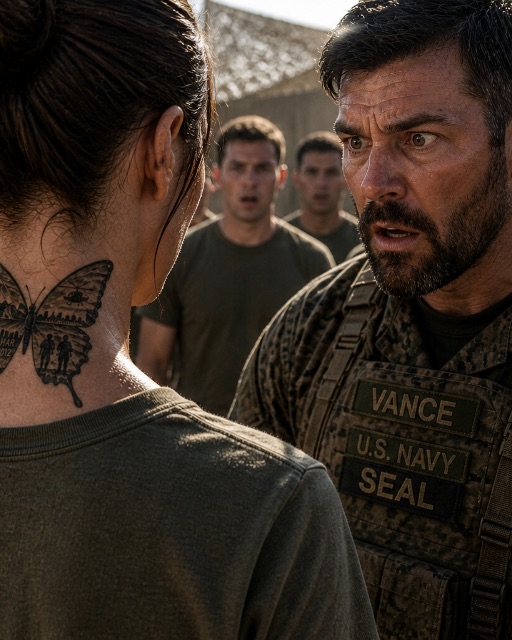
…a map.
Tiny coordinates. Rivers drawn in ink so fine you’d miss them unless you were six inches from her throat. And a date stitched into the bottom wing: 03.14.2014.
I felt the blood drain out of my legs. Every grunt in this country knew that date. The night the convoy burned outside Kandahar. Forty-two men pinned down in a ravine. No air support. No extraction. A massacre on the news for three straight weeks.
Except it wasn’t a massacre. Thirty-eight of those men walked out alive.
And nobody – NOBODY – ever figured out how.
Vance’s voice cracked like a whip. “I was in that ravine, Miller. Bleeding out under a Humvee. I was the radio op who couldn’t reach base.” He took a step toward Miller, and Miller actually flinched. “Do you know who answered my distress call on a frequency that didn’t exist? Do you know who walked three miles through hostile territory, alone, with a busted ankle and a sidearm, to drag my squad leader out of a collapsed building?”
Miller’s mouth opened. Nothing came out.
Casey was staring at her boots again. Same old Casey. Tugging that collar up.
“She was nineteen years old,” Vance said. “Nineteen. And the Pentagon told us she didn’t exist. They told us we hallucinated her. They buried her name so deep even her mother got a folded flag.”
He turned back to Casey, and his voice went soft in a way that made my skin crawl.
“Ma’am. I got the call this morning. They’re reactivating the program.”
Casey finally looked up. And for the first time since she’d shown up at Camp Hawthorne, she smiled. It wasn’t a shy smile. It wasn’t a librarian smile.
It was the smile of someone who’d been waiting ten years for a phone to ring.
“Then you know why I’m really here, Commander,” she said.
Her hand moved to her collar. But this time, she wasn’t hiding the tattoo.
She was pulling out what was underneath it.
And when Miller saw what she was holding, he dropped to his knees right there in the dirt.
It was a dog tag. Scratched, bent, and blackened by soot.
It hung on a simple leather cord, worn smooth with time.
Miller knew that name. Every man in Vance’s old unit knew that name. It was the name of the man they couldn’t save.
SGT. EVANS, ROBERT. A POS.
Sergeant Evans. The squad leader Vance had just talked about. The one they all saw get buried when the roof of that clay hut caved in.
Miller looked from the tag to Casey’s face, his own expression a mess of confusion and awe.
“He… he didn’t make it,” Miller stammered, his voice barely a whisper. “We all saw it.”
Casey’s gaze was steady, her eyes holding a decade of secrets. “I was with him,” she said, her voice quiet but clear. “I was holding his hand when he went.”
She tucked the tag back under her collar, a sacred promise kept close to her heart.
Vance cleared his throat, pulling the focus back to the present. “This isn’t a history lesson, Miller. This is a briefing.”
He turned to both of us, his face grim. “The program is Project Nightingale. An old and very buried initiative for operators with… unique navigational and situational talents.”
He looked directly at Casey when he said it. “Nightingales don’t break doors down. They find the doors no one else can see.”
I watched Miller get to his feet, dusting off his knees but looking profoundly shaken. He was a door-breaker. A man of overwhelming force. This was a language he didn’t understand.
“So why now?” I asked, breaking the tense silence. “Why reactivate it after a decade?”
Vance pulled a tablet from his vest. He swiped the screen and a picture appeared. A young woman with kind eyes and a determined set to her jaw, standing in front of a village in the Hindu Kush mountains.
“This is Sarah Evans,” Vance said. “A freelance journalist. She was on assignment documenting the resurgence of local warlords in the Kunar province.”
He paused, letting the name sink in.
Evans.
My stomach knotted. “Sergeant Evans’ daughter?”
Vance nodded grimly. “The one and only. She was taken two days ago.”
Miller swore under his breath.
“The location is a fortress,” Vance continued, pulling up a satellite image of a village carved into the side of a sheer cliff face. “Zero ground access for a conventional team without starting a war. One road in and out, heavily guarded. Anti-air on the high ground.”
He looked at Casey. “They’re holding her in a place our best minds can’t figure out how to crack.”
Casey didn’t look at the map on the tablet. She lightly touched the tattoo on her throat. She already knew the terrain. It was part of her.
“The Pentagon wants to send in a ghost,” Vance’s voice was low. “Someone who can slip through the cracks. Someone who doesn’t officially exist. If you’re caught…”
“…then I was never there,” Casey finished for him. It wasn’t a question. It was a statement of fact she’d lived with for ten years.
“What’s the twist?” Miller asked, his voice rough. “There’s always a twist.”
Vance hesitated. “This wasn’t just a random kidnapping. Sarah Evans was getting close to something. She sent a coded message to her editor an hour before she was taken. It was one word: Kandahar.”
A chill ran down my spine that had nothing to do with the morning air.
This wasn’t just a rescue. This was about digging up a ghost from that ravine.
“The man who sanctioned this reactivation… the one who specifically requested a Nightingale…” Vance said, his eyes hard. “Director Hastings. He’s the Deputy of Special Operations now.”
Miller’s jaw tightened. “Hastings. He was the intel officer who cleared our route that night in 2014. The one who promised the valley was clear.”
A heavy, sickening silence fell over us. The man whose bad intel got them trapped was now sending Casey in to clean up another mess tied to the same event.
Casey just nodded, a deep, sad understanding in her eyes. “Her father told me about her,” she said softly. “He made me promise that if I ever got the chance… I’d tell her he was proud of her.”
She looked at Vance. “When do I leave?”
That night, they prepped her for insertion. It was the strangest gearing-up I’d ever seen.
No heavy armor. No assault rifle. Just a simple field pack with water, medical supplies, and protein bars. She wore dark, civilian-style hiking clothes. Her only weapon was a small sidearm strapped to her thigh.
Her real weapon was the map on her skin and whatever was happening behind those quiet, observant eyes.
Miller stood by, watching her check her meager equipment. He was quiet, the usual loud certainty gone from him. He finally walked over to her.
“I have to ask,” he said, his voice low enough that only she could hear, but I was close enough to catch it. “Sergeant Evans. Why couldn’t you get him out?”
Casey didn’t flinch. She paused in her work and looked up at him.
“Because he wouldn’t leave,” she said simply. “The building was coming down, and he was pinned. He knew it. He told me to save the others. To use the time I had.”
She met Miller’s gaze directly. “His last order was for me to go. So I did. Sometimes, saving everyone isn’t the mission. Saving who you can… that’s the job.”
Miller just stared at her, then gave a slow, deliberate nod. He finally understood. She wasn’t a failure; she was a soldier who followed the last order of a dying NCO.
A helicopter dropped her ten miles from the target area, in the dead of night. We watched her lone heat signature on the drone feed as she melted into the jagged landscape.
For two days, there was nothing. Just the drone circling, showing us empty rocks and shadows. Vance chain-smoked. Miller paced the command tent like a caged animal.
On the third day, her signal popped up. Not a radio call. It was a simple, encrypted text message sent from a burner phone she must have acquired.
“IN. EYES ON. PATIENCE.”
Vance let out a breath he seemed to have been holding for 48 hours. She was inside the fortress.
We couldn’t see her, but we knew she was there. A ghost in the machine.
Another day passed. Then, a new message came through. It was a garbled audio file, just a few seconds long. It sounded like two men talking in Pashto, their voices muffled.
Our translator worked on it for an hour, cleaning it up.
He came back to the command tent, his face pale.
“The asset… she was close to them,” the translator said. “They are talking about their payment. About who is funding them.”
“And?” Vance demanded.
“They’re not being paid by a rival warlord,” the translator said, reading from his notes. “The funds were wired from an offshore account. An account they say is controlled by an American. They mention his name.”
He looked up at Vance. “They called him Hastings.”
The air in the tent went cold.
Miller stared at the map, his fists clenched. “Son of a bitch,” he whispered. “He didn’t send her in to rescue the girl. He sent her in to get caught.”
It was a setup. A perfect trap. Hastings was sending the one person who could tie him to Kandahar into a place no one could get out of. He was burying his last two problems in one grave.
Vance grabbed the comms panel. “Get me a line to the strike team. I want them ready to move on my command. To hell with the rules of engagement.”
“They’ll never make it in time,” Miller said, his face a mask of fury.
Just then, another message came from Casey. A picture this time.
It was a hand-drawn map of the inside of the compound. A route was marked in red. At the end of the route, a single spot was circled with a time next to it: 0300.
Underneath it, a single line of text.
“Tell Sarah’s story.”
It wasn’t a request for help. It was her final objective. She was going to get the girl out, or die trying, and she was trusting us to burn Hastings to the ground with the truth.
Vance looked at me. “Get that audio file and every message from Casey to the Joint Chiefs. Bypass Hastings’ office. Flag it Level One National Security Threat. Go.”
I ran.
Back in the Kunar province, Casey moved through the shadows. She found Sarah in a cold, damp storage room in the belly of the compound.
The young journalist was scared but defiant. Her eyes widened when she saw Casey.
“Who are you?” Sarah whispered.
“My name is Casey. I knew your father,” she said softly, no time for more. “We’re leaving.”
She handed Sarah a set of dark clothes. “Put these on. Don’t make a sound. Do exactly as I say.”
They moved through the sleeping compound, following the route Casey had mapped. She moved with an unnatural quiet, her feet seeming to know where the loose stones and creaky floorboards were before she stepped on them.
They were almost out when a lone guard rounded a corner. He saw them. His mouth opened to shout.
Casey moved with a speed that was terrifying. She closed the distance in a heartbeat, not with violence, but with a hand on his arm. She spoke to him in fluent, calm Pashto. I learned later she wasn’t threatening him.
She was talking about his family in a nearby village, about the coming winter. She was seeing him, not as a guard, but as a person. He was so stunned, so completely disarmed, that he just stood there, silent, as she and Sarah slipped past him and out into the night.
But their luck had run out. Another patrol spotted them on the cliffs. The night exploded with gunfire.
In the command tent, we saw the muzzle flashes on the drone feed.
“She’s pinned down!” Miller yelled, pointing at a small outcropping of rock where two heat signatures huddled. “They’re trapped.”
It was Kandahar all over again.
But this time, it was different.
Vance was on the comms, ordering the strike team to launch, ignoring the frantic calls from the Pentagon telling him to stand down.
Miller, the man of action, was staring at the satellite map, helpless. But then he saw it.
“Wait,” he said, moving to a different screen. “The drone. Look at her position.”
Casey and Sarah weren’t just hiding. On the ground next to them, Casey had arranged a series of light-colored rocks into a strange pattern. It looked like nonsense.
“What is that?” I asked.
Miller zoomed in. His eyes went wide. “It’s not for us. It’s for the pilot.” He looked at Vance. “The Nightingale program… it wasn’t just about lone operators, was it? It was a network.”
Vance smiled, a grim, tired thing. “The pilots. The comms techs. All trained to see a different kind of signal.”
On the comms, we heard the rescue pilot’s voice, calm and steady. “I see her. Going in low. Tell the birds to give me cover.”
The strike team helicopters roared over the ridge, laying down suppressing fire while the rescue bird, a sleek, dark chopper, swooped down toward Casey’s position with impossible precision.
We watched as the two figures were hoisted up into the belly of the chopper. It lifted off, bullets pinging off its fuselage, and soared into the safety of the dark sky.
When Casey and Sarah landed back at our base, the sun was rising. Sarah ran into the arms of the embassy staff, safe.
Casey just stood on the tarmac, looking tired but whole. Miller walked right up to her. He didn’t say a word. He just raised his hand in a slow, perfect salute.
He held it there, his eyes locked on hers, until she gave a small, appreciative nod.
The fallout was immediate. Director Hastings was arrested before breakfast. The audio file Casey had sent was undeniable. Faced with charges of treason and murder, he confessed everything. He sold the convoy’s position in Kandahar for a promotion, and he kidnapped Sarah Evans to cover his tracks.
Two weeks later, Camp Hawthorne was being packed up. The mission was over.
I saw Casey standing by herself near the perimeter fence, looking out at the mountains. She was no longer an operator or a ghost. She was just a woman in a dusty landscape.
I walked over and stood beside her.
“What now?” I asked.
“I have a library card that’s ten years expired,” she said with a small smile. “I think I’ll start there.”
She had refused every medal, every commendation. She didn’t want a parade. Her name would be buried again, this time at her own request.
Sarah Evans’ story was published on the front page of every major newspaper. She didn’t just write about the warlords; she wrote about her father. She wrote about a system that creates heroes and then erases them. She wrote about a nineteen-year-old angel in a ravine. She told her father’s story, and in doing so, she told Casey’s.
As Casey turned to leave, she paused and pulled the dog tag from under her collar. She looked at it for a long moment.
“He asked me to give this to her,” she said, holding it out to me. “I think she’s earned the right to carry it now. My promise is kept.”
I took the tag from her hand. Her job was done.
Watching her walk toward the transport plane, I finally understood the lesson. It wasn’t about the heroes we see on TV or the ones with statues built in their honor.
The most profound strength, the most incredible courage, often comes from the quietest people. The ones who do the impossible not for a flag or a medal, but for the person right in front of them, for a promise made in the dark. They are the ghosts in our history, the nightingales in the storm. And their silence is the most powerful story of all.



