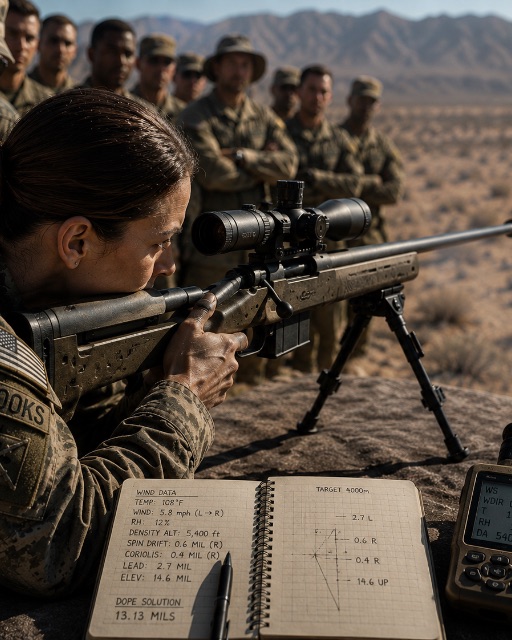
The Arizona sun was brutal. The steel targets sat 4,000 meters out – almost two and a half miles of shimmering, lying air.
Thirteen of the Army’s best marksmen had already fired. Thirteen bullets vanished into the desert like they’d never existed.
General Wendell Carter lowered his sunglasses. Hundreds of soldiers stood frozen in the dust, nobody daring to breathe.
“Any snipers still left?” he barked.
Silence. Nobody wanted to be number fourteen.
Then a voice. Soft. Almost apologetic.
“May I take a shot, sir?”
Every head snapped around. It was Captain Darlene Brooks. The supply officer. The woman famous for her perfect inventory sheets and being first to the coffee pot at 0500.
A few men actually laughed.
The General didn’t. He just nodded once.
Darlene walked to the line. The rifle looked too heavy in her hands. She pulled a small, beat-up notebook from her jacket pocket – pages yellowed, edges soft from years of handling.
She didn’t look at the target. She looked at the air. The heat ripples. The way the dust moved sideways three hundred meters out. The mirage climbing off the rocks.
One breath. One trigger pull.
CLANG.
The sound came back through the heat like a bell. Clean. Impossible.
The formation didn’t cheer. They couldn’t. They were staring.
The General walked up to her slowly, his boots crunching in the silence. He looked at the notebook still open in her hand – and his face went white.
“Captain,” he said, his voice suddenly shaking. “Where did you get this notebook?”
Darlene finally looked up at him. “From the man whose name is on the cover, sir.”
The General turned the notebook toward the soldiers. And when they saw the name written on the inside flap, three officers in the front row took off their hats.
On the worn leather flap, in faded but clear handwriting, was the name: Sergeant Major Thomas ‘Ghost’ Callahan.
A collective gasp rippled through the front ranks. The younger soldiers just looked confused, but the older NCOs and officers stood straighter.
These were men who knew the legends. Stories told in hushed tones in barracks after midnight. Thomas Callahan wasn’t just a sniper; he was a myth. A man who could read the wind like a book and calculate drop and drift in his head faster than a computer.
He was a whisper in the history of Special Forces, and he’d been dead for fifteen years.
General Carter gently closed the notebook, his hand trembling slightly as he handed it back to Darlene.
“Walk with me, Captain.”
It wasn’t a request.
Darlene fell into step beside him, the massive rifle now feeling even heavier. They walked away from the stunned formation, toward the General’s command tent flapping in the hot breeze.
The silence between them was thick with unasked questions.
Inside the tent, the air was a little cooler. A map of the training area was spread across a folding table.
The General turned to her, his face a mask of confusion and something that looked like pain. “I need you to tell me everything, Captain Brooks. No omissions.”
“He was my father, sir,” Darlene said, her voice steady.
The General sank into a camp chair as if his legs had given out. “Thomas… had a daughter?”
“He did, sir. He raised me himself.”
“But… why are you a supply officer?” The question was blunt, born of pure disbelief. “With a skill like that, you could have written your own ticket in any combat unit in the world.”
Darlene set the heavy rifle down and placed the notebook on the table with reverence. She ran a finger over her father’s name.
“It’s because of him that I’m a supply officer, sir. Not in spite of it.”
She looked up, and for the first time, the General saw the ghost of Thomas Callahan in her eyes. It wasn’t just the focus; it was a deep, quiet sadness.
“My father taught me how to shoot, yes. From the time I was big enough to hold a .22 without falling over.”
“He taught me how to read the spin of a falling leaf. How to feel the change in humidity on my skin. How to watch a mirage and know exactly what lie it was telling me.”
“That shot out there,” she gestured vaguely toward the range, “that wasn’t my shooting. It was his math. His observations. His life’s work, all in that little book.”
The General stared at the notebook like it was a holy relic. “I knew him, you know. We came up together. He was my Sergeant Major in Afghanistan.”
Darlene’s expression softened. “He mentioned you in his letters. Lieutenant Carter, back then. The ‘good-hearted FNG who might just make it.’”
A weak, sad smile touched the General’s lips. “He really said that?”
“He did. He said you listened. That was the highest compliment he could give an officer.”
The smile faded from the General’s face. He looked down at his hands, his knuckles white. “I was there, Captain. The day he… the day we lost him.”
His voice dropped to a choked whisper. “I’m the one who sent him on that last mission.”
Darlene remained silent, letting him speak. The tent was suddenly a confessional.
“It was supposed to be simple. Overwatch for a snatch-and-grab. High-value target in a village in the Kunar Province. Standard stuff for him.”
“We had intel the target was there. Callahan set up on a ridge about 2,000 meters out. He was just supposed to be our eyes and ears, provide cover only if everything went to hell.”
“But it never even started,” the General continued, his gaze lost in the past. “Before my teams were even in position, we heard a single shot from Callahan’s position. And then nothing. Silence.”
“The enemy was alerted. The whole village lit up. We had to scrub the op and pull back. We searched for him for three days. Found his position. Found the spent casing. But no Callahan.”
He finally looked up at Darlene, his eyes filled with a guilt that was fifteen years old. “He was listed as missing, presumed captured. A year later, declared killed in action.”
“I sent him there, Captain. I sent the greatest marksman we ever had on a simple mission, and he vanished. We never got the target. We never found your father. My career moved on. I made General. But I’ve carried that failure every single day.”
Darlene reached into her jacket pocket again. This time, she pulled out a worn, folded envelope.
“You’ve been carrying the wrong story, General,” she said softly.
She opened the envelope and carefully unfolded a single, brittle page. It was a letter, the handwriting a perfect match to the scrawl on the notebook.
“This was tucked into the last page of his journal. A friend of his in the mail room knew to send it to me if he didn’t come back to claim it.”
She cleared her throat and began to read.
“My Dearest Darlene,” she began, her voice catching for just a moment. “If you’re reading this, it means I’ve gone to see the great range in the sky. Don’t you be sad. A soldier knows the risks. I lived a fuller life than most, and the best part of it was you.”
“I need to tell you about today. The brass, including your friend Lt. Carter, think I’m watching a bad guy named Omar. They’re not wrong, he’s here. But they don’t see the whole picture.”
“From up here on this ridge, Darlene, I can see everything. It’s what I always taught you. Don’t just look at the target. Look at the whole world around it.”
“There’s a school in the village. It’s not a school for fighters. It’s a school for children. About forty of them. And there’s a man here who is not on anyone’s list. He’s got a truck full of artillery shells rigged to a timer. He’s not with Omar’s crew. He’s something else. Something worse.”
The General leaned forward, his elbows on his knees, his face a study in dawning horror.
Darlene continued reading, her voice gaining strength.
“He’s going to wait for the American raid to start, and in the chaos, he’s going to detonate that truck. The target, Omar, is just bait. The real plan is to kill those kids and blame it on the Americans. To turn the whole province against us for a generation.”
“The timer on the bomb is old. Mechanical. I can see it through my scope. I have one chance to stop it. Not to disarm it. To destroy the trigger mechanism with a single shot.”
“It’s a one-in-a-million shot, pumpkin. 2,000 meters. Wind is tricky in this valley. And the timer is behind a dirty piece of plexiglass. But you and I know, one-in-a-million is still a chance.”
“Here’s the problem. If I take that shot, everyone will know I’m here. Omar’s men will swarm this ridge. I won’t make it out. And worse, young Carter will be blamed for a ‘failed’ mission. They’ll say the Ghost got spooked and fired early. They might even ruin his career over it.”
“I’ve made my choice. I’m going to save those kids. And I’m going to protect that good-hearted Lieutenant. I’m going to take the shot, and then I’m going to disappear. Let them think I was captured. It’s better that way. No one gets blamed. A soldier’s sacrifice is quiet, or it’s just noise.”
“Live a good life, Darlene. Find a way to serve that builds things, not just breaks them. Be the person who makes sure the soldiers have what they need. Look after them. That’s a kind of overwatch, too. Know that your old man loved you more than all the stars in the sky. Don’t just be a good shot. Be a good person. That’s the only target that matters.”
“Love, Dad.”
Darlene folded the letter carefully. The only sound in the tent was the General’s ragged breathing.
Tears were streaming down his face, silent and unashamed. He wasn’t mourning a failure anymore. He was mourning a friend. A hero.
“He saved them,” the General whispered. “He saved those kids. And he saved me.”
He looked at Darlene, truly seeing her for the first time. Not as a supply officer. Not as a secret sharpshooter. But as the living legacy of the best soldier he had ever known.
He finally understood. She wasn’t hiding in the supply corps. She was honoring her father’s last wish. Looking after the troops. Building things. Being a good person.
General Carter stood up, wiping his face with the back of his hand. He walked to the tent’s entrance and bellowed, “Sergeant Major!”
His senior NCO rushed over. “Sir!”
“Get every man on this base back in formation on the main parade ground. Five minutes.”
“Sir!”
Minutes later, the entire post was assembled. The sun was beginning to dip lower, painting the sky in hues of orange and purple.
General Carter stood before them, with Captain Darlene Brooks by his side.
“Today,” the General began, his voice booming with a new, clear authority, “you all witnessed an extraordinary feat of marksmanship.”
“Some of you laughed when a supply officer stepped up to the line. You saw a captain’s rank and a logistics insignia. You didn’t see the soldier.”
“This is Captain Darlene Brooks. And yes, she hit a target from 4,000 meters. But that is the least important thing you should know about her.”
He paused, letting his words hang in the evening air.
“She is the daughter of Sergeant Major Thomas ‘Ghost’ Callahan.”
A wave of murmurs washed over the formation. This time, there was no confusion.
“Fifteen years ago, I was the officer who sent Sergeant Major Callahan on his final mission. For fifteen years, I believed that mission was a failure. I believed his life was wasted because of my orders. Today, I learned the truth.”
The General’s voice was raw with emotion, but it never wavered.
“Sergeant Major Callahan did not fail. He identified a threat no one else saw. He willingly and knowingly sacrificed his own life to save over forty innocent children, and in the process, protected the honor of the United States Army and his commanding officer.”
“He was a hero in the truest sense of the word. His last action was not for a medal, or for glory, but because it was the right thing to do. His memory will be submitted for the highest honors.”
He then turned to Darlene.
“Captain Brooks has honored her father’s legacy not by seeking the spotlight, but by quietly serving, just as he asked her to. She has been our overwatch all along, making sure we have the supplies we need, the support we count on.”
“Effective immediately, Captain Brooks is being reassigned. She will not be a sniper. She will be an instructor.”
“She will head a new program at the Advanced Marksmanship School. It will not be about pulling triggers. It will be called ‘The Callahan Method.’ It will teach our next generation of leaders how to see the whole picture. How to value observation over action. How to understand that the most important targets are often the ones you’re not assigned to.”
He unpinned the silver oak leaf from his own collar. He walked over to Darlene, who stood with tears in her eyes.
“The Army owes your family a debt it can never repay,” he said, his voice now soft enough for only her to hear. “But we can start by recognizing its legacy.” He pinned the insignia, promoting her to Major on the spot.
“Go make them see, Major Brooks.”
Darlene saluted, her hand crisp and steady. “I will, sir.”
A real smile, bright and full of hope, finally reached her eyes.
The story ends not with the clang of a bullet hitting steel, but with the quiet, profound ripple of a life well-lived. It reminds us that greatness isn’t always loud. Sometimes, it’s in the quiet dedication of a supply officer, the faded ink of a father’s last letter, or the lifelong burden of a friend’s sacrifice, finally understood. True strength is not just about hitting the target, but in knowing which targets truly matter.