
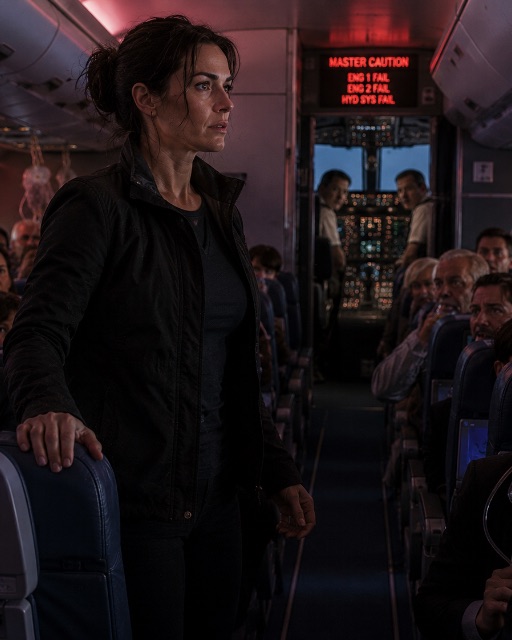
I don’t talk on planes. Haven’t in years. Twenty years of flying missions that don’t exist will do that to you.
I was in 14C. Black jacket, white sneakers, backpack under the seat. The guy next to me never even glanced my way. Good. That’s how I like it.
Call sign: PHANTOM. Colonel, United States Air Force. Retired on paper. Never retired up here.
I felt it before anyone else did.
Not turbulence. Something deeper. The kind of shudder that tells you metal is failing. I’ve felt it in cockpits over places I’m not allowed to name.
Then the engines went quiet.
Not quiet like throttle-back. Quiet like dead.
The lights cut to emergency red. Masks dropped. A woman screamed. Kids wailed. The businessman beside me turned gray and started whispering prayers into his laptop.
I closed my eyes. Three seconds. That’s all I needed.
Boeing 777. Dual engine flameout. Hydraulic leak – I could feel it in the sluggish yaw. We were dropping at four thousand feet per minute. At this altitude, we had roughly eight minutes before the Atlantic swallowed all 236 of us.
The flight attendants were frozen near the galley. I could see it in their faces – they knew.
I unbuckled my seatbelt and stood up.
The businessman grabbed my arm. “Lady, sit down, we’re going to – ”
I pulled free without a word and walked to the cockpit door. A flight attendant blocked me, shaking. “Ma’am, you can’t – ”
I leaned in close and said the first words I’d spoken in seven hours: “I’m Colonel Sarah Mitchell, USAF. I have four thousand hours in heavy aircraft. Your pilots are losing this plane. Open the door or we all die in six minutes.”
She opened it.
The cockpit was chaos. Captain Miller was white-knuckling the yoke with both hands, getting almost nothing back. His First Officer was cycling through checklists with shaking fingers, skipping steps.
“Gentlemen,” I said, calm as Sunday morning. “I’m taking comms. You fly what’s left of this aircraft. I’ll get us help.”
Miller looked at me like I was a hallucination. But he didn’t argue. When a voice carries that kind of authority, you don’t.
I grabbed the radio. Switched to guard frequency – 121.5. The one every military aircraft in the world monitors.
“Any station, any station, this is PHANTOM on guard. Mayday, mayday, mayday. Civilian heavy, Flight 742, dual engine flameout, hydraulic failure, descending through flight level two-eight-zero, two hundred thirty-six souls, requesting immediate assistance.”
Static. Two seconds. Three.
Then a voice crackled back. Young. Southern accent. An F-16 pilot out of Langley, flying a routine patrol.
“PHANTOM, Viper One-One. Say again your call sign?”
“You heard me, Viper. PHANTOM. Look me up later. Right now I need you to relay to New York Center and get me the nearest divert field with a runway over nine thousand feet. We have no thrust and partial flight controls. We are a glider.”
Dead silence on the frequency.
Then another voice. Older. The flight lead. “PHANTOM… the PHANTOM?”
“The one and only. Clock’s ticking, son.”
What happened next — the scramble, the vectors, the impossible turn I talked Miller through using nothing but trim and gravity — that got classified faster than anything I’ve ever been part of.
But here’s what no one reported. What the F-16 pilots won’t talk about on record.
When they pulled alongside us at twelve thousand feet, close enough to see into the cockpit, they expected to see the captain in the left seat fighting for control.
Instead they saw a woman in a worn black jacket, standing between two pilots, holding a radio in one hand and pointing out the windscreen with the other — guiding a dead aircraft toward a runway she couldn’t even see yet.
Viper One-One keyed his mic one last time before we touched down.
What he said made every controller in New York Center go silent.
He said: “Tower… you’re not going to believe who’s flying this plane. She’s not even in the seat. She’s… she’s conducting it. Like an orchestra.”
It was the best description I’d ever heard. The plane was an instrument, and gravity was the music.
“We need to drop the gear, Colonel,” Miller grunted, sweat beading on his forehead. “We’re running out of altitude.”
“Not yet,” I said, my eyes fixed on the distant line of the coast. “We need every bit of glide. We drop it at five hundred feet. No sooner.”
The First Officer looked at me, his face pale. “Manual release might not even work.”
“It will work,” I said, not because I was sure, but because they needed me to be.
The F-16s were our guardian angels, our external sensors. “PHANTOM, Viper Lead. Airspeed is one-niner-zero knots. You’re holding steady. Runway is twelve miles out, dead ahead.”
“Copy, Viper. Tell them to have the field to themselves. We’re coming in hot and we won’t be stopping pretty.”
The silence in the main cabin must have been deafening. The gentle hum of a normal flight replaced by the unnerving whistle of wind over the wings.
I could feel the life of every person on that plane behind me. A weight heavier than any G-force I’d ever pulled.
We passed over the coastline. The runway at Naval Air Station Oceana was a perfect, beautiful black stripe. Cleared and waiting.
“Five hundred feet,” the Viper pilot called out from his cockpit a hundred yards away.
“Now,” I ordered. “Drop the gear.”
The First Officer pulled the manual release handle. A gut-wrenching clunk echoed through the airframe, followed by the roar of the landing gear locking into place against the wind.
The drag was immense. The nose pitched down hard.
“Hold her!” I yelled at Miller. “Use your trim! Fly the nose, not the plane!”
He fought the yoke, his knuckles white, muscles straining. He was a good pilot, just shell-shocked. He just needed someone to point the way.
We crossed the runway threshold. Far too fast.
“Brace,” I said into the radio, a final, calm command to the pilots.
The impact was violent. A bone-jarring slam as the rear wheels hit the tarmac.
Tires exploded like gunshots. The plane veered hard to the left, metal screaming as the wingtip threatened to dig into the ground.
“Right rudder! Full right rudder now!”
Miller stomped on the rudder pedal with everything he had. The massive aircraft straightened, skidding and groaning down the runway, a comet of sparks trailing behind us.
It felt like an eternity. We slid past the halfway point, then the two-thirds mark. We were running out of asphalt.
Finally, with a final, grinding shudder, the ruined Boeing came to a stop just feet from the end of the runway.
For a moment, there was only silence. The sound of our own ragged breathing in the cockpit.
Then, the distant wail of sirens growing closer.
It was over.
Captain Miller slumped over the yoke, utterly spent. The First Officer was just staring into space, his hands shaking uncontrollably.
I gave one last look out the window at the flashing lights of the emergency crews. Then I turned.
“You’re okay, gentlemen. You did good,” I said quietly.
I stepped out of the cockpit, closing the door behind me.
The cabin was a scene of chaos and relief. People were crying, hugging, shouting into their phones.
No one looked at me. I was just another passenger.
I walked back to 14C. The businessman was staring at the now-empty cockpit door, his face a mask of utter astonishment. He saw me and his mouth opened, but no words came out.
I simply picked up my backpack, slung it over my shoulder, and got in line.
Emergency slides were inflated. Firefighters and medics were coming aboard.
I went down the slide like everyone else, my white sneakers hitting the tarmac. I melted into the crowd of shaken survivors being herded towards waiting buses.
Someone put a blanket around my shoulders. I took it, then let it slip off a moment later, letting it fall to the ground.
I kept walking, right past the buses, towards the base gate. A young Marine guard tried to stop me.
I didn’t break my stride. I just showed him my retired military ID. He saw the rank, the name, and his eyes went wide. He snapped a salute and opened the gate.
I walked out into the Virginia night and never looked back.
The story exploded, of course. “The Angel of Flight 742.” News channels ran speculative segments. The FAA and the NTSB were desperate to debrief the “unidentified female passenger.”
The Air Force issued a single, terse statement: “All military personnel, active and retired, are bound by a duty to act in a crisis. The matter is under review.”
It was a wall of silence. My entire career was built inside walls like that.
I went home. To my small house on a quiet street in a town you’ve never heard of. My life was simple now. I had a dog, a small garden, and a volunteer shift at the local animal shelter.
It was the peace I had fought for. The peace I craved after a lifetime of noise.
Two weeks later, a sleek black car pulled up to my curb. A man in a tailored suit got out. It was the businessman from 14B.
He stood on my porch, looking nervous. I opened the door before he could knock. My dog, a scruffy terrier mix named Gus, growled softly at my feet.
“Colonel Mitchell,” he said. His name was Arthur Vance. He was the CEO of some massive tech conglomerate. “It took me a while to find you. The Air Force was… not helpful.”
“They’re trained not to be,” I said. “What do you want, Mr. Vance?”
“I wanted to thank you,” he said, his voice thick with emotion. “You saved my life. You saved all our lives. I wanted to… I don’t know. Reward you. There’s a foundation, I can…”
“I don’t want a reward,” I cut him off, my voice gentle but firm. “I did what anyone in my position would have done.”
“No,” he insisted, shaking his head. “They don’t. I’ve seen it. People freeze. People panic. You didn’t. You walked into that cockpit and took control. Then you just… vanished. I have to know why.”
I sighed and stepped aside. “Come in, Mr. Vance. Gus, be nice.”
I made us coffee in the kitchen. He sat at my simple wooden table, looking out of place in his expensive suit. His eyes scanned the room, taking in the quiet modesty of it all.
He was looking for an answer. An explanation for the woman who could command a falling skyscraper from the sky and then return to a life of potting soil and rescue dogs.
His gaze landed on the mantelpiece over the small fireplace.
On it was a single framed photograph. A young man with my eyes and a confident smile, wearing the flight suit of an Air Force pilot.
“My son,” I said, my voice barely a whisper. “Second Lieutenant Daniel Mitchell.”
Arthur stood up and walked over to it, studying the photo.
“He was a pilot, too,” Arthur stated, more than asked.
“The best I ever knew,” I said, a familiar ache blooming in my chest. “Better than me.”
I continued, the words coming out slowly, painfully. “He didn’t die in combat. There was no enemy fighter, no surface-to-air missile. He died five years ago during a routine training flight over Texas.”
“A mechanical failure in his T-38 Talon. A faulty actuator in the hydraulic system. He lost control. The investigation was… brief.”
I walked over to a small desk and pulled out a worn file folder. “The contractor that supplied the part deflected blame. They hinted at pilot error. It was cleaner for the Air Force. Cheaper for the company. My son, a kid who could fly a plane before he could properly drive a car, had his legacy tainted to save a few dollars and a corporate reputation.”
Arthur took the folder from my hands. He opened it, his eyes scanning the official reports, the letters I’d written, the stonewalled replies.
He stopped on the name of the aerospace contractor. He stared at it for a long, silent moment.
I watched as the color drained from his face. His expression shifted from gratitude to confusion, and then to a dawning, sickening horror.
He looked from the paper, to my face, then back to the paper.
“Vantage Aerospace,” he breathed. “I… I acquired them. Three years ago. They’re a subsidiary of my company.”
The air in the room grew heavy and cold.
Here was the man whose life I had saved. The man whose company, in a previous life, had been responsible for shattering my own. The universe, in its strange and terrible wisdom, had placed us side-by-side on a falling plane.
He sank back into the chair, looking utterly broken. “I never knew,” he whispered. “God, Sarah, I never knew.”
I didn’t answer. I just stood there, the grief of five years washing over me again. It wasn’t his fault, not directly. But the cosmic irony was crushing.
He spent the next hour at my table, reading every document, every letter. When he was done, he closed the folder carefully.
“This is not a reward,” he said, his voice hard as steel. “This is a debt. And it will be paid.”
Arthur Vance left my small house a different man than the one who had arrived. The mission of gratitude had become a mission of atonement.
He didn’t offer me money again. He didn’t offer me a new house or a car. He offered me the one thing I truly craved. Justice.
He disappeared from the public eye for a month. When he resurfaced, it was with an earthquake.
He launched a brutal, no-holds-barred internal audit of the Vantage Aerospace acquisition. He hired the best independent investigators money could buy, empowering them to dig through every record, every email, every falsified report from years past.
He found it all. The cover-up. The emails discussing the cost-benefit analysis of recalling the faulty actuator versus the risk of failure. The hushed settlement with another family. The deliberate smearing of my son’s record.
Then he did something no CEO in his position would ever do. He went public.
He held a press conference. He didn’t just announce a recall. He confessed. He laid out the entire sordid tale of corporate malfeasance, naming the executives who had signed off on it, some of whom were still with the company.
He announced he was firing them all, voiding all their severance packages, and establishing a multi-million-dollar fund for the families affected by the faulty parts.
Most importantly, he publicly cleared Daniel’s name, reading a personal, heartfelt apology to me and to the memory of my son. He spoke of Daniel’s skill, his promise, his sacrifice.
The story was no longer about the “Angel of Flight 742.” It was about a corporation doing the right thing, no matter the cost to its stock price. My name was never mentioned. Arthur protected my privacy fiercely, referring to me only as “the hero who taught me the meaning of integrity.”
The Air Force, faced with irrefutable proof, officially re-opened the investigation. Weeks later, they posthumously awarded Second Lieutenant Daniel Mitchell the Air Force Commendation Medal for his skill in trying to save an uncontrollable aircraft. His record was not just cleared; it was celebrated.
Months later, I stood before the Air Force Memorial in Arlington. Its soaring silver spires reached for the sky, a tribute to the men and women I had served alongside.
I found his name etched into the granite. I traced the letters with my fingers. Daniel Mitchell. For the first time in five years, it felt whole. The ache in my chest was still there, but it was no longer a wound. It was just a space, filled now with peace.
I felt a presence behind me and turned. It was Arthur, standing a respectful distance away. He wore a simple coat, not a business suit.
He didn’t say a word. He just gave me a small, solemn nod.
I nodded back.
In that quiet moment, between a grieving mother and a changed man, the balance was restored. My actions on that flight were not for glory or reward. They were an echo of a life of service. But the universe had answered back, not with fame, but with something far more precious.
It brought me justice. It brought me peace. It brought my son home.
The greatest rewards in life aren’t the ones you seek, but the ones that find you when you’ve done the right thing, simply because it was the right thing to do.



