
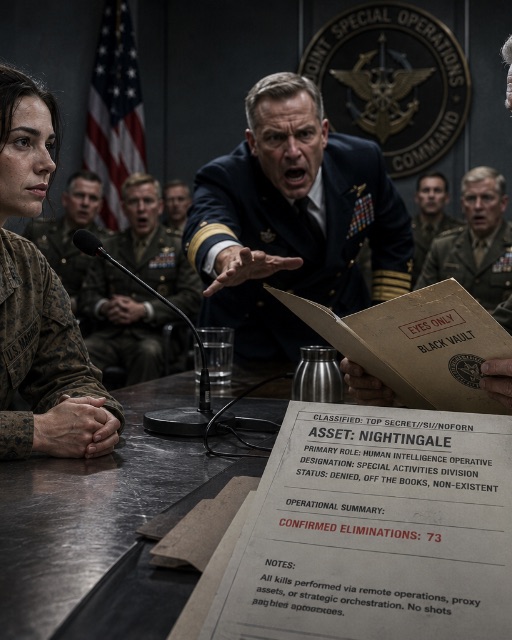
Staff Sergeant Mara Vale sat alone at the metal table. No medals on her chest. No lawyer by her side. Just a young woman in a uniform that looked two sizes too big for her.
General Brenda Vance smirked at the cameras. He thought this tribunal was a joke. He wanted to humiliate her on live feed.
“Let’s get this over with,” the General chuckled, leaning into the mic. “So, Sergeant… what’s your confirmed kill count? One? Maybe two?”
The other officers laughed. They expected her to stare at the floor.
Mara didn’t blink.
“Seventy-three,” she said.
The laughter died. The room went ice cold.
“Excuse me?” The General’s smile cracked. “Seventy-three? That’s impossible. You’re an analyst. You push paper.”
Mara leaned forward. Her voice was flat. Almost bored.
“I didn’t say I shot them, General.”
In the back row, a 4-star Admiral who hadn’t moved in three hours suddenly kicked his chair back so hard it hit the wall.
“CUT THE FEED!” he roared, lunging at the stenographer. “Shut it down! NOW!”
The General froze. “Admiral? What the hell is going on?”
The Admiral slammed a redacted folder onto the desk. His hands were shaking. Actually shaking.
“You idiot,” he hissed. “This hearing was never supposed to happen. Do you have ANY idea what she is?”
The General’s fingers trembled as he opened the folder. He read the first line. The color drained from his face.
He turned the page.
And when he saw HOW she got those 73 kills – the method, the locations, the names on that list – he dropped the file like it had burned him.
He looked up at the quiet young woman across the table. And in a voice barely above a whisper, he said…
“My god. You’re not a soldier. You’re a…”
The word caught in his throat, a suffocating knot of disbelief and horror. He couldn’t say it.
Admiral Peterson slammed the door shut behind the last panicked technician, leaving only the three of them in the silent, cavernous room. The red ‘ON AIR’ light flickered once, then died.
“She’s a whisper,” the Admiral finished for him, his voice low and dangerous.
General Vance just stared, his mind refusing to connect the dots. “A whisper? What is that, some kind of code name for an assassin?”
The Admiral shook his head, a look of profound disappointment on his face. “You command armies, Vance, but you don’t understand the first thing about real warfare.”
He gestured toward Mara, who still hadn’t moved. She watched them both with an unnerving calm, like a doctor observing a strange new species.
“This is Sergeant Mara Vale, head analyst and lead operator for Project Nightingale,” the Admiral said.
Vance had never heard of it. That alone was terrifying. He was on the Joint Chiefs’ strategic committee. He was supposed to know everything.
“Project Nightingale doesn’t eliminate targets, General,” the Admiral continued, his voice dropping even lower. “It redeems them.”
Vance blinked. “Redeems them?”
“That number,” the Admiral stabbed a finger toward Mara. “Seventy-three. That’s not a kill count. It’s a save count.”
Mara finally spoke again, her voice still without any hint of emotion. It was the voice of pure data.
“The term ‘kill’ is internal jargon, General. It refers to the termination of a threat. We just have a different definition of ‘termination’.”
Vance picked up the file again, his hands no longer trembling but numb. He flipped through the pages, really looking this time.
Each entry had a name, a high-value target. Warlords, bomb-makers, terrorist financiers. People he had personally signed off on drone strikes for.
Next to each name was a summary. Not of an operation, but of a conversation.
He saw transcripts of encrypted chats. Voice analyses. Psychological profiles built from fragments of their digital lives.
Mara wasn’t kicking down doors. She was finding cracks in souls.
“You… talk to them?” Vance whispered, the idea so alien to his world of shock and awe.
“I listen,” Mara corrected gently. “And then I talk.”
“Project Nightingale is the single most effective and most secret intelligence program we have,” the Admiral explained. “Sergeant Vale here can take a man who has sworn to die for his cause and convince him to live for something better.”
“She finds their leverage,” the Admiral said. “Not a family member to threaten. A memory. A regret. A lost dream.”
He pointed to one name on the list. “Commander Khaleel, ‘The Butcher of Al-Khaf’. Responsible for over 200 coalition casualties. We were weeks away from a strike that would have leveled a whole village to get him.”
The Admiral looked at Mara. “Tell him what you did.”
Mara’s eyes seemed to look past the General, into a memory. “His profile was a wall. No vices. No fear. Pure ideology.”
“But everyone has a beginning,” she said. “I spent four weeks digging. I went through his childhood school records, his late mother’s social media, everything.”
“I found a photo. Him, as a boy, no older than ten. He was holding a small, hand-carved wooden bird.”
Vance frowned. “A bird?”
“I ran pattern analysis on the carving style,” Mara continued, her voice matter-of-fact. “It matched the folk art from a specific mountain province, one his family had fled during a civil war.”
“It was his only connection to a time before the hate. A time his father was still alive, teaching him to carve.”
The Admiral took over. “She got a message to him. No threats. No demands. Just a single, high-resolution image of that same kind of wooden bird, resting on a windowsill.”
“He ghosted his network for a week,” Mara said. “When he came back online, he replied with one character: ‘?’.”
“That was the opening. That’s always the opening,” she explained. “The moment they ask ‘why’. The moment they show a flicker of the person they used to be.”
“We talked for six months. Not about war. About woodworking. About the smell of pine trees. About his father.”
“And then what?” Vance demanded.
“Last month, Commander Khaleel and twelve of his senior lieutenants walked into one of our embassies and surrendered,” the Admiral said flatly. “They brought with them intelligence that dismantled their entire network across three countries. It saved a C-130 full of our people from being shot down.”
Vance sank into his chair. His entire concept of warfare, of strength, was dissolving. He had measured power in destructive force. Mara measured it in salvaged humanity.
“The seventy-three names in that file aren’t corpses, General,” the Admiral hissed. “They are assets. They are men and women who have laid down their arms because this Sergeant showed them a better way. She has saved more lives with a keyboard and a telephone than you have with an entire carrier group.”
“Then why is she here?” Vance asked, his voice cracking. “This tribunal… I called it. For insubordination. She refused a direct order to transfer a data set.”
“The data set was the personal correspondence of a potential subject,” Mara said calmly. “It was against protocol to share it on an unsecure network. I was protecting the integrity of the program.”
“You were protecting a terrorist!” Vance shot back, a flash of his old self returning.
“I was protecting a person,” Mara replied, her gaze unwavering. “My work depends on trust, General. On the belief that redemption is possible. If I break that trust, even once, Project Nightingale fails.”
The room fell silent again. The weight of it all pressed down on General Vance. The fast-tracked promotions, the accolades from the highest offices, the quiet respect from people like Admiral Peterson. It all made a horrifying kind of sense now.
She wasn’t a paper-pusher getting a leg up. She was a national treasure being hidden in plain sight.
And he, in his arrogant ignorance, had tried to break her. He had put the most sensitive human intelligence program in the world on a live feed because his pride was wounded.
The Admiral’s face was grim. “This hearing gets buried. The records will be wiped. You will personally recommend Sergeant Vale for the Distinguished Service Medal. And then, Vance, you will pray that your career survives this.”
Vance could only nod, his throat too tight to speak.
He looked at Mara, really looked at her. He saw the faint dark circles under her eyes, the tension in her shoulders that wasn’t there before. This wasn’t a desk job. It was carrying the weight of seventy-three broken souls and trying to piece them back together. It was a burden he couldn’t possibly imagine.
“There’s one more thing you need to know, General,” the Admiral said, his voice softening just a fraction.
He slid another, much thinner file across the table. It wasn’t blacked out. It had a single name on the cover.
It was a name General Vance knew well.
It was his own son.
“No,” Vance breathed, his heart stopping. He snatched the file.
His son, Daniel, had dropped out of college two years ago. He’d fallen in with a radical anti-government group online. He cut off all contact with his family. Vance had used all his resources to find him, but Daniel had vanished.
Six months ago, Daniel had shown up on his doorstep. Thin, tired, but… clear. The anger was gone from his eyes. He had apologized, cried, and started the slow process of coming home.
He’d told Vance he just “woke up one day and realized what a fool he’d been.”
Vance opened the file. It contained a different kind of transcript. Chats from a gaming forum. Discussions on encrypted message boards.
And then, a new voice entering the conversation. Someone calm. Someone who didn’t argue, but asked questions.
Someone who talked to Daniel not about his anger at the world, but about the fishing trips he used to take with his dad. About the dog they had when he was a boy.
Vance read the words, and he could almost hear them in Mara’s quiet, steady voice.
He saw the turning point. Daniel, full of rhetoric and fury, had typed: “This whole system needs to burn to the ground. There’s nothing left to save.”
The reply came a few minutes later. “Maybe you don’t have to save the whole system. Maybe you just have to save one part of it. What’s the one good thing you remember?”
Daniel hadn’t replied for a day.
His next message was a single word: “Fishing.”
The file detailed how Mara, operating under a pseudonym, had spent two months talking Daniel Vance down from the ledge. She had systematically and gently dismantled the ideology of hate he’d been wrapped in, not by telling him he was wrong, but by reminding him of the person he was before.
She had never mentioned his father, the General. She had just used the simple, powerful memory of a boy and his dad by a lake.
She was Subject #68. His own son. The “kill” before Commander Khaleel.
The file slipped from the General’s fingers. He looked at Mara, and for the first time, saw her not as a soldier, not as a whisper, but as a human being who had reached into the darkness and pulled his son back.
Tears welled in Brenda Vance’s eyes. The crushing weight of his arrogance, his pride, his monumental, catastrophic mistake, broke him.
He stood up, his tall, decorated frame seeming to shrink. He walked around the table and stood before the young Sergeant.
“Sergeant Vale,” he began, his voice thick with emotion. He stopped, cleared his throat, and tried again.
“Mara.”
He took a shaky breath. “I… I have been a fool. A proud, blind fool.”
He didn’t offer his hand. He knew he didn’t deserve to have it shaken.
“What you did… for my son… I didn’t know. He just came home. He just came home.”
The General’s uniform couldn’t hide the trembling of a grateful father.
“Thank you,” he whispered. “You saved his life. You gave me my son back.”
Mara looked up at him. There was no victory in her eyes. No ‘I told you so’. There was only a deep, weary empathy.
“Everyone deserves a chance to come home, General,” she said softly.
Admiral Peterson watched them, his hard expression finally relaxing. He knew this was a turning point, not just for Vance, but for how strength would be measured from now on.
The tribunal was formally dismissed within the hour. The official record would state it was a clerical error.
General Vance did recommend Mara for the Distinguished Service Medal. He also quietly submitted his own resignation papers, effective in six months. He had a lot of lost time to make up for. A lot of fishing trips to take.
Mara went back to her quiet room full of monitors and data streams. She slipped on her headset, opened a new encrypted file, and began to listen.
Somewhere out there, Subject #74 was waiting. Lost in their own darkness, convinced they were beyond saving.
And Mara Vale, the Marine with no medals on her chest, was ready to prove them wrong.
The story reminds us that the loudest voices and the biggest weapons are not always the most powerful. True strength can be quiet. It can be found in listening, in understanding, and in the profound courage it takes to choose empathy over anger. It teaches us that we should never judge a person by the role they appear to play, for the greatest heroes are often the ones working silently, far from the battlefield, mending the world one broken piece at a time.



