Tuesday morning, I left a note on the kitchen counter that said, “Took a job out of state. Will call when I can. – Madison.”
That was it. Eight words for eighteen years.
I weighed the note down with a coffee mug, the chipped one nobody used because it had a hairline crack down the handle. I figured it suited me.
My mother found it around 9 a.m. I know because she texted me at 9:04. Call me when you land, sweetheart. No questions. No panic. Like I’d told her I was running to the store for milk.
That should have hurt more than it did.
The car that picked me up at the gas station two miles from our house didn’t have plates. The driver didn’t introduce himself. He handed me a manila folder and a bottle of water and said, “Sleep if you can. It’s a long ride.”
I didn’t sleep.
I read the folder three times instead. By the time we crossed the second state line, I had memorized the name they were giving me, the cover story I’d recite if anyone asked, and the address of a woman in a town I’d never heard of who was expecting a “niece visiting for the summer.”
That summer lasted four years.
I’m not allowed to tell you what I did during those four years. I can tell you I learned six languages well enough to argue in them. I can tell you I broke my left wrist twice and my nose once and learned how to set both myself in the dark. I can tell you that the woman who pretended to be my aunt was the most dangerous person I have ever met, and she taught me how to make a man twice my size believe I was a waitress, a tourist, a grieving widow, or nobody at all.
I can tell you the name “Madison Hale” stopped existing in any database my father could access by the end of my first month.
What I cannot tell you is why.
But I can tell you this: by the time I was twenty-three, I had been promoted twice. By twenty-five, I was running my own team. By twenty-seven, I outranked every man my father had ever bragged about at a barbecue.
And nobody back home knew. That was the point.
Then came the email.
It arrived on a Tuesday – the same day of the week I’d left, four years and ten months earlier. My handler forwarded it without comment. The subject line read: Hale, Dylan – Academy Graduation Ceremony – Family Attendance Confirmed.
My brother had finally made it through. After two failed attempts, a medical discharge scare, and a quiet year of “personal leave” my mother had explained away on Facebook as “a sabbatical,” Dylan was graduating from the same military academy he’d swaggered off to a decade ago.
The whole family would be there. Front row. Dad in his old dress uniform, the one he had taken in twice because age had thinned him in places pride couldn’t reach.
I stared at the email for a long time.
Then I picked up the phone and called Drill Sergeant Frey.
I had not spoken his name out loud in three years. He answered on the second ring like he’d been waiting.
“Hale,” he said. Not Madison. Never Madison.
“I want to attend my brother’s graduation,” I said.
There was a pause. The kind of pause that meant he was already calculating.
“In what capacity?”
I looked at the uniform hanging on the back of my door. The one I had earned in a ceremony my family was never told about. The one with the rank insignia my father would not be able to read at first, because his brain would refuse to accept what his eyes were seeing.
“In mine,” I said.
Frey was quiet for a long moment. Then I heard something I had only heard from him twice in five years.
He laughed.
“Major Hale,” he said, “it would be my honor.”
I flew in the night before. Checked into a hotel under a name that wasn’t mine. Pressed the uniform myself, the way I’d been taught, the way my father had once tried to teach Dylan and given up because Dylan thought ironing was beneath him.
The next morning, I sat in the back of the auditorium during the early arrivals, in civilian clothes, hair down, sunglasses on. I watched my family file in.
My mother had aged. Not badly – just quietly, the way she did everything. She kept touching the empty seat beside her like she wasn’t sure why it was empty.
My father walked in like he owned the building. Chest out. Chin up. He shook hands with three different officers on the way to his seat and made sure everyone within twenty feet knew his son was graduating today.
Dylan was already on the field with his class, standing at attention in formation. From this distance, I couldn’t tell if he’d grown into the man my father had always promised everyone he’d be.
The ceremony began.
I slipped out of my seat halfway through the opening remarks and walked to the side door where Frey was waiting. He looked me up and down once, nodded, and handed me my cover.
“Front of the house wants you on the dais,” he said. “After the cadet oath. Before the commandant’s address.”
“Understood.”
“Your father is in row two, seat fourteen.”
“I know.”
He almost smiled. “He’s going to make a sound, Hale. When he sees you.”
“I’m counting on it.”
I waited in the wing as the cadets recited their oath. I watched my brother’s mouth move with the words. I watched my father mouth them along with him, eyes wet, hand over his heart.
Then the announcer’s voice came over the speakers.
“Ladies and gentlemen, before we proceed to the commandant’s address, we have an unscheduled presentation. Would the academy please rise.”
The whole auditorium stood. My father stood the tallest, chest puffed, certain this moment was somehow about him or his son.
Drill Sergeant Frey walked to the center of the stage. He was not a man who smiled in uniform. He was not smiling now.
“It is the policy of this academy,” he said, his voice carrying to the rafters, “that we do not interrupt graduation ceremonies. We make exceptions only for the recognition of officers on extended classified assignment whose service has not been publicly acknowledged.”
A murmur went through the crowd. My father’s head tilted slightly. He did not yet understand.
“Today,” Frey continued, “we make such an exception.”
He turned toward the wing. Toward me.
“Would the officer please take the stage.”
I stepped out into the light.
I walked the way I had been taught to walk in rooms where the wrong footstep could end a life. Heel, toe, even, silent. I felt every eye in the auditorium land on me at once, and I felt one specific pair of eyes — second row, seat fourteen — register confusion, then disbelief, then something that looked very much like fear.
My father’s mouth opened. No sound came out.
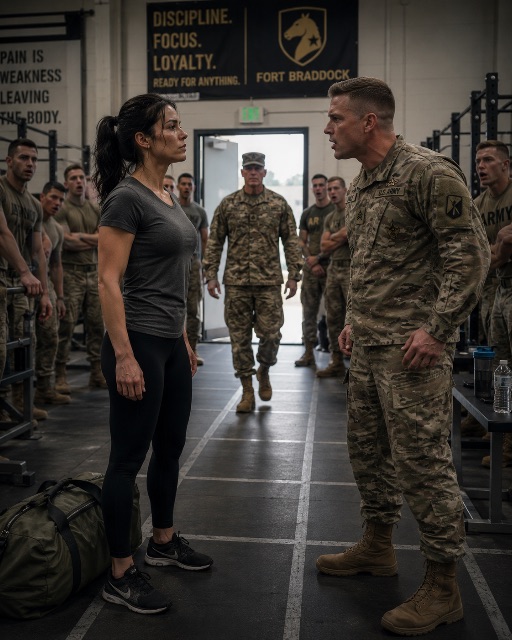
I reached the center of the stage and snapped to attention beside Drill Sergeant Frey. Perfect form. The form my father had once told me, at age nine, that I would “never have the discipline for.”
Frey turned to face me. He raised his hand in a slow, deliberate salute. Held it.
Then he spoke, and his voice carried to every corner of that room, including the second row.
“Ladies and gentlemen, it is my privilege to present Major Madison Hale, currently on extended assignment, returning today in honor of her brother’s commissioning.”
The auditorium went absolutely still.
I returned the salute.
And then, very slowly, I turned my head and looked directly at my father in the second row.
His face had gone the color of old paper. His hand was gripping my mother’s wrist so hard her fingers had started to curl. His mouth was still open. Still no sound.
But it was what my mother did next that nobody in that auditorium expected.
She stood up. Slowly. Without looking at my father. And she pulled something out of her purse — something she had been carrying for almost five years — and held it up so I could see it from the stage.
My breath caught.
Because what my mother was holding in her trembling hand was the one thing that proved she had known exactly where I was, and what I was doing, the entire time.
It was a coin. A challenge coin.
Not just any coin. It was from my first unit, the one they don’t list on any official rosters. Heavy, bronze, with an eagle on one side and a sequence of numbers on the other that meant nothing to anyone who hadn’t earned it.
I had sent it to a P.O. box from a country I was not officially in, on the off chance it might one day make its way to her. A small, silent signal across the world that I was okay.
And she had brought it here.
Time seemed to freeze. I could see the glint of the metal under the auditorium lights. I could see the faint, imperceptible nod that Drill Sergeant Frey gave her. A sign of respect from one professional to another.
My father saw it too. He looked from the coin in her hand, to her face, to my face on the stage. The confusion on his features curdled into a new, dreadful kind of understanding. This wasn’t just my secret. It was theirs.
Frey turned back to the audience. “As you were,” he commanded.
He dismissed me with a sharp nod. “Side stage, Major. We’ll a have room for you after.”
I pivoted and walked back into the wings, my face a mask of professional calm. Inside, my heart was a drum solo.
The ceremony resumed. The commandant gave his address, but I didn’t hear a word of it. I watched from the shadows as my brother, Dylan, marched across the stage to receive his commission.
He looked different. The swagger was gone, replaced by a quiet solemnity. As he saluted the Commandant, his eyes scanned the audience and found my mother. He looked at her, then briefly at the empty space beside her where Dad should have been beaming.
My father had sat back down, but he hadn’t fully returned. He was a hollowed-out version of the man who had walked in. His uniform seemed too big for him now. He didn’t rise. He didn’t applaud. He just stared at his own hands, resting uselessly in his lap.
He had built his entire identity on a foundation of reflected glory from his son. In a single moment, that foundation had been bulldozed.
When the ceremony finally ended, I was escorted by a young lieutenant to a small, private conference room backstage. It was sterile and plain, with a long table and a dozen chairs.
I was the first one there. I stood by the window, looking out at the families celebrating on the lawn.
The door opened and my mother walked in. She closed it softly behind her, and for a moment, we just looked at each other. The quiet, mousy woman I remembered was gone. In her place was someone with steel in her eyes.
Then her composure broke, just for a second, and she crossed the room and wrapped her arms around me. It was the first real hug I’d had from her in my life. Solid. Unshakeable.
“I’m so proud of you, Madison,” she whispered into my shoulder.
She pulled back and pressed the coin into my palm. It was warm from her hand.
“How?” was all I could manage to ask.
“Did you really think I didn’t see you?” she said, a small, sad smile on her face. “Your father saw a girl who couldn’t iron a shirt. I saw a girl who could read a map upside down by age ten and who learned to be invisible in her own home just to survive his moods.”
It was the most honest thing she had ever said about our family life.
“The phone call… the text message when I left…” I started.
“I was waiting for it,” she said simply. “I knew you weren’t running to the store for milk. I knew you were running for your life.”
Then came the part I never could have predicted.
“The woman you called your aunt,” she said, her voice dropping lower. “Eleanor. She and I go way back. We worked together at the State Department, a long time ago.”
My mind reeled. The State Department. That was the official story. The one she told at parties when people asked what she did before marrying Dad. A boring administrative job.
“Her job wasn’t administrative, was it?” I asked, already knowing the answer.
My mother shook her head. “Neither was mine.”
The world tilted on its axis. My quiet, unassuming mother. The woman who arranged flowers and hosted perfect, silent dinners.
“I made a phone call the night your father laughed at your acceptance letter,” she confessed. “I called an old friend. I told him I had a candidate who was smarter, tougher, and more resilient than anyone they’d find at the top of their class. Someone who had already spent eighteen years in deep cover.”
I stared at her, speechless. She had orchestrated the whole thing. The unmarked car. The anonymous driver. My entire career. It wasn’t my handler who had found me. It was my mother.
The door opened again. Dylan walked in, his new Second Lieutenant bars gleaming on his shoulders. He looked at me, then at Mom, his face a mixture of awe and confusion.
“Maddie?” he said, his voice cracking. “A Major? But… how?”
Before I could answer, our father filled the doorway behind him. He looked old. The swagger was gone, replaced by a deep, weary ache in his eyes.
He looked at me, then at my mother. “You,” he said, his voice raspy. “This was you. All of it.”
My mother didn’t flinch. “I gave him a son to show off,” she said, her voice cutting through the silence. “I wasn’t going to let him destroy my daughter.”
My father flinched as if she’d struck him. He opened his mouth to argue, to bluster, to try and regain some footing, but no words came out. He had built his world on a set of simple, unshakeable rules, and those rules had just been proven false.
He looked at me, at the rank on my uniform that dwarfed his own past achievements. He saw a stranger.
Dylan, my brother, the golden child, stepped forward. He looked from our father’s broken expression to my steady one. For his whole life, he had been trying to win a race his father had set for him. Now he saw that I had been running a marathon he never even knew existed.
He did something then that surprised everyone. He reached up and carefully unpinned one of the shiny new bars from his collar.
He held it out in his palm. Not to me. To our mother.
“I think,” he said, his voice thick with emotion, “you should have this. You’re the one who has been leading this family all along.”
My mother’s eyes filled with tears. She gently closed his hand over the insignia. “No, sweetheart. You earned that. You just make sure you earn it for yourself from now on. Not for him.”
Her words hung in the air. For him.
My father just stood there, a ghost at a feast. He had wanted a legacy. Now he had two, but one of them he had tried to bury, and the other he no longer understood.
Without another word, he turned and walked out of the room, closing the door softly behind him. It wasn’t an act of anger. It was an act of surrender. We never saw him walk with his chest puffed out again.
The three of us were left in the quiet room. A new family, forged in secrets and revelations.
That evening, we didn’t go to the formal officers’ dinner my father had been bragging about for months.
Instead, the three of us went to a small, greasy diner off the highway. My mother, my brother, and me. A Major, a Second Lieutenant, and the woman who had out-maneuvered them all.
Over burnt coffee and greasy omelets, my mother told us stories. Not about Dad, but about her life before him. A life spent in quiet service, in tense situations in cities with names I recognized from my own mission briefings.
I didn’t just see my mother. I met her.
Dylan listened, rapt. He wasn’t a rival or a disappointment. He was just my brother. He asked me questions about my training, not with envy, but with genuine respect.
I learned that day that some people’s strength isn’t in their voice, but in their silence. It’s in the choices they make when no one is watching. My father’s pride was a loud, hollow drum. My mother’s love was a silent, unshakeable fortress.
She had seen something in me I hadn’t even seen in myself. She didn’t just let me fly; she built the runway, cleared my flight path, and stood watch until I was safely in the air.
The greatest honors aren’t always the ones pinned to your chest in front of a crowd. Sometimes, the greatest honor is a quiet nod from across a room, a shared secret held in a warm palm, or a cup of cheap diner coffee with the people who truly see you. Service, I realized, isn’t just about the uniform you wear. It’s about the sacrifices you make for the people you are sworn to protect, whether it’s a country or your own daughter.