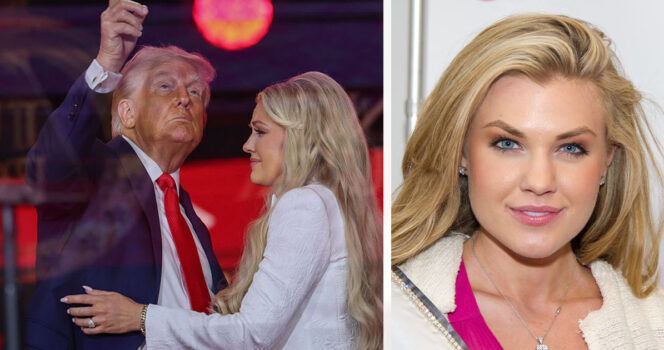
In the days since a moving memorial service in Arizona, a simple hug on stage has sparked a wave of curiosity. Former President Donald Trump and Erika Kirk, the widow of conservative activist Charlie Kirk, shared a heartfelt embrace as thousands looked on. While their closeness in the wake of tragedy felt natural and compassionate, many people are now noticing a surprising connection between Donald Trump and Erika that goes back more than a decade, long before their lives converged in the public eye this year.
What began as a solemn moment of unity has turned into a point of fascination online. People are learning that Erika, known to many for her poise and strength at the memorial, once moved in a very different public sphere—one that Donald Trump helped oversee for years. The discovery has led to questions about how often our paths cross in ways we don’t realize until much later, and it has added another layer to a story already filled with emotion, resilience, and public attention.
A moment of unity at State Farm Stadium
The memorial for Charlie Kirk was held at State Farm Stadium in Glendale, Arizona, where tens of thousands gathered to honor his life and legacy. The setting was grand, but the atmosphere was intimate, built around memories, tributes, and the shared grief of a community. Amid the speeches and reflections, Erika Kirk stood at the center, calm yet visibly moved, as she thanked those who had reached out to support her during the most difficult days of her life.
Donald Trump delivered his own remarks at the event, speaking to the crowd with Erika standing nearby. When he finished, he pulled her into an embrace. The audience reacted with loud, sustained applause—a moment of human connection that cut through the political backdrop. In an age when nearly everything is captured, replayed, and analyzed online, that hug quickly traveled across social media, inspiring both sympathy and curiosity.
Erika Kirk’s words of thanks
In the lead-up to the memorial, Erika appeared on The Charlie Kirk Show and expressed heartfelt gratitude to many who had reached out, including the Trump family. She spoke through tears as she recalled the friendship and support shown to her late husband over the years. At one point she said, “Mr President, my husband loved you. And he knew that you loved him too. He did. Your friendship was amazing. You supported him so well, as did he for you.”
Her words resonated with those who admired Charlie Kirk’s public work and those who identified with the private strength required to navigate sudden loss. It was clear she intended to carry forward his mission with dignity and purpose. That intention has already taken concrete form: Erika is now stepping in to lead Turning Point USA, the organization Charlie founded in 2012. For supporters, it signaled continuity at a time of upheaval; for Erika, it is a deeply personal responsibility to honor her husband’s vision.
The hug that kept people talking
While many who saw the hug on stage simply took it as a meaningful show of support, the image spurred conversations online. Some viewers focused on the expression on Donald Trump’s face while others commented on the gravity of the moment and the unusual convergence of public figures in a setting defined by grief and remembrance. As tends to happen in today’s media environment, that single moment opened a door to a broader look at Erika’s path to public life—and that is where the story took an unexpected turn for many.
An unexpected link from years earlier
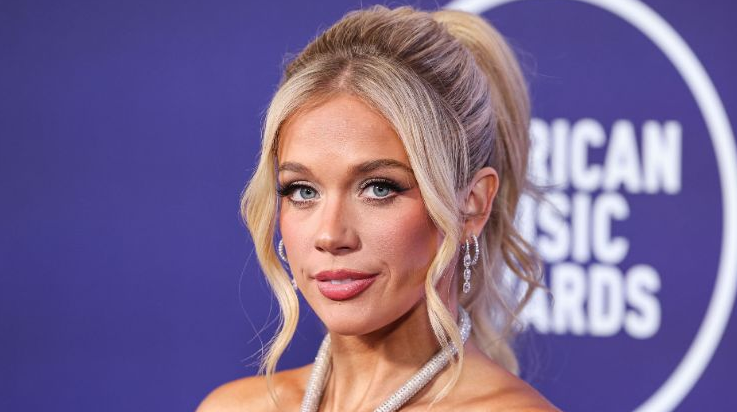
Not long after the memorial, a social media post drew attention to a lesser-known part of Erika’s background: her pageant days. Before she was known as Erika Kirk, she competed under her maiden name, Erika Frantzve. She won the Miss Arizona USA title in 2011 and advanced to the national Miss USA competition in 2012. One detail that caught people’s attention was a talent routine she is said to have performed during the Miss Arizona competition—an athletic basketball-dribbling exhibition using two balls—showing a different side of her poise and discipline than most had seen at the memorial.
This discovery wouldn’t have been especially notable on its own, except for one important historical fact: at that time, Donald Trump was a co-owner of the Miss Universe Organization, which oversaw the Miss USA pageant. Although he stepped away from the organization in 2015, his involvement spanned many years. For people learning about Erika’s pageant history for the first time, the overlap felt like a surprising twist. It suggested that Trump and Erika’s paths may have crossed long before their public hug—if only in passing, backstage, or during the swirl of national pageant events.
Trump’s years with Miss USA
To understand why this link stood out, it helps to remember what the Miss USA competition represented during those years. The pageant was a high-profile national event, and as co-owner of the Miss Universe Organization, Donald Trump had a recognizable presence. Media coverage from that era often showed him at rehearsals, photo calls, and press events, emphasizing his influence on how the show was run and presented. While day-to-day operations involved a large team of producers, judges, and state directors, Trump’s imprint on the brand and its public image was unmistakable.
Over time, various accounts suggested that his role sometimes extended beyond the ceremonial. Reporting in national outlets described situations in which preliminary judging and final outcomes did not always align in predictable ways. Some involved judges later recounting that the winners announced did not match what the judges believed their scores would have produced. Stories like these have fueled a long-running conversation about how much influence Trump exercised behind the scenes and what it meant for contestants navigating the experience.
What the reporting has said—and what remains unknown
Among the discussions that resurfaced after the memorial were past interviews and articles describing how contest outcomes were decided. In one notable account reported by The New Yorker, preliminary judges said they were surprised when certain winners were announced, indicating that the results differed from their own tallies or expectations. Those recollections added to the perception that Trump’s personal preferences may have played a role in shaping the final lineup of contestants and even the ultimate winner in some years.
It is important to be clear about what we know and what we do not. There is no public evidence that Erika Frantzve—who would later become Erika Kirk—was selected or advanced because of any personal involvement by Trump. Her Miss Arizona USA victory in 2011 and her participation in Miss USA the following year are facts of record, but the details of backstage deliberations are not known. What is likely, given the structure of the pageant at the time, is that their paths may have intersected in some capacity during the national competition. Whether they met directly or simply passed each other in the flurry of events is something only those present could say for sure.
Seeing a familiar face in a new light
For many people, learning about this older connection did not change their feelings about the memorial itself. Erika’s presence at State Farm Stadium, her steady composure, and her heartfelt words of thanks stood on their own. Yet the pageant detail added a human layer to her story: before she was a public figure associated with a national organization, she was a young woman competing on a big stage, pursuing a dream with the same mixture of nerves and determination that pageant contestants have carried for generations.
In fact, Erika once summed up her outlook in simple, grounded terms: what truly mattered to her, she said at the time, was making a difference; the outward shine was “just a bonus.” That sentiment resonates even more now, as she steps into a leadership role amid grief and transition, facing an audience that includes not only loyal supporters but also new observers who know her mainly through a clip of a hug and a headline about a long-ago pageant.
Turning Point USA and Erika’s next chapter
Turning Point USA, founded by Charlie Kirk in 2012, quickly grew into a prominent conservative nonprofit focused on student outreach and activism. Its events, media presence, and campus chapters put it at the center of many national conversations. Erika’s decision to take the helm is significant both symbolically and practically. It signals a desire to keep Charlie’s work moving forward while bringing her own perspective to the role.
For supporters reflecting on this transition, it underscores how personal and organizational stories often overlap. Grief does not pause the responsibilities of leadership, and leadership cannot erase grief. The balance takes strength, patience, and the kind of community support Erika acknowledged in her remarks. It may be that her experience on the pageant stage—learning to perform under pressure, to handle scrutiny, and to carry herself with composure—has prepared her in unexpected ways for the path ahead.
Why the internet fixates on connections like this
One reason this story caught fire online is that it blends public and private narratives. A powerful public moment—a hug at a memorial—meets a revealing piece of personal history—a pageant from years earlier connected to a famous figure. These contrasts are compelling. They remind us that public figures, even those we feel we know well, often carry parts of their past that only become meaningful when placed alongside something new.
There is also the simple fact that social media thrives on rediscovery. A single photo or a short video clip can send people digging through old articles, event programs, and archived footage, piecing together timelines and drawing lines between then and now. Sometimes those lines are meaningful; other times, they are interesting without changing the core story. In this case, the discovery offers context rather than a conclusion. It suggests proximity and potential meetings, not hidden arrangements. And for many observers, that nuance matters.
Respecting the heart of the story
Amid the attention on pageant history and backstage rumors, it can be easy to lose sight of what brought everyone together at the stadium: the life and memory of Charlie Kirk. The tributes shared were, above all, about honoring a person whose work made an impact on his community and whose absence is felt deeply by family, friends, colleagues, and supporters. Erika’s poise on stage spoke to that reality. Her thanks to the Trump family fit within a larger expression of gratitude to many who reached out—not as a headline, but as a human response to loss.
Seen in that light, the embrace at the memorial reads as a moment of solidarity. The renewed interest in a decade-old connection is, in many ways, a side note—interesting, yes, and even surprising to those who didn’t know about Erika’s pageant background, but still a secondary thread that runs alongside a larger, more personal story about grief, support, and resolve.
Looking back, looking ahead
As more people learn about Erika’s time as Miss Arizona USA and her appearance at the 2012 Miss USA competition, the natural question becomes what, if anything, it changes about how we see the present. The most honest answer is that it provides context without rewriting the moment we all witnessed. It confirms that public lives often weave together in unexpected ways. It suggests that the nation’s most-watched stages—political rallies, memorials, pageant runways—can be closer than they appear.
For Erika, the days ahead will likely be full of both remembrance and responsibility. Leading a national organization is no small task, particularly when assumed during a time of mourning. The skills that carried her through past challenges—poise, preparation, and a commitment to purpose—may serve her well now. And for those looking on from a distance, the rediscovered pageant link offers a reminder that today’s headlines often rest on yesterday’s footnotes, waiting to be found when the moment comes.
Final reflection
In the end, the story here is shaped by two moments separated by more than a decade. In one, a young woman from Arizona steps onto a national stage, part of a long tradition of pageantry that prizes presence, discipline, and ambition. In the other, that same woman—now Erika Kirk—stands before a stadium of mourners, thanking those who supported her husband and embracing a former president at the close of a tribute. The thread that ties those moments together is not a controversy or a conspiracy. It is the ordinary, surprising way lives intersect over time.
People may continue to debate old pageant procedures and wonder who met whom backstage in 2012. They may study the expressions in a photo from the memorial and try to read into them. But the heart of the matter remains rooted in empathy and endurance. A widow accepted support from a longtime friend of her husband. A public figure responded with a gesture of comfort. And the internet, doing what it does best, uncovered a detail from years past that made everyone look twice. It is a reminder that behind even the most public moments are personal histories—some we know well, and some we are only just discovering.
As this story continues to ripple outward, it’s worth keeping that balance in mind. The viral twist is interesting, even unexpected. But the deeper significance lies in how people come together when it matters most, how they carry forward the work of those they loved, and how the threads of our past sometimes reappear in the present, offering a fuller picture of lives lived on very large stages.