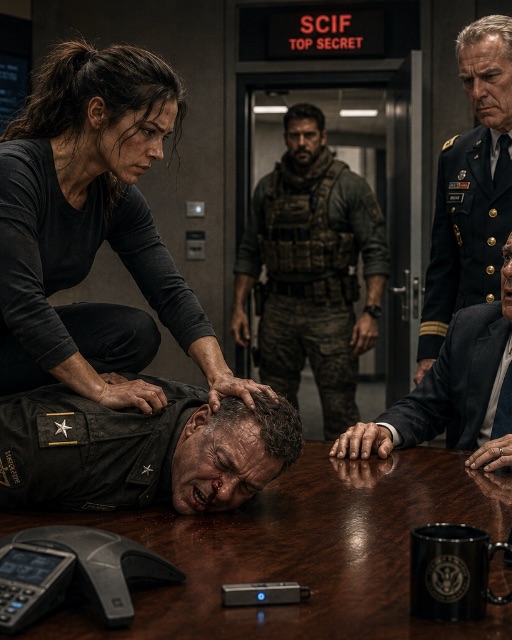
Wade’s nose was bleeding into the mahogany. Audrey’s knee pinned his spine against the table while her forearm crushed the back of his neck. He sputtered, twitching, his uniform soaked in his own coffee.
“Don’t,” he wheezed. “Don’t play it. Please. There are people – there are people who will – ”
“Who will what?” Audrey said quietly. “Kill me again?”
The MPs outside the glass were screaming into their radios, but General Brackett raised a single steady hand, and they froze in place like men who had been ordered not to look at something they were not cleared to see.
Brackett stared at his executive officer. The man who had stood beside him at three funerals. The man who had handed him the pen to sign Specter Six’s death certificate four years ago. The man who, Brackett suddenly remembered, had insisted the casket stay closed.
“Play it,” Brackett said.
Lang stiffened. “General, protocol demands – ”
“Play it.”
Audrey released Wade just enough to reach the drive. She slid it across the table toward the secure terminal. Her hand left a faint red print on the wood.
The technician’s fingers shook as he connected it. A password prompt appeared on the wall screen.
Audrey did not look at the keyboard. She recited the string from memory, sixteen characters of letters and numbers that meant nothing to anyone in the room – except one man.
Deputy Director Richard Lang made a sound in his throat. A small, broken sound.
Because that password was not Wade’s.
It was his.
The screen flickered. A folder opened. Inside were audio files, dated four years and two days ago, time-stamped to the exact minute Specter Team had crossed the threshold in Deir ez-Zor.
Audrey turned her gray eyes toward the deputy director, who was now gripping the edge of the table as though the floor had tilted beneath him.
“I didn’t come here for Wade,” she said softly. “Wade was just the man who pulled the trigger.”
She tapped the first audio file.
A voice filled the SCIF – calm, clipped, unmistakable. A voice that had briefed three presidents. A voice that had spoken at her memorial service.
The voice said: “Tell Aegis to lift. Leave the team. We cannot let Specter Six reach the defector.”
Lang’s knees gave out. He caught himself on the chair, but his face had gone the color of old paper.
General Brackett rose slowly to his full height. He did not look at Wade. He did not look at Lang. He looked at Audrey — at the woman he had eulogized, at the operator he had failed, at the ghost who had walked five thousand miles through sand and blood to stand in his sealed room.
“Specter Six,” he said, and his voice cracked on the second word.
Audrey did not blink.
“Reporting in, sir.”
Brackett’s hand moved toward the red phone on the wall — the line that connected directly to the Secretary of Defense, the line he had used only twice in his entire career.
But before his fingers touched the receiver, the heavy steel door of the SCIF hissed.
Someone was overriding the lock from the outside.
The biometric panel flashed green.
The door swung open six inches, then stopped, the hydraulics groaning as if the room itself was refusing to let him in.
Audrey’s hand drifted to the small of her back, where the ceramic blade she had carried through four countries and two checkpoints was still warm against her spine. Her gray eyes did not widen. They narrowed.
Wade, still bleeding on the table, made a noise that wasn’t quite a laugh and wasn’t quite a sob. “Oh God,” he whispered into the wood. “Oh God, he’s alive too.”
Lang’s lips moved without sound. His face wasn’t pale anymore. It was gray. The gray of a man watching his own coffin being pried open from the inside.
General Brackett’s hand was still hovering over the red phone, frozen mid-air, because the man he was about to call — the only man with the authority to override that biometric panel from the outside — was the same man he had identified in a closed casket at Arlington six years ago.
The door swung the rest of the way open.
The figure in the doorway took one step into the SCIF. The overhead lights caught the left side of his face — the half that hadn’t been rebuilt — and Brackett heard himself make a sound he had not made since he was a young lieutenant in a burning Humvee.
Audrey’s voice was barely a whisper.
“Hello, Dad.”
The man in the doorway smiled, and when he did, Lang began to scream — not in fear, but in recognition — because he finally understood what was on the rest of that hard drive.
But what the dead man pulled out of his coat pocket next made even Audrey lower her blade.
It wasn’t a weapon. It wasn’t a threat.
It was a small, folded piece of paper, yellowed and softened with age. He held it between his thumb and forefinger, a fragile offering in the sterile, steel heart of the Pentagon.
Audrey’s father, Arthur Vance, a man officially struck from the record six years ago, held out the drawing. It was a child’s crayon sketch of two stick figures holding hands under a lopsided sun. One figure was tall, the other small. Written in blocky, uneven letters at the bottom was “ME AND DADDY.”
The ceramic blade in Audrey’s hand felt suddenly heavy and useless. Her composure, the iron shell she had forged in fire and betrayal, cracked. Her hand lowered, not in surrender, but in memory.
Arthur’s eyes, one a piercing blue and the other a clouded, reconstructed gray, were fixed on her. “It was always my job to bring you home,” he said, his voice a low gravel, rough but steady. “I’m just a little late.”
Lang’s screaming had dissolved into desperate, gulping sobs. He knew. He knew what that drawing meant. It wasn’t just a father-daughter token. It was a key.
Arthur Vance had been the original Specter. The ghost that even the other ghosts whispered about. He had trained Brackett. He had designed the protocols that Lang was now cowering behind. And six years ago, he’d gotten too close to something rotten.
“Project Nightingale,” Arthur said, his gaze shifting from his daughter to the crumbling Deputy Director. The name fell into the silent room like a dropped bomb.
General Brackett flinched as if struck. He had heard whispers of it. A phantom slush fund, an unofficial treasury for operations too dark for even the darkest ledgers. It was a myth, a boogeyman that young analysts joked about.
“It’s not a myth, is it, Richard?” Arthur said, taking another step into the room.
Lang just shook his head, slobbering, his perfectly tailored suit now looking like a costume on a scarecrow.
“Audrey,” Brackett said, his voice raw. “What is this?”
“This,” Audrey replied, her eyes never leaving Lang, “is what he sent me to die for.” She turned back to the terminal. “This is why he couldn’t let me reach the defector.”
Her finger hovered over the second audio file. “The defector wasn’t military. He wasn’t a spy. He was a banker from Geneva. The one who set up the accounts for Project Nightingale.”
She tapped the screen.
A new voice filled the room, this one slick and condescending. It was tinny, clearly recorded from a phone. “The Vance girl is taking the bait,” the voice said. “She’ll go for the asset. Lang, you are absolutely certain she can’t succeed?”
Lang’s voice, the one from four years ago, answered, stronger and more arrogant than the puddle of a man currently in the room. “The kill box is set. Wade is on a short leash. Specter Six is a ghost. We’re just making it official.”
The slick voice chuckled. “Good. Nightingale is about to fund the Midwest project. We can’t have any loose ends.”
Brackett’s blood ran cold. The ‘Midwest project’ was the unofficial name for a senator’s last-minute, wildly over-funded infrastructure bill. A bill that had sailed through congress on a wave of anonymous donations. A bill that had made a lot of powerful men very, very rich.
“He used a black ops fund for domestic political gain,” Brackett breathed. The scope of the treason was staggering.
“Gain?” Arthur laughed, a harsh, broken sound. “This was never about patriotism, Brackett. It was about retirement plans. It was about buying islands and silencing journalists and ensuring their families stayed in power for generations.”
“I was supposed to die six years ago because I found the original ledger,” Arthur explained, his voice flat. “They blew up my convoy. I was the only one who walked out of the fire. I wanted to see who showed up to my funeral.”
He looked directly at Lang. “You gave a lovely speech, Richard. Very moving.”
“The last four years,” Audrey picked up the thread, her voice gaining strength, “we haven’t just been hiding. We’ve been working.” She gestured to the hard drive. “What the defector had was access. A key. Not to the bank account, but to the bank’s servers.”
“He gave it to me before Wade’s team breached the door,” she said. “He knew he wouldn’t make it. He told me to find the ‘first ghost.’ He told me to find my father.”
She looked at Arthur, and for a fleeting moment, the hardened operator vanished, replaced by the little girl who drew stick figures under a lopsided sun.
Arthur nodded. “She found me in a back-alley clinic in Istanbul. It took me a year to put her back together. Cared for her in a small apartment, piecing her shattered spirit back together one memory at a time. It took us three more years to follow the money.”
This was the part Lang didn’t know. The part that was not on the hard drive. He thought they had evidence. He didn’t realize they had become the weapon.
“Play the next one, honey,” Arthur said softly.
Audrey’s finger moved to a different folder, one labeled “Transactions.” She didn’t click on an audio file. She clicked on a spreadsheet.
The massive wall screen filled with lines of code, numbers, and routing information. It looked like nonsense to most, but Brackett, who had overseen budgets in the billions, understood immediately. It was a digital treasure map.
“That’s Project Nightingale,” Audrey stated. “Just under nine hundred million dollars. Untraceable, un-auditable.” She paused. “Or, it was.”
She clicked another file. A video opened. It was a screen recording, sped up, showing a cursor moving with inhuman speed. It flew through digital firewalls, bypassed security protocols, and entered the core of a global banking network.
“It took us a year to build the algorithm,” Arthur said, watching the video with a sort of paternal pride. “A ghost in their machine. For the last two years, we’ve been making withdrawals.”
Lang finally looked up, a sliver of his old arrogance returning. “You can’t spend it,” he sneered, his voice cracking. “Every intelligence agency in the world would be on you in a second!”
“Oh, we didn’t spend it,” Audrey said, and she smiled. It was the first time she had smiled since entering the room, and it was terrifying. “We gave it away.”
The screen changed. It was no longer a spreadsheet. It was a montage.
A picture of a new prosthetic for a triple-amputee veteran from a forgotten war. A check paying off the mortgage for the widow of a fallen police officer. A letter from a hospital, confirming that an experimental cancer treatment for a dozen retired field agents had been fully funded by an anonymous donor.
A new wing on a children’s hospital, named after a CIA agent who died in a bombing everyone had forgotten. Scholarships for the children of every member of Specter Team. Dozens, then hundreds of small acts of justice and grace, all paid for with stolen money.
Audrey let the montage play for a full minute, the silence in the room broken only by the soft, triumphant music she had paired with the images.
“You built a slush fund to buy politicians and yachts,” she said, her voice ringing with clarity. “We used it to honor the people you threw away. We used it to pay the debts this country forgot it owed.”
Wade was openly weeping now, his face buried in the table. He was crying not just from pain, but from the horrifying realization that he had been on the wrong side of history in every conceivable way.
Lang was silent. His face was a mask of utter ruin. He hadn’t just been exposed. He had been rendered irrelevant. His legacy, his power, his carefully constructed world, had been dismantled and given away to his victims. It was a karmic checkmate so complete there was no move left to make.
General Brackett stared at the screen, at the faces of the men and women he had served with, cared for, and sometimes mourned. He saw the tangible good that had been done. He saw the honor in their actions.
His hand, which had been frozen over the red phone, moved. But it didn’t go to the line for the Secretary of Defense. It went to his personal, encrypted comms unit. He keyed in a sequence he hadn’t used in a decade.
“This is Brackett. Code word ‘Orion’s Belt’,” he said into the device. “I need a clean-up crew at the SCIF. My authority. No questions.”
He looked at Lang and Wade. “And I need medical for two prisoners who are about to have a very long, very quiet conversation with me.”
He then looked at Audrey and Arthur. His eyes were wet. “Six years. I signed your death certificate, Arthur. I read your daughter’s eulogy. I told her mother she died a hero, and I believed it.”
“She did,” Arthur said simply.
Brackett nodded, composing himself. The General was back. “The men who are coming are loyal to me, not to the office. They will escort you out of this building. We will have a conversation later, somewhere far from here.”
He stepped forward, closing the distance between himself and the ghosts he thought he had buried.
“What you did,” he said, his voice low and firm, “was not sanctioned. It was illegal. It was unprecedented.” He paused, his gaze taking in the father, the daughter, and the wreckage of the corrupt system at their feet. “It was also the most honorable thing I have ever witnessed in my forty years of service.”
He cleared his throat. “We’ll draft a story. A training accident for Colonel Wade. A sudden resignation due to health concerns for Director Lang. The senator and his friends will find their accounts mysteriously empty. There will be investigations, but they will lead nowhere. The money is gone.”
Audrey nodded. This was what she had hoped for. Not a pardon, but an understanding. A chance for the system to heal itself, guided by a good man.
“There’s one more thing,” Arthur said. He reached into his pocket again, but this time he pulled out a simple memory stick, different from the one on the table. “This isn’t for the politicians. It’s for you.”
He handed it to Brackett. “Every piece of intel. Every name. The entire network. Not just the money, but the infrastructure. The agents they compromised, the assets they burned. Everything you need to pull the weed out by the root.”
Brackett took it, his knuckles white. This was the real prize. The ability to not just punish the guilty, but to fix the damage.
As the quiet, plain-clothed men arrived to take Lang and Wade away, Brackett put a hand on Audrey’s shoulder. It wasn’t the touch of a general to a subordinate. It was the touch of an old friend.
“You’re still listed as deceased,” he said. “You both are. It might be best if you stay that way. For a while.”
“We’re good at being ghosts, sir,” Audrey replied, a hint of a real smile on her face.
An hour later, Arthur and Audrey Vance stood on a quiet bluff overlooking the Potomac, the lights of the city twinkling below them. They were just two shadows in the twilight, their war finally over.
Arthur put his arm around his daughter. “You did good, kid. You did real good.”
She leaned her head against his shoulder, feeling the solidness of him, a feeling she thought she had lost forever. The hole in her heart, carved out by loss and betrayal, was still there, but it wasn’t empty anymore. It was filled with a sense of peace, a sense of justice done.
They hadn’t just gotten revenge. They had balanced the scales. They had taken a system built on greed and ego and forced it, against its will, to perform acts of selfless honor. They reminded the powerful of the forgotten soldiers and broken promises, using the very money meant to erase them as a tool for remembrance and restoration. True victory wasn’t watching your enemies fall; it was watching the people they wronged rise up, healed and whole. And in doing so, they had finally, after all these years, brought each other home.